Nine years of government arrived here before the state did. The United Nations Security Council placed the territory under an international administration by Resolution 1244 on 10 June 1999, a NATO-led force entered on 12 June 1999, and the German mark replaced the Yugoslav dinar the same year, so a currency, a customs service and a police force were all working before there was a republic to attach them to. Kosovo is a landlocked territory of 10,909 square kilometres in the central Balkans that declared independence from Serbia on 17 February 2008 and was recognised by 110 of the 193 United Nations member states as of 2025. Almost every institution here was built before the sovereignty behind it was settled, and that order explains most of what is hard to describe about the country.
At a glance
Where it is
Where Kosovo is, and what is around it
Kosovo is landlocked. It shares a border with 4 countries, counted as shared borders, which includes neighbours across water.
 Albania
 Montenegro
 North Macedonia
 Serbia
How the territory was run before it existed
On 10 June 1999 the United Nations Security Council passed Resolution 1244, which placed Kosovo under a transitional United Nations administration and authorised a NATO-led peacekeeping force. That force entered on 12 June 1999 and made its operational headquarters at Camp Bondsteel near Ferizaj, and it continues to operate under the same mandate. Resolution 1244 also affirmed the territorial integrity of Yugoslavia, the clause Serbia reads as decisive and Pristina reads as overtaken by events.
The practical machinery arrived with it. Kosovo took the German mark in 1999 in place of the Yugoslav dinar and later moved to the euro, so a working currency was circulating years before there was a treasury behind it. Customs posts, a police service and a court system were assembled under the same international administration, and the Central European Free Trade Agreement was signed on Kosovo's behalf by that administration in 2006.
The declaration of independence came on 17 February 2008 and the constitution took effect on 15 June 2008. Some of the national symbols were adopted at once while work on defining an anthem was still going on, which is a small illustration of a general pattern: the apparatus was older than the state it belonged to. Serbia rejected the declaration and continues to claim the territory as its Autonomous Province of Kosovo and Metohija, while accepting the governing authority of the Kosovo institutions under the 2013 Brussels Agreement. The International Court of Justice, asked whether the declaration breached international law, answered in 2010 that it did not. The history article follows the argument from the Ottoman vilayet of the 1870s forward.
Why the constitution enacts a rejected plan
The document Kosovo governs itself by was drafted by the United Nations envoy Martti Ahtisaari and was never adopted. A draft Security Council resolution backing his proposal was formally discarded on 20 July 2007 once it became clear it would not secure Russian support. Seven months later the Assembly in Pristina declared independence and obliged the new republic to follow the plan's provisions in full, so the clauses became binding by self-imposition instead of by ratification.
Several features of the state come straight out of that text. The Assembly has 120 members elected for four-year terms, twenty of them reserved, ten for Kosovo Serbs and ten for the other minority communities. Two supervisory bodies were created alongside it: an International Civilian Office with veto powers, which completed its work in 2012, and the European Union Rule of Law Mission, which was given arrest and prosecution authority inside the country and now runs a reduced monitoring mandate. A Kosovo Security Force was established in 2009 and had over 5,000 active members in 2023.
Recognition is the part of the record with no single number. As of 19 December 2025 at least 110 of the 193 United Nations member states had recognised Kosovo, along with 22 of the 27 European Union members and 28 of the 32 NATO members. Kosovo puts the total at 120 and Serbia puts it at 84, on the argument that some recognitions have since been withdrawn. Kosovo is not a member of the United Nations. It signed a Stabilisation and Association Agreement with the European Union that has been in force since April 2016, filed a formal membership application on 15 December 2022, and its nationals became exempt from Schengen visa requirements for stays of up to 90 days in any 180-day period on 1 January 2024. The politics article takes the institutions clause by clause.
What the land does with its water
Kosovo covers 10,909 square kilometres enclosed by four neighbours, Albania to the southwest, Montenegro to the west, Serbia to the north and east and North Macedonia to the southeast, with no access to the sea. The terrain is high plain broken and ringed by mountains, the high point is Gjeravica at 2,656 metres, and forest covers at least 39% of the ground.
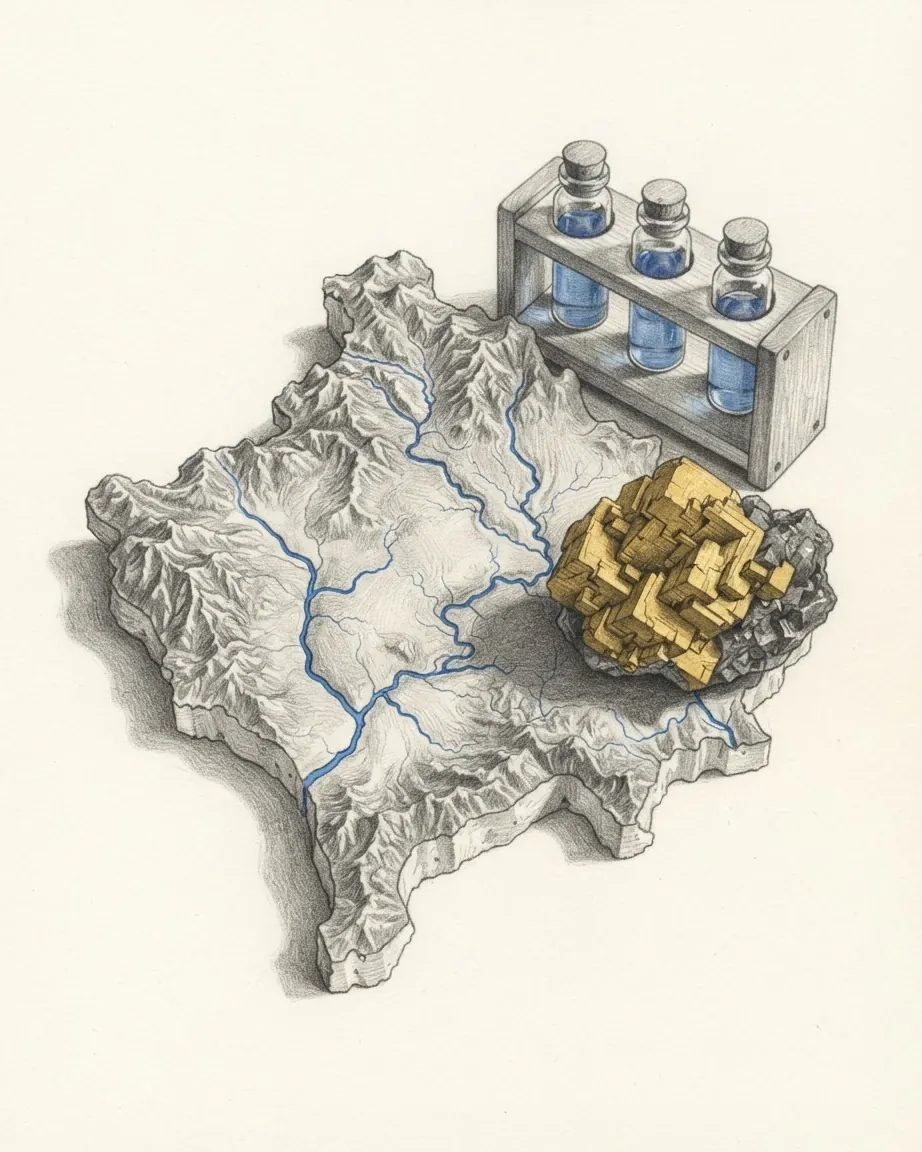
Where the water goes is the unusual part. The Black Sea drainage basin takes 50.7% of the territory, 5,520 square kilometres of it, carried out by the Ibar and the Sitnica. The Adriatic basin takes 43.5%, drained by the White Drin, which runs 122 kilometres inside Kosovo and then leaves. The remainder goes to the Aegean by way of the Lepenac. The Nerodime is the only river in Europe that splits and delivers water to two seas at once, the Black Sea and the Aegean.
Two national parks hold most of the protected ground. Bjeshkët e Nemuna in the west and southwest covers 63,028 hectares of the Albanian Alps, and the Sharr Mountains park runs along the border with North Macedonia. Eleven nature reserves and 103 further protected areas sit around them, and the forested parts still carry brown bear, grey wolf, lynx and golden eagle. The geography article sets out the basins, the three climate zones and the lakes.
Where the money actually comes from
Public revenue in 2016 came to about 1.8 billion euros. Indirect taxes supplied around 69% of it and direct taxes around 13%, which is to say that value added tax, excise and customs duties on goods crossing the boundary pay for most of what the state does. The budget therefore rises and falls with consumption.
Consumption is funded substantially from outside the country. The Central Bank of the Republic of Kosovo recorded 124.40 million euros of remittances in June 2026, down from 134.60 million in May, against a monthly average of 100.92 million euros over the period from 2004 to 2026. Most of it is sent by Kosovo Albanians living in Germany and Switzerland, and a survey in 2009 found that roughly a quarter of businesses in Kosovo had been set up with diaspora capital. Economic growth has been positive in every year since 1999 with the single exception of 2020.
| Goods trade in 2024 | Exports | Imports |
|---|---|---|
| European Union | 312.6 million euros | 2.9 billion euros |
| CEFTA countries | 426 million euros | 851.9 million euros |
| All other markets | 202.9 million euros | 2.7 billion euros |
Goods exports for 2024 totalled 941.5 million euros against a foreign trade deficit of 5.4 billion euros, an increase of 7.4% on 2023. Underground the picture reverses. Lignite supplied 97% of electricity generation, with about 3% from hydropower, and the deposits spread across the Kosovo, Dukagjin and Drenica basins are measured at some 14.7 billion tonnes, of which only the Kosovo basin has been mined. The economy article follows each euro of revenue to the point where it is raised.
What holds the population together and apart
The census of 2024 counted 1,585,566 people and the record used here puts the population at 1,586,659 as of 1 January 2024. Both figures sit well under the estimated peak of 2.2 million in 1998, before the war and the emigration that followed it. Life expectancy at birth was 79.68 years in 2023 and the total fertility rate 1.88 children per woman.
The composition looks uniform at the national level and is anything but uniform on the map. Albanians were about 92% of the population in 2024, Serbs 2.3%, Bosniaks 1.7%, Ashkali and Balkan Egyptians 1.7% and Turks 1.2%, with smaller Romani and Gorani communities. Serbs are concentrated in the north and in municipalities such as Gračanica and Štrpce. Turks form a local majority in Mamusha just north of Prizren, Bosniaks live mainly inside Prizren itself, and the Gorani are in Dragash at the southernmost tip.
Religion follows the same lines. The 2024 census recorded 93.5% of the population as Sunni Muslim, 2.3% Eastern Orthodox and 1.8% Roman Catholic. Islam reached the territory with the Ottomans in the medieval period, and the state has no established religion. The culture article explains why the Albanian majority takes its nationhood from the language it speaks while the Serb minority takes its from the church it belongs to, and what that asymmetry has done to the heritage register.
Who arrives here and when they arrive
Pristina International Airport handled 4,082,481 passengers in 2024, more than two and a half times the number of people living in the country at the start of that year, and it is the only port of entry for air travellers. Hotels recorded 357,717 foreign visitors in 2023, up from 297,588 in 2022, and 746,501 hotel nights spent by non-residents in 2023 against 544,701 the year before.
The distance between four million air passengers and a third of a million hotel guests is the diaspora going home to family houses, which puts the busy weeks in July and August. Anyone else is travelling inside somebody else's season. Overland routes have become simpler since 1 January 2024, when Kosovo and Serbia each accepted the other's vehicle registration plates, ending the dispute that had produced demonstrations between 2021 and 2023. The R7 motorway runs to the Albanian coast at Durrës and the R6, finished in 2019, runs to the North Macedonian border at Hani i Elezit, about 20 kilometres from Skopje. The travel article covers the seasons, the two national parks, the old towns and the railway.
What the record actually shows
A currency, a customs service, a police force and a peacekeeping mandate were all in place here before there was a republic to own them, and the constitution that eventually arrived enacted a plan the Security Council had discarded. That order accounts for the shape of the accounts, where the taxes fall on goods at the boundary and the spending is underwritten from Germany and Switzerland. It accounts for the reserved seats in the Assembly and the foreign judges in the courts. It accounts for a recognition count that has three different answers depending on who is publishing it. The six articles below take each of those in turn.
Read
Everything about Kosovo
Six articles, each answering one question and each written to be read on its own.
The record
What is measured about Kosovo
Pages that nobody writes, built from the record and from the data files beside it.
Common questions
Questions about Kosovo
Where is Kosovo?
In the centre of the Balkan Peninsula in southeastern Europe, enclosed by Albania to the southwest, Montenegro to the west, Serbia to the north and east and North Macedonia to the southeast. It has no coast and covers 10,909 square kilometres. The capital is Pristina. Its rivers reach three different seas: 50.7% of the territory drains to the Black Sea, 43.5% to the Adriatic and the remainder to the Aegean.
How many countries recognise Kosovo?
There are three answers, which is itself part of the record. Third party counts put it at around 110 of the 193 United Nations member states as of 19 December 2025, along with 22 of the 27 European Union members and 28 of the 32 NATO members. Kosovo states the figure as 120. Serbia states it as 84, on the argument that a number of recognitions have since been withdrawn.
Why is Kosovo not in the United Nations?
Admission requires a recommendation from the Security Council, where Russia and China have not recognised Kosovo. The territory has been formally under Security Council Resolution 1244 since 10 June 1999, and that resolution affirmed the territorial integrity of the Yugoslav state Serbia legally succeeded. The International Court of Justice found in 2010 that the 2008 declaration of independence did not breach international law, which did not alter the position in the Council.
What currency does Kosovo use?
The euro. Kosovo replaced the Yugoslav dinar with the German mark in 1999 and moved to the euro when the mark was withdrawn, in both cases without being a member of the monetary union whose money it uses. The Serbian dinar is still used in some Serb-majority areas in the north. The arrangement leaves no monetary policy to set, so fiscal policy carries the whole burden of responding to an external shock.
What language is spoken in Kosovo?
Albanian and Serbian are both official. Albanians were about 92% of the population in 2024, and Serbs 2.3%, with Bosniak, Ashkali, Balkan Egyptian, Turkish, Romani and Gorani communities making up most of the rest. Turkish holds local official status in Mamusha.
Nearby in the catalogue