Albanian
Language · official in 3 countries and territories
Shqip, as its speakers call it, is the only surviving language of the Albanic branch of Indo-European. It was first mentioned in writing in 1284, and its oldest surviving text, a baptismal formula, dates from 1462. Standard Albanian, based mainly on the Tosk dialect, is the official language of Albania and Kosovo and co-official in North Macedonia.
The language on record
- Own name
- shqip
- ISO 639-1
- SQ
- ISO 639-3
- SQI
- Script
- Latin
- Family
- Albanic
- Official in
- 3 countries
Where Albanian is official
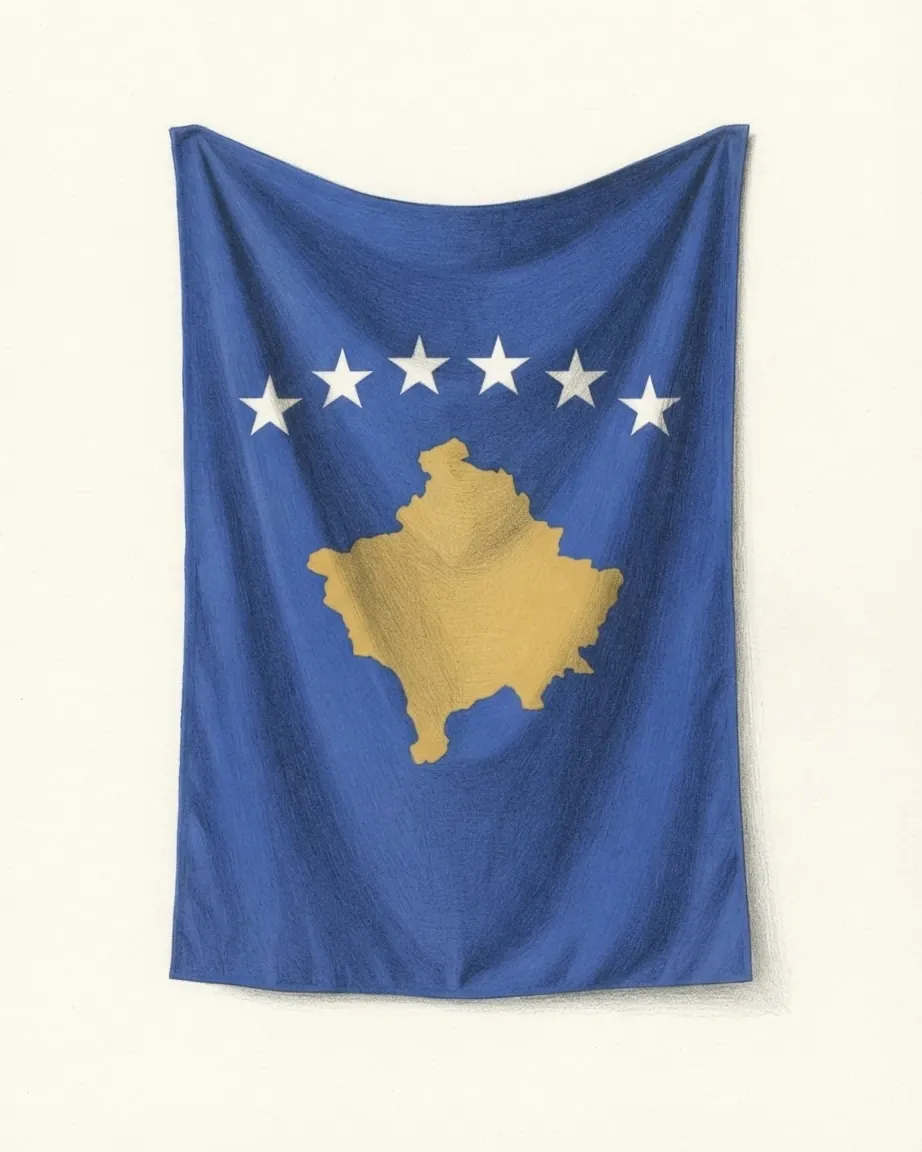
Albania and Kosovo have Albanian as an official language, and North Macedonia makes it co-official. Montenegro also names it co-official, although its record here lists Montenegrin alone.
Official beside Albanian
About Albanian
Where Gheg ends and Tosk begins
The Shkumbin river roughly divides the two dialect groups, Gheg to the north and Tosk to the south. How each treats native words and loanwords suggests the split came after the region was Christianised in the 4th century AD, and probably by the 6th. Gheg has four sub-dialects and is spoken in northern Albania, Kosovo, Montenegro and northwestern North Macedonia. Tosk has five, among them Arvanitika in southern Greece and Arbëresh, spoken in Sicily and Calabria by descendants of migrants of the 15th and 16th centuries.
How many alphabets Albanian went through
Albanian writers followed their church. Catholic writers in the north used Latin letters, Orthodox writers in the south Greek ones, and Muslim writers Arabic script, while Cyrillic and local inventions such as the Elbasan, Vithkuqi and Todhri alphabets also appeared. Robert Elsie counted at least ten alphabets in use between 1750 and 1850. The Congress of Manastir, held in what is now Bitola from 14 to 22 November 1908, settled on the Latin alphabet with ë, ç and nine digraphs: dh, gj, ll, nj, rr, sh, th, xh and zh.
Why the standard follows Tosk
The same congress recommended the speech of Elbasan, a southern Gheg variety close to Tosk, as the base of a national language. A Literary Commission meeting in Shkodër between 1916 and 1918 confirmed it and published spelling rules in 1917. After the Second World War the communist government imposed Tosk in administration, schools and literature, and orthography rules followed in 1967 and 1973. Kosovo and the other Albanian-speaking areas of Yugoslavia kept a standard based on the 1917 rules until 1968 and adopted the Tosk standard in 1969.
Common questions
Questions about Albanian
What is the oldest book in Albanian?
The Meshari, a missal written by Gjon Buzuku between 1554 and 1555 in the Gheg dialect and in Latin script. Its 188 pages hold about 154,000 words, and the only known copy is in the Apostolic Library. The first printed work in Tosk, a catechism by Lekë Matrënga, followed in 1592.
Do Gheg and Tosk speakers understand each other?
Yes, in their standard varieties. The two differ mainly in sounds.
Who are the Arbëreshë?
Albanian speakers in southern Italy, descended from migrants of the 15th and 16th centuries. Their Arbëresh dialect is a form of Tosk that keeps archaic features and has taken in Italian vocabulary.