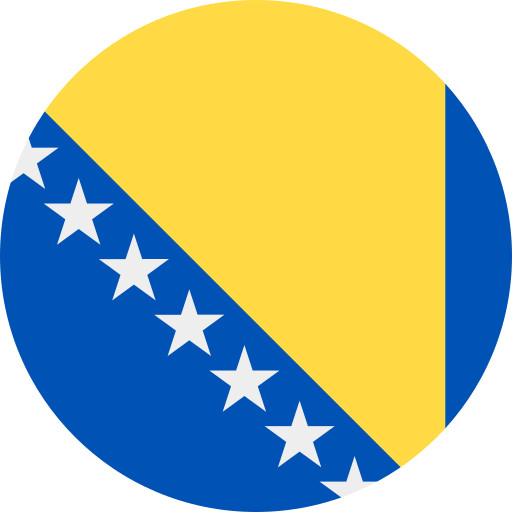
Bosnia and Herzegovina keeps two railway companies, two stock exchanges, two public broadcasters and two health insurance systems inside one outline, and the outline is by far the older arrangement. Its northern line along the Sava dates from the Treaty of Belgrade of 1739, and the peace agreement of 1995 kept the state in its recognised borders while dividing the inside between two Entities, with Brčko District belonging to both. The state holds 51,197 square kilometres of land, and the census of October 2013, the first since 1991, counted 3,531,159 people on it.
At a glance
Where it is
Where Bosnia and Herzegovina is, and what is around it
Bosnia and Herzegovina has a coast. It shares a border with 3 countries, counted as shared borders, which includes neighbours across water.
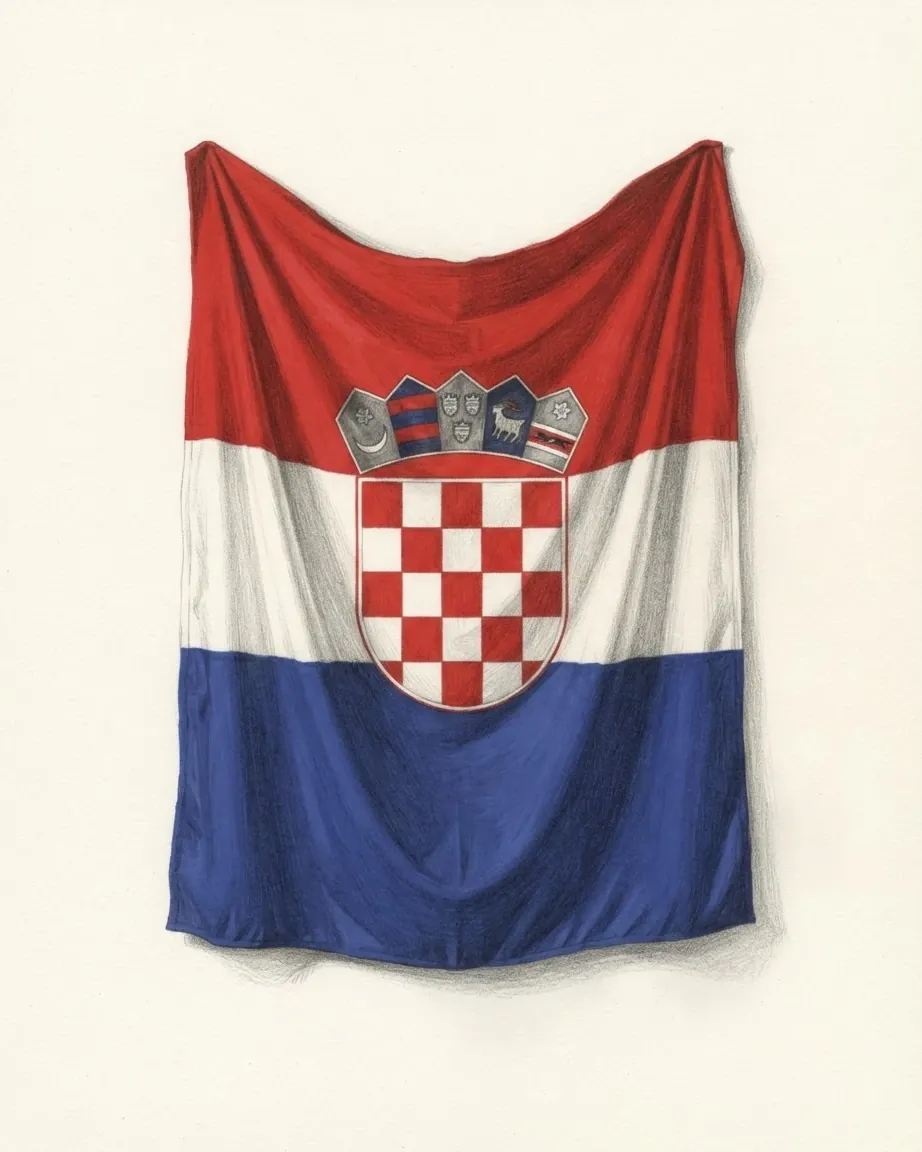
 Croatia
 Montenegro
 Serbia
How an Ottoman province kept its outline
The name is older than the state. A Banate of Bosnia, ruled by local bans, is dated from at least 1154, and in 1377 Tvrtko I had himself crowned king. The kingdom fell to the Ottomans in stages from 1463, and in 1580 the province received the full status of an eyalet, which it kept to the end of Ottoman rule.
Two treaties drew most of the frontier that still stands. At Passarowitz in 1718 Venetian Dalmatia was allowed to extend inland to a line that became part of the southwestern border, and at Belgrade in 1739 Austria gave up its claim south of the Sava, which Britannica calls the basis of the modern northern border.
The rulers changed more often than the line did. Austria-Hungary occupied the province in 1878 while it stayed notionally Ottoman, and annexed it on 6 October 1908. The Kingdom of Yugoslavia replaced every Bosnian unit with banovinas in 1929, and in 1941 the whole territory was handed to the Independent State of Croatia. On 29 November 1943 the Partisan council meeting at Jajce restored Bosnia and Herzegovina as a republic of the federation "in its Habsburg borders".
Independence came by a referendum on 29 February and 1 March 1992 that most Serbs boycotted. Turnout was 63.4%, 99.7% of those voting chose independence, and war followed. In July 1995 Bosnian Serb forces killed the Bosniak men and boys of Srebrenica, and the International Criminal Tribunal for the former Yugoslavia found the killings to be genocide, first in the case of General Radislav Krstić. The Research and Documentation Center in Sarajevo recorded 101,040 dead or disappeared across the whole war in its final figures of 2012. Bosnia and Herzegovina: history follows each change of ruler and what it did to the outline.
What Dayton built inside the old borders
The constitution is Annex 4 of the peace agreement initialled near Dayton, Ohio, on 21 November 1995 and signed in Paris on 14 December. Its first article continues the Republic "with its present internationally recognized borders". The rest of the text divides what lies inside them.
The Federation of Bosnia and Herzegovina covers 51% of the area and Republika Srpska 49%, lines based largely on where the warring sides stood in 1995. The Federation is split again into ten cantons, each with its own government; Republika Srpska has none. Brčko District, created in 2000 after an international arbitration, lies within the territory of both Entities and is governed by neither.
Offices follow two keys at once: the constituent people a holder belongs to, and the Entity that elects him. The Presidency has one Bosniak, one Croat and one Serb member, and its chair rotates every eight months. Of the 42 seats in the House of Representatives, 28 are elected in the Federation and 14 in Republika Srpska, and the House of Peoples seats five delegates of each people. Three of the nine judges of the Constitutional Court are chosen from abroad by the President of the European Court of Human Rights.
A High Representative, appointed through the Peace Implementation Council, has held powers since the council met in Bonn in December 1997 to impose decisions when the parties cannot agree and to remove officials who obstruct the agreement. The state became a candidate for membership of the European Union on 15 December 2022. The politics article sets out how a law clears the Entity vote and the vital interest veto.
Why the population of Bosnia and Herzegovina is disputed
Many offices are keyed to the shares of the three peoples, which makes the census a political question. The census of 1991 counted 4,369,319 people. Political disagreement then blocked another count for twenty-two years: one was planned for 2011, moved to 2012 and held in October 2013. It recorded 3,531,159 people, about a fifth fewer, of whom 50.1% declared themselves Bosniaks, 30.8% Serbs and 15.5% Croats.
The statistical office of Republika Srpska and Bosnian Serb politicians reject that result because it includes residents who were not permanently present. Eurostat concluded in May 2016 that the method of the state statistics agency followed international recommendations.
| Count or estimate | Date | People | Published by |
|---|---|---|---|
| Census | 1991 | 4,369,319 | Yugoslav census, as cited by Wikipedia |
| Census | 1996 | 3,764,425 | World Bank Group, as cited by Wikipedia |
| Census | October 2013 | 3,531,159 | state statistics agency |
| Estimate | 2020 | about 3.3 million | World Bank climate risk profile |
| Mid-year estimate | 2025 | 3,402,000 | Agency for Statistics |
| Estimate | 2026 | 3,386,000 | Britannica |
The war explains part of the fall. Britannica records that the ethnic cleansing of the 1990s displaced about half the population, inside the country or abroad, and that a significant portion of the displaced emigrated. By the early twenty-first century, in the same account, the natural rate of increase had fallen below zero. The United Nations Population Fund put the loss at 25,000 people a year between 2013 and 2020, and the United States State Department's investment climate statement of 2025 cites estimates that 50,000 people leave each year.
The official series sits near the top of what is argued. Tim Judah called the agency's estimate of 3.4 million for 2022 "extremely optimistic", and the demographer Stevo Palašić concluded that the country lost 1.4 million people, a third of its population, between 1991 and 2023. The World Bank's own pair for 2025, output of 32.6 billion dollars and 10,382 dollars a head, implies a divisor of about 3.14 million. None of these has the standing of a census.
How the Dinaric Alps divide the water
The Dinaric Alps cross the country from northwest to southeast and rise as they go south, to 2,386 metres on Maglić at the border with Montenegro. The World Bank's climate risk profile of 2021 classes 42% of the land as mountain, 29% as karst, 24% as hills and 5% as lowland.
The ranges split the drainage unevenly. The International Sava River Basin Commission puts 38,349 square kilometres, 75% of the territory, in the basin of the Sava, which gathers the Una, the Vrbas, the Bosna and the Drina and carries them to the Danube and the Black Sea. The rest drains to the Adriatic through karst, where rivers run largely underground. Vjetrenica Cave at Ravno, 7,324 metres long and part of the Trebišnjica system, was inscribed as a natural World Heritage site in 2024.
The Neretva is the main surface river of the south, and it crosses into Croatia before it reaches the sea. The coast that belongs to Bosnia and Herzegovina lies around Neum, enclosed by Croatian territory on both sides and without a natural harbour, and it measures about 20 kilometres in Britannica's figure and 25.5 in the World Bank's profile of 2021.
The mountains divide the climate as well. Banja Luka, north of the ranges, averages about 0 °C in January and gets its heaviest rain in May and June; Mostar averages about 6 °C in January and gets most of its rain between October and January. The geography article follows each basin down to its sea.
How one currency serves a divided economy
The convertible mark has been fixed at 1.955830 to the euro since it was issued in 1998, by a central bank the constitution bound to currency board rules for its first six years. Four of its banknote values are printed in one design for each Entity, and every version is legal tender everywhere.
Past the money, the economy runs to Entity rules. Direct tax is set in three jurisdictions, the two Entities and Brčko District. Each Entity keeps its own pension and health insurance system, banks are licensed by two Entity agencies, and shares trade on exchanges in Sarajevo and Banja Luka that both opened in 2002.
The Agency for Statistics put output at 58,171 million marks in 2025, with real growth of 2.4%, and trade and manufacturing together produced 27.8% of it. Electricity comes about two thirds from lignite and one third from hydropower, and the country sells more of it abroad than it buys. In January 2025 unemployment stood at about 11.7% on the International Labour Organization definition and about 28% on the register, a gap the State Department traces to informal workers who stay registered for health insurance and other benefits.
Money from abroad covers much of the trade gap. The State Department estimated in 2025 that remittances from the diaspora amount to as much as 15% of GDP, and the World Bank put GDP per head at one third of the European Union average in 2024. Bosnia and Herzegovina: economy works through the two rulebooks and what each one charges.
What the three constituent peoples hold in common
In the census of 2013, 52.86% of residents gave Bosnian as their mother tongue, 30.76% Serbian and 14.6% Croatian. Britannica treats the three as one set of mutually intelligible languages. The state constitution names no official language, and in 2000 the Constitutional Court ruled the Entity constitutions incompatible with it because each had recognised only some of the three. Latin and Cyrillic are both taught, and Britannica records that the nationalism of the 1990s aligned Serbs with Cyrillic and Croats and Bosniaks with Latin.
Some of what the country made sits across those lines. Orthodox, Catholic and Bosnian church communities all buried their dead under stećci, carved limestone tombstones of the twelfth to the sixteenth century, which UNESCO inscribed in 2016 as a property shared with Croatia, Montenegro and Serbia. The Old Bridge at Mostar, built in 1566, was destroyed by artillery in 1993, rebuilt in 2004 and inscribed in 2005. Konjic woodcarving, on UNESCO's intangible heritage list since 2017, is described in its file as practised by different ethnic and confessional groups.
Ivo Andrić, born in Dolac, received the Nobel Prize in Literature in 1961. Bosnia and Herzegovina: culture goes through what each community names separately and what it keeps in common.
Where visitors sleep and where the count stops
The Agency for Statistics builds its tourism figures from the guest books of registered accommodation. It counted 1,963,443 arrivals and 4,083,977 nights in 2025, an average stay of 2.1 nights, and foreign visitors accounted for 70.3% of the nights.
Pilgrims to Međugorje, in Herzegovina, mostly fall outside that count. The parish has drawn Catholic visitors since 1981, when six local people reported apparitions of the Virgin Mary, and Wikipedia's tourism article gives more than a million visitors a year in 2016, the great majority of them not registered by accommodation providers.
Sarajevo held the Winter Olympics in February 1984, with the alpine events on Jahorina and Bjelašnica. The Neretva valley south of it strings Konjic, Mostar, Blagaj and Počitelj along one river. Four international airports, at Sarajevo, Tuzla, Mostar and Banja Luka, are all owned and run by government. The travel article sets the registered count beside what it leaves out.
Read
Everything about Bosnia and Herzegovina
Six articles, each answering one question and each written to be read on its own.
The record
What is measured about Bosnia and Herzegovina
Pages that nobody writes, built from the record and from the data files beside it.
Common questions
Questions about Bosnia and Herzegovina
Where does Herzegovina end and Bosnia begin?
Nowhere that has been drawn. The two regions give the country its name, and the border between them was never defined. Bosnia covers roughly the northern four fifths and Herzegovina the south. Herzegovina takes its name from the title herceg, duke, which Stefan Vukčić gave himself as lord of Hum in the fifteenth century, and the official name included no region until the Austro-Hungarian occupation.
What is Republika Srpska?
One of the two Entities created by the Dayton constitution of 1995, covering 49% of Bosnia and Herzegovina. It has its own constitution, government, legislature and supreme court, elects the Serb member of the state Presidency and 14 of the 42 members of the House of Representatives, and runs its own railway company, public broadcaster, pension system and stock exchange at Banja Luka. It has no cantons. Its statistical office rejects the results of the 2013 census.
Why is Brčko governed separately from the two Entities?
Negotiators at Dayton could not agree on it, and the question went to an arbitral tribunal whose final award came on 5 March 1999. The tribunal gave the whole pre-war municipality to neither side. Brčko District, created in 2000, sits under the sovereignty of the state and within the territory of both Entities.
Which currency is used in Bosnia and Herzegovina?
The convertible mark, issued since 1998 by the Central Bank of Bosnia and Herzegovina and fixed at 1.955830 marks to the euro. The name comes from the Deutsche Mark, the one currency trusted across the whole territory before 1998. Britannica records that the euro also circulates as semi-official legal tender, while the State Department reports that Entity laws require payments inside the country to be made in marks.
Nearby in the catalogue