The convertible mark
Currency · BAM · KM · 1 country
The Dayton Agreement of 1995 provided for the convertible mark, and its first banknotes went into circulation on 22 June 1998. It replaced the Bosnia and Herzegovina dinar, the Croatian kuna and the Yugoslav dinar as the one currency of the whole country. Mark refers to the Deutsche Mark, which it matched at par until the euro took the German currency's place.
The abbreviation
KM abbreviates konvertibilna marka, the convertible mark, and the name points back to the Deutsche Mark it was pegged to at par. Republika Srpska notes print the letters in Cyrillic first, as КМ. The fraction is written F, as on the first notes of 50 F.
- ISO code
- BAM
- ISO number
- 977
- Subunit
- fening, 1/100
An amount, written out
KM 1,234.50
- KM 1,234.50English
- 1.234,50 KMBosnianBosnia and Herzegovina
In English the sign comes before the amount. Where the Bosnia-Herzegovina Convertible mark is used, it comes after the amount in Bosnia and Herzegovina.
Where the Bosnia-Herzegovina Convertible mark is the official currency
Bosnia and Herzegovina uses it in both entities, the Federation and Republika Srpska, whose banknotes differ in script order but circulate everywhere in the country.
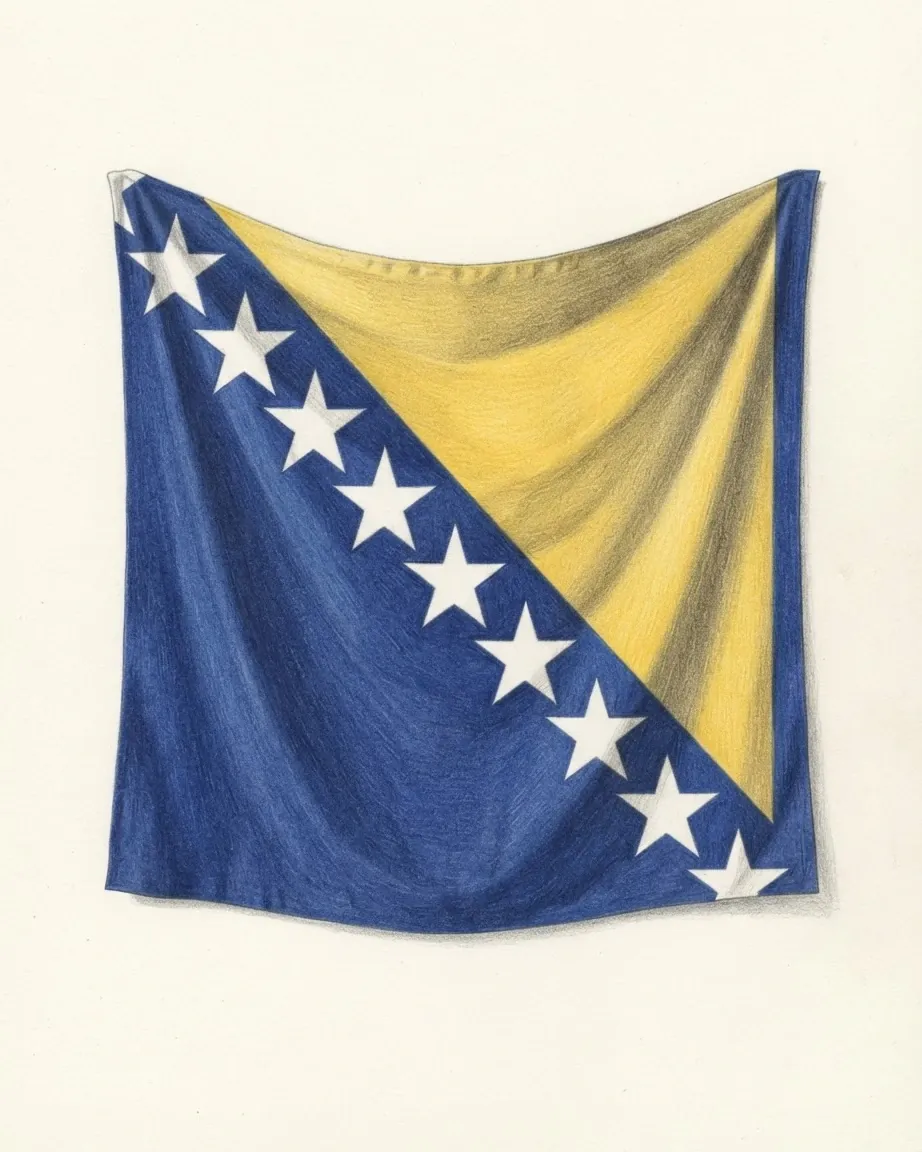
About the Bosnia-Herzegovina Convertible mark
What the currency board lets the central bank do
The Central Bank of Bosnia and Herzegovina issues the mark under the rules of a currency board, which the Law on the Central Bank sets out. Every issue of notes and coins since 1998 has followed those rules. The same law guarantees that the mark can be converted into euros in full.
The guarantee has been tested. During the global financial crises, the Covid-19 pandemic and the market turmoil that followed the war in Ukraine, demand for cash rose, and the bank supplied commercial banks with enough marks and enough euro banknotes to meet every withdrawal. By law, payments inside Bosnia and Herzegovina are made in convertible marks only.
How the mark inherited a German rate
Before 1998, cash payments in the country ran on several currencies at once, and the central bank describes winning space for its own money as hard work. The new mark was pegged to the Deutsche Mark at par. When the euro replaced the German mark in 2002, the convertible mark kept the German currency's fixed rate, 1.95583 marks to the euro.
Cash in circulation outside the monetary authorities came to KM 162 million at the end of 1998. By June 2023 it had reached KM 7.5 billion.
Why the banknotes come in two designs
The country has two entities, the Federation of Bosnia and Herzegovina and Republika Srpska, and the banknotes follow them. Each version carries its own portrait on the front and its own motif on the back. The Federation notes print Latin before Cyrillic and the Republika Srpska notes reverse the order. Size, colour and security features match exactly, and both circulate everywhere in the country. The central bank says the two versions came into equal use soon after launch.
Two exceptions were shared from the start. The KM 1 and KM 5 notes carried the writers Ivan Franjo Jukić and Meša Selimović, by consensus between the entities, from 1998 to 2010. The KM 200 note, designed by Robert Kalina and issued on 15 May 2002, has a single design, with a bridge on the back meant to recall the euro notes he also drew.
Which notes and coins have been issued
The first notes, of 50 fenings, KM 1, KM 5 and KM 10, came out on 22 June 1998, and the KM 20, KM 50 and KM 100 followed on 27 July. Oberthur in France printed that first issue, and the French government paid for it. Coins began on 9 December 1998 with 10, 20 and 50 fenings, minted by the Royal Mint. The KM 1 and KM 2 coins arrived on 31 July 2000, and the 5 fening and KM 5 coins on 5 January 2006.
The 50 fening, KM 1 and KM 5 notes were later withdrawn and coins took their place. Five note denominations and seven coin denominations circulate. The coins have one design for the whole country.
How pfenig turned into fening
The official gazettes named the hundredth the pfenig, a loan from the German Pfennig. Speakers found the pf cluster hard to say and dropped the p almost at once. The coins were engraved fening, and the spelling took such hold that it became the official name. The central bank writes fenings in English.
The notes carry other slips. The 50 fening note called the pfenig convertible, although only the mark is. A KM 1 note for Republika Srpska misspelled the name of Ivo Andrić in Cyrillic and was withdrawn at once. In 2017 an archaeologist in Sarajevo found that the stećak tombstone on the Federation's KM 10 note came from a different necropolis than the one named, and the central bank confirmed the error.
Common questions
Questions about the Bosnia-Herzegovina Convertible mark
Can euros be spent in Bosnia and Herzegovina?
Payments inside the country are made in convertible marks only, by law. What the law does guarantee is conversion: the Central Bank of Bosnia and Herzegovina must exchange marks for euros in full, at the fixed rate of 1.95583 marks to the euro inherited from the Deutsche Mark.
Why is the Bosnian currency called a mark?
It was built on the Deutsche Mark. The convertible mark was pegged to the German currency at par when it launched in 1998, and the three official languages of the country took marka and pfenig from German as loanwords. When the euro replaced the German mark in 2002, the Bosnian currency kept the old German rate against it.
Are Republika Srpska banknotes valid in the Federation?
Yes. The Central Bank of Bosnia and Herzegovina issues most banknotes in two versions, one for the Federation of Bosnia and Herzegovina and one for Republika Srpska, and both are legal tender everywhere in the country. They share size, colour and security features and differ in the portrait, the motif on the back and whether Latin or Cyrillic comes first. The KM 200 note has only one design, and so do all the coins. The central bank reports that both versions came into equal use across the country soon after they were issued in 1998, and that the payment system has never treated them differently.
Is the subunit a pfenig or a fening?
Both names have official standing. The gazettes wrote pfenig, after the German Pfennig. The coins, struck from 1998, say fening, because speakers dropped the hard pf sound almost at once, and that spelling became the accepted name. The central bank uses fenings as the English plural.