Three figures answer the question of how many people live in Ukraine, and the record holds all three. The population peaked at roughly 52 million in 1993 and had fallen by 6.6 million by 2014. Ukraine held an estimated 41.17 million people on 603,550 square kilometres in Eastern Europe on 1 January 2022, independent since 24 August 1991 and a member of the United Nations, the Council of Europe and the World Trade Organization. In 2024 the government put the population of the regions it administers at 25 to 27 million. None of the three is wrong. Each was taken on a different date, over a different piece of ground.
At a glance
- Population
- 38 980 376
- Capital
- Kyiv
- Area
- 603 550km²
- Currency
- ₴UAH
- Official language
- Ukrainian
- Local time
- UTC+02:00
Where it is
Where Ukraine is, and what is around it
Ukraine has a coast. It shares a border with 7 countries, counted as shared borders, which includes neighbours across water.
 Belarus
 Hungary
 Moldova
 Poland
 Romania
 Russia
 Slovakia
Why the land is the fixed part
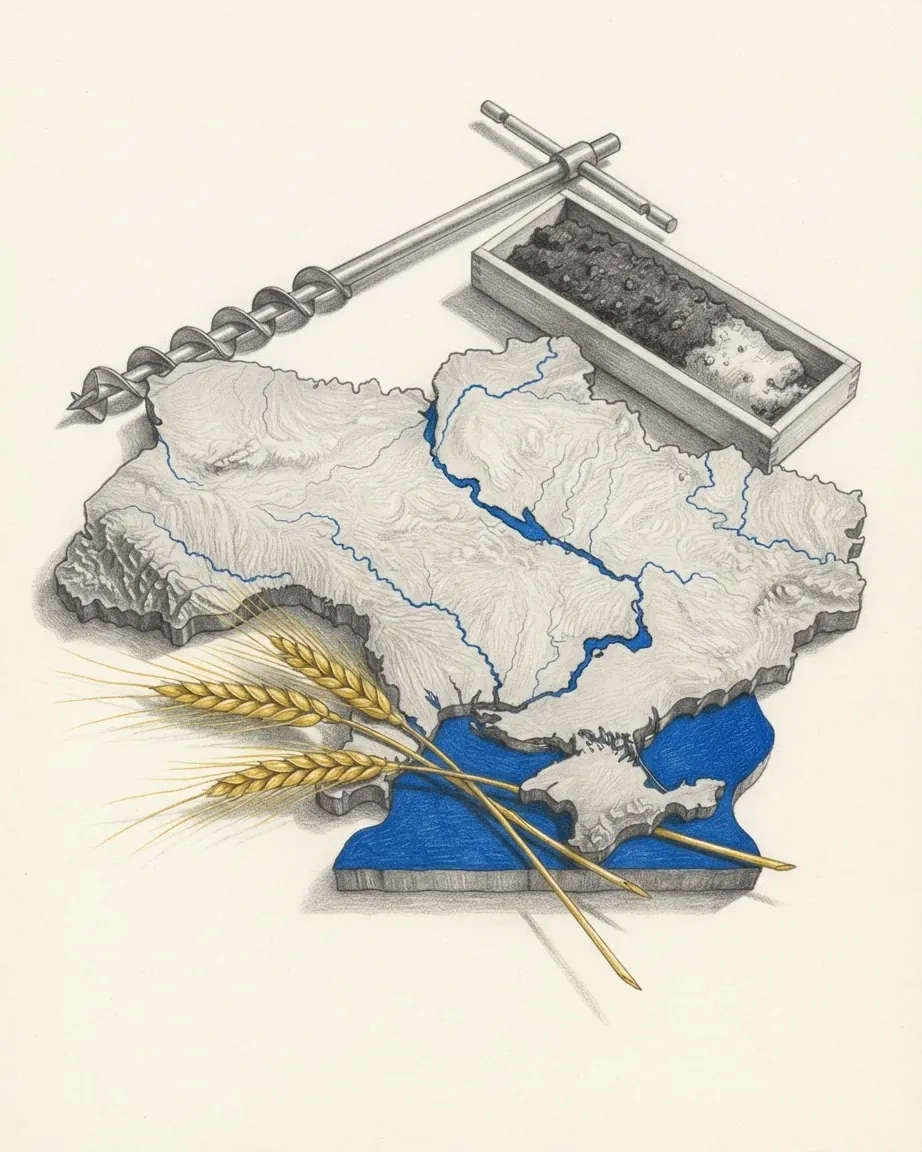
Ukraine occupies 603,550 square kilometres of Eastern Europe, with Belarus to the north, Poland, Slovakia, Hungary, Romania and Moldova to the west and south-west, Russia to the east, and the Black Sea and the Sea of Azov along the southern edge. Two thirds of that surface is chernozem, a black humus-rich earth lying about 1.5 metres deep in the northern belt, spread over a plain that averages 175 metres above sea level. Mountains are confined to the western and southern rims and cover barely 5% of the area, the highest of them Hoverla in the Carpathians at 2,061 metres.
The soil and the plain are the part of the record that stays still. Almost every other figure the country publishes about itself carries a measurement date, and each was taken over a different piece of ground: how many people live here, how much territory Kyiv administers, what the economy produced in a year. A number about Ukraine without its date and its boundary cannot be checked against anything. The geography article sets out the soil, the rain that misses the steppe, and what the damming of the Dnieper did to the river.
How the borders were assembled
The territory inside which Ukrainians voted in 1991 was put together between 1939 and 1954, in four additions, none of them decided in Kyiv. Eastern Galicia and Volhynia arrived when the Soviet Union and Germany partitioned Poland in September 1939. The northern and southern districts of Bessarabia, Northern Bukovina and the Hertsa region followed in 1940, from territory the Soviet Union forced Romania to cede. Zakarpattia was annexed in 1945. The Crimean oblast was transferred from the Russian republic in 1954.
Independence was proclaimed on 24 August 1991 and approved by 92% of the electorate at a referendum on 1 December that year, with majorities in every region and 56% in Crimea. Before that vote, a state of this name had existed only in short stretches: Kyivan Rus, which emerged in the ninth century and was destroyed by the Mongols in the thirteenth; the Cossack Hetmanate, founded in 1648 and absorbed by the Russian Empire during the eighteenth century; and the Ukrainian People's Republic, declared after the Russian Revolution of 1917 and extinguished by the Bolshevik consolidation that produced the Ukrainian Soviet Socialist Republic.
That Soviet republic became a founding member of the United Nations in 1945 under an arrangement agreed at the Yalta Conference, so it held a vote in New York for forty-six years before it held sovereignty in Kyiv. The history article follows the whole sequence, from Kyivan Rus to the Budapest memorandum.
Why the population keeps being re-estimated
The count of people has moved faster than the borders ever did. The population peaked at roughly 52 million in 1993 and had fallen by 6.6 million, or 12.8%, by 2014, as deaths exceeded births and emigration continued. The estimate for 1 January 2022 was 41,167,335. In 2024 the government put the population of the regions under its own administration at 25 to 27 million.
| Measured | People | What the figure covers |
|---|---|---|
| 1993 | about 52 million | the post-Soviet peak, whole territory |
| 1 January 2022 | 41.17 million | estimate, internationally recognised territory |
| 2024 | 25 to 27 million | government estimate, regions it administers |
All three figures are in the record and none of them corrects the others. They differ because the date differs and because the ground underneath the count differs.
Displacement explains much of the distance between them. About 1.4 million people were internally displaced by the war in Donbas during the late 2010s, and more than 4.1 million left the country in early 2022, when most male nationals aged 18 to 60 were refused exit. The twentieth century's counts moved the same way and further: at least 3.9 million Ukrainians died in the famine of 1932 and 1933, according to a study by a team of Ukrainian demographers, and losses to the population during the Second World War are estimated at 6 million.
The most recent full description of who lives here is the census of 2001, which recorded ethnic Ukrainians at roughly 78% and Russians at 17.3%, with Belarusians, Moldovans, Crimean Tatars, Bulgarians, Hungarians, Romanians and Poles each below 1%. About 67% of Ukrainians give Ukrainian as their primary language and 30% give Russian. Urban residents were 69.6% of the population in 2025, and life expectancy at birth was 74.7 years in 2024.
Who administers which regions of Ukraine
On paper Ukraine has 27 regions: 24 oblasts, the Autonomous Republic of Crimea, and Kyiv and Sevastopol as cities of special status, subdivided into 136 raions. A year after the invasion of 24 February 2022, Russian forces controlled about 17% of the internationally recognised territory, which was all of Crimea, 94% of Luhansk oblast, 73% of Kherson, 72% of Zaporizhzhia and 54% of Donetsk.
The system of government is a semi-presidential republic with a single chamber, the 450-seat Verkhovna Rada, under a constitution adopted on 28 June 1996 and interpreted by the Constitutional Court. Where the balance sits between the president and the parliament has been settled four times since that text was written, and none of the four settlements came out of an election. Since February 2022 the constitution has been beyond amendment, because Article 157 forbids changing it under martial law.
The country held an estimated 1,900 strategic warheads, 176 intercontinental ballistic missiles and 44 strategic bombers when the Soviet Union dissolved in 1991, and had returned every warhead to Russia by 1996. In exchange, the Budapest Memorandum on Security Assurances, signed on 5 December 1994 by Russia, the United Kingdom and the United States, promised to respect Ukraine's sovereignty and existing borders. The politics article traces the constitutional machinery and where the alliances point.
What the economy earns and what it is given
Output was 214.23 billion United States dollars in 2025, or 5,866 dollars a head, and 18,905 dollars a head measured at purchasing power parity. Growth ran at 1.8% and inflation at 12.7% in the same year. In the first half of 2025 the European Union took almost 60% of Ukrainian shipments abroad, and the country has held European Union candidate status since 23 June 2022.
Against those earnings sits a bill that dwarfs them. The World Bank assessment published in February 2026 put the cost of reconstruction and recovery at almost 588 billion dollars over the following decade, about three times what the country produced in 2025. 14% of the housing stock had been damaged or destroyed, affecting more than 3 million households, and the largest sectoral needs were transport at over 96 billion dollars, energy at nearly 91 billion and housing at almost 90 billion.
This is a country with an established habit of losing and rebuilding an economy. Between 1991 and 1999 output fell by 60%, hyperinflation peaked at 10,000% in 1993, and the currency introduced in the middle of that decade, the hryvnia, fell sharply again in late 1998. The economy article deals with the grain, the ore, the closed ports and who now pays the difference.
What the censors could not confiscate
Ukrainian publishing was restricted by the Valuev Circular of 1863 and prohibited outright by the Ems Ukaz of 1876, which also banned imported Ukrainian books, Ukrainian theatre and public readings. What survived best was what a censor cannot seize: singing, stitching, painting and cooking, carried in families instead of in print.
The international register reflects that weighting. Petrykivka decorative painting was inscribed on the UNESCO Representative List in 2013 and the tradition of Kosiv painted ceramics in 2019, while the Cossack songs of Dnipropetrovsk region went onto the List of Intangible Cultural Heritage in Need of Urgent Safeguarding in 2016. The culture of Ukrainian borscht cooking joined that urgent list on 1 July 2022, fast-tracked at Ukraine's own request as a case of extreme urgency, with the committee recording that displacement had left people unable to grow the vegetables or gather to cook it. In 2019, 82% of Ukrainians described themselves as Christians, of whom 72.7% were Eastern Orthodox. The culture article takes up the language, the ornament, the singing and the churches.
Where the visitor map now ends
Foreign visits ran at 24.7 million in 2013 and 12.7 million in 2014, the year Crimea was annexed, and the gap between those two numbers is the part of the map that left the count in a single step. Ukraine holds eight properties on the World Heritage List, seven of them cultural. One of the eight, the Ancient City of Tauric Chersonese and its Chora, inscribed in 2013, stands at Sevastopol under Russian administration. The properties in Kyiv and Lviv were inscribed on the List of World Heritage in Danger on 15 September 2023.
What a visitor can reach is now the west and the centre: Lviv, whose historic ensemble was listed in 1998, the Carpathians, the Residence of the Bukovinian and Dalmatian Metropolitans at Chernivtsi, listed in 2011, and Kyiv itself, where Saint Sophia Cathedral and the Kyiv-Pechersk Lavra were listed in 1990. The travel article sets out the seasons, the regions and how arrivals now come overland.
What the record adds up to
A country whose ground is settled and whose accounting is not. The soil, the plain and the rivers have been where they are for as long as anyone has measured them, and the black earth still carries the exports. The borders were assembled from outside between 1939 and 1954 and confirmed by a vote in 1991. The population has been recorded at three very different sizes in thirty-one years, the administered territory at two, and the value of the economy against a reconstruction bill three times its size. Each of the six articles above takes one of those measurements and follows it back to where it was made.
Read
Everything about Ukraine
Six articles, each answering one question and each written to be read on its own.
The record
What is measured about Ukraine
Pages that nobody writes, built from the record and from the data files beside it.
Common questions
Questions about Ukraine
How many people live in Ukraine?
It depends on the date and on the territory being counted. The population peaked at roughly 52 million in 1993. The estimate for the whole internationally recognised territory on 1 January 2022 was 41,167,335. In 2024 the Ukrainian government estimated the population of the regions under its own administration at 25 to 27 million. More than 4.1 million people left the country in early 2022 and about 1.4 million had already been internally displaced by the war in Donbas during the late 2010s.
When did Ukraine become independent?
Independence was proclaimed on 24 August 1991 by the Supreme Soviet of the Ukrainian Soviet Socialist Republic and approved by 92% of the electorate at a referendum on 1 December 1991, with majorities in every region and 56% in Crimea. The Soviet Union formally ceased to exist on 26 December that year.
Where is Ukraine?
In Eastern Europe, on 603,550 square kilometres bordered by Belarus to the north, Poland, Slovakia, Hungary, Romania and Moldova to the west and south-west, and Russia to the east, with the Black Sea and the Sea of Azov along the southern edge. The capital is Kyiv.
Which Ukrainian things are known abroad?
Black earth. Two thirds of the land surface is chernozem, about 1.5 metres deep in the northern belt, and it carries the grain exports. The country is also known for the famine of 1932 and 1933, in which at least 3.9 million Ukrainians died according to a study by Ukrainian demographers, and for giving up the nuclear arsenal it inherited in 1991 under the Budapest Memorandum of 5 December 1994.
Is Ukraine in the European Union?
No. Ukraine has held European Union candidate status since 23 June 2022 and is negotiating accession. It joined the Council of Europe on 9 November 1995 and the World Trade Organization on 16 May 2008, and the European Union took almost 60% of its exports in the first half of 2025.
Nearby in the catalogue