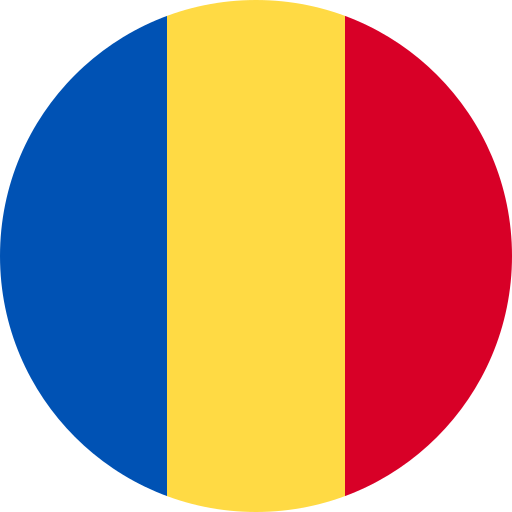
The convention that was meant to keep two Danubian principalities apart in 1858 gave them one shared name and two separate thrones, and it did not say that the same man could not sit on both. Romania is a country of about 19 million people on the lower Danube and the Black Sea, formed when Moldavia and Wallachia elected the same prince in 1859, enlarged by Transylvania and the other provinces in 1918, and a member of NATO since 2004 and the European Union since 2007. Almost every border it has held was drawn somewhere else: at Berlin in 1878, at Trianon in 1920, by Soviet ultimatum and German arbitration in the summer of 1940, and at Paris in 1947. What has held steady underneath the borders is the claim they were argued over: a Romance language written in Latin letters, and an Orthodox church that alone among Orthodox churches works inside a Latin culture.
At a glance
- Population
- 19 020 271
- Capital
- Bucharest
- Area
- 238 397km²
- Currency
- leiRON
- Official language
- Romanian
- Local time
- UTC+02:00
Where it is
Where Romania is, and what is around it
Romania has a coast. It shares a border with 5 countries, counted as shared borders, which includes neighbours across water.
 Bulgaria
 Hungary
 Moldova
 Serbia
 Ukraine
How two thrones became one country
The Crimean War loosened an arrangement that had held the Danubian principalities for a century. The Treaty of Paris of 1856 put Moldavia and Wallachia under the joint tutelage of the Ottoman Empire and the great powers, and the Paris Convention of 1858 conceded the smallest union it could: one shared name, the United Principalities of Moldavia and Wallachia, with two thrones, two governments and two separate elections.
Both assemblies elected Alexandru Ioan Cuza in 1859. The convention had specified two thrones without saying that one man could not occupy both, the powers accepted the result, and a country existed that no treaty had authorised. Cuza spent seven years merging the institutions the text had kept apart. He abolished serfdom, secularised the monastery estates, unified the government and the parliament, and in 1862 changed the country's name to the United Principalities of Romania. A coalition of opposed parties forced him to abdicate in 1866 and imported a replacement, Karl of Hohenzollern-Sigmaringen, who ruled as Prince Carol.
Independence from the Ottoman Empire was declared during the Russo-Turkish war of 1877 and recognised by the Treaty of Berlin in 1878, at a price: southern Bessarabia went to Russia, and Dobruja with a Black Sea coast came in exchange. The principality was raised to a kingdom in 1881. The history article carries the sequence from Roman Dacia forward.
What the union added and what war took
Romania joined the First World War on the side of the Entente in 1916, was invaded and lost Bucharest, and finished the war on the winning side because the Austrian and Russian empires had come apart. Assemblies in Bessarabia, Bukovina and Transylvania voted during 1918 to join the kingdom, and the Transylvanian vote at Alba Iulia on 1 December is the national day. The census of 1930 counted 18,057,028 people, 71.9% of them Romanians and 28.1% members of the minorities the enlarged state had acquired along with the land.
Ten weeks in the summer of 1940 undid most of the gain.
| Territory | Taken in 1940 | Taken by | Returned |
|---|---|---|---|
| Bessarabia and northern Bukovina | July, after a Soviet ultimatum | Soviet Union | Never |
| Northern Transylvania | 30 August, Second Vienna Award | Hungary | 1947, Paris peace treaties |
| Southern Dobruja | 7 September, Treaty of Craiova | Bulgaria | Never |
Romania signed the Tripartite Pact in November 1940, entered the war against the Soviet Union in June 1941, and turned to the Allies in August 1944, recovering Northern Transylvania. King Michael I was forced to abdicate in 1947 and a people's republic was proclaimed. Nicolae Ceaușescu led the communist party from 1965 until December 1989, when a protest in Timișoara grew into a national uprising and he and his wife Elena were executed on 25 December.
Why the mountains sit in the middle
The Carpathian arc curves through the interior instead of marking a frontier, and the relief is arranged in rings around it. The Transylvanian Plateau lies enclosed inside the arc. Around the outside, the Sub-Carpathians and the Western Hills form a fringe of rolling ground between 396 and 1,006 metres. Beyond that come the tablelands, and beyond those the plains, running down to the Danube and the Black Sea. The shares are close to even across 238,397 square kilometres: 23% mountain, 35% hill, 39% plain, with Moldoveanu Peak at 2,544 metres.
The Danube closes the ring from outside. It enters in the south-west at Bazias and runs about 1,075 kilometres through or along Romanian territory, close to 40% of the river's entire length, forming the frontier with Serbia and Bulgaria before it splits into three branches and ends in a delta of 5,800 square kilometres. Virtually every river in the country is a tributary of it.
The same mountains sort the weather. They hold Atlantic influence in the west and centre and block the continental air coming off the plain to the north, and rainfall falls away from west to east, from about 635 millimetres a year in central Transylvania to about 381 millimetres at Constanța on the coast. The geography article sets out the ranges, the rivers and the delta.
Where the arguments get settled now
The constitution adopted in 1991 makes Romania a semi-presidential republic: a directly elected head of state beside a prime minister answerable to a parliament of two chambers. The design puts the two offices within reach of each other, and parliament may suspend the president and put the removal to a national referendum.
That has happened twice. The referendum of 2007 declined to remove the president. In 2012 more than 7.4 million voters, close to 90% of the ballots cast, voted for removal, and the Constitutional Court invalidated the result because turnout stood at 46%. In December 2024 the same court annulled the first round of a presidential election outright, citing Russian interference. The revision of 2003 had removed the power of a parliamentary majority to overturn the court, which is why the court is where these fights now end.
The alignments outside the borders are settled by comparison. Romania joined NATO on 29 March 2004 and the European Union on 1 January 2007. Schengen checks were lifted at its air and sea borders on 31 March 2024 and at its land borders on 1 January 2025. The politics article sets out the institutions, the parties, and the seats held by recognised minorities.
What the country farms and what it ships
Two economies occupy the one territory, and little passes between them. Agriculture accounted for about one in five people employed in Romania in 2023, 20.7% of total employment, worked largely by managers without formal training: 1.0% of them held a full agricultural qualification, the rest having learned in practice.
The other economy ships. Goods exports came to 104 billion dollars in 2024 against 138 billion dollars of imports, and the export list runs to cars at 10.1 billion dollars, vehicle parts at 8.18 billion and insulated wire at 3.88 billion, made for assembly lines in other countries. Germany alone took 19.1 billion dollars of it.
Convergence with the rest of the union has been quick. Income per head measured in purchasing power stood at 44% of the European Union average in 2007, the year of accession, and 77% in 2022. The population has moved the other way: the census of 2021 counted 19,053,815 residents, against 18 million in 1930 within much larger borders, and the number of Romanians and people of Romanian descent living abroad is estimated at 12 million. The economy article sets out what the farms produce and what the convergence has cost.
How an Orthodox country writes in Latin letters
Romanian is a Romance language, and it is written with the 26 letters of the Latin alphabet plus five that carry diacritics. It was not always written that way. The Latin-based alphabet took shape in Transylvania after the Act of Union of 1698 brought part of the Romanian church into communion with Rome, and it eventually supplanted the Cyrillic script the language had been printed in.
The faith did not follow the script. At the census of 2021, 73.60% of respondents identified as Orthodox Christians, and the Romanian Orthodox Church, alone among Orthodox churches, works inside a Latin culture and uses a Romance liturgical language. What that produced is a stock of buildings carrying two traditions at once: monastery walls in Moldavia painted on the outside, timber churches in Maramureș, fortified Saxon churches in the Transylvanian villages, all of them on the World Heritage list.
The same doubling runs through the art. The culture article follows it into literature, music and sculpture, including Constantin Brâncuși, whose sculptural ensemble stands at Târgu Jiu.
What travellers find in the Carpathians
About half of Europe's brown bears outside Russia live in the Romanian Carpathians, along with about a fifth of the continent's wolves. Authorised lodging recorded more than 14 million arrivals in 2024 and 30.2 million overnight stays, 4.5% above 2023 and 7.7% above 2019.
Most of that movement is Romanian. In December 2024 the border crossings counted 916,100 foreign visitor arrivals while 1,007,600 residents travelled out. Bran Castle near Brașov takes hundreds of thousands of visitors a year on a Dracula association that is false, and the Danube Delta, a biosphere reserve and a World Heritage site, takes a fraction of that. The travel article works through the seasons and the water.
What all of it comes down to
A state that began in a gap in a treaty, took its present name three years later, assembled its territory in 1918 and lost most of the addition in ten weeks in 1940, spent the years from 1947 to 1989 inside the Soviet bloc, and has spent the years since converging on a union it joined in 2007. The mountains sit in the middle, the Danube runs around the outside, and the Latin language at the centre of it is the claim the country was named for. Each part above has an article of its own.
Read
Everything about Romania
Six articles, each answering one question and each written to be read on its own.
The record
What is measured about Romania
Pages that nobody writes, built from the record and from the data files beside it.
Common questions
Questions about Romania
Where is Romania?
On the lower Danube and the western shore of the Black Sea, bordered by Bulgaria, Serbia, Hungary, Ukraine and Moldova. The Carpathian mountains run through the middle of the country instead of along a border, which is why the relief is arranged in rings, with the Transylvanian Plateau enclosed inside the arc and the plains outside it.
Where does the name Romania come from?
The name is a claim of descent from the Romans who held Dacia in the second and third centuries, and it entered official use in 1862, when Alexandru Ioan Cuza renamed the United Principalities of Moldavia and Wallachia. The name preceded by 56 years the borders it now describes, which were assembled in 1918.
What language do Romanians speak?
Romanian, a Romance language written with the 26 letters of the Latin alphabet plus five that carry diacritics. It was printed in Cyrillic until a Latin-based alphabet, worked out in Transylvania after the Act of Union of 1698, supplanted it. The Romanian Orthodox Church is the one Orthodox church that uses a Romance liturgical language.
Is Romania in the European Union?
Yes, since 1 January 2007, and in NATO since 29 March 2004. Schengen checks were lifted at Romanian air and sea borders on 31 March 2024 and at the land borders on 1 January 2025. The currency is still the leu.
Is Romania the same country as Moldova?
No. The two are separate states. Bessarabia, most of which is now the Republic of Moldova, was part of Romania between 1918 and 1940, when a Soviet ultimatum took it and two thirds of it became the Moldavian Soviet Socialist Republic. The canonical jurisdiction of the Romanian Orthodox Church still covers both territories.
Nearby in the catalogue