Ukraine's history: a state older than its borders
3 093 words · 14 min · updated 2026-09-10
 Back to Ukraine
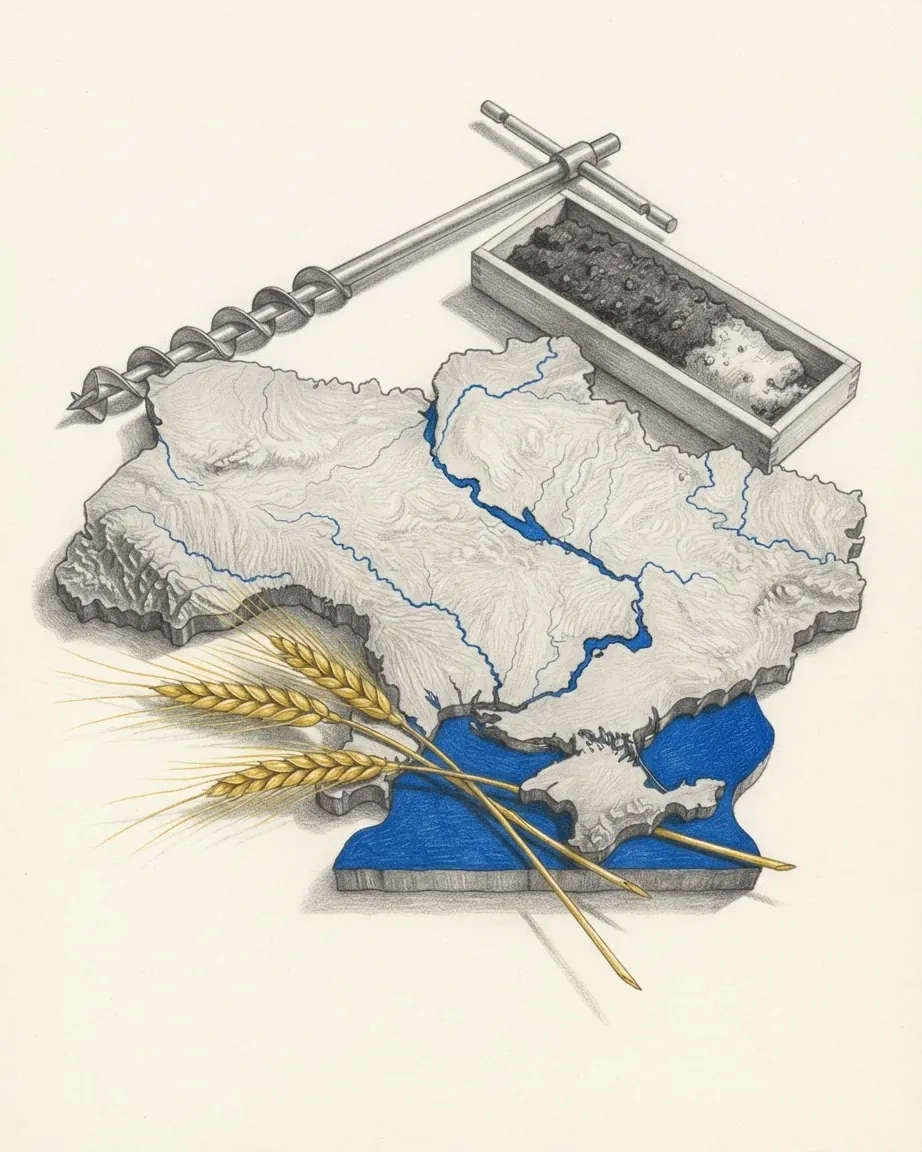
The borders inside which Ukraine voted for independence in 1991 were assembled between 1939 and 1954, in four additions, none of them decided in Kyiv. Eastern Galicia and Volhynia arrived when the Soviet Union and Germany partitioned Poland in September 1939, the Bessarabian districts and Northern Bukovina came from Romania in 1940, Zakarpattia followed in 1945, and the Crimean oblast was transferred from the Russian republic by a resolution of 19 February 1954. On 1 December 1991 the assembled whole voted as one: 92% for independence, with majorities in every region and 56% in Crimea.
In short
- First state centred on Kyiv
- Kyivan Rus, a principality at Kyiv from around 880
- Christianity accepted in Rus
- 988, under Volodymyr I
- Cossack Hetmanate
- From the 1648 uprising to its abolition in the 1760s
- Founding dates in the record
- Six, from around 900 to 24 August 1991
- Present borders completed
- 19 February 1954, by the transfer of the Crimean oblast
- Independence referendum
- 1 December 1991, approved by 92%
- Nuclear weapons returned
- All warheads back in Russia by 1996
- European Union candidate
- 23 June 2022
How Kyivan Rus rose and disintegrated
Settlement here is documented deep into prehistory: stone tools found at Korolevo in western Ukraine have been dated to 1.4 million years, and the Neanderthal sites at Molodova, dated to 45,000 to 43,000 BC, include a dwelling framed from mammoth bone.
Written history begins with a state centred on Kyiv. The Varangian nobleman Oleh is generally credited with establishing a principality there around 880, though Slavic settlement on the site is attested from the end of the fifth century and the town may have paid tribute to the Khazars before he took it. Petro Tolochko and other historians read the early city as an intertribal centre holding Slavic, Scandinavian and Finno-Ugric groups together.
Volodymyr I converted to Orthodox Christianity in the 980s, and the formal acceptance of Christianity in Rus is dated to 988, which tied the realm to the Byzantine Empire ecclesiastically as well as politically. The reign of Yaroslav the Wise, from 1019 to 1054, is generally treated as the height of the state; he promulgated the Russkaya Pravda, the law code that survived into the Lithuanian period. Rus was never a centralised state. It was a loose aggregation of principalities held by members of the Rurik dynasty, and from the twelfth century that arrangement came apart.
What broke apart was claimed afterwards by more than one state. In the north the name of Moscow enters the record in the Principality of Suzdal, from which the Russian state developed; in the north-west Polotsk asserted the separateness of the Belarusian lands. Kyiv was sacked by the Principality of Vladimir in 1169 and by the Mongols in 1240, and by 1240 every principality on present-day Ukrainian territory acknowledged Mongol overlordship.
One successor held out longest. Galicia and Volhynia were united in 1199 by Roman Mstyslavych, and under his son Danylo the state founded new cities, Lviv among them, and traded west into Poland and Hungary. Danylo paid tribute to the Mongol khan and collected it from other Rus princes, and in 1253 a papal delegation crowned him king of Rus, a title no earlier ruler of Rus had held. His dynasty died out in 1340.
Who ruled the Ukrainian lands after the Mongols
Lithuania took the interior. Chernihiv fell in the 1350s, Kyiv and Podolia in the 1360s, and the Battle of Blue Waters in 1362 or 1363 confirmed the change; the grand dukes then styled themselves rulers of Rus. Competition with Poland over the Galician-Volhynian inheritance ended in partition in the 1380s, with Volhynia to Lithuania and Galicia to Poland. Ruthenian was one of the written languages of the grand duchy alongside Latin and Old Church Slavonic, and it was displaced by Polish in the early modern period.
The Union of Lublin in 1569 detached most Ukrainian territory from Lithuania and annexed it directly to the Polish crown. Colonisation followed, and most Ukrainian nobles were Polonised and became Catholic while the Ruthenian-speaking peasantry stayed Orthodox and was pressed into serfdom. At a synod in Brest in 1596 the Kyivan metropolitan and most of his bishops accepted union with Rome, producing the church later called Uniate and a religious division that ran through the same population.
The coast and the steppe answered to other powers. Genoese colonies fortified the Black Sea shore from the thirteenth century until Genoese dominance ended in the fifteenth. The Crimean Khanate formed as the Golden Horde declined, and between 1500 and 1700 it exported roughly 2 million slaves from the Ukrainian and Russian lands to the Ottoman Empire and the Middle East. The khanate remained an Ottoman vassal until 1774 and was dissolved by the Russian Empire in 1783.
What the Cossack Hetmanate agreed at Pereiaslav
Peasants who fled serfdom into the open steppe became known as Cossacks. The Commonwealth enlisted some of them to guard its southeastern border, refused them autonomy, and attempted to turn most of the Cossack population into serfs. Rebellions followed.
The rebellion of 1648 under Bohdan Khmelnytsky opened the period Ukrainian historians call the Ruin. The Cossack Hetmanate that emerged from it is usually treated as the precursor of a Ukrainian state, and it found itself between the Ottomans, the Commonwealth and Muscovy at once. In January 1654 Khmelnytsky agreed the Treaty of Pereiaslav with Russia.
The exact nature of the relationship established by this treaty between the Cossack Hetmanate and Russia remains a matter of scholarly controversy.
Three hundred years later the same treaty was cited in Moscow as the reason for handing Crimea to Soviet Ukraine. What it produced immediately was war. The Treaty of Hadiach of 1658 would have made a Polish-Lithuanian-Ruthenian commonwealth of three members; it was superseded by the Truce of Andrusovo in 1667, which divided Ukrainian territory between the Commonwealth and Russia along the Dnieper. The Treaty of Perpetual Peace signed in 1686 confirmed the eastern bank to Russia and set 146,000 rubles as compensation for the right bank. The Polish Sejm did not ratify it for a generation, and by the account of Jacek Staszewski it was not confirmed by a resolution of the Sejm until the session of 1764.
The same year, 1686, the Metropolitanate of Kyiv passed from Constantinople to the Moscow Patriarchate. That transfer stood for 333 years, until the Ecumenical Patriarch granted a tomos of autocephaly to the Orthodox Church of Ukraine in January 2019.
Autonomy inside the Russian orbit was then closed down in stages. Hetman Ivan Mazepa allied with Charles XII of Sweden in 1708 and the alliance was broken at the Battle of Poltava in 1709. The Hetmanate was disestablished in the 1760s, the Zaporozhian Sich was destroyed in the 1770s, and after the partitions of Poland in 1772, 1793 and 1795 the far west of Ukraine was Austrian and the remainder Russian.
How two empires governed the same people
For more than a century the same people lived under two administrations that treated their language differently.
In the Russian Empire it was banned twice in thirteen years. The Valuev Circular of 1863 barred Ukrainian from religious and educational literature, and the Ems Ukaz of 1876 outlawed Ukrainian-language publications outright, along with the import of Ukrainian texts printed abroad, the use of Ukrainian on the stage and in public readings, and its use in schools. The emancipation of 1861 reached a population of whom 42% were serfs. Economically the region was being drawn into the imperial system: in the late nineteenth century the steppe produced 20% of the world's wheat and 80% of the empire's sugar, and the first railway track was laid in 1866.
Under the Habsburgs the arrangement was poorer and freer. About 2.4 million Ukrainians lived in eastern Galicia, some 95% of them peasants, with the nobility Polish or Polonised. After the revolutions of 1848 they founded the Supreme Ruthenian Council, asked for autonomy, and published Zoria halytska, the first Ukrainian-language newspaper. Intellectuals leaving Russian repression moved west into Galicia, and the Russophile current there gave way to a Ukrainophile one that then crossed back over the border. When the First World War began, Austrian forces interned Russophile Slavs at Talerhof, where many died.
Why independence collapsed after the revolution
Several states claiming Ukrainian independence existed between 1917 and 1921 and none of them lasted. The Ukrainian People's Republic was announced under Mykhailo Hrushevsky, deposed by the coup of Pavlo Skoropadskyi that produced the Ukrainian State under German protection, and revived under the Directorate before its army was overrun. The West Ukrainian People's Republic and the Hutsul Republic never joined the rest. The anarchist Makhnovshchina held its own territory. The Canadian historian Orest Subtelny described the result:
In 1919 total chaos engulfed Ukraine. Indeed, in the modern history of Europe no country experienced such complete anarchy, bitter civil strife, and total collapse of authority as did Ukraine at this time.
Six armies operated on the territory by his count, those of the Ukrainians, the Bolsheviks, the Whites, the French, the Poles and the anarchists, and Kyiv changed hands five times in less than a year. Fighting across the former Russian Empire left more than 1.5 million dead, and famine hit the eastern provinces in 1921.
The settlement divided the population four ways. Poland annexed the western provinces, Romania occupied Bukovina, Carpathian Ruthenia entered Czechoslovakia as an autonomous region, and the Ukrainian Soviet Socialist Republic became a founding republic of the Soviet Union on 30 December 1922. Soviet policy in the 1920s promoted Ukrainian under the indigenisation programme run by Mykola Skrypnyk, which made Ukrainian the language of administration and schools and drew figures such as Hrushevsky back from exile. Arrests and deportations of Ukrainian academics had begun in July 1922 and continued through the decade.
What the famine did to Soviet Ukraine
Collectivisation was decided in 1929 and enforced by troops and secret police. Members of collective farms were sometimes barred from taking any grain until quotas were met, and the quotas were not met.
Between 1931 and 1934 at least 5 million people died of hunger across the Soviet Union. Among them, by a study conducted by a team of Ukrainian demographers, were at least 3.9 million Ukrainians, the toll of the famine of 1932 to 1933 that is called the Holodomor, from the Ukrainian words for hunger and extermination. Other estimates run higher, at 4 to 5 million Ukrainians within a Soviet total of 6 to 8 million. A series of decrees aimed mostly or only at Ukraine made the Ukrainian famine deadlier than the wider Soviet one.
The famine ran alongside an assault on Ukrainian institutions. Ukrainisation was halted, the political establishment and the intelligentsia were arrested, sent to the Gulag or shot, and anyone connected to the Ukrainian People's Republic was liable to reprisal. Skrypnyk, who had run the indigenisation policy, took his own life rather than face a show trial. The generation of writers and scholars destroyed in these years is remembered as the Executed Renaissance.
Then the record was closed. Party officials did not mention the famine, Western correspondents in Moscow were instructed not to report it, and the census of 1937, which showed the loss, was suppressed and its administrators arrested. The first public mention inside the Soviet Union came in 1986, when the poet Ivan Drach cited it after the Chernobyl reactor explosion of 26 April 1986 as an example of what official silence costs. By early 2019, 16 countries and the Vatican had recognised the Holodomor as a genocide, and both houses of the United States Congress had passed resolutions stating that genocide was committed against the Ukrainians in 1932 and 1933.
How the present borders were assembled
The map of the country that declared independence in 1991 was completed within living memory of that declaration, in four additions made across fifteen years.
| Territory | Added | Taken from |
|---|---|---|
| Eastern Galicia and Volhynia | 1939 | Poland |
| Northern Bukovina, northern and southern Bessarabia, Hertsa | 1940 | Romania |
| Zakarpattia | 1945 | Czechoslovakia |
| Crimean oblast | 1954 | Russian Soviet Federative Socialist Republic |
What the war added to the map
German and Soviet forces divided Poland after the invasion of September 1939, and eastern Galicia and Volhynia, with their Ukrainian population, were attached to the Ukrainian SSR. The republic took northern and southern Bessarabia, Northern Bukovina and the Hertsa region from Romania in 1940, and handed the western part of the Moldavian Autonomous Soviet Socialist Republic to the new Moldavian SSR. The Paris peace treaties of 1947 recognised those gains internationally. Zakarpattia was annexed in 1945.
The cost of the intervening years was counted in millions. Total Ukrainian losses in the war are estimated at 6 million, including an estimated 1.5 million Jews killed by the Einsatzgruppen, sometimes with the help of local collaborators. Between 4.5 and 7 million ethnic Ukrainians fought in the Soviet army. In western Ukraine the Ukrainian Insurgent Army fought the Germans and the Soviets both, and from mid-1943 it carried out massacres of ethnic Poles in Volhynia and eastern Galicia in which around 100,000 Polish civilians were killed; remnants of it fought Soviet forces into the 1950s. More than 700 cities and towns and 28,000 villages were destroyed, and a drought famine in 1946 and 1947 killed at least tens of thousands more. In 1945 the Ukrainian SSR became a founding member of the United Nations under an agreement reached at Yalta, holding a vote without being independent.
Why Crimea changed republics under Khrushchev
Crimea had been Russian since the annexation of 1783. Its Tatar population was deported to Central Asia in May 1944, and by the 1950s the peninsula held about 1.1 million people, roughly 75% of them ethnic Russians and 25% Ukrainians. The Presidium of the Communist Party approved the transfer on 25 January 1954, the Presidium of the USSR Supreme Soviet passed the authorising resolution on 19 February 1954, and the Soviet press announced it eight days later. Two reasons were given publicly: the three hundredth anniversary of the Treaty of Pereiaslav, and the territorial and economic closeness of Crimea to Ukraine.
Mark Kramer, writing for the Wilson Center, holds that neither rationale withstands examination, since Pereiaslav has no connection to a peninsula that came under Russian control 130 years after the treaty, and Crimean ties were stronger with Russia than with Ukraine. His reading is that Nikita Khrushchev, who had run the Communist Party of Ukraine from the late 1930s to 1949 and overseen the suppression of the insurgency in the newly annexed west, treated the transfer as a way to consolidate Soviet control and to secure allies in the leadership contest then under way. Some 860,000 ethnic Russians joined Ukraine with it. The transfer was carried out under Article 18 of the 1936 Soviet constitution, which required the consent of the republic concerned, and both republic parliaments consented; Kramer records that it is incorrect to call the transfer unconstitutional. Crimea then stayed an oblast of Soviet Ukraine for 37 years, becoming an autonomous republic in 1991.
What the vote for independence decided
The unravelling was quick. On 21 January 1990 more than 300,000 people formed a human chain between Kyiv and Lviv. On 16 July 1990 the Supreme Soviet of the Ukrainian SSR adopted a Declaration of State Sovereignty. After the failed coup in Moscow, the parliament proclaimed independence on 24 August 1991, and on 1 December 1991 a referendum confirmed it with the approval of 92% of the electorate, carrying every region and taking 56% in Crimea. Leonid Kravchuk was elected president the same day, signed the Belavezha Accords, and the Soviet Union voted itself out of existence on 26 December 1991.
Independence arrived with a collapse in output. Between 1991 and 1999 the economy lost 60% of its measured product, and hyperinflation peaked at 10,000% in 1993.
Two contested elections then produced two mass protests. In the 2004 presidential election the runoff was declared void by the Supreme Court after allegations of rigging, and the repeat runoff was won by Viktor Yushchenko, in the events called the Orange Revolution. In November 2013 Viktor Yanukovych declined to sign the association agreement with the European Union and turned towards Russia, protesters occupied Independence Square in Kyiv, about 80 people were killed in February 2014, and parliament voted to remove him from office on 22 February 2014.
What Ukraine surrendered under the Budapest memorandum
The Declaration of State Sovereignty of July 1990 already carried the pledge "not to accept, produce, or acquire nuclear weapons". What the state inherited a year later made the pledge expensive: an estimated 1,900 strategic warheads, 176 intercontinental ballistic missiles and 44 strategic bombers stationed on its territory in 1991, along with a military force of 780,000.
Disarmament took four years of bargaining. The Minsk Agreement of 30 December 1991 put the weapons under Russian charge while leaving the host states a veto on use; the Lisbon Protocol of 23 May 1992 committed Ukraine to return them and to join the Non-Proliferation Treaty. Parliament resisted, and in April 1993 a statement signed by 162 Ukrainian politicians attached 13 preconditions to ratification, among them security assurances from Russia and the United States and compensation for the nuclear material. The Trilateral Statement of 14 January 1994 settled the terms, START was ratified on 3 February 1994, and on 5 December 1994 Russia, the United States and the United Kingdom signed the Budapest Memorandum, a political agreement giving assurances against the threat or use of force against Ukraine's territory or political independence and promising to respect its sovereignty and existing borders. Ukraine acceded to the Non-Proliferation Treaty as a non-nuclear weapon state that day. The last warheads went back to Russia in 1996 and the last strategic delivery vehicle was eliminated in 2001.
Twenty years after the signature the borders it named were in dispute. Russian forces entered Crimea in late February 2014 and the annexation was declared on 18 March 2014, after a referendum held under Russian military occupation that the European Union and the United States denounced as illegal. The United States, the United Kingdom and Ukraine called the annexation a breach of the assurances given in 1994. The stated position of the Russian foreign ministry was that "the security assurances were given to the legitimate government of Ukraine but not to the forces that came to power following the coup d'etat".
Fighting in Donetsk and Luhansk oblasts followed from April 2014, and by December 2015 United Nations figures counted more than 9,100 dead, most of them civilians, with over half a million people displaced inside the country by the end of 2014. Russian forces invaded across the whole frontier on 24 February 2022. On 30 September 2022 Russia declared the annexation of Donetsk and Luhansk and most of Kherson and Zaporizhzhia oblasts, and a year after the invasion began it held about 17% of Ukraine's internationally recognised territory. Ukraine applied for membership of the European Union in February 2022 and was granted candidate status on 23 June 2022.
Timeline
The dates in order
- c. 880
- Oleh is credited with establishing a principality at Kyiv.
- 988
- Christianity formally accepted in Rus under Volodymyr I.
- 1240
- The Mongols sack Kyiv; the principalities acknowledge Mongol overlordship.
- 1569
- The Union of Lublin annexes most Ukrainian territory directly to Poland.
- 1648
- Khmelnytsky's rebellion opens the era of the Cossack Hetmanate.
- 1654
- The Treaty of Pereiaslav, whose nature historians still dispute.
- 1876
- The Ems Ukaz outlaws Ukrainian-language publishing outright.
- 1917
- The Ukrainian People's Republic is announced; four years of war follow.
- 1932
- The Holodomor begins; at least 3.9 million Ukrainians die by 1933.
- 1939
- Eastern Galicia and Volhynia are attached to the Ukrainian SSR.
- 1945
- Zakarpattia is annexed; the republic joins the United Nations.
- 1954
- The Crimean oblast is transferred from the Russian republic on 19 February.
- 1991
- Independence proclaimed on 24 August, confirmed by referendum on 1 December.
- 1994
- The Budapest Memorandum is signed on 5 December; disarmament completes in 1996.
- 2014
- Crimea annexed on 18 March; fighting begins in Donetsk and Luhansk oblasts.
- 2022
- Russia invades on 24 February; European Union candidate status on 23 June.
Common questions
Questions about Ukraine
How was Ukrainian independence declared?
The parliament proclaimed independence on 24 August 1991, after the failed coup in Moscow, and a referendum on 1 December 1991 confirmed it with the approval of 92% of the electorate, carrying every region and taking 56% in Crimea. Leonid Kravchuk was elected president the same day and signed the Belavezha Accords; the Soviet Union voted itself out of existence on 26 December 1991.
Was there a Ukrainian state before 1991?
Several. Kyivan Rus was centred on Kyiv from around 880, the principality of Galicia-Volhynia outlasted it until 1340, and the Cossack Hetmanate ran from the rebellion of 1648 until its abolition in the 1760s.
What put Crimea inside Ukraine?
By an administrative transfer inside the Soviet Union. The Presidium of the Communist Party approved it on 25 January 1954 and the Presidium of the USSR Supreme Soviet passed the authorising resolution on 19 February 1954, moving the Crimean oblast from the Russian republic to the Ukrainian one. The published reasons were the three hundredth anniversary of the Treaty of Pereiaslav and economic proximity. The peninsula had been Russian since 1783.
What was the Holodomor?
The famine of 1932 to 1933 in Soviet Ukraine, named from the Ukrainian words for hunger and extermination. At least 5 million people died of hunger across the Soviet Union between 1931 and 1934, of whom at least 3.9 million were Ukrainians by a study of Ukrainian demographers. Decrees aimed mostly or only at Ukraine made it deadlier there, and it was denied in the Soviet Union until 1986.
What persuaded Ukraine to give up its nuclear weapons?
In exchange for economic help and written security assurances. An estimated 1,900 strategic warheads, 176 intercontinental ballistic missiles and 44 strategic bombers stood on Ukrainian territory in 1991. Under the Lisbon Protocol of 1992 and the Budapest Memorandum of 5 December 1994, signed by Russia, the United States and the United Kingdom, Ukraine returned the warheads to Russia by 1996 and joined the Non-Proliferation Treaty as a non-nuclear weapon state.