A Danish citizen living in Tórshavn is not a citizen of the European Union, although Denmark is a member, because a protocol to Denmark's accession treaty leaves out Danish nationals resident in the Faroe Islands. The Faroe Islands are a self-governing community within the Kingdom of Denmark, 1,399 square kilometres of North Atlantic basalt holding 54,149 people as of 1 January 2023. They form a separate jurisdiction inside the realm, and a line runs through almost every public matter on them: fisheries, trade and taxes are decided by the Løgting in Tórshavn, while nationality, defence and the currency stay with Copenhagen.
At a glance
Where it is
Where Faroe Islands is, and what is around it
Faroe Islands has a coast. It shares a border with 1 country, counted as shared borders, which includes neighbours across water.
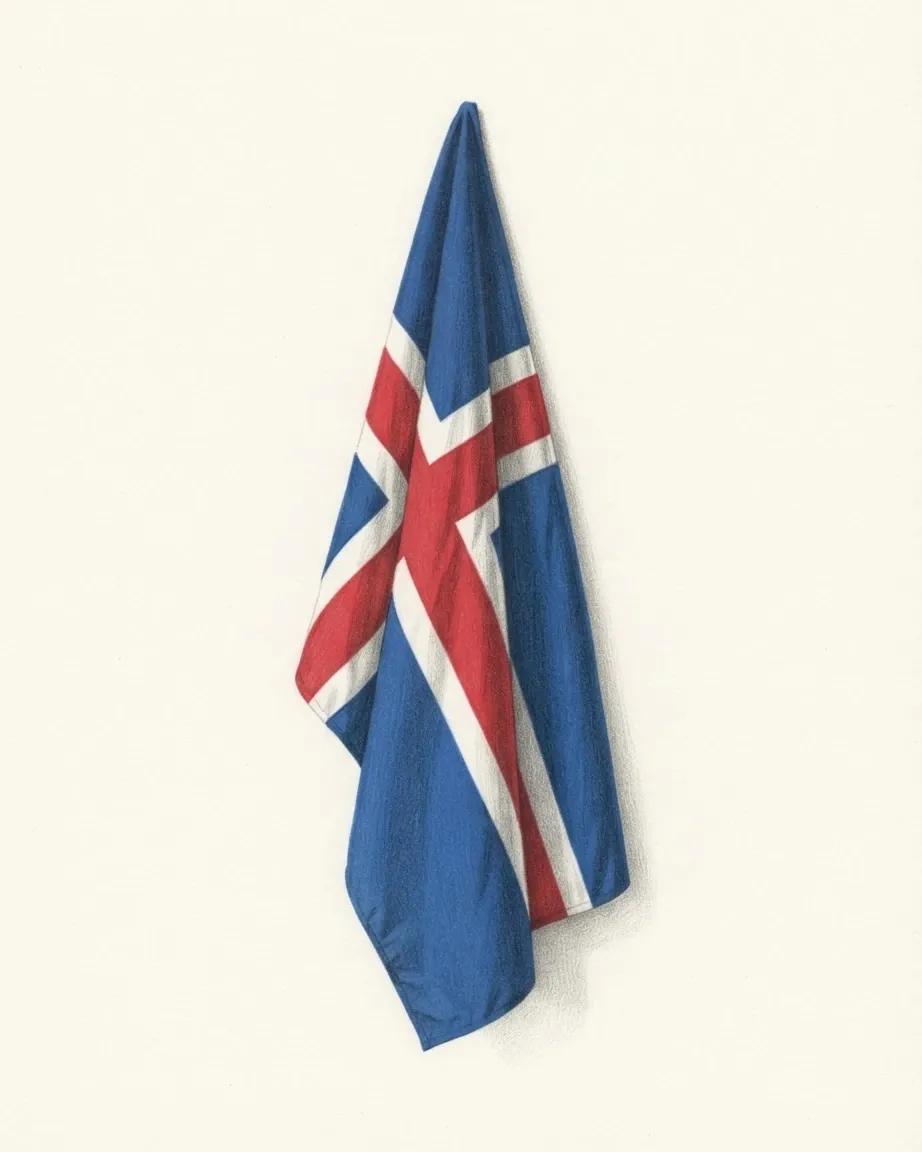
 Iceland
Where Tórshavn's authority stops and Copenhagen's begins
Two Danish acts set the arrangement. The Home Rule Act, no. 137 of 23 March 1948, in force from 1 April that year, made the islands a self-governing community within the kingdom. The Takeover Act, no. 578 of 24 June 2005, in force from Ólavsøka on 29 July 2005, lets the Faroese government assume on its own initiative any field it does not yet hold, with a short list of exceptions. Whatever it takes over arrives with legislative and executive power and with its whole cost, and the Danish Prime Minister's Office notes that the act makes a grant for such a field impossible.
The Faroese government lists what it already holds: marine resources, the environment, the continental shelf, external trade, taxation and customs, energy, transport, social security, culture, education and research. A second group sits in between. The police, the courts, the prison service, immigration and border control, financial regulation and aviation could be taken over and have not been, and for the police and the courts the Danish side records that the timing has to be negotiated because the preparation is so heavy.
| Field | Decided in | On what basis |
|---|---|---|
| Fisheries and marine resources | Tórshavn | Assumed under home rule |
| Taxation, customs and external trade | Tórshavn | Assumed under home rule |
| Trade agreements with other states | Tórshavn, on behalf of the realm | Authorisation Act, 2005 |
| Police, courts and prisons | Copenhagen, until taken over | Takeover Act, timing negotiated |
| Financial regulation and aviation | Copenhagen, until taken over | Not yet assumed |
| Constitution, nationality and the Supreme Court | Copenhagen | Excluded by the Takeover Act |
| Foreign, defence and security policy | Copenhagen | Excluded by the Takeover Act |
| Exchange rate and monetary policy | Copenhagen | Excluded by the Takeover Act |
A Danish act in a field the islands have not assumed reaches them only with explicit Faroese consent, and so does a treaty Denmark signs. In 1973 the islands declined to follow Denmark into the European Economic Community, keeping control of their own fishing waters, and that decision is the origin of the Danish resident in Tórshavn who holds no European citizenship. The politics article follows the same line through the Løgting, the Folketing and the committee that settles disputes over who holds a competence.
How the Faroe Islands came to govern themselves
The written record opens with Irish hermits, described around 825 by the monk Dicuil, and Norse settlers followed them. Their assembly met on Tinganes, the headland in what is now Tórshavn, and the Løgting counts a documented history from the Sheep Letter of 24 June 1298, a statute on sheep breeding and the oldest constitutional text the islands hold. The islands came under the Norwegian crown from 1035 and passed with Norway to the Danish crown around 1380.
When the Treaty of Kiel gave Norway to Sweden in 1814, the Faroes stayed Danish. Copenhagen abolished the Løgting in 1816 and ran the islands as a Danish county; an Act of 23 March 1852 brought the assembly back as an advisory body, and a royal trade monopoly that had controlled Faroese commerce ended on 1 January 1856. Meanwhile the national movement grew out of the language, which V. U. Hammershaimb gave the spelling still in use in 1846.
British troops landed on 12 April 1940, after Germany occupied Denmark, and for five years the Løgting legislated on its own. A consultative vote on secession on 14 September 1946 went narrowly for leaving, Denmark annulled the declaration that followed, and the Home Rule Act was the compromise. Faroe Islands: history carries the sequence from the first barley growers to the drafts of a Faroese constitution.
How the sea divides the Faroese basalt
The islands are one plateau of lava about six kilometres thick, cut by fjords and sounds into 18 major islands, or 779 when every islet and skerry is counted. The coast runs to 1,117 kilometres and is mostly cliff, and the highest summit, Slættaratindur on Eysturoy, stands at 880 metres. Arable land made up 2.14% of the total in 2012, and grass for sheep is the main crop.
The nearest land is British. Rona, an uninhabited British island, lies 260 kilometres away and mainland Britain 320; Iceland is 450 kilometres off, Norway 580, and Denmark 990.
The Danish Meteorological Institute's normals for Tórshavn over 1991 to 2020 give an annual mean temperature of 7.0 °C and 1,399.2 millimetres of precipitation falling on 264.3 days a year, and the mountains push the totals past 3,000 millimetres in the north. Since the first road tunnel opened in 1963 the islands have been boring through their own rock to join themselves up, and four tunnels now run under the sea, the most recent to Sandoy in 2023. Suðuroy, in the south, is the one major island still reached by ferry. The geography article explains how the plateau was built and why the weather changes between neighbouring fjords.
Why independence divides the Faroese electorate
The Løgting has 33 members, elected by proportional representation for four years, and since 2008 the whole country has voted as one constituency. A løgmaður, the head of government, is put forward by the speaker and is rejected only if a majority votes against. The islands also elect two members of the Folketing in Copenhagen, which still legislates for them in every field the Løgting has not assumed.
Every party carries two positions, one on taxes and welfare and one on the tie to Denmark, and the electorate was described in 2021 as evenly split between independence and staying in the kingdom. The Danish block grant fell from 982 million kroner to 616 million in 2001 and is frozen at 642 million, the figure Danmarks Nationalbank gave for 2017; the Faroese government puts it at 9.5% of the national budget in 2020, against 28.7% in 2000.
A Faroese constitution has twice stalled. In 2011 the Danish government of the day called a draft incompatible with the Danish constitution, and a cross-party draft of February 2017, due to go to a vote in April 2018, stalled when its committee could not agree the wording on family law. Faroe Islands: politics sets out the parties, the 2026 result and the dispute over the islands' place in the Nordic Council.
What the Faroese economy catches and farms
Fish and fish products make up 90 to 95% of Faroese export value by the government's own figures, with the fishing industry and its related trades accounting for around 20% of GDP and 15% of the labour force. Salmon farmed in the fjords accounted for 46% of exports in 2024, from three companies. The World Bank puts output at 4.05 billion US dollars in 2024, 74,175 dollars a head, with growth of 0.8% that year.
Overfishing and heavy public borrowing ended in a crash in the early 1990s, when a Faroese bank needed a Danish rescue and unemployment peaked at 26% in January 1994. Unemployment reached 0.9% in December 2019. Offshore oil was the hope in between, and Equinor gave up its exploration programme in 2015 after four wells.
The money itself belongs to the Danish side of the line. The Faroese króna is issued by Danmarks Nationalbank at par with the Danish krone, Faroese and Danish notes circulate together and the coins are Danish. Faroe Islands: economy explains how salmon took over the fjords and who is allowed to own the fish.
How the Faroese language and flag mark the islands
Section 11 of the Home Rule Act makes Faroese the principal language and requires Danish to be taught well and carefully. The written standard came late: Danish replaced Faroese in the church and the administration after the Reformation, and Faroese entered school teaching only in 1938 and the complete Bible in 1961. Through those centuries the language lived in speech and in the ballads of the chain dance, a ring danced with no instrument, and Tjóðsavnið, the national museum, counts the ballads among the reasons written Faroese took the form it has.
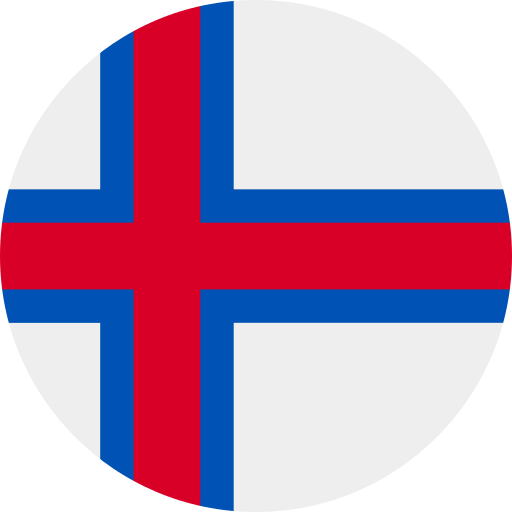
The flag came out of the same movement. Faroese students in Copenhagen designed the Merkið, a red cross edged in blue on white, in 1919, and the British authorities recognised it in wartime so that Faroese fishing boats could be told apart at sea. The Lutheran state church counted 79.7% of the population as members in 2019, and the pilot whale drive, recorded since 1584, is argued over at home and abroad.
Sport shows where the line falls. The islands belong to UEFA and FIFA and field a national football team under the Merkið, while the Olympic movement admits only independent states, so the two Faroese Olympians so far rowed and swam for Denmark. Faroe Islands: culture takes in the dance, the food dried in the wind, the churches and the literature written in two languages.
How visitors reach and cross the Faroe Islands
Two routes lead in: Vágar Airport, built by British Royal Engineers in 1942 and 1943 and still the islands' only airport, and the Smyril Line ferry from Hirtshals in Denmark and Seyðisfjörður in Iceland. The Faroes are outside the Schengen Agreement and have belonged to the Nordic Passport Union since 1966, so travellers from Schengen countries pass no border check.
Statistics Faroe Islands registered just over 230,400 hotel nights in 2024, and 209,260 of them were spent in the capital area. Visitors mostly sleep near Tórshavn and see the rest on day trips by tunnel, ferry or helicopter. A law of 2024 lets landowners charge for certain paths, sets a sustainability fee of 20 kroner a night capped at 200, and allows local communities to limit visitor numbers. Faroe Islands: travel follows the routes out of the capital and the villages that have pushed back.
For the arrangement itself, Faroe Islands: history and Faroe Islands: politics are the places to begin.
Read
Everything about Faroe Islands
Six articles, each answering one question and each written to be read on its own.
The record
What is measured about Faroe Islands
Pages that nobody writes, built from the record and from the data files beside it.
Common questions
Questions about Faroe Islands
What does Denmark still decide for the Faroe Islands?
Under the Takeover Act of 2005 six areas can never pass to the islands: the constitution, nationality, the Supreme Court, foreign policy, defence and security policy, and exchange rate and monetary policy. A further group could be taken over and so far has not been, among them the police, the courts, the prison service, immigration and border control, financial regulation and aviation. The Danish Folketing, in which the islands hold two seats, legislates in those fields, and its acts apply in the Faroes once the Faroese authorities consent.
Do Faroe Islanders carry Danish passports?
Yes. Nationality stays with Copenhagen, and the Home Rule Act of 1948 provides that a passport issued in the islands to a Faroese adds the Faroese words for a Faroe Islander and for the Faroes after the Danish ones. Any Danish subject resident in the islands counts as Faroese for that purpose.
Why do the Faroe Islands have a football team but no Olympic team?
Football's governing bodies admit the islands in their own right, and the Faroes are members of UEFA and FIFA. The Olympic movement admits only independent states, so the rower Katrin Olsen in 2008 and the swimmer Pál Joensen in 2012 competed for Denmark. At the Paralympics, and at world and European swimming championships, Faroese athletes compete under their own flag.
How many people live in the Faroe Islands?
The record gives 54,149 on 1 January 2023, and the Nordic Council of Ministers gives 54,561 for 2025. Tórshavn had 14,038 inhabitants on 1 January 2024 by the record's count, while the Nordic figure for the whole Tórshavn municipality in 2025 is 23,239.
Nearby in the catalogue