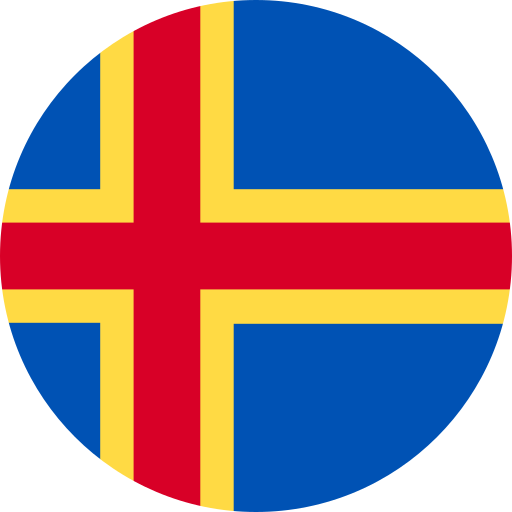
A Finnish citizen who moves from Helsinki to Mariehamn must live on the islands for five years and show a sufficient command of Swedish before the Government of Åland grants the right of domicile, and that regional citizenship carries the vote for the island parliament, the freedom to buy land and, in most cases, the right to open a business without a permit. It is one exception in a stack of them, each written down by somebody other than the islanders alone: a convention of 1856, a League of Nations decision of 1921, an Autonomy Act of 1991 and a protocol to Finland's treaty of accession to the European Union. Åland is an autonomous and demilitarised region of Finland at the entrance to the Gulf of Bothnia, where 30,836 people lived at the end of 2025.
At a glance
Where it is
Where Åland is, and what is around it
Åland has a coast. It borders no other country.
Who counts as an Ålander in law
The right of domicile, hembygdsrätt in Swedish, entered the law in the revision of the Autonomy Act in 1951, together with the conditions for doing business on the islands. It is held alongside Finnish citizenship and never replaces it. A child who is a Finnish citizen resident on Åland receives it automatically when a parent holds it. Anyone else applies to the Government of Åland after at least five years of residence, with a sufficient command of Swedish.
Holders elect the Parliament of Åland and may stand for it. They may acquire land and set up a business, where a person without the right usually needs the government's permission for either. Holders are exempt from service in the Finnish army, unless they took up residence on Åland after the age of twelve. Residents without it vote in municipal elections after one year, a change made when Finland and Åland joined the European Union, and Protocol No. 2 to the accession treaty wrote the land and business rules into Union law as exceptions.
Åland: politics follows the franchise, the permits and the review of each law the island parliament passes.
What the treaties forbid on Åland
Russia began fortifying the islands in the 1830s, and British and French forces destroyed the fortress at Bomarsund in 1854 during the Crimean War. The convention signed in Paris in 1856 bound Russia to leave Åland unfortified. After Finland became independent, islanders petitioned to join Sweden in 1917 and again in 1919, and in June 1921 the League of Nations left the islands with Finland on condition that their Swedish language and local customs were guaranteed. A convention of 20 October 1921 then made the islands neutral in time of war as well as demilitarised.
The Åland Islands Peace Institute points out that Åland is a party to none of these instruments. The treaty that ended the Winter War in 1940 added a Soviet right to keep a consulate in Mariehamn to watch over the demilitarisation, a right that passed to Russia. When Finland applied to join NATO in 2022, the government in Helsinki and the alliance both treated the conventions as still in force and left the status as it was; the Finnish foreign ministry started a legal study of it in 2023.
| What Åland has that mainland Finland lacks | Where it was written | Year |
|---|---|---|
| No fortifications | Convention signed in Paris after the Crimean War | 1856 |
| Guarantees for Swedish and local customs | League of Nations decision | 1921 |
| Neutrality in time of war | Convention of 20 October | 1921 |
| A Soviet, now Russian, consulate in Mariehamn | Treaty ending the Winter War | 1940 |
| The right of domicile | Revision of the Autonomy Act | 1951 |
| Its own legislature within listed fields | Autonomy Act, the third, in force 1993 | 1991 |
| Land and business rules and the VAT exception inside the Union | Protocol No. 2 to Finland's accession treaty | 1994 |
Åland: history traces the whole sequence from the Swedish castle at Kastelholm to the present Act.
Where the islands lie between Sweden and Finland
Åland sits at the mouth of the Gulf of Bothnia. The main island, Fasta Åland, is separated from the Roslagen coast of Sweden by 38 kilometres of open water, while to the east the archipelago runs on without a break into the Finnish one. Most of the territory is sea. Statistics and Research Åland (ÅSUB) counted 13,325 km² in total on 1 January 2026, of which 11,769 km² was water and 1,556 km² land, and it lists 6,757 islands larger than a quarter of a hectare and about 20,000 smaller ones, about 60 of them inhabited.
The land is low granite. Orrdalsklint in Saltvik is the highest ground, at 129 metres in ÅSUB's yearbook and 127 metres in this site's record, and forest covers about 70% of the land area. The mean temperature at the station was 6.5 °C over 1991 to 2020 and 7.8 °C in 2025. The islands' geography explains why the count of islands keeps changing and what the ice left behind.
Who lives on Åland and where
The population has grown for decades, and the growth now comes from outside. ÅSUB counted 22,783 residents at the end of 1980, 25,776 at the end of 2000 and 30,836 at the end of 2025. In 2025 there were 251 births against 315 deaths in the preliminary figures, and a net inflow of 220 people made up the difference. The share of residents born on Åland fell from 72.5% at the end of 2000 to 60.6% at the end of 2025, while 17.5% were born in Finland and 10.7% in Sweden.
The growth has settled around the town. Mariehamn had 11,957 residents at the end of 2025, and the neighbouring municipality of Jomala grew from 2,615 in 1980 to 5,817 in 2025, while the six archipelago municipalities fell from 2,452 residents to 1,990 over the same years.
Sottunga, the smallest of the sixteen municipalities, had 101 residents at the end of 2025. Across the islands, 24.8% of residents were 65 or older at that date, against 15.6% in 1980.
Registered Swedish speakers made up 84% of the population at the end of 2025, down from 94% in 2000, and ÅSUB recorded 82 languages. Membership of the Lutheran church fell from 92.8% of residents in 2000 to 64.0% at the end of 2025. Åland: culture sets those figures against the school law and the midsummer customs built on the Swedish guarantee.
How the Lagting governs within the Autonomy Act
The Parliament of Åland, the Lagting, first met on 9 June 1922, and the date is kept as Autonomy Day. It has 30 members elected for four years, and it works in Swedish. It appoints the Government of Åland and legislates alone in the fields the Autonomy Act assigns to it. The present Act, the third, dates from 1991 and came into force on 1 January 1993. Changing it takes matching decisions of the Parliament of Finland and of the Lagting, where two thirds of the votes cast are required.
The state keeps a presence of its own. A governor represents it on the islands, nominated by the President of Finland in agreement with the Lagting's speaker. The president may annul an Ålandic law that exceeds the island parliament's powers, after hearing the Åland Delegation and the Supreme Court. Åland elects one member of the Parliament of Finland. The state funds the self-government through an equalisation amount, set in the 1991 text at 0.45% of the state's accounted income for each year, a ratio that roughly matched Åland's share of the Finnish population when the Act was negotiated.
Åland also held its own referendum on joining the European Union, on 20 November 1994, and joined with Finland in 1995. The islands send two members to the Nordic Council, beside the delegations of Greenland and the Faroe Islands.
How shipping and a tax border fund Åland
Åland's gross domestic product came to €1,549 million at market prices in 2023, in ÅSUB's national accounts. Of the value added at basic prices, shipping produced €254 million, or 18.2%, financial services and real estate €275 million, or 19.7%, and government services €303 million, or 21.6%. Public employers took 36% of everyone employed in 2023. Unemployment was 5.2% in 2025.
The ferry trade rests on a tax exception. Åland lies inside the European Union's customs union and outside its VAT area, and that lets ferries that call at Mariehamn or Långnäs sell goods tax-free on routes between Finland and Sweden. The same exception makes Åland a separate tax zone for goods crossing to the Finnish mainland.
Electricity supply has moved from imports to wind. In 2025 wind turbines produced 202 GWh of the 351 GWh supplied, against 15 GWh of 242 GWh in 2000, and imports from Sweden fell from 194 GWh to 127 GWh over the same period. The fleet, the banks and the fish farms are in Åland: economy.
How visitors reach Åland and when they come
ÅSUB recorded 1,213,000 travellers arriving in 2025, 876,000 of them from Sweden and 325,000 from Finland. The count stood at 2,173,000 in 2010 and fell to 679,000 in 2020. The international ferries land at the Western Harbour in Mariehamn, at Berghamn in Eckerö and at Långnäs, and inside the islands the public archipelago ferries carried 1,008,000 passengers and 661,000 vehicles in 2025. Clocks follow Finland, at UTC+2 in winter and UTC+3 in summer.
Visitors find the medieval castle at Kastelholm, the ruins of the fortress at Bomarsund and, in Mariehamn, the four-masted barque Pommern, kept as a museum ship. Åland: travel sets out the routes, the season and where visitors stay.
The six articles each take one of these threads further: Åland: history for the treaties, Åland: geography for the rising land, Åland: politics for the Act, Åland: economy for the tax border, Åland: culture for the language and Åland: travel for the ferries.
Read
Everything about Åland
Six articles, each answering one question and each written to be read on its own.
The record
What is measured about Åland
Pages that nobody writes, built from the record and from the data files beside it.
Common questions
Questions about Åland
Is Åland part of Finland or of Sweden?
Åland is part of Finland. The islanders petitioned to join Sweden in 1917 and 1919, and in June 1921 the League of Nations left the islands with Finland on condition that their Swedish language and customs were guaranteed. The Autonomy Act of 1991 now carries those guarantees, and Swedish is the official language.
What is the right of domicile on Åland?
A regional citizenship held alongside Finnish citizenship. It comes automatically to a Finnish child resident on Åland whose parent holds it, or by application after five years of residence with sufficient Swedish. It carries the vote for the Lagting, the freedom to buy land and, for holders who arrived before the age of twelve, exemption from Finnish military service.
Why may no army be based on Åland?
A convention of 1856 forbade fortifying the islands, and a convention of 20 October 1921 added neutrality in wartime. Åland is not a party to either. Finland and NATO treated both conventions as still in force when Finland applied for membership in 2022.
How many people live on Åland?
30,836 at the end of 2025, by the count of Statistics and Research Åland, of whom 11,957 lived in Mariehamn. Deaths exceeded births in 2025 and migration supplied the growth.
Does Åland use the euro?
Yes. Åland uses the euro as Finland does. Its difference lies in tax: the islands sit inside the European Union's customs union and outside its VAT area, which allows ferries calling at Mariehamn or Långnäs to sell goods tax-free.
Nearby in the catalogue