Between 1 January 1986 and 1 January 2026 Greenland gained 3,334 residents and its capital gained 9,326, so the total barely moved while the smaller places on the coast emptied into Nuuk. Greenland, a self-governing part of the Kingdom of Denmark since 21 June 2009, held 56,740 people on 1 January 2026 on 2,166,086 square kilometres, and more than a third of them lived in Nuuk. The ice sheet has always kept people off the interior. Since home rule a second concentration has followed, from the settlements into one town, and it now bears on the public finances and on the case for independence.
At a glance
- Population
- 56 831
- Capital
- Nuuk
- Area
- 2 166 086km²
- Currency
- krDKK
- Official language
- Greenlandic
- Local time
- UTC-02:00
Where it is
Where Greenland is, and what is around it
Greenland has a coast. It shares a border with 3 countries, counted as shared borders, which includes neighbours across water.
 Canada
 Iceland
 Norway
Why Greenland's people keep moving to Nuuk
Statistics Greenland sorts every resident by the kind of place they live in, and its series from 1986 to 2026 describes a population that hardly grew and moved a great deal. The total rose from 53,406 on 1 January 1986 to 56,740 on 1 January 2026. Over the same forty years the capital went from 10,972 people to 20,298, and the class the bureau calls settlements fell from 7,019 to 3,814.
| Type of residence | 1 January 1986 | 1 January 2026 |
|---|---|---|
| Capital city | 10,972 | 20,298 |
| Main settlements | 14,701 | 16,631 |
| Larger settlements | 14,965 | 12,095 |
| Settlements | 7,019 | 3,814 |
| Smaller settlements | 4,793 | 3,395 |
| Smallest settlements | 507 | 439 |
| Other localities | 449 | 68 |
| Total | 53,406 | 56,740 |
Only the capital and the main towns grew. Every smaller class shrank, and other localities lost 381 of their 449 people.
The movement is older than the series. Nuuk began as Godthåb, a royal colony founded in 1728, and took its Greenlandic name in 1979, the year home rule began. After 1953 the Danish reforms known as G50 and G60 concentrated housing and services in selected towns, and between 1952 and 1963 about 3,000 households moved from small coastal settlements into them. Statistics Greenland describes the towns absorbing both the natural increase and the migration from the settlements after the 1960s, a trend it says has run for fifty years.
By January 2026, 50,407 people lived in towns and 6,255 in settlements. Over 65% lived in the five largest towns, Nuuk, Sisimiut, Ilulissat, Aasiaat and Qaqortoq, and Nuuk alone held more than the other four combined.
The next quarter-century points the other way. Statistics Greenland expects the population to fall below 50,000 by 2050 on current trends, and Danmarks Nationalbank, writing on 6 January 2026, projected a fall of 20% by 2050. Net migration came to minus 263 in 2025, and 17,466 people born in Greenland were living in Denmark that year, up from 15,845 in 2015.
What self-government leaves to Greenland and to Denmark
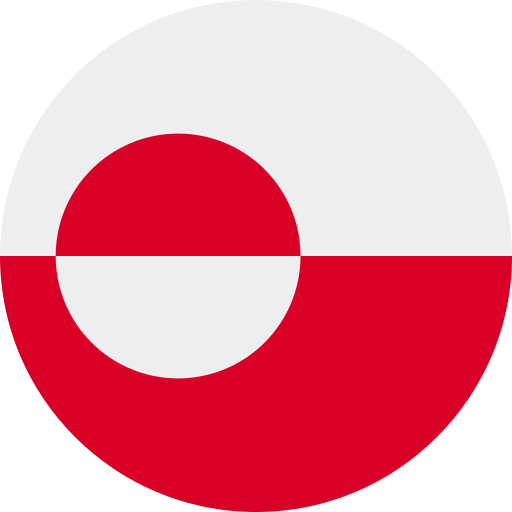
Greenland is a dependency in this catalogue's terms: a self-governing part of the Kingdom of Denmark with its own parliament and flag, and it issues its own stamps. It has no currency of its own; the Danish krone is legal tender. Greenland was a Danish colony from 1721 and a Danish county from 1953, gained home rule in 1979 and self-government on 21 June 2009, after a referendum on 25 November 2008 in which 75.5% of the votes cast were for the change.
The Self-Government Act lets Greenland take over fields of government one at a time and pay for each from the day it does. Denmark keeps foreign affairs, defence, security policy and monetary policy. The Danish block grant came to DKK 4,323.7 million in 2024 on preliminary figures, in a year when public revenue totalled DKK 14.8 billion. The Act also sets out the way out: if the people of Greenland decide on independence, the two governments negotiate, and the agreement needs the consent of Inatsisartut, a referendum in Greenland and the consent of the Folketing in Copenhagen.
Inatsisartut has 31 seats, and Greenland sends two members to the Folketing. Greenland entered the European Community with Denmark on 1 January 1973, voted to leave in a referendum in 1982 and left on 1 February 1985. Greenland: politics works through the block grant formula and the Act clause by clause.
How the ice sheet confines Greenland to its coast
Of 2,166,086 square kilometres, Statistics Greenland counts 1.7 million under the ice sheet, and every town and settlement stands on the ice-free rim. Britannica describes the island as a structural extension of the Canadian Shield, and the Nordic Council of Ministers records it as part of the North American continent and geopolitically part of Europe. The yearbook gives the distances as 2,670 kilometres from north to south and 1,050 from east to west, around a coastline of 44,087 kilometres.
Counted against ice-free land alone, the density was 0.3 people per square kilometre in the 2026 yearbook. The north-east is a national park of 972,000 square kilometres whose only residents are the Sirius dog sled patrol and the staff of weather stations, and it belongs to none of the five municipalities. Gunnbjørn Fjeld, the highest point, reaches 3,694 metres.
NOAA's Arctic Report Card recorded a loss of 55 ± 35 gigatonnes of mass in 2024 and net loss in every year since 1998. The land under and around the ice has its own article, from the bedrock to the northern capes.
Who lived in Greenland before the Danish colony
The Saqqaq culture inhabited southern and western Greenland from about 2500 BC to 800 BC. The ancestors of today's Greenlanders, people of the Thule culture, moved east from what is now Alaska from around AD 1000 and reached Greenland around 1300. Norse settlers who had already settled Iceland farmed the south of the island from the tenth century and disappeared in the fifteenth.
Dano-Norwegian expeditions of the seventeenth century found the Norse settlement extinct. Greenland became a Danish colony in 1721, and when Denmark and Norway separated in 1814 it passed to the Danish crown. Britannica records the regional names Greenlanders use for themselves, Kalaallit in West Greenland among them. In January 2026, 88% of Greenland's residents had been born there. Greenland: history follows the claim from the Norse colony to the Act of 2009.
What Greenland earns from the sea
The fishing industry provides over 90% of Greenland's exports, according to the 2026 yearbook. Exports came to DKK 6,299 million in 2025 on preliminary figures, against imports of DKK 6,591 million. Landings of northern prawn were 49,218 tonnes in 2025 and of Atlantic cod 29,898 tonnes.
The self-government owns all of five large companies: Royal Greenland in fishing, KNI in retail and fuel, Royal Arctic Line in shipping, Air Greenland and the telecommunications company Tusass. The 2026 yearbook puts over 40% of jobs in the public sector. In 2024 an average of 29,131 people were employed each month, and 2,633 of them were counted under Denmark in the bureau's nationality table. Unemployment averaged 3.4% a month that year.
The World Bank put output at about US$3.3 billion in 2023, or US$58,499 a head. Danmarks Nationalbank found that liquidity in the Greenland Treasury had fallen to a critically low level in the second half of 2025, and the 2026 Finance Act tightened spending in response. The Nationalbank also names the demographic trend as a pressure on public finances, which returns the argument to the table above: fewer people of working age, living in fewer places. Greenland: economy explains how the price of prawns reaches the Treasury.
What Greenlanders speak and where they worship
Greenlandic became the sole official language in June 2009, and about 57,000 people spoke it natively in 2025. About 12% of the population speak Danish as their primary language, mostly Danish immigrants, and monolingual Danish speakers are concentrated in Nuuk and the larger towns. The move into the capital is therefore also a move toward the place where Danish carries the most weight in daily life. English is taught from the first school year.
The Church of Denmark is the established church, and 91% of Greenland's population belonged to it in 2025. UNESCO inscribed Inuit drum dancing and singing on its Representative List in 2021. 21 June, the longest day of the year, is the national day.
Greenland: culture traces both the written language and the drum song back to the eighteenth-century mission.
How visitors reach a Greenland without roads
No roads or railways join towns and settlements, so every passenger and every load of freight travels by sea or air. The 2026 yearbook counts 14 airports and 43 helipads. Sea ice closes the routes to the far north and to East Greenland in winter.
Nuuk's international airport opened in 2024, and the passenger count moved with it. Kangerlussuaq handled 75,522 of 96,362 international passengers in 2023 and 8,179 of 114,431 in 2025, when Nuuk handled 93,753, so the capital now takes most of the arrivals as well as most of the residents.
UNESCO inscribed Ilulissat Icefjord on the World Heritage List in 2004 and the Norse and Inuit farming landscape of Kujataa in 2017, and the Inuit hunting ground of Aasivissuit and Nipisat is also on the list. Greenland: travel sets out which airport opens which part of the coast.
Read
Everything about Greenland
Six articles, each answering one question and each written to be read on its own.
The record
What is measured about Greenland
Pages that nobody writes, built from the record and from the data files beside it.
Common questions
Questions about Greenland
Why do so many Greenlanders live in Nuuk?
Danish reforms after 1953 concentrated housing and services in selected towns, and between 1952 and 1963 about 3,000 households moved from small settlements. The drift continued: Nuuk grew from 10,972 people on 1 January 1986 to 20,298 on 1 January 2026, while the smaller classes of settlement shrank.
Can Greenland leave the Kingdom of Denmark?
The Self-Government Act of 2009 leaves the decision to the people of Greenland. An agreement on independence would be negotiated between the two governments and would need the consent of Inatsisartut, a referendum in Greenland and the consent of the Folketing.
Is Greenland part of the European Union?
Greenland joined the European Community with Denmark on 1 January 1973, voted to leave in 1982 and left on 1 February 1985. It keeps a fisheries agreement with the EU.
Will Greenland's population keep growing?
Statistics Greenland expects it to fall below 50,000 by 2050 on current trends, from 56,740 on 1 January 2026. Danmarks Nationalbank projected a fall of 20% by 2050 in its analysis of 6 January 2026, with fewer people of working age and more older residents, and net migration was minus 263 in 2025.
Nearby in the catalogue