The Danish krone
Currency · DKK · kr · 3 countries and territories
Danmarks Nationalbank, set up in 1818 with a monopoly on banknotes, issues the krone used in Denmark, Greenland and the Faroe Islands. The krone took over from the rigsdaler on 1 January 1875, at two kroner for one rigsdaler, and splits into 100 øre. Danish voters rejected the euro in September 2000, and the krone stays tied to it through ERM II.
The abbreviation
Prices carry kr., short for krone, the Danish word for crown. The ISO code DKK usually stands before a figure, while kr. often follows it. The name is older than the currency: a krone was already a unit of account worth 8 marks in 1513.
The same abbreviation stands for 3 other currencies, among them the Icelandic króna and the Norwegian krone.
- ISO code
- DKK
- ISO number
- 208
- Subunit
- øre, 1/100
An amount, written out
kr 1,234.50
- kr 1,234.50English
- 1.234,50 kr.DanishDenmark
- kr 1.234,50KalaallisutGreenland
In English the sign comes before the amount. Where the Danish krone is used, it comes after the amount in Denmark and before it in Greenland.
Where the Danish krone is the official currency
Denmark, Greenland and the Faroe Islands count in it. Greenland dropped plans for notes of its own in 2010, while the Faroes use Danish coins with their own krónur notes at par.
- Denmark5.8 million people on 42,925 square kilometres of peninsula and islands, highest point 171 metres. A 179-seat parliament, four of whose seats sit in the Arctic.
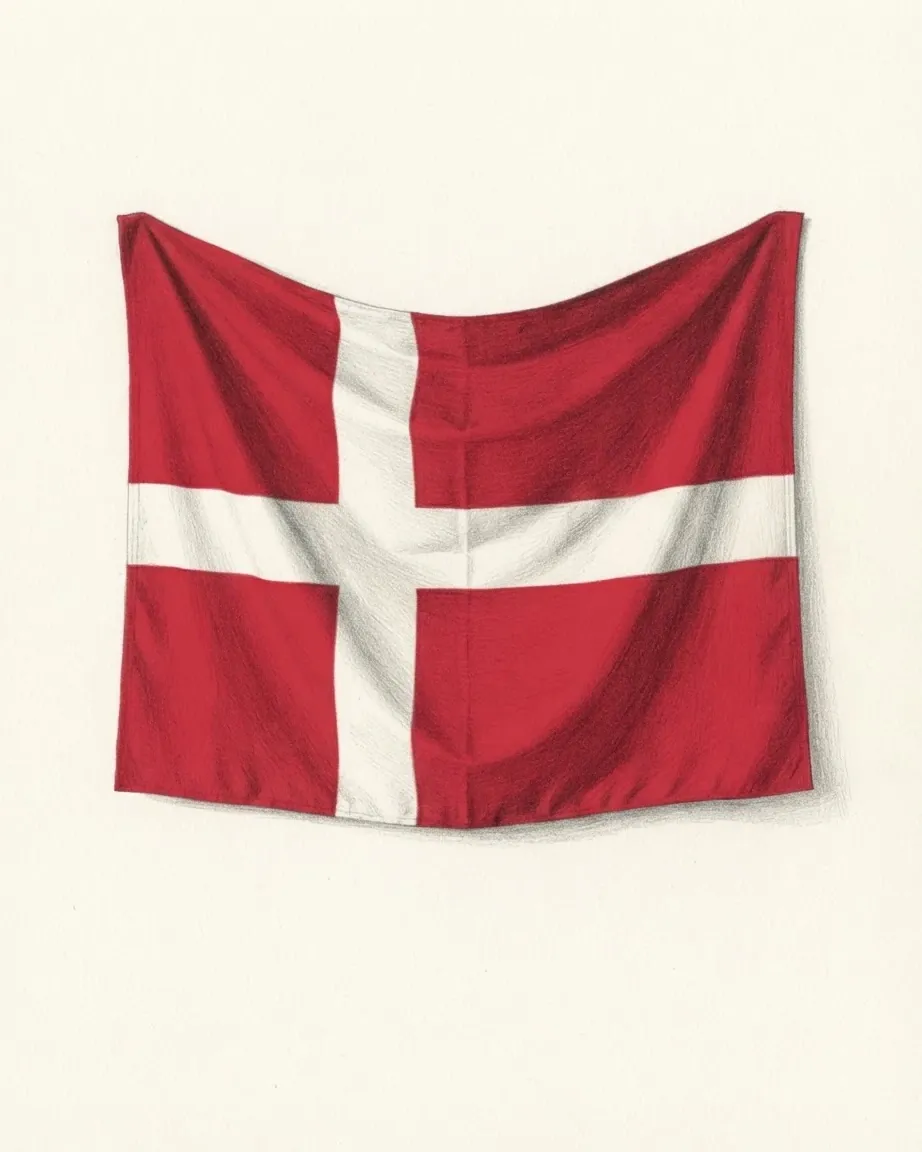
- Faroe Islands54,149 people in 2023 on 18 islands that run their own fisheries, taxes and trade while Denmark keeps nationality, defence and the currency.
- Greenland56,740 people on 1 January 2026, more than a third in Nuuk. A self-governing part of Denmark since 2009, on an island mostly under ice.
About the Danish krone
How the krone took over from the rigsdaler
The Coinage Act of 1873 took effect on 1 January 1875 and brought in the krone at two kroner for one rigsdaler. The same act made the money decimal, with 100 øre to the krone, and moved it from silver to gold: a kilogram of fine gold was set at 2,480 kroner. Germany had gone over to gold in 1871. Danmarks Nationalbank names Germany and the United Kingdom, both on gold, as the trading partners Denmark followed.
The word is much older than the act. A krone was a unit of account worth 8 marks as early as 1513, and krone coins have been struck in Denmark since the 17th century.
What the Nationalbank was founded to stop
Before 1818 the King alone decided how many banknotes were printed. He paid for the Napoleonic Wars that way, and in 1813 prices rose by more than 300%. The currency reform that followed created Danmarks Nationalbank, gave it the sole right to issue notes in Denmark and made it independent of both the government and the King, so that a budget deficit could no longer be covered by printing money.
Production has since left the country. The Royal Mint of Denmark became a subsidiary of the Nationalbank in 1975. In 2014 the decision was taken to have notes and coins made abroad, and the Nationalbank printed its last notes on 20 December 2016.
Why Denmark held on to its own money
On 1 January 1999, the day the euro started, the krone entered ERM II, the European Union's exchange rate mechanism, with the euro as its anchor. The central rate is 7.46038 kroner to the euro, and the krone may move 2.25% either side of it. The Nationalbank uses its interest rates to hold that line, which leaves them unavailable for steering the Danish economy.
Voters were asked on 28 September 2000 whether to join the euro. On a turnout of 87.6%, 53.2% said no and 46.8% said yes.
Why Greenland never printed notes of its own
Under the colonial administration Greenland had banknotes of its own from 1803 to 1968 and coins from 1926 to 1964. An Act on Banknotes in Greenland, passed in 2006 and in force from 1 June 2007, prepared a separate Greenlandic series. In the autumn of 2010 a new Greenlandic government said it did not want one, and the Nationalbank dropped the project. Greenland keeps the Danish krone as its only official currency, although it has its own IBAN code, GL, and a transfer from Denmark counts as international.
The Faroe Islands take a different route. They use the Danish coins, but their banknotes are their own: the Faroese króna, a local version of the krone held at par with it, printed in series since the 1950s. The Faroes also have an IBAN code of their own, FO.
How the coins sort by colour and rim
The coins come in three metals, an order kept from the time when a coin's metal was its value. The 50 øre is copper-coloured bronze. The 1, 2 and 5 kroner are silver-coloured cupronickel with a hole through the middle, and the 10 and 20 kroner are golden aluminium bronze. The rims are smooth on the 50 øre and the 10 kroner, milled on the 1 and 5, and interrupted on the 2 and 20, so blind and partially sighted people can tell the coins apart by touch.
The notes, of 50, 100, 200 and 500 kroner, belong to a 2009 series by the artist Karin Birgitte Lund that pairs a Danish bridge with an archaeological find on each note. The 1000-krone note and the older series stopped being legal tender after 31 May 2025. A new series is due in 2028.
Common questions
Questions about the Danish krone
Does Greenland use the Danish krone?
Yes, as its only official currency. Greenland had its own notes under the colonial administration, from 1803 to 1968, and a 2006 act prepared a new Greenlandic series. A new government in Greenland said in the autumn of 2010 that it did not want separate notes, and Danmarks Nationalbank stopped work on them. Greenland does keep its own IBAN code, so a payment from Denmark counts as an international transfer.
Is the Faroese króna a separate currency?
No. The Faroese króna is a local version of the Danish krone, held at par with it and without a life of its own. The Faroe Islands use the Danish coins but have their own banknotes, first issued in the 1950s and modernised in the 1970s and the 2000s. Like Greenland, the Faroes have their own IBAN code, FO, so a transfer from Denmark counts as international.
What does kr. mean on a Danish price tag?
It abbreviates krone, which means crown. Danish usage puts the code DKK before an amount and often writes kr. after it. One krone divides into 100 øre, and since the smaller øre coins were withdrawn the 50 øre piece is the only one left.
Why do some Danish coins have a hole in the middle?
The 1, 2 and 5 krone coins are silver-coloured cupronickel with a hole through the centre. Together with the rims, which are smooth, milled or interrupted depending on the coin, the hole lets blind and partially sighted people tell the denominations apart by touch. The coins also keep an old colour order: bronze for the lowest value, a silver colour in the middle and golden aluminium bronze for 10 and 20 kroner.
Is the krone pegged to the euro?
It has been since 1 January 1999, when the krone joined ERM II, the European Union's exchange rate mechanism, with the euro as its anchor. The central rate is 7.46038 kroner to one euro, and the krone may move 2.25% above or below it. Danmarks Nationalbank sets its interest rates to keep the krone in that band. Danish voters had the chance to replace the krone with the euro on 28 September 2000 and turned it down, 53.2% against and 46.8% in favour, on a turnout of 87.6%.