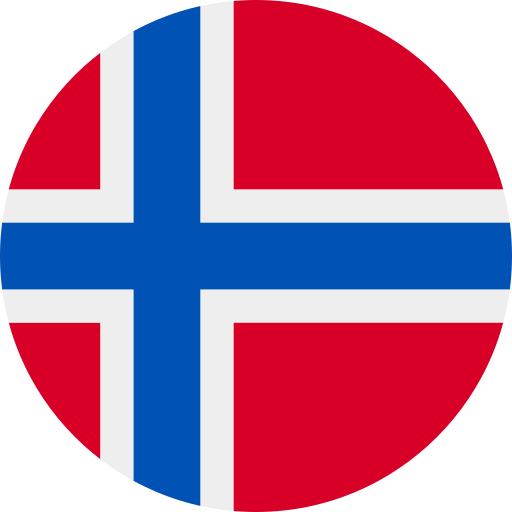
Norway has a habit of settling the ownership of things it does not yet have. The constitution written at Eidsvoll over six weeks in the spring of 1814 was adopted by a country that had already been signed over to Sweden that January, and it went on governing Norway through the ninety-one years of union that followed. The law claiming the continental shelf and everything under it for the state was passed in May 1963, six years before Phillips reported the Ekofisk discovery just before Christmas in 1969. Norway is a Nordic constitutional monarchy of 5,627,400 people as of 1 January 2026, outside the European Union and inside its single market, and that order of operations, the rule before the asset, is the shortest account of how a thin northern country came to hold a sovereign fund worth close to four times its annual output.
At a glance
- Population
- 5 627 400
- Capital
- Oslo
- Area
- 385 207km²
- Currency
- krNOK
- Official languages
- Norwegian
- Local time
- UTC+01:00
Where it is
Where Norway is, and what is around it
Norway has a coast. It shares a border with 3 countries, counted as shared borders, which includes neighbours across water.
 Finland
 Russia
 Sweden
Why the rule usually came first
The pattern is easiest to see in the three cases where the gap is measured in decades. A constitution was signed at Eidsvoll on 17 May 1814 for a state that would wait another ninety-one years to govern its own foreign affairs. State ownership of the seabed was legislated in May 1963, when no commercial field had been found off the Norwegian coast and most geologists doubted there was one. The Government Pension Fund Global was set up in 1995 to receive petroleum money that the budget would never be allowed to spend, and its first net transfer went in the following year.
| What was settled | When it was settled | What it later governed | When that arrived |
|---|---|---|---|
| The Constitution of the Kingdom | 17 May 1814 | An independent Norwegian state | 7 June 1905 |
| State ownership of the shelf | May 1963 | The Ekofisk field | December 1969 |
| The Government Pension Fund Global | 1995 | Petroleum revenue on a scale nobody had budgeted for | first net transfer in 1996 |
One important rule ran the other way. Cabinets have had to hold the confidence of the Storting since 1884, and that requirement was only written into the Constitution in February 2007, one hundred and twenty-three years after it started being obeyed. For most of Norwegian parliamentary history the central rule of government was custom, which is to say a rule everybody followed and no document stated. The history article follows the whole sequence, from the unification at Hafrsfjord to the terms the state wrote for an oil industry that did not yet exist.
What the land actually offers
Norway, Svalbard and Jan Mayen come to 385,207 square kilometres in the official area statistics, and almost none of it is farmable. Agricultural land covered 3.5% of the mainland when it was measured in 2026, and built-up land 1.8%. Galdhøpiggen reaches 2,469 metres, the mainland runs 1,748 kilometres from Lindesnes to Kinnarodden, and at Elvenes on Bøkfjorden the whole country is 1.7 kilometres wide.
What the land withholds, the water supplies. The coastal baseline measured headland to headland runs 2,532 kilometres; measured into every fjord and around every island the shoreline runs 102,936 kilometres, on Kartverket figures compiled between 2006 and 2020, with 320,249 islands and islets registered. The exclusive economic zone covers 2,385,178 square kilometres, about six times the land area. A country whose usable surface is an edge and whose real estate is mostly submerged had good reason to be precise about who owned the seabed. The geography article sets out the ice, the fjords, the rainfall and the ground that keeps slipping.
The population of 5,627,400 on 1 January 2026 is concentrated where the terrain allows, and 83.6% of it lived in urban areas in 2025. Oslo held 717,710 people on 1 January 2024.
How the constitution outlived the union
Norway was a kingdom in its own right through the high Middle Ages, lost perhaps a third to two-thirds of its population to plague from 1349, entered the Kalmar Union in 1397 and was reduced to a Danish province in 1537 when Christian III dissolved the Council of the Realm. Three centuries of rule from Copenhagen ended at Kiel in January 1814, when Denmark ceded Norway to Sweden as a loser's payment in the Napoleonic wars.
The Norwegians used the interval. An assembly at Eidsvoll wrote and signed a constitution before Sweden could take possession, and when the Convention of Moss settled the matter on 14 August 1814 Sweden accepted that constitution as the price of the union. For the next ninety-one years Norway had its own parliament, government, courts, army and bank, and no foreign service. That is why the events of 1905 look so undramatic on paper. The Storting declared the union dissolved on 7 June, Oscar II renounced the Norwegian crown on 26 October, a plebiscite chose a monarchy and Prince Carl of Denmark took the throne as Haakon VII. No new state had to be founded because the institutions were already running.
The occupation from 9 April 1940 to 8 May 1945 ended the other long-standing Norwegian rule, which was neutrality. In 1949 the country became a founding member of NATO.
Who sits in the Storting and for how long
The Storting seats 169 representatives for four fixed years, and no Norwegian government can shorten that term: the Constitution provides no way to dissolve the chamber and holds no by-elections. A cabinet that loses its majority is replaced from inside the same chamber, by the same members the voters last returned. No party has held a majority on its own since 1961, so minority and coalition government is the normal condition and not a crisis.
Voters have twice been asked to join the European Community and its successor, in 1972 and in 1994, and twice declined. Norway instead takes the single market through the European Economic Area agreement, which obliges it to implement the Union legislation deemed relevant to that market, and it joined the Schengen Area on 18 May 1999. The Sámi Parliament opened at Karasjok on 9 October 1989 and gives the indigenous population its own elected body inside the Norwegian state. Local government has 15 counties and 357 municipalities as of 1 January 2024. The politics article explains the seat arithmetic and what a minority government has to do to pass a budget.
What Norway does with its oil money
The design settled in the early 1970s has three parts, and each one was a choice that other producers made differently. Petroleum profits carry a marginal tax rate of 78% as levied in 2026. The state takes direct ownership stakes in fields alongside the tax. And the resulting cash never touches the domestic economy: it goes into the fund, the fund is invested entirely abroad, and the budget may draw only the expected real return, currently estimated at 3% a year.
At the end of 2025 the fund held about 21,300 billion kroner. Most of that total was earned in financial markets, since accumulated investment return and currency gains exceed the petroleum money that was paid in. The country stayed out of OPEC, priced at world markets and taxed the rent instead.
Around the oil sits a second economy that predates it and will outlast it: seafood exports worth 181.5 billion kroner in 2025, hydropower supplying 98 to 99% of electricity, shipping, metals and a state that owns roughly 35% of the value of the Oslo stock exchange. GDP per head was about 94,594 US dollars in 2025, life expectancy 83.2 years in 2024, and the Gini index 26.5 in 2023. The economy article works through the tax, the fund and the question of what happens when the shelf empties.
What Norwegians write and build
Norwegian is written in two standards, Bokmål and Nynorsk, both official and both a product of the nineteenth century, when a country without a state of its own built one out of language, folk collection and painting. The Language Act in force since 1 January 2022 requires central state bodies to publish at least a quarter of their public documents in each. Sámi is recognised alongside them.
The buildings the country protects are wooden. Twenty-eight stave churches survive of roughly 1,300 that have been indexed, and the wooden quarter at Bryggen in Bergen, the stave church at Urnes and the copper town of Røros are on the UNESCO list. The national day on 17 May belongs to the constitution and its parades are made of schoolchildren. Norwegian writers took the Nobel Prize in Literature in 1903, 1920 and 1928. The culture article works through the two standards, the food, the music and the year as it is marked.
Why a visitor ends up on the water
The road and rail network stops before the country does. There are about 95,120 kilometres of road and 664 kilometres of motorway, and no railway runs north of Bodø. The through route is the coast, worked by ships between Bergen and Kirkenes, because the North Atlantic Current keeps that water open in every month of the year at latitudes where no other Arctic coast stays ice free.
The light is the other timetable. North of the Arctic Circle the sun stays up from late May to late July and stays down from late November to late January. The driest months on the western coast are April to June instead of high summer. Access to open country is a legal right, allemannsretten, which covers walking and camping on uncultivated ground. The travel article covers the seasons, the distances and what the far north is for.
What the whole country comes down to
A long thin kingdom on the edge of Europe that kept its institutions through four centuries of foreign rule, recovered its independence in 1905 without founding a new state, decided who owned its seabed before anyone knew what was under it, and then declined to spend the proceeds. Everything above has its own article.
Read
Everything about Norway
Six articles, each answering one question and each written to be read on its own.
The record
What is measured about Norway
Pages that nobody writes, built from the record and from the data files beside it.
Common questions
Questions about Norway
Where is Norway?
On the western and northern edge of the Scandinavian peninsula in Northern Europe, sharing land borders with Sweden, Finland and Russia and facing the North Sea, the Norwegian Sea and the Barents Sea. The mainland runs 1,748 kilometres from Lindesnes in the south to Kinnarodden in the north, and the territory also includes Svalbard and Jan Mayen.
Is Norway in the European Union?
No. Membership was put to referendum in 1972 and again in 1994 and was declined both times. Norway takes part in the single market through the European Economic Area agreement, which requires it to implement the Union legislation deemed relevant to that market, and it joined the Schengen Area on 18 May 1999. It has been a member of NATO since 1949.
Where does Norwegian wealth come from?
Because the state claimed the resources of the continental shelf in May 1963, six years before the Ekofisk field was found, and then taxed and part-owned the industry that developed. Petroleum profits carried a marginal tax rate of 78% in 2026, the proceeds go into a fund invested entirely outside the country, and the budget may draw only the expected real return, currently put at 3%.
What language is spoken in Norway?
Norwegian, which has two official written standards, Bokmål and Nynorsk. A Language Act in force since 1 January 2022 obliges central state bodies to publish at least a quarter of their public documents in each. Sámi languages are recognised, and the Sámi Parliament has met at Karasjok since 9 October 1989.
When did Norway become independent?
The Storting declared the union with Sweden dissolved on 7 June 1905, and Oscar II renounced the Norwegian crown on 26 October of that year. The constitution behind that claim dates from 17 May 1814, which is why the national day falls in May and not in June.
Nearby in the catalogue