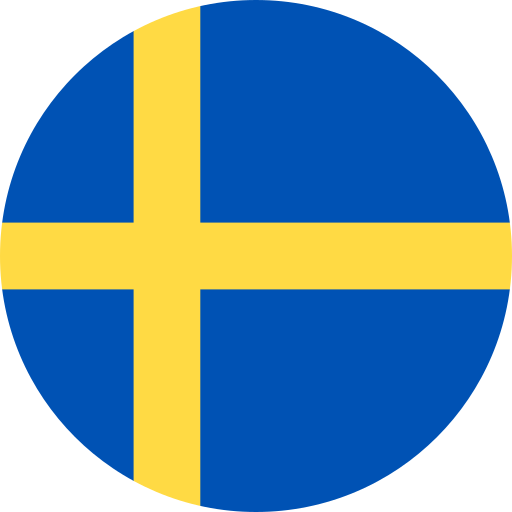
The Instrument of Government of 1974 removed the king's political power entirely, leaving a head of state with ceremonial duties and a single-chamber Riksdag of 349 members. Sweden runs about 1,600 kilometres from the Baltic to the Arctic, 528,861 square kilometres carrying 10,609,460 people as of 1 September 2025.
At a glance
- Population
- 10 609 460
- Capital
- Stockholm
- Area
- 528 861km²
- Currency
- krSEK
- Official language
- Swedish
- Local time
- UTC+01:00
Where it is
Where Sweden is, and what is around it
Sweden has a coast. It shares a border with 3 countries, counted as shared borders, which includes neighbours across water.
 Denmark
 Finland
 Norway
How far Sweden runs from south to north
Sweden runs roughly 1,600 kilometres from the Baltic south to the Arctic north, 528,861 square kilometres holding 10,609,460 people as of 1 September 2025. It borders Norway along its whole western flank, Finland in the north-east, and Denmark across a strait spanned by a bridge. Almost nine in ten residents live in urban areas, and most of them live in the southern third of the country.
Stockholm, the capital, is a municipality of 984,748 people as of 31 December 2022, built across a set of islands where a lake meets the Baltic. The land rises to Kebnekaise at 2,097 metres in the far north-west, and the north is forest, bog, mountain and very few people.
| The record in short | |
|---|---|
| Population | 10,609,460 as of 1 September 2025 |
| Area | 528,861 km² |
| Capital | Stockholm, 984,748 people as of 31 December 2022 |
| Highest point | Kebnekaise, 2,097 m |
| Currency | Swedish krona |
| Language | Swedish |
| European Union | joined 1 January 1995 |
| NATO | joined 7 March 2024 |
Sweden: geography covers the forests and the long north.
Why a monarchy has a king with no power
Sweden is a constitutional monarchy with four fundamental laws rather than a single constitution: the Instrument of Government, the Act of Succession, the Freedom of the Press Act and the Fundamental Law on Freedom of Expression. Written rules for how the country is governed have existed since the fourteenth century and the first Instrument of Government was enacted in 1634.
The one in force dates from 1974, and it completed a process that had run for a century and a half. An Instrument of Government of 1809 divided power between the king and the Riksdag; the 1974 text removed the king's political power entirely, leaving a head of state with representational and ceremonial duties and nothing else. Succession is regulated by the Act of Succession of 1810, amended in 1994 to lower the qualifying age from twenty-five to eighteen.
The Riksdag is a single chamber of 349 members, elected proportionally every four years on the second Sunday in September, with a threshold of 4% of the national vote. Voting is for parties, with an option to express a preference for a candidate. Sweden: politics goes into the institutions and the unusual rule by which governments are formed.
What Sweden sells to the world
Swedish output reached 669.0 billion United States dollars in 2025, which is 63,133 dollars a head, or 72,529 dollars at purchasing power parity. Growth was 1.5% and inflation 0.7%, while unemployment stood at 8.7%, which is the standing weakness of the Swedish record.
The country kept its own currency. The krona is not the euro and Sweden has never joined the single currency, so monetary policy is set by the Riksbank against an inflation target of its own. Income is distributed relatively evenly, at a Gini coefficient of 29.3 in 2023, and life expectancy reached 84.1 years in 2024. The OECD projects growth of 1.9% in 2026 and 2.5% in 2027, supported by fiscal expansion, rising real incomes and a rebound in residential and defence investment, with unemployment falling to 7.6% by 2027. Its recommendations concern housing above all: phasing out rent controls and tax subsidies to homeowners would address the imbalances in that market. Sweden: economy works through the sectors and the housing question.
How the energy system got so clean
Sweden generates most of its electricity from hydropower and nuclear, with a growing contribution from wind, and it has committed to cutting greenhouse gas emissions 59% by 2030 against a 2005 baseline and to a net zero carbon economy by 2045.
The instrument that did most of the work was a price. Sweden was the first country in the world to introduce carbon pricing, and the International Energy Agency credits it with driving decarbonisation effectively. The point is worth stating plainly because it is unusual: a country cut emissions substantially while growing, using a tax rather than a prohibition.
The remaining problem is the one that follows from success. An electricity system already low in carbon has to expand rather than clean up, because the emissions left are in transport and in industrial heat, and electrifying those requires more generation and more grid than the current system carries.
What the culture holds on to
Swedish is the language of a country whose cultural exports are recognised far more widely than its cultural institutions. Design, popular music, crime fiction and children's literature travel; the welfare model and the relationship with nature that produced them are less exportable and better explain the place.
The country holds 15 properties on the UNESCO World Heritage List, thirteen cultural, one natural and one mixed, and the list is a good description of what Sweden thinks is worth keeping. It is mostly not palaces. Engelsberg ironworks, the Falun copper mine, the naval port of Karlskrona, the Grimeton radio station and the Hälsingland farmhouses are working places, and the Laponian Area is a Sámi cultural region rather than a monument. Right of access to the countryside is a legal principle rather than a custom, and outdoor life is a mainstream activity rather than a specialist one. The right of public access lets people hike, pick berries and pitch a tent on land they do not own, subject to an outdoor access code and to defined exceptions, which shapes how Swedes use a country that is mostly forest. Sweden: culture deals with the language, the design tradition, the church that stopped being a state church, and what allemansrätten actually permits.
Who comes and where they stay
Sweden registered 8.7 million international overnight visitors in commercial accommodation in 2024, staying 16.8 million nights, an increase of 15.3% in visitors on 2023 while nights rose 2.0%. Germany supplied 21% of foreign bednights, Norway 20% and Denmark 12%.
Domestic travel is much larger. Commercial accommodation recorded 50.1 million domestic nights in 2024, three times the international figure, down 2.5% on 2023 but 0.6% above 2019. Sweden is a country whose tourism is mostly Swedes.
Tourism contributed 2.8% of national output in 2024, or 181 billion kronor, up 12.7% on the year, and employed 130,900 people on average, 2.6% of total employment. Sweden: travel takes up the seasons and the practicalities.
Read
Everything about Sweden
Six articles, each answering one question and each written to be read on its own.
The record
What is measured about Sweden
Pages that nobody writes, built from the record and from the data files beside it.
Common questions
Questions about Sweden
How big is Sweden?
528,861 square kilometres, carrying 10,609,460 people as of 1 September 2025. It runs about 1,600 kilometres from the Baltic in the south to the Arctic in the north, borders Norway, Finland and Denmark, and has almost nine in ten residents living in urban areas concentrated in the southern third.
Does Sweden use the euro?
No. The Swedish krona remains in circulation and monetary policy is set by the Riksbank. Sweden joined the European Union on 1 January 1995 and has never adopted the single currency.
What power does the Swedish king have?
None politically. The Instrument of Government that came into force in 1974 stripped the monarch of political power, leaving representational and ceremonial duties. Succession is regulated by the Act of Succession of 1810, amended in 1994 to lower the qualifying age from twenty-five to eighteen.
When did Sweden join NATO?
On 7 March 2024, ending roughly two centuries of non-alignment. It had joined the European Union on 1 January 1995 and the Schengen area in 2001.
Nearby in the catalogue