The flag of Estonia
Eesti lipp · since 1918
 Back to Estonia
A horizontal tricolour of blue, black and white, called sinimustvalge. It began as the flag of an Estonian student society, sewn in 1884, and was the flag of the Estonian nation before it was the flag of a state. Banned under Soviet rule, it went back up on the Pikk Hermann tower in Tallinn on 24 February 1989 and was restored as the state flag in 1990.

At a glance
- Adopted
- 1918
- Proportion
- 7:11
- Colours
- Earlier flags
- 5
- Designers
- 2
The colours
The colours of the flag of Estonia, in the order it has them
- 0133.5%
Blue
sinineTop stripe
- HEX
#0072CE- RGB
0 114 206- CMYK
91 43 0 0- Pantone
285 C
- 0233%
Black
mustMiddle stripe
- HEX
#000000- RGB
0 0 0- CMYK
0 0 0 100- Pantone
Black
- 0333.5%
White
valgeBottom stripe
- HEX
#FFFFFF- RGB
255 255 255- CMYK
0 0 0 0
No law gives these codes. HEX and RGB are the colour this site draws the flag in; CMYK, Pantone and RAL are the values most often published for it.
Construction
How the flag is drawn
Three horizontal stripes of equal width, blue over black over white.
- Stripes
- Three, of equal width: blue at the top, black in the middle, white at the bottom
- Size
- At least 105 × 165 cm on a wall-mounted staff or a roof pole
- Vertical flag
- The blue stripe on the left as the observer sees it
- Flagpole
- About six times the height of the flag; a wall-mounted staff about three times
Other forms
- Flag of the President
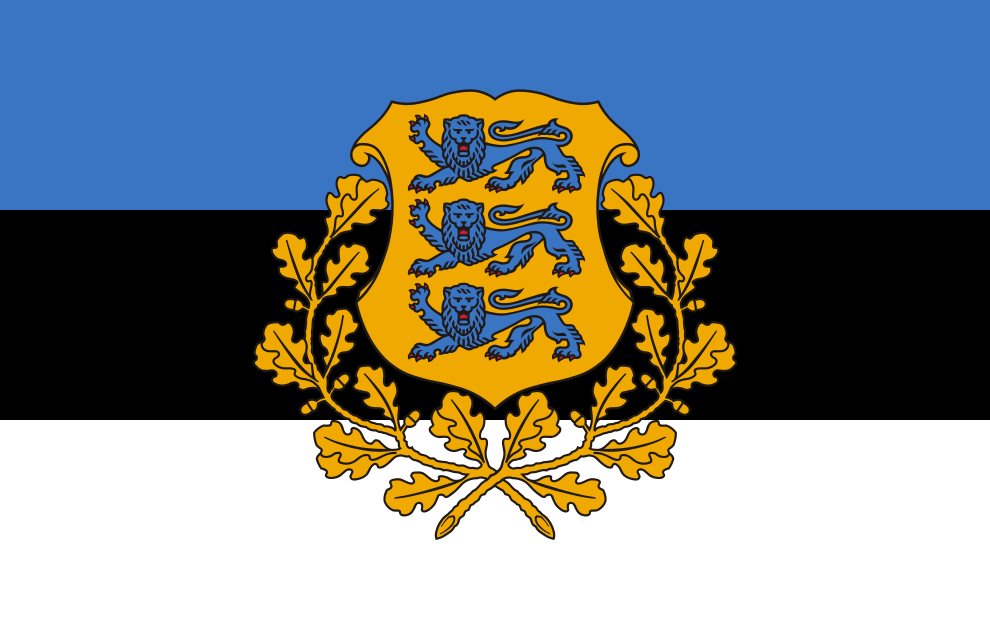
- The tricolour with the greater national coat of arms at the centre on both sides, the lions facing the staff. Flown on the President's residence and car.
- Naval ensign
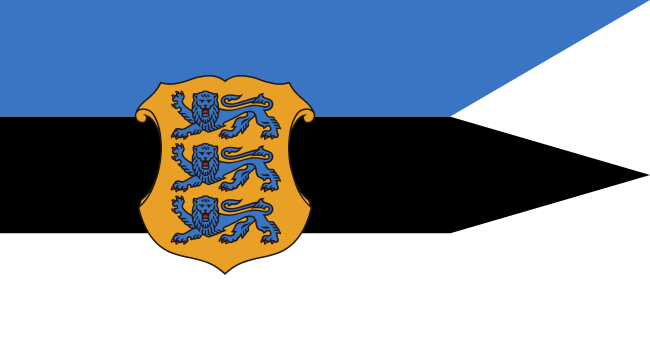
- The tricolour with a swallowtail, at 7:13, with the small national coat of arms set towards the hoist.
- Vertical flag
- The stripes turned upright, blue on the left as the observer sees it.

Meaning
What each part stands for
- Blue
- In Mõttus's reading of 1881, the reflection of the Estonian sky, lakes and sea, and a symbol of truth and of loyalty to national ideals
- Black
- The colour of the soil of the homeland and of the traditional national coat
- White
- The people's striving towards happiness and light
- The poem Eesti lipp
- Martin Lipp's poem, printed in 1897 and set to music by Enn Võrk in 1922, popularised a similar reading: the sky above, the soil of the homeland, purity and hard work
Who drew it
- Aleksander Mõttus
- Theology student at Tartu whose idea fixed blue, black and white as the colours of the Vironia fraternity in 1881
- Emilie Beermann
- Daughter of a schoolmaster in Põltsamaa, who sewed the first flag of the Estonian Students' Society in 1884
History
How the flag of Estonia got here
- 1884
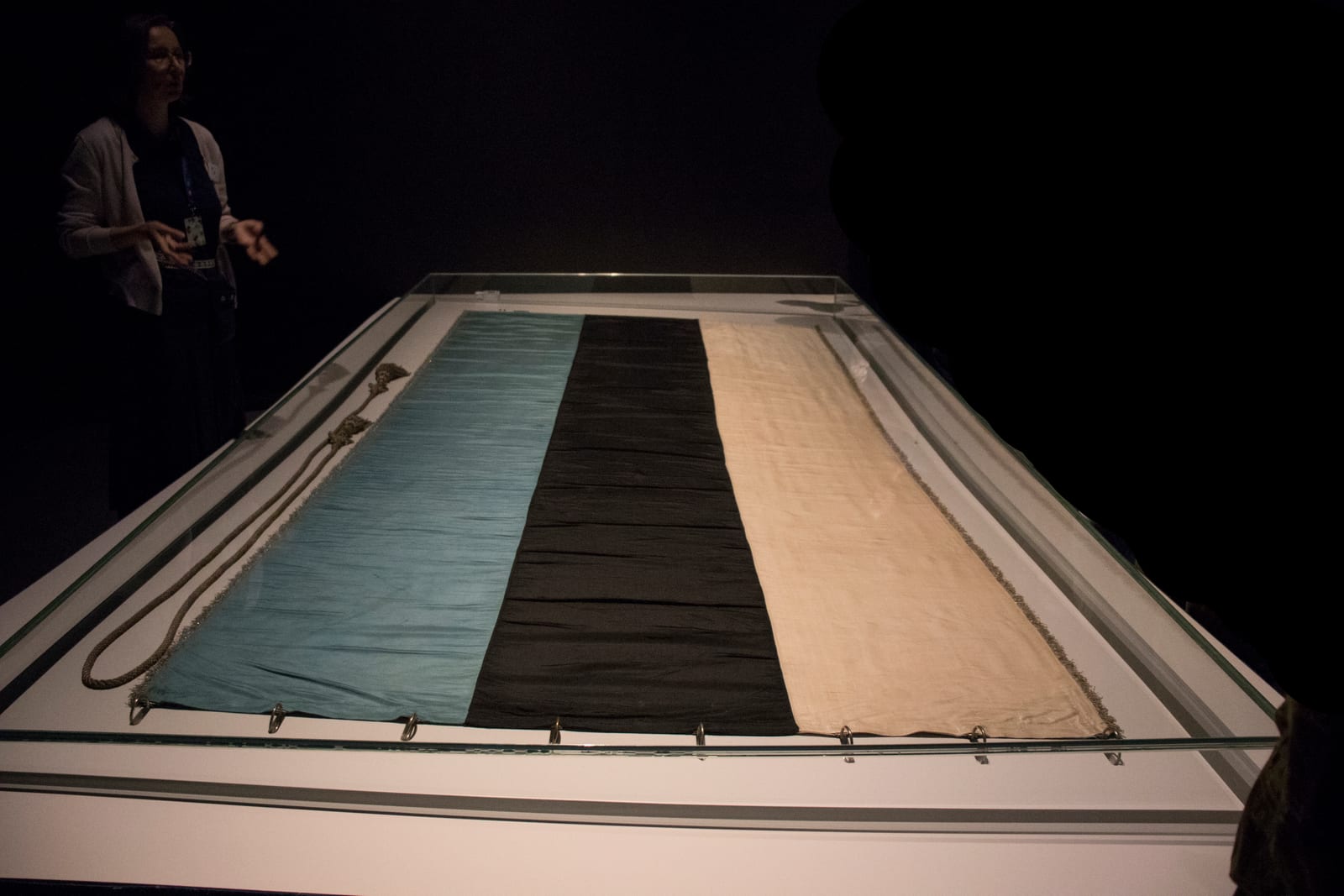
The flag of the Estonian Students' Society
4 Jun 1884 → 21 Nov 1918
The colours were chosen in Tartu in 1881 for a fraternity the authorities refused to register, and passed to the Estonian Students' Society. Its first blue, black and white flag, sewn in silk by Emilie Beermann, was consecrated at Otepää on 4 June 1884 and survives. After it was carried in a demonstration in Tartu on 1 November 1905 it became the recognised symbol of the Estonian nation.
Image: WanderingTrad, CC BY-SA 4.0
- 1918
The flag of the Republic
21 Nov 1918 → 27 Jul 1940
The Republic of Estonia was proclaimed under the tricolour on 24 February 1918. The Provisional Government made it the state flag that November, it went up on the Pikk Hermann tower on 12 December 1918, and parliament confirmed it by law in 1922 over a Nordic cross and a green, violet and white proposal.
- 1940
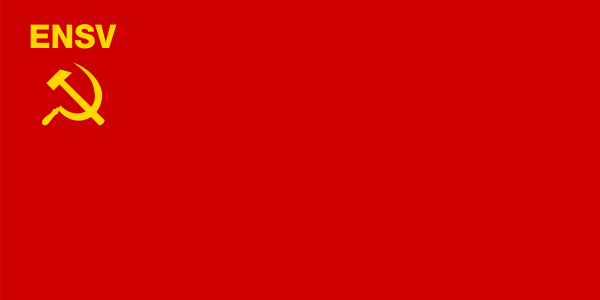
Occupation
27 Jul 1940 → 1953
After the Soviet invasion of June 1940 the tricolour was flown beside the red flag on the Pikk Hermann tower and then removed. Under German occupation from 1941 to 1944 it was accepted as the flag of the Estonian people but not of a state, and it flew on the tower for a few days in September 1944. The Soviet authorities then banned the flag and its colours.
- 1953
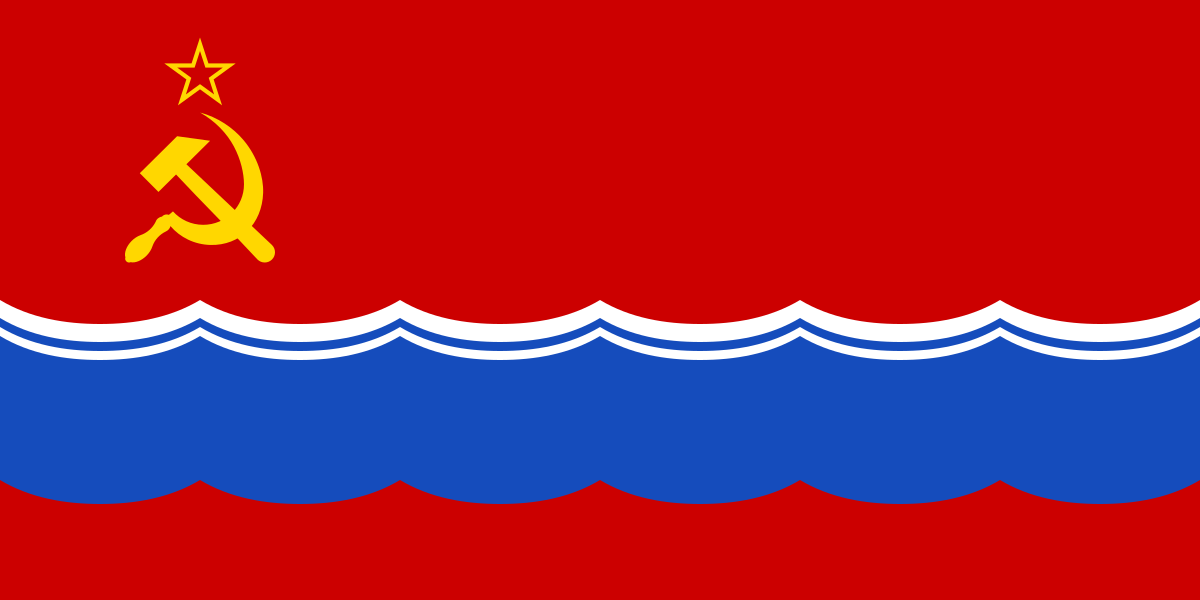
The Estonian SSR
1953 → 1990
The flag of the Estonian SSR. Raising the tricolour was punished, often as hooliganism and with prison camp, yet it was raised in protest on national anniversaries. The government-in-exile and the diaspora kept using it.
- 1988
The national colours again
23 Jun 1988 → 7 Aug 1990
A decree of 23 June 1988 recognised blue, black and white as the Estonian national colours, and the tricolour as the national flag followed on 20 October 1988. On 24 February 1989 it was raised on the Pikk Hermann tower at 08:33 for the first time since 1944.
- 1990

The state flag restoredIn use
7 Aug 1990 → today
The Supreme Council resumed the tricolour as the state flag a year before independence was restored in August 1991. The Act of 7 July 1992 fixed its blue as Pantone 285 C, and the Estonian Flag Act of 2005 governs its use.
The law
What defines it, and who flies it
- 21 November 1918
Decision of the Provisional Government
Proposed regulations on a provisional state flag: blue (cornflower blue), black and white, in horizontal order.
- 27 June 1922
State Flag Act
Confirmed the tricolour as the state flag, with the blue as sky blue or cornflower blue, a proportion of 7:11 and a nominal size of 105 × 165 cm.
- 7 August 1990
Act on the State Flag and the State Coat of Arms
Continued the use of the same tricolour as the state flag.
- 7 July 1992
Act confirming the reference images of the state flag and the state coat of arms
Sets the blue as Pantone 285 C.
- 23 March 2005
In force since 1 January 2006 and amended since. Describes the flag, the flag days, the hours of hoisting, the mourning flag, the President's flag and the right of everyone to fly it.
In use
Everyone has the right to fly it; on Independence Day, Victory Day and the Day of the Restoration of Independence it must be flown on residential, commercial and office buildings
Hoisted every day on the Pikk Hermann tower in Tallinn at sunrise but not before 07:00 and lowered at sunset, to fragments of the anthem and of two songs
Elsewhere raised at sunrise but not later than 08:00 and lowered at sunset but not later than 22:00; it is not lowered on Midsummer Night
Never lowered on the buildings of parliament, the government, the courts, the ministries, the central bank, local councils and at border checkpoints, and lit at night
Flown on school buildings on every school day
A mourning flag carries a black ribbon at the top of the staff or is flown at half-mast
Its image may not be used as a trade mark, and a worn-out flag is destroyed with dignity
Related flags
The flags it is confused with or comes from
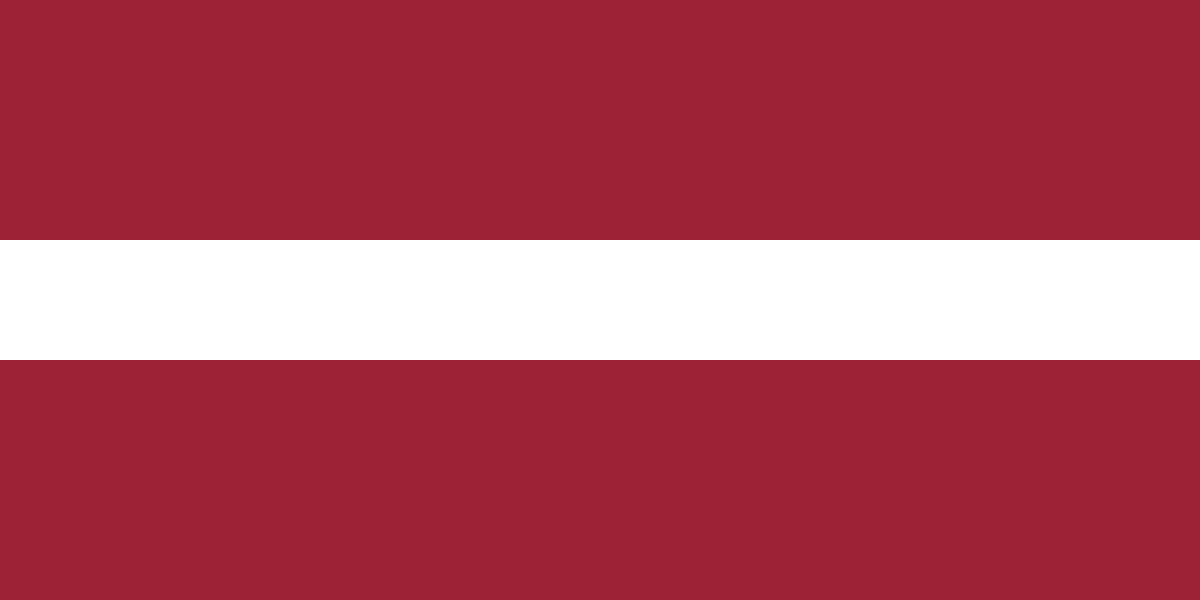 Latvia
- The Latvian flag is flown beside the Estonian flag on parliament, the President's and the government's buildings on 18 November.
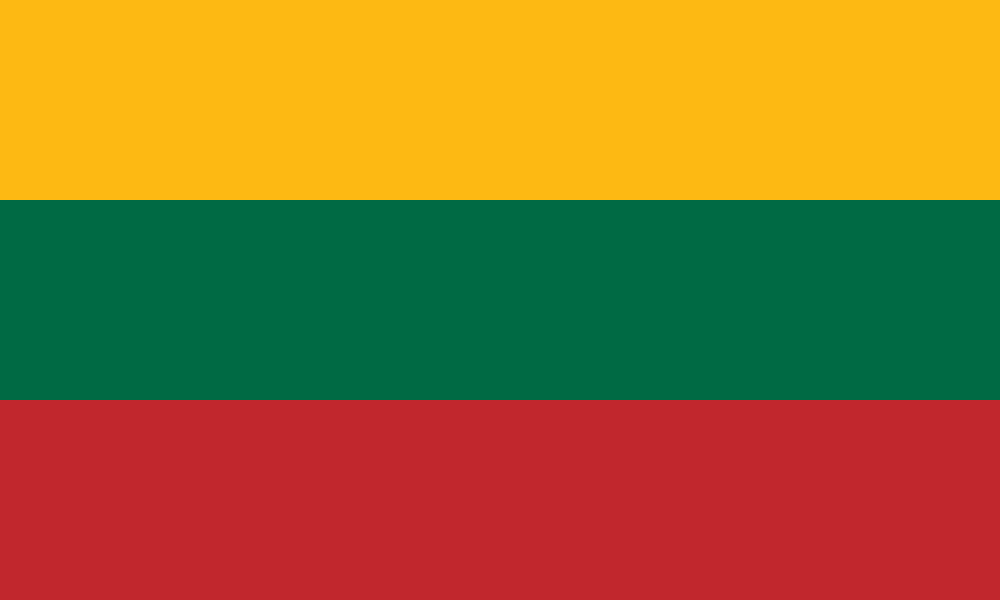 Lithuania
- The Lithuanian flag is flown beside the Estonian flag on parliament, the President's and the government's buildings on 16 February.
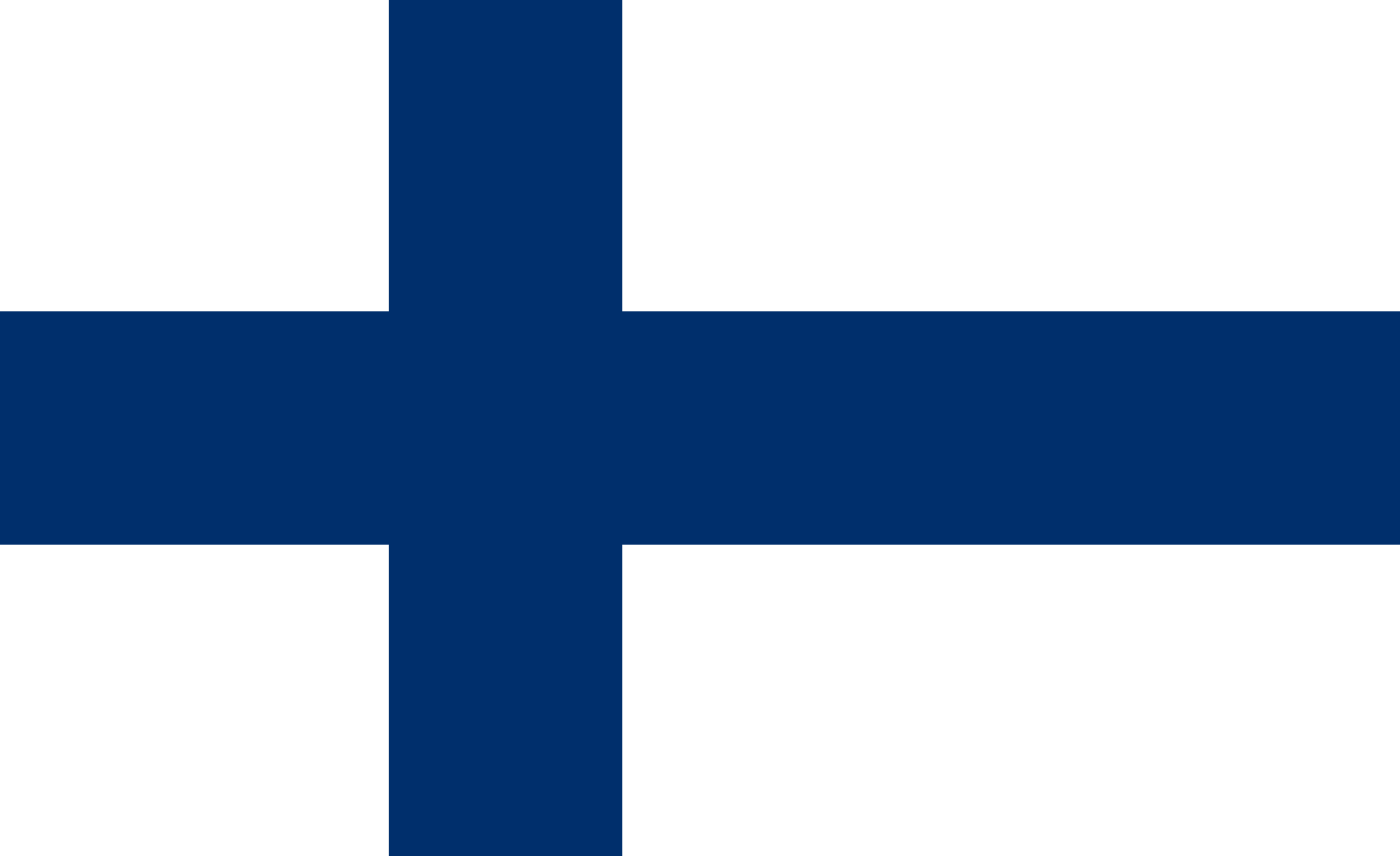 Finland
- Nordic cross versions of the Estonian colours were proposed in 1919 and again in 2001, on the model of Finland and the other Nordic flags. Neither was adopted.
Coat of arms
The arms of Estonia