Croatia's history: a border that outlived the empires that drew it
2 607 words · 12 min · updated 2026-09-10
 Back to Croatia
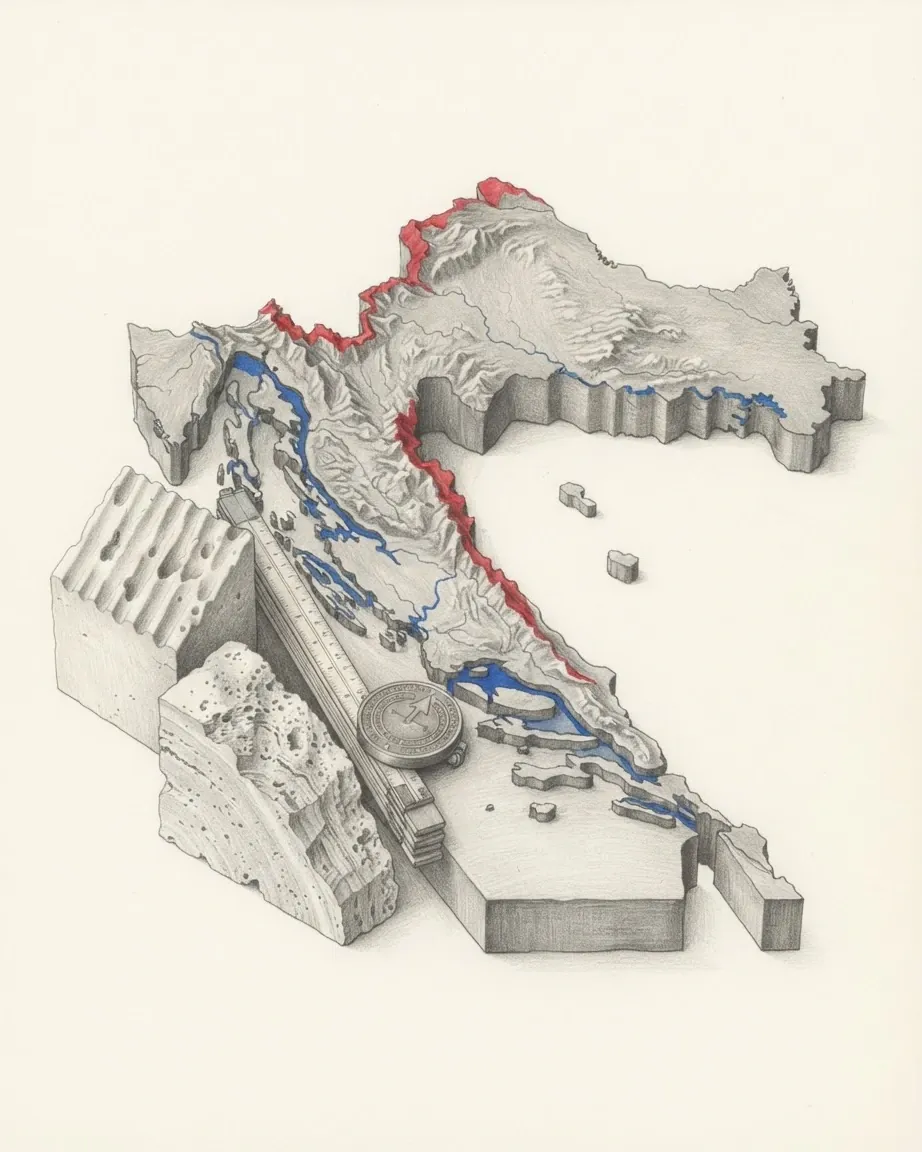
Croatia's border with Bosnia and Herzegovina is a remnant of where the Ottoman advance was halted and the Habsburg counter-offensive stopped short, and the belt of country immediately behind that line was taken out of Croatian hands for three centuries to be garrisoned. The Sabor voted it away to Ferdinand Habsburg's war council in the sixteenth century. Vienna ran it directly, granted land there to soldier-peasants who owed no feudal dues, drew a large Orthodox population into it from Ottoman territory, and gave it back only in 1881. That arrangement produced both the minority the war of the 1990s was fought over and much of the ground it was fought on.
In short
- First recorded king
- Tomislav, named as king in 925
- Union with Hungary
- 1102, keeping its Sabor and its ban
- Military Frontier
- Run from Vienna until 1881
- Independence declared
- 25 June 1991, in force 8 October 1991
- War of independence
- 1991 to 1995, war dead around 20,000
- United Nations
- 22 May 1992
- European Union
- 1 July 2013
- Euro and Schengen
- 1 January 2023
Who ruled Croatia before the Habsburgs arrived
Slavs settled the eastern Adriatic and its hinterland in the sixth and seventh centuries, on ground that had been the Roman provinces of Pannonia and Dalmatia, and merged over time with the Latinised population already there. A duchy under Borna is attested in Frankish chronicles from 818. Dalmatian Croatia received papal recognition as a state from Pope John VIII on 7 June 879, under Duke Branimir, and Tomislav is named as king in a letter of Pope John X in 925. The medieval kingdom reached its widest extent under Petar Krešimir IV, who ruled from 1058 to 1074, and Dmitar Zvonimir, from 1075 to 1089.
How the crown passed to Hungary
Zvonimir left no male heir. Stjepan II died in 1091, the Trpimirović line ended, and Ladislaus I of Hungary, the brother of Zvonimir's widow, claimed the crown. His successor Coloman took it in 1102. Historians have never settled what happened: one group holds that Croatia was simply conquered, another that Coloman and the Croatian nobility reached some form of agreement.
What is not in dispute is what survived the change. Croatia stayed a separate kingdom under a shared monarch, with its own Sabor, its own ban acting as royal deputy, and its own tax system, coinage and army. Hungarian kings were crowned separately as kings of Croatia from Coloman until Andrew II, and Charles Robert in 1301 was the last of them to be crowned twice. The first Croatian-Dalmatian assembly attested in the sources met near Benkovac around 1350 and gathered twelve noble families; later sessions were usually held at Knin.
What the Ottoman wars took away
Venice bought the Dalmatian claims of Ladislaus of Naples in 1409 for 100,000 ducats and controlled most of Dalmatia by 1428, holding it for nearly four centuries until 1797. Bosnia fell to the Ottomans in 1463, and from then the Croatian lands were fought over continuously. The Croatian defeat at Krbava field in 1493 and the destruction of the Hungarian army at Mohács in 1526 removed the crown and most of the defence with it.
On the last day of 1526 the Croatian nobles assembled at Cetin and, at a Mass held the next day, proclaimed Ferdinand of Habsburg their ruler on condition that he defend Croatia against the Ottomans and respect its political rights. The historian Ivan Jurković estimates that Croatia lost almost three-fifths of its population in this period. What was left, called in Croatian historiography the remnants of the remnants of the once glorious kingdom, ran to about 18,200 square kilometres by the late sixteenth century, roughly a third of the 56,594 square kilometres the republic holds today. The assemblies of Croatia and of Slavonia merged permanently on 1 September 1558, and on 7 March 1577 Zagreb was called the capital city for the first time.
Why Vienna took the frontier out of Croatian hands
The parliament that had elected Ferdinand then authorised him to cut large areas of Croatia and Slavonia adjacent to Ottoman territory out of the kingdom altogether. The result was the Military Frontier, Vojna krajina in Croatian and Militärgrenze in German, administered directly by the Imperial War Council in Vienna and not by the ban or the Sabor. The dating varies with the source: the split of Croatia into civilian and military territories is put at 1538, while the study of the buffer zone by Bogdan Popescu for Cambridge University Press dates its establishment to 1553 and its dissolution to 1881.
| Land | Who governed it | When it rejoined the rest |
|---|---|---|
| Croatia proper | the Sabor and the ban, under the Hungarian and then the Habsburg crown | held throughout |
| Slavonia | its own assembly from 1273, raised to a kingdom in the fifteenth century | assemblies merged in 1558 |
| Dalmatia | Venice from about 1420, Vienna after 1797 | 1918 |
| The Military Frontier | the Imperial War Council in Vienna | 1881 |
| Ragusa | its own republic under successive suzerains | abolished by Napoleon in 1808 |
The arrangement worked as defence. The Ottoman governor of Bosnia, Teli Hasan Pasha, mounted an offensive intended to finish off what remained of Croatia and was stopped and killed at Sisak in June 1593, the first decisive Ottoman defeat in these lands, after which the border stabilised. The Great Turkish War from 1683 to 1698 recovered Slavonia, confirmed by the Peace of Karlowitz in 1699, but the lands between the Una and the Vrbas stayed inside the Ottoman province of Bosnia. The border between Croatia and Bosnia and Herzegovina today is a remnant of that outcome, and the southern stretch of it was fixed by the Ottoman wars with Venice.
How the frontier changed who lived there
Constant warfare emptied the buffer zone, and the Habsburgs filled it again. Serbs, Vlachs, Croats and Germans were settled there as free peasant-soldiers, granted land without the usual feudal obligations and owing military service instead, an arrangement confirmed by the imperial decree of 1630 known as the Statuta Valachorum. They were free of serfdom and held considerable local autonomy, which the population under the ban and the Sabor did not. Encyclopaedia Britannica states the consequence plainly: the Frontier's land rights drew a large Orthodox inflow from Ottoman-conquered territory, and such was the origin of Croatia's Serb population, most of whose ancestors moved into these border districts between the sixteenth and eighteenth centuries.
Popescu's study measures what else the arrangement did. Large landowners were displaced, communal property in extended households, the zadruga, was formalised, governors were appointed from Vienna, and investment in infrastructure was deliberately held down to keep the social order the colony depended on. Households of twelve to sixty people lived together without individual property rights until roughly 1920, and the census of 1895, taken fourteen years after the Frontier was abolished, still found communal property markedly more common inside the old boundary than outside it. The former military zone had less access to roads, railways and health care. Surveys carried out between 2010 and 2016 found that people living in the former military area reported lower trust in others and higher trust in their own families than people in the former civilian districts.
How the frontier came back to Croatia
Politics caught up with the arrangement in 1848. The Sabor's petition of 25 March 1848, the Demands of the People, opened by asking that a Military Frontier colonel, Josip Jelačić, be made ban of Croatia, and went on to demand that the Frontier and Dalmatia be united with Croatia proper. Jelačić was appointed, was also made imperial commander of the Frontier, declared war on Hungary on 7 September 1848 and crossed the Drava four days later. Croatia lost its domestic autonomy anyway once the Hungarian revolution had been put down.
Language moved faster than territory. Ivan Kukuljević Sakcinski gave the first speech in Croatian in the Sabor on 2 May 1843, when Latin was still the language of public institutions, and the Sabor proclaimed Croatian the official language in 1847. The Illyrian movement around Ljudevit Gaj had already chosen the Shtokavian dialect as the standard, which brought the written language closer to Serbian at the moment the national movement was separating the two.
The Austro-Hungarian Compromise of 1867 placed Croatia-Slavonia under Hungary while Dalmatia, Istria and the Military Frontier stayed under Vienna. The Croatian-Hungarian Settlement of 1868, the Nagodba, formally recognised Croatian statehood while leaving Zagreb little real control of its own affairs. A decision to incorporate the Frontier was taken in July 1871, it was demilitarised in 1873, and its Croatian and Slavonian sectors were rejoined to Croatia in 1881. Britannica records the political arithmetic that followed: with the Frontier inside Croatia, Serbs made up a larger share of the population, and Budapest secured support by making concessions to them, which sharpened Croat and Serb antagonism at the same time. Ban Károly Khuen-Héderváry governed by Magyarisation from 1883 to 1903 until riots in which protesters burned Hungarian flags cost him the post.
What the first Yugoslavia offered the Croats
The Sabor severed relations with Austria-Hungary on 29 October 1918 and joined the State of Slovenes, Croats and Serbs, which merged with the Kingdom of Serbia in December 1918. The Sabor never ratified that union. The constitution of 1921 abolished the historical entities of Croatia and Slavonia outright and centralised authority in Belgrade, which the Croatian Peasant Party opposed from the day it was passed.
The state that resulted was administered by people the Croats had not chosen. By 1938 about 10% of army officers were Croats. In 1928 a deputy of the Serbian Radical People's Party shot five Croatian deputies on the floor of parliament, killing two outright; Stjepan Radić died of his wounds. King Alexander abolished the parliamentary system the following year, banned the parties and imposed integral Yugoslavism, and Ante Pavelić went into exile and founded the Ustaše. The Cvetković-Maček Agreement of 1939 finally created an autonomous Banovina of Croatia with its own parliament and ban, twenty-one years after the state was formed and two years before it collapsed.
How the war years split Croatian memory
Germany and Italy invaded in April 1941 and installed the Independent State of Croatia under Pavelić. It passed racial laws and ran eight concentration camps, of which the Jasenovac complex was the largest, and its programme, formulated by Mile Budak, was to purge Croatia of Serbs by killing one third, expelling one third and assimilating the remainder. Approximately 330,000 Serbs were killed. Serbian nationalist Chetnik formations killed an estimated 18,000 to 32,000 Croats in Lika and northern Dalmatia over the same years, aided by Italy.
The resistance began in the same country and in the same year. The 1st Sisak Partisan Detachment was formed in the Brezovica forest on 22 June 1941, and by Tito's own figure of May 1944 Croats made up 30% of the Partisan movement while forming 22% of the population of Yugoslavia. The State Anti-Fascist Council for the National Liberation of Croatia operated from 1942 and formed an interim civil government in 1943. At the end of the war, columns of Ustaše, conscripts, Chetniks and civilians who reached British lines in Austria were returned to the Partisans and many were executed, an episode Croatian public life records as the Bleiburg repatriations.
The demographers Vladimir Žerjavić and Bogoljub Kočović put total deaths on the territory at 295,000, or 7.3% of the population, among them 125,000 to 137,000 Serbs, 118,000 to 124,000 Croats, 16,000 to 17,000 Jews and 15,000 Roma. Both records belong to the same four years, and Croatian public argument has never reconciled them. International civil rights monitoring has criticised the normalisation of contested historical symbols in public life since 2024, and a series of anti-fascist marches in late 2025 and 2026 was followed by legal and public disputes over freedom of assembly and speech.
How Croatia became independent and went to war
Multi-party elections on 22 April and 7 May 1990 gave Franjo Tuđman's Croatian Democratic Union 42% against 26% for the reformed communists, which under a first-past-the-post system translated into 205 of 351 seats. A Serbian Assembly was established at Srb on 25 July 1990 and declared the sovereignty and autonomy of the Serb people in Croatia, its position being that if Croatia could secede from Yugoslavia then the Serbs could secede from Croatia. On 17 August 1990 barricades of logs went up across roads in the south, cutting Dalmatia off from the rest of the country. The Serbian Autonomous Oblast of Krajina was announced on 21 December 1990, and the first fatal clash came at the Plitvice Lakes on 31 March 1991.
A referendum on 19 May 1991 drew a turnout of almost 80% and 93.24% for independence; the Krajina had held its own vote a week earlier and boycotted this one. Parliament declared independence on 25 June 1991, and the declaration took effect on 8 October 1991 after a three-month moratorium. Recognition by the European Economic Community followed on 15 January 1992 and United Nations membership on 22 May 1992.
Where the front lines actually ran
The entity that declared itself in December 1990 called itself the Krajina, the same word the Habsburg buffer had carried for three centuries as the Vojna krajina, and it formed in the districts whose Serb population Britannica traces to the Frontier's settlement. By the end of 1991 the Yugoslav People's Army and Serb paramilitaries had reduced Croatian control to about two-thirds of the territory. Vukovar fell on 18 November 1991 after a three-month siege that destroyed most of the city. Between 400,000 and 500,000 Croats and other non-Serbs were expelled or displaced from the occupied areas.
What the fighting left behind it
Operation Storm in early August 1995 retook most of the Krajina in days. Estimates of the Serbs who left before, during and after it range from 90,000 to 200,000, hundreds of mainly elderly Serb civilians were killed in the aftermath, and some 19,000 Serb homes were later settled by Croat refugees from Bosnia. The Croatian government stated publicly that expulsions carried out by its own forces were not policy and sought to stop them. Eastern Slavonia was returned by negotiation under the Erdut Agreement of November 1995 and a United Nations transitional administration, completed in January 1998. Most sources put the war dead at around 20,000. The United Nations High Commissioner for Refugees records around 125,000 Serbs registered as having returned, of whom about 55,000 remain permanently. Serbs had been more than a tenth of the population before the war and were under half that share by 2001; the census of 2021 recorded 3.20%.
What Croatia has joined since the war
Accession took two decades and turned on the war. Croatia entered the Council of Europe in 1996 and the World Trade Organization in November 2000, and negotiations with the European Union opened in 2003, then stalled over the extradition of Croatian generals to the International Criminal Tribunal for the former Yugoslavia and again over a border dispute with Slovenia, cleared by an agreement in late 2009. NATO membership followed on 1 April 2009, European Union membership on 1 July 2013 after a referendum the previous year, and the euro and the Schengen Area together on 1 January 2023. The Pelješac Bridge, opened on 26 July 2022, connected the district around Dubrovnik to the rest of the mainland across the strip of coast belonging to Bosnia and Herzegovina.
The old boundary is still legible in the record. The census of 2021 counted 3,871,833 inhabitants, down 9.64% on 2011, and the steepest falls were in Vukovar-Srijem county at 20.28% and Sisak-Moslavina county at 19.04%, the eastern and central districts the fighting ran through. The earthquake of December 2020 that destroyed much of Petrinja struck Banovina, the region that took its name from the one stretch of the old frontier the ban of Croatia was left to pay for and command.
Timeline
The dates in order
- 925
- Tomislav is named king of Croatia in a letter of Pope John X.
- 1102
- Coloman takes the crown. Croatia keeps its Sabor, its ban and its own army.
- 1493
- Croatian defeat at Krbava field opens two centuries of Ottoman raiding.
- 1527
- The nobles at Cetin elect Ferdinand of Habsburg on terms.
- 1538
- Croatia is split into civilian and military territories.
- 1593
- Hasan Pasha is stopped and killed at Sisak. The border stabilises.
- 1630
- The Statuta Valachorum confirm land without feudal dues for military service.
- 1847
- The Sabor proclaims Croatian the official language.
- 1881
- The Military Frontier is rejoined to Croatia after three centuries.
- 1918
- The Sabor severs relations with Austria-Hungary on 29 October.
- 1939
- The Cvetković-Maček Agreement creates the autonomous Banovina of Croatia.
- 1941
- Axis invasion. The Independent State of Croatia is installed in April.
- 1971
- The Croatian Spring is suppressed; a new federal constitution follows in 1974.
- 1991
- Independence declared on 25 June and in force on 8 October.
- 1995
- Operation Storm in August; the Erdut Agreement in November.
- 2013
- European Union membership on 1 July.
- 2023
- The euro and the Schengen Area on 1 January.
Common questions
Questions about Croatia
How was Croatian independence declared?
Parliament declared independence from Yugoslavia on 25 June 1991, and the declaration took effect on 8 October 1991 after a three-month moratorium. A referendum on 19 May 1991 had returned 93.24% for independence on a turnout of almost 80%. The European Economic Community recognised the state on 15 January 1992 and United Nations membership followed on 22 May 1992.
Who settled the Military Frontier?
A belt of land along the Ottoman border, cut out of Croatia and Slavonia in the sixteenth century and administered directly by the Imperial War Council in Vienna instead of by the Croatian ban and Sabor. Its settlers held land free of feudal dues in exchange for military service, confirmed by the Statuta Valachorum of 1630. It was demilitarised in 1873 and rejoined to Croatia in 1881.
Was Croatia ever part of Hungary?
Croatia entered a personal union with Hungary in 1102 and shared a monarch with it until 1918, but it remained a separate kingdom with its own parliament, its own viceroy, its own coinage and its own army. Hungarian kings were crowned separately as kings of Croatia until 1301. The Croatian-Hungarian Settlement of 1868 recognised Croatian statehood formally while leaving most real control in Budapest.
Where does Croatia's Serb minority come from?
Encyclopaedia Britannica traces it to the Military Frontier. The buffer zone was emptied by warfare and refilled by the Habsburgs with settlers who received land in exchange for garrison duty, and that offer drew a large Orthodox population out of Ottoman-held Serbia and Bosnia between the sixteenth and eighteenth centuries. Serbs were more than a tenth of the population before the war of the 1990s and 3.20% at the census of 2021.
What was the Independent State of Croatia?
A puppet state installed by Germany and Italy in April 1941 and led by Ante Pavelić and the Ustaše. It passed racial laws, ran eight concentration camps including the Jasenovac complex, and killed approximately 330,000 Serbs along with Jews, Roma and Croatian opponents. The Partisan resistance that fought it was formed in Croatia in the same year and was led by the Croatian-born Josip Broz Tito.