Croatian culture: a country catalogued village by village
2 492 words · 11 min · updated 2026-09-10
 Back to Croatia
Fifteen of the twenty-three elements Croatia has placed on the UNESCO intangible heritage lists name the place they belong to. Klapa singing is of Dalmatia, bećarac of eastern Croatia, gingerbread of the north, the Poklad carnival of the island of Lastovo, the alka of Sinj. That is what a national culture looks like when it was assembled in the nineteenth century out of an Adriatic coast that had been Roman and then Venetian, a north governed from Vienna and Budapest, and a military frontier facing the Ottomans. The parts were catalogued before the whole existed, and they are still the unit the country counts in.
In short
- Standard language
- Štokavian, chosen over Kajkavian in the 1840s
- Oldest Croatian prose
- Baška tablet, Glagolitic, about 1100
- Intangible heritage
- 23 UNESCO elements, 15 named for a place
- World Heritage
- Ten properties, eight of them cultural
- Mother tongue Croatian
- 95.25% of residents in 2021
- Catholics
- 78.97% in 2021, down from 86.28 in 2011
- Cuisine
- Called the cuisine of the regions
- Cultural export
- The cravat, from Croatian units in France
Why the heritage lists read as a gazetteer
Croatia has twenty-three elements on the UNESCO intangible cultural heritage lists, inscribed between 2009 and 2025. Fifteen of them carry a place in the title, and the places are small: a town, an island, a valley, a stretch of hinterland. The Festivity of Saint Blaise belongs to Dubrovnik, the Za Križen procession to the island of Hvar, wooden toy making to Hrvatsko Zagorje, the carnival bell ringers to the Kastav area, the spring procession of the Ljelje to the village of Gorjani. The eight elements without a place name are named for a practice instead: dry stone construction, transhumance, falconry, lacemaking, ojkanje singing, Lipizzan horse breeding, the Mediterranean diet, and a shared safeguarding programme for traditional games.
| Element | Where it belongs | Inscribed |
|---|---|---|
| Festivity of Saint Blaise | Dubrovnik | 2009 |
| Procession Za Križen | island of Hvar | 2009 |
| Wooden toy making | Hrvatsko Zagorje | 2009 |
| Two-part singing in the Istrian scale | Istria | 2009 |
| Carnival bell ringers' pageant | Kastav area | 2009 |
| Spring procession of the Ljelje | Gorjani | 2009 |
| Sinjska alka | Sinj | 2010 |
| Gingerbread craft | northern Croatia | 2010 |
| Bećarac singing and playing | eastern Croatia | 2011 |
| Nijemo kolo | Dalmatian hinterland | 2011 |
| Klapa multipart singing | Dalmatia | 2012 |
| Međimurska popevka | Međimurje | 2018 |
| Poklad carnival custom | Lastovo | 2025 |
The World Heritage list runs the other way and is as revealing. Ten Croatian properties are inscribed, eight of them cultural and two natural. The eight cultural ones are the Euphrasian Basilica complex at Poreč in Istria, listed in 1997, the historic city of Trogir, also 1997, the palace of Diocletian at Split and the old city of Dubrovnik, both listed in 1979, the Cathedral of St James at Šibenik in 2000, the Stari Grad Plain on Hvar in 2008, the stećci tombstone graveyards at Cista Provo in 2016 and the Venetian works of defence in 2017. None of them stands in Zagreb, in Slavonia, or anywhere in the Pannonian north.
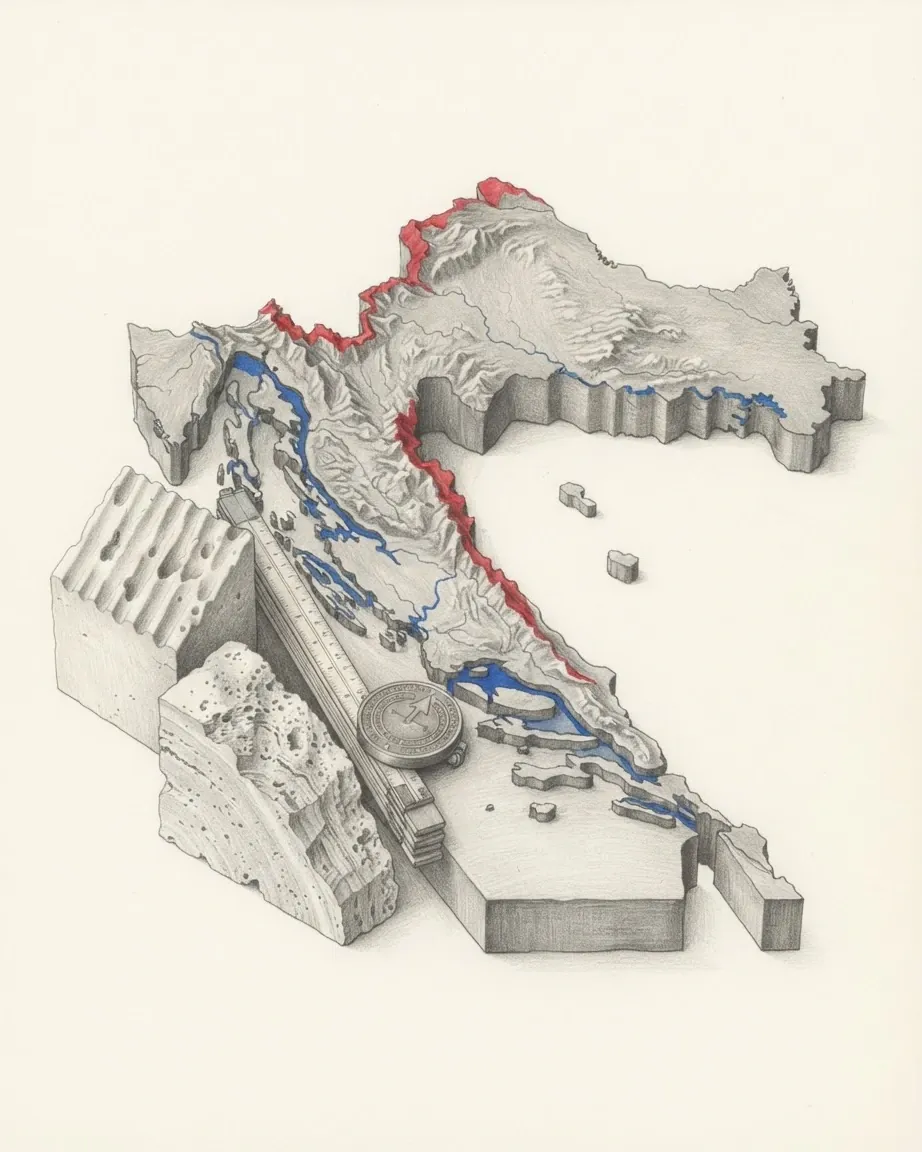
Read together the two lists describe one country twice. The monumental culture, the part built in stone by somebody with money, sits on the Adriatic, where Rome and Venice paid for it. The living culture, the part carried by a village and its neighbours, is spread across the whole territory in units no larger than a valley. The national layer sits on top of both, and it was built late.
What the Glagolitic centuries left behind
Croatian was a written language for seven hundred years before anybody agreed on how to write it. The oldest surviving prose in Croatian is the Baška tablet, cut into stone on the island of Krk around 1100, which records a donation by King Zvonimir and carries the earliest use of a Croatian royal title in the Croatian language. It is written in Glagolitic, the alphabet devised for Slavonic liturgy, and it survives because Croatia went on using that alphabet long after most of Europe had stopped.
For centuries Latin, Church Slavonic and Glagolitic all ran at once in the liturgy of the Croatian church. The early medieval churches carry a shallow woven ornament known as Croatian interlace, and Glagolitic letters appear cut into the altar screens among it before Latin lettering replaced them. Documents issued by medieval Croatian rulers were written in Latin, in Beneventan, Carolingian or Gothic minuscule.
The alphabet reached print. A press was set up at Kosinj in the late fifteenth century under the patronage of the magnate Ivan VIII Frankopan, and the Missale Romanum Glagolitice of 1483 is the oldest book printed in the Croatian language, set in Glagolitic type. A second Glagolitic printing house operated at Senj between 1494 and 1508, producing the Senj Missal of 1494 and the confession manual Spovid općena of 1496.
The practical consequence is that Croatian literacy has a deep record and no single continuous standard. What was written down between the Baška tablet and the nineteenth century was written in three alphabets and several regional idioms, which left the national revival with an archive rather than a language.
Which dialect became the written standard
Croats speak three dialect groups, Štokavian, Čakavian and Kajkavian, and they differ in lexicon, phonology and syntax rather than in accent alone. All three were spoken by Croats in the nineteenth century, as they still are, so a literary standard meant choosing one.
The Illyrian movement chose Štokavian over Kajkavian. Led by Ljudevit Gaj, it emerged in the middle of the nineteenth century against Germanisation and Magyarisation, and it made its choice on grounds of reach: Štokavian was widespread among Croats and was also the speech of Serbs, which gave the movement a South Slavic character from the start. Britannica places Štokavian in eastern Slavonia, along the coast from Makarska to Dubrovnik and in Herzegovina, as well as in Montenegro and Serbia. The standard was picked for the ground it covered rather than for the ground it held alone.
The institutions followed quickly. Janko Drašković published a manifesto of national revival in 1832 that called for Croatia, Slavonia, Dalmatia, Rijeka, the Military Frontier, Bosnia and the Slovene lands to be joined into one unit with Croatian as its official language, which is a fair measure of how separately those places were then administered. Matica ilirska was founded in 1842 within the Zagreb Reading Room and renamed Matica hrvatska in 1872. Use of the Illyrian name was banned in 1843 and its proponents renamed themselves Croatian. Croatian replaced Latin as the official language of government in 1847 and 1848.
What followed was a century and a half of argument about the name. The Vienna Literary Agreement of 1850 produced a unified Croatian or Serbian standard that became the language of Yugoslavia under several titles. From 1972 to 1989 the constitution of the Croatian republic designated it the Croatian literary language, a result of the Declaration on the Status and Name of the Croatian Literary Language issued during the Croatian Spring. Since independence the constitution names it Croatian and the state regulates it by prescription, a habit linguists describe as Croatian linguistic purism. It has been an official language of the European Union since accession on 1 July 2013. In the census of 2021, 95.25% of residents gave Croatian as their mother tongue and 1.16% gave Serbian.
How the coast and the interior built differently
The oldest standing architecture in Croatia is ninth century and ecclesiastical, the largest example being the Church of St Donatus at Zadar, with the Church of the Holy Trinity at Split beside it. Underneath that sits the Roman layer the coast never lost. Diocletian, born at Salona, built his palace at Split around 300 AD and retired into it after abdicating in 305; the amphitheatre at Pula dates from the second century; the Euphrasian Basilica at Poreč is sixth century and keeps its Byzantine mosaics.
Along the Adriatic the building tradition is Mediterranean, and the Renaissance arrived through Venice. The Cathedral of St James at Šibenik was worked by Giorgio da Sebenico, known in Croatian as Juraj Dalmatinac, and by Nicolas of Florence. Radovan cut the west portal of Trogir cathedral around 1240 and Andrija Buvina made the wooden doors of the Split cathedral around 1220, the two best pieces of Romanesque sculpture in the country.
Inland the reference points change. Austrian and Hungarian influence shows in the public buildings and the street plans of the north and centre, and large scale Baroque planning shaped Tvrđa in Osijek, Varaždin and Karlovac: squares named for culture heroes, laid out parks and pedestrian cores. Art Nouveau arrived later and marked the same towns.
So a reader crossing the country from Dubrovnik to Osijek passes from one European building tradition to another without leaving the state, which is the point. The two halves were joined administratively in the twentieth century, and the fabric records the arrangement that preceded it.
What Croatians eat depends on the region
Croatian cooking is described inside Croatia as the cuisine of the regions, and the split follows the same line as the architecture. Dalmatia and Istria cook Italian and Mediterranean: seafood, cooked vegetables, pasta, olive oil and garlic. The continental north and east cook under Austrian, Hungarian, Turkish and Balkan influence, with meat, freshwater fish and vegetable dishes predominant. The written record is old for a country this size. The Gazophylacium of 1740 is a Latin and Kajkavian dictionary that handled food before the comparable French work, and Ivan Bierling's book of 1813 gives recipes for 554 dishes and counts as the first Croatian cookbook.
Wine has been made here since Greek settlers planted on Vis, Hvar and Korčula about 2,500 years ago. Croatia now has over 300 geographically defined wine regions, most of the output is white, and annual production exceeded 72 million litres as of 2017. Wine is normally drunk with food and is often cut with water, as gemišt with sparkling water and bevanda with still. The country drank almost only wine until the late eighteenth century, when beer production grew. Olive oil is the other old crop: 18,683 hectares of groves as of 2018, mostly near the coast, yielding about 5,000 tonnes of oil a year, with a 1,600 year old olive tree still standing on Veli Brijun.
Coffee is a social form rather than a drink. Research by the GfK agency found that 80% of Croatians over the age of 15 drink coffee daily, and a sitting runs 40 to 45 minutes; the person who issues the invitation pays. At the other end of the scale, 111 restaurants in Croatia appeared in the Michelin Guide as of 2026, of which 14 held at least one star.
Who the census says lives here
The 2021 census counted 3,871,833 people, which is 413,056 fewer than in 2011, a fall of 9.64% in ten years. The decline is not evenly spread, and where it fell hardest matters for everything above. Vukovar-Srijem County lost 20.28%, Sisak-Moslavina 19.04%, Požega-Slavonia 17.88%, Brod-Posavina 17.85% and Virovitica-Podravina 17.05%, all of them in the eastern interior. The City of Zagreb lost 2.90%, Zagreb County 5.55%, Dubrovnik-Neretva 5.71%, Zadar 6.03%, Istria 6.16% and Međimurje 7.52%.
The ethnic structure recorded in 2021 was 91.63% Croats, 3.20% Serbs, 0.62% Bosniaks, 0.46% Roma, and 0.36% each for Italians and Albanians, with every other minority below 0.30%.
Religious affiliation moved sharply in the same decade. Catholics were 86.28% of the population in 2011 and 78.97% in 2021, a loss of 639,408 people. Orthodox Christians fell from 190,143 to 128,395, and Muslims from 62,977 to 50,981. Declared atheists rose from 163,375 to 182,188, and agnostics and sceptics from 32,518 to 64,961. Catholicism remains the frame the calendar hangs on, and the church founded much of the education system, including the 1669 Jesuit academy that the University of Zagreb traces itself to.
What Croatia sends out into the world
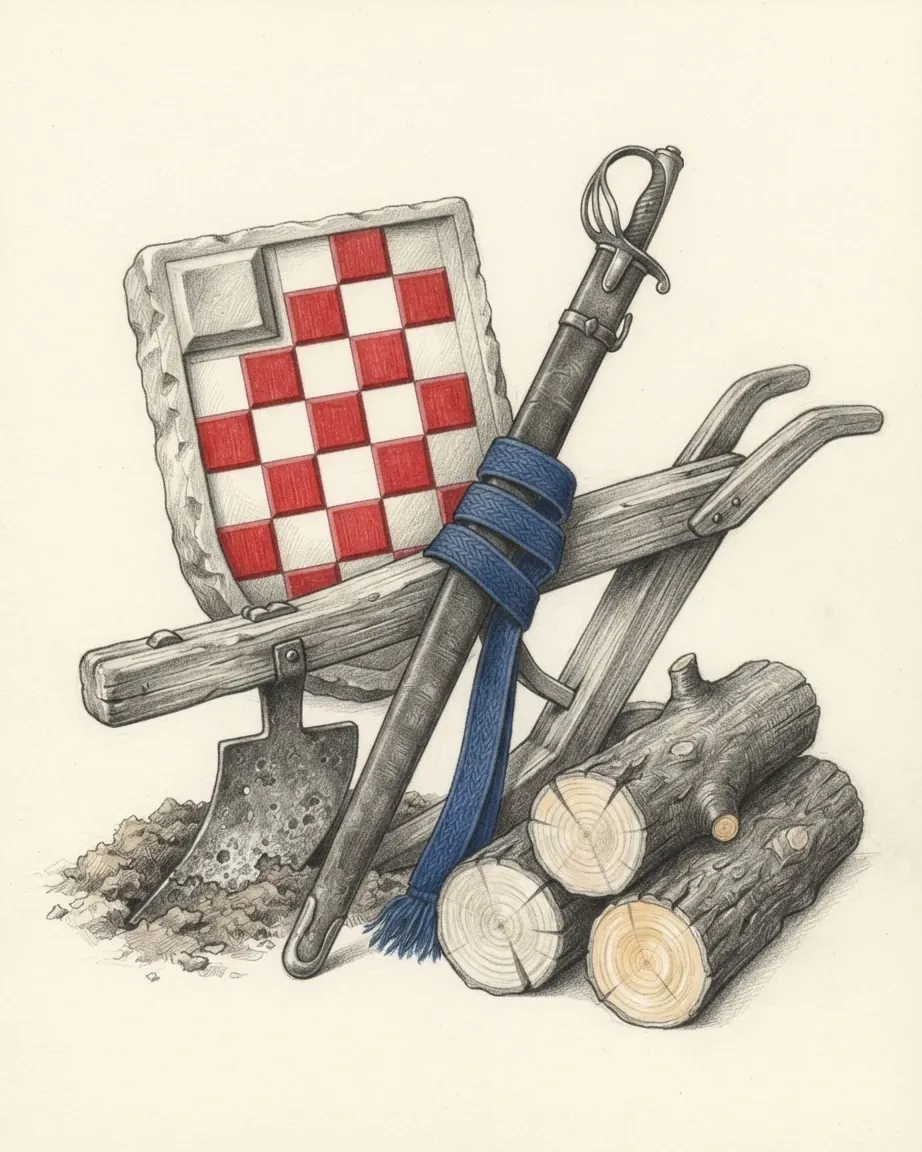
The best travelled Croatian object is the necktie. During the Thirty Years' War French observers met the Croatian units serving in France, took up the scarf they wore at the throat and named it after them, giving French cravate and eventually the modern tie. Croatia treats the necktie as national heritage, marks Cravat Day on 18 October, and raised a Cravat Regiment as a guard of honour in Zagreb in 2010, in replica seventeenth century uniform.
Film has travelled on a smaller scale and with better luck than the industry behind it. Dušan Vukotić won the Academy Award for best animated short film in 1961 with Surogat; Branko Lustig produced two winners of best picture, Schindler's List and Gladiator; Nebojša Slijepčević took a nomination for best live action short at the 97th Academy Awards with a 2024 film. Animafest Zagreb has run since 1972 and the Pula Film Festival is the national awards event. Domestic production runs at five to ten features a year and depends on state grants.
Sport is where the flag travels furthest. Football has close to 1,500 clubs and 110,000 registered players, and the men's national team finished third at the 1998 World Cup, second in 2018 and third again in 2022. The handball team won Olympic gold in 1996 and 2004 and the world title in 2003. Croatian athletes have taken 59 Olympic medals including 20 golds since first entering as an independent state in 1992, and the tennis team has won the Davis Cup twice.
Where the country keeps its culture
The public infrastructure is larger than the population would suggest. Croatia had 222 museums drawing more than 2.71 million visits in 2023, along with 1,768 libraries holding 26.8 million volumes and 19 state archives. In 2019 there were 95 professional theatres, 30 professional children's theatres and 51 amateur theatres, together seen by more than 2.27 million people a year, with 1,195 artists on professional theatre payrolls; 42 professional orchestras, ensembles and choirs drew an attendance of 297 thousand; 75 cinemas with 166 screens took 5.026 million admissions.
The named institutions are mostly nineteenth century or later. The Croatian National Theatre building in Zagreb went up in 1895 and was opened by Franz Joseph I. Vatroslav Lisinski wrote the first Croatian opera, Love and Malice, in 1846, and the national music award Porin, given annually since 1994, is named after another of his operas. Zagreb Radio began broadcasting on 15 May 1926. The Croatian Academy of Sciences and Arts dates from 1866. Zagreb also holds the Museum of Broken Relationships, an exhibition of objects left over from ended partnerships, housed in a baroque palace.
The festival calendar, by contrast, is where the gazetteer reappears. The Dubrovnik Summer Festival, Varaždin Baroque Evenings, the Rijeka Carnival, Đakovački vezovi, Vinkovačke jeseni, Špancirfest in Varaždin and the Sinjska alka, ridden in memory of the siege of Sinj in 1715, each belong to one town and are held there. The Ministry of Culture and Media keeps the national register and the state pays for the theatres, but the unit the register counts in is the place. A klapa group belongs to a coastal town, a lace pattern to Pag, a wooden toy to a village in Zagorje. The national layer was assembled in the 1840s by people who had to pick a dialect and then argue about its name, and the argument outlasted three states. What sits underneath it was inventoried village by village, and that is still how the country files itself.
Common questions
Questions about Croatia
Why is standard Croatian based on the Štokavian dialect?
Because the Illyrian movement chose it for its reach. Croats spoke three dialect groups, Štokavian, Čakavian and Kajkavian, and the movement led by Ljudevit Gaj passed over Kajkavian in favour of Štokavian, which was widespread among Croats and also the speech of Serbs. Croatian replaced Latin as the official language of government in 1847 and 1848.
What is the Baška tablet?
A stone slab cut on the island of Krk around 1100 and inscribed in the Glagolitic alphabet. It records a donation by King Zvonimir, carries the earliest use of a Croatian royal title in the Croatian language, and counts as the oldest surviving prose in Croatian.
What is klapa singing?
Multipart a cappella singing from Dalmatia in southern Croatia, inscribed on the UNESCO Representative List of the Intangible Cultural Heritage of Humanity in 2012. It is one of fifteen Croatian inscriptions that name the region, island or town they belong to.
How did the necktie come from Croatia?
The modern tie descends from the scarf worn by Croatian military units serving in France during the Thirty Years' War, which the French adopted and named after them, giving the word cravate. Croatia recognises the necktie as national heritage, marks Cravat Day on 18 October, and raised a Cravat Regiment as a guard of honour in Zagreb in 2010.
What food is Croatia known for?
There is no single national dish, because the cooking is described inside Croatia as the cuisine of the regions. Dalmatia and Istria cook Mediterranean, with seafood, olive oil, pasta and garlic, while the continental north and east cook meat, freshwater fish and vegetables under Austrian, Hungarian, Turkish and Balkan influence.