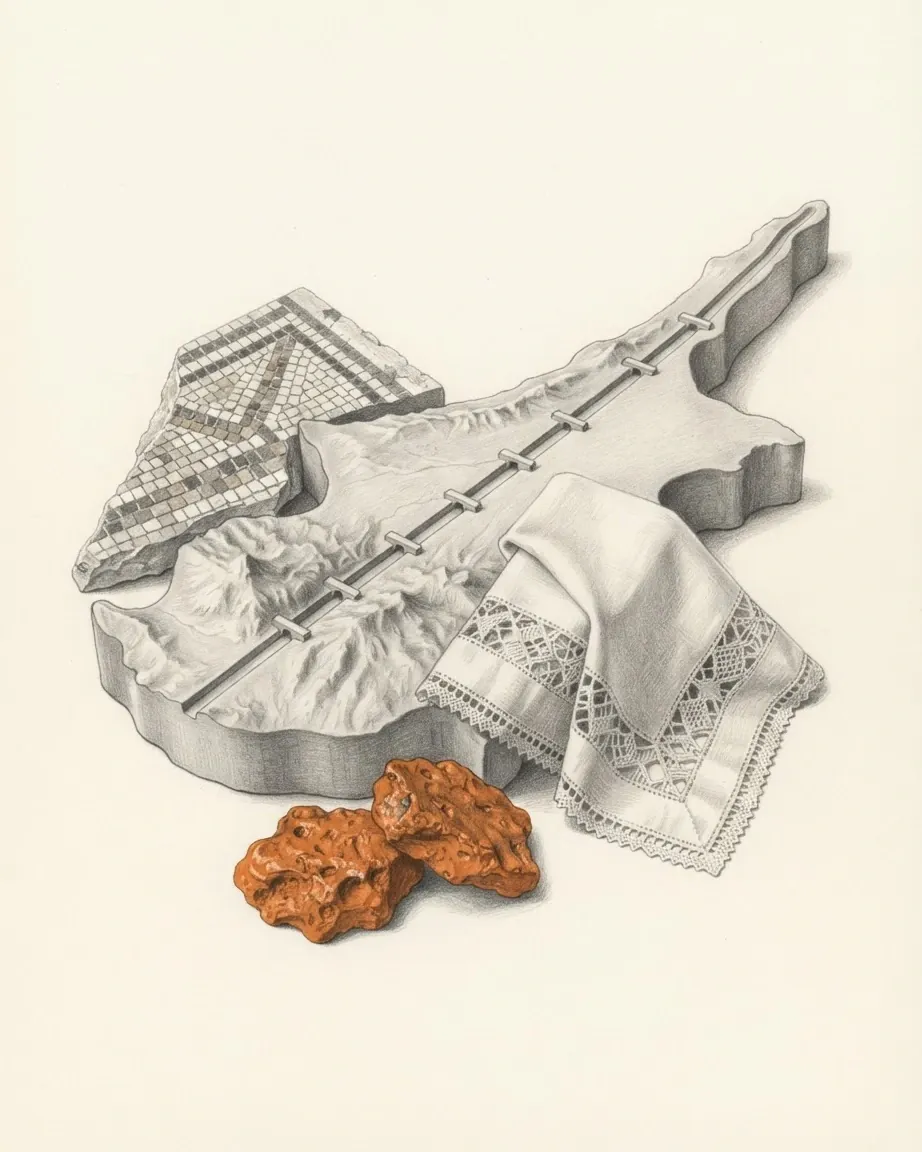
Cyprus governs itself under a constitution it cannot use
3 142 words · 14 min · updated 2026-09-10
 Back to Cyprus
A constitution written to be shared by two communities has been operated by one of them since 1964, under a doctrine of necessity that keeps the Republic of Cyprus lawful while much of its founding text goes unexecuted. The vice-presidency has stood vacant for six decades, twenty-four of the eighty seats in the House of Representatives are held open for members nobody elects, and the articles that would settle any of it were placed beyond amendment by the powers that drafted them.
In short
- Constitution in force
- since independence on 16 August 1960
- Basic articles
- unamendable under Article 182
- Vice-presidency
- vacant since 1964
- House of Representatives
- eighty seats statutory, fifty-six filled
- Council of Ministers
- eleven, appointed under the law of necessity
- President
- directly elected for five years, absolute majority
- European Union
- joined 1 May 2004, acquis suspended in the north
- Buffer zone
- about 180 km, nine crossing points
How the founders wrote a constitution nobody could amend
The Republic of Cyprus came into being on 16 August 1960 under a text its own people had not drafted. The terms were settled at Zurich on 11 February 1959 between Greece and Turkey, confirmed in London with Britain, and handed to the island as the price of ending British rule. Greek Cypriots abandoned enosis, union with Greece; Turkish Cypriots abandoned taksim, partition. The population the new state inherited numbered 573,566 in 1960, of whom 442,138 were Greek Cypriots, 104,320 Turkish Cypriots and 27,108 others, and Britain kept the sovereign base areas of Akrotiri and Dhekelia.
Two provisions then fixed the settlement in place. Article 181 gives constitutional force to the Treaty of Guarantee, concluded with Greece, Turkey and the United Kingdom, and to the Treaty of Military Alliance concluded with Greece and Turkey. Article 182 divides the document in two. The articles carried across from the Zurich agreement are the basic articles, and they "cannot, in any way, be amended, whether by way of variation, addition or repeal". Everything else may be changed only by a law carrying two-thirds of the representatives of the Greek community and two-thirds of the representatives of the Turkish community.
Annex III lists what falls into the first category, and the list is long. It covers the two official languages, the five-year presidential term, the composition of the Council of Ministers, both vetoes, the 70 and 30% split of the House, the communal chambers, the ratios in the public service and the security forces, the Supreme Constitutional Court, the separate municipalities, and Article 182 itself. The constitutional lawyer de Smith called the result unique in its tortuous complexity and in the multiplicity of the safeguards it provided for the principal minority, and judged that the constitution of Cyprus stood alone among the constitutions of the world. Cyprus: history goes into the campaign that produced it.
What power sharing required of both communities
Article 1 states the arrangement without ornament: the president is Greek and the vice-president is Turk, each elected by his own community. Article 46 gives the two of them a Council of Ministers of seven Greek and three Turkish members, appointed by an instrument both must sign, with one of foreign affairs, defence or finance reserved for a Turkish minister.
Articles 48 and 49 then set out the powers of the two offices in matching lists, item for item. Each holds a final veto over any law or decision of the House concerning foreign affairs, defence or security, and Article 50 defines foreign affairs to include the recognition of states, the conclusion of treaties, the declaration of war and the appointment of envoys. Each may also return a law, or the budget, to the House, which has fifteen days to pronounce on a law and thirty on the budget before the two of them must promulgate it.
The legislature rested on the same principle. Article 62 fixes the number of representatives at fifty, 70% elected by the Greek community and 30% by the Turkish community, and adds that the proportion shall be independent of any statistical data, which disposes in advance of any argument from a future census. Article 78 requires separate simple majorities from each community's representatives for any change to the electoral law, for any law on municipalities and for any law imposing duties or taxes. Beneath the House sat two Communal Chambers legislating for their own community on religion, education, personal status and communal taxation.
| What the constitution allocates | Greek Cypriot share | Turkish Cypriot share |
|---|---|---|
| Head of state | president | vice-president |
| Council of Ministers | seven ministers | three ministers |
| House of Representatives | 70% | 30% |
| Public service | 70% | 30% |
| Police and gendarmerie | 70% | 30% |
| Army | 60% | 40% |
| Supreme Constitutional Court | one judge | one judge |
The ratios ran further down than the table suggests. Article 123 splits the public service seventy and thirty and applies the split, so far as practically possible, in all grades of the hierarchy. Article 130 gives the police and gendarmerie a contingent of two thousand on the same ratio. Article 129 provides an army of two thousand men at 60% Greek and 40% Turkish, and permits compulsory military service only by common agreement of the president and the vice-president. Article 133 seats a Supreme Constitutional Court of one Greek judge, one Turkish judge and a presiding neutral judge who could be a citizen of neither Cyprus nor Greece nor Turkey nor the United Kingdom. Article 173 requires separate Turkish municipalities in Nicosia, Limassol, Famagusta, Larnaca and Paphos, with the two heads of state to examine within four years whether the separation should continue.
Why the design broke within three years
The parts that failed first were the ordinary ones. Because tax law needed a majority from each community and municipal law needed the same, a disagreement in either area stopped the state rather than the bill, and deadlock in the House became deadlock in the government.
On 30 November 1963 Archbishop Makarios put thirteen points to the three guarantor powers, presented as a way of clearing the impediments to government. Among them was the abandonment of the veto by both the president and the vice-president. Turkey rejected the proposal. Fighting broke out in Nicosia on 21 December 1963 and spread across the island, killing 364 Turkish Cypriots and 174 Greek Cypriots and displacing 25,000 Turkish Cypriots.
How the power-sharing government ended is contested, and it is written here as contested. Greek Cypriots hold that the Turkish Cypriots withdrew in order to form an administration of their own. Turkish Cypriots hold that they were forced out. The record carries both readings and some of each: many chose to withdraw, some who wished to stay in their posts were prevented from doing so by Greek Cypriots, others stayed away because they feared for their lives after the violence, and the Turkish Cypriot organisation TMT applied pressure of its own. At the debates in New York in February 1964 the administration led by Greek Cypriots was recognised as the government of the Republic, and Security Council resolution 186 of 4 March 1964 established the peacekeeping force that is on the island still.
The courts went the same way. The neutral president of the Supreme Constitutional Court resigned, the court ceased to exist, and its jurisdiction and powers were taken over by a Supreme Court formed by merging it with the High Court. In March 1965 the legislative functions of the Greek Communal Chamber passed to the House of Representatives. The Turkish Cypriot seats have stayed empty since 1965.
How the doctrine of necessity keeps the state lawful
The government's own account of what happened next is blunt. In 1964 the Turkish Cypriot vice-president and the three Turkish Cypriot ministers withdrew, and since then, in the words of the presidency, the government has been functioning by necessity with Greek Cypriots in all ministries. Under the law of necessity the president alone appoints the ministers, the count has risen from the ten of Article 46 to eleven, and deputy ministries for shipping, tourism, research and digital policy, social welfare, culture and migration have been created under ordinary national legislation rather than under the constitution.
The practical effect is a long list of constitutional acts with one signatory where the text demands two. Article 47 reserves fourteen matters to the president and the vice-president acting conjointly, among them the appointment of ministers, the promulgation of every law and the appointments to the Supreme Constitutional Court. Both of the vetoes in Article 50 now sit in one office. The vice-president's power to publish the laws of the Turkish Communal Chamber attaches to a chamber that no longer legislates.
Conscription is the clearest single case. Article 129 permits compulsory military service only by common agreement of a president and a vice-president, and caps the army at two thousand men. The National Guard trains about ten thousand recruits a year, service ran to twenty-four months until it was cut to fourteen in 2016, and none of it rests on the article that would have to authorise it.
The same gap runs through the legislature. The Inter-Parliamentary Union records a statutory eighty seats, fifty-six elected by Greek Cypriots and twenty-four allotted to Turkish Cypriots and vacant, against the fifty that Article 62 prescribes; altering that number under Article 62 would need two-thirds of the representatives of a community that has not sat since 1964. By conventional measures the resulting state is a stable one, scoring 72.5 for political stability and 68.8 for rule of law on the World Bank's governance indicators in 2024. It runs on a founding document it can neither execute in full nor lawfully replace.
How Cypriots choose a president and a parliament
The president is elected directly, by universal suffrage and secret ballot, for a term of five years. A candidate needs more than half the valid votes, and if nobody reaches that threshold the two leading candidates meet again on the corresponding day of the following week. In February 2023 Nikos Christodoulides led a field of fourteen with about 32% and took nearly 52% in the runoff against Andreas Mavroyiannis. His predecessor Nicos Anastasiades, elected with 57.48% in 2013 and re-elected with 56% in 2018, was barred from a third term.
Article 44 makes the president of the House act in the office if it falls vacant, with a by-election within forty-five days, which is how Glafcos Clerides became acting president in July 1974 after the coup and Makarios's flight. Prosecuting a sitting president for high treason requires a secret ballot of the House carried by three-quarters of the total membership, on a charge preferred by the attorney-general and the deputy attorney-general.
Voting for the House is universal, direct, secret and compulsory. Elections fall on the second Sunday of the month before the outgoing chamber's five-year term expires, they are announced by decree of the minister of the interior, and any question about their validity is settled finally and irrevocably by the Supreme Court. The territory is divided into six electoral districts whose boundaries match those of the six administrative districts.
| Electoral district | Seats |
|---|---|
| Nicosia | 21 |
| Limassol | 12 |
| Famagusta | 11 |
| Larnaca | 5 |
| Paphos | 4 |
| Kyrenia | 3 |
Kyrenia returns three of those seats and lies wholly beyond the government's control; Famagusta returns eleven and lies largely beyond it. The constitution prescribes no electoral system whatever, leaving the question to ordinary law. A majoritarian system ran until 1979, when law 72/1979 replaced it with qualified proportional representation on the grounds that the old system had failed to represent the minority and allocated seats unjustly; law 11(1)/1996 moved the country close to simple proportional representation. 12% of the representatives is the threshold for forming a parliamentary group. The House may dissolve itself by an absolute majority of the plenary, with the election following between thirty and forty days later.
Three religious groups, the Armenians, the Latins and the Maronites, each elect a representative under the Law on Religious Groups enacted in 1970. They sit in the plenary and on the Standing Committee on Education, hold the same immunity, remuneration and tax exemptions as other members, and have no vote.
Eleven of the fifty-six sitting members were women after the 2026 election, 19.6% against 14.3% in 2021, and the average age of the chamber was 47.9. Annita Demetriou, elected to preside on 10 June 2021 and re-elected on 4 June 2026, is the first woman in the office. Measured against the statutory eighty seats, the chamber holds one member for every 16,813 inhabitants.
What the classic quartet of parties stands for
Four parties have organised Cypriot politics for decades, and they are known collectively as the classic quartet. The Democratic Rally, DISY, was founded on 4 July 1976 by Glafcos Clerides when the right-wing Eniaion split in two. It is Christian democratic and liberal conservative, the most Atlanticist and pro-European of the four, a member of the European People's Party, and it is led by Annita Demetriou. Two of its former leaders reached the presidency, Clerides from 1993 to 2003 and Anastasiades from 2013 to 2023.
The Progressive Party of Working People, AKEL, was founded in 1926 as the Communist Party of Cyprus, fighting British rule as well as fascism. It is Marxist-Leninist and eurosceptic, sits with The Left in the European Parliament, and is led by Stefanos Stefanou. Demetris Christofias governed for it from 2008 to 2013 and did not seek a second term. The Democratic Party, DIKO, came out of the same split of 1976, claims the inheritance of Makarios, declared a move towards social democracy under Tassos Papadopoulos in June 2003, and belongs to the Progressive Alliance. EDEK, the Movement for Social Democracy, was founded in 1969 by Vassos Lyssaridis with anti-imperialist and Greek Cypriot nationalist roots, and takes around a tenth of the vote.
| Party | Founded | Position | European family |
|---|---|---|---|
| Democratic Rally, DISY | 1976 | liberal conservative | European People's Party |
| Progressive Party of Working People, AKEL | 1926 | communist, eurosceptic | The Left |
| Democratic Party, DIKO | 1976 | centrist | Progressive Alliance |
| Movement for Social Democracy, EDEK | 1969 | social democratic | Party of European Socialists |
What divides them is the Cyprus problem more than the economy. The leadership of DISY backed the 2004 settlement plan while much of its membership opposed it, and prominent figures left the party to campaign against it; AKEL rejected the plan under pressure from its own base; DIKO and EDEK opposed it outright, DIKO from a hardline position it has held ever since. Disagreement over the same question produced the European Party, European Democracy and the Solidarity Movement out of DISY, and Democratic Alignment, DIPA, out of DIKO in 2018. Christodoulides, once DISY's government spokesman and then its foreign minister, left and ran as an independent with DIKO's support, which makes DIKO the largest party of the present government.
Where the European Union stops on the island
Referendums on the United Nations settlement plan were held in both communities on 24 April 2004. About 65% of Turkish Cypriots voted for it and about 74% of Greek Cypriots against, and the plan fell. A week later, on 1 May 2004, Cyprus joined the European Union.
The whole island entered as a member, yet the acquis communautaire is suspended in the north, so European law stops at the buffer zone where European territory does not. Individual Turkish Cypriots able to document their eligibility for Republic of Cyprus citizenship hold the rights of any other citizen of a member state. The constitution absorbed membership through Article 1A, which provides that nothing in the text annuls what the obligations of membership require and that European legislation has legal effect in the Republic, a clause sitting inside a document whose own amendment rule calls for two-thirds of the representatives of both communities.
Membership elsewhere is broad and old. Cyprus joined the United Nations on 20 September 1960, a month after independence, entered the Commonwealth in 1961, and uses the euro. It belongs to no military alliance, though DIKO has argued for joining NATO's Partnership for Peace, and the National Guard remains the state's own force. The Treaty of Guarantee survives, and its survival under the 2004 plan was among the Greek Cypriot objections to it. In 2014 the European Court of Human Rights ordered Turkey to pay Cyprus well over $100m in compensation for the invasion, and Ankara announced that it would ignore the judgment.
The Union also measures the state it admitted. The European Commission's 2026 country report finds the time taken to dispose of civil and commercial cases to be long, low digitalisation of court procedure, and delays in enforcing final judgments. A reform in 2023 created a Commercial Court and an Admiralty Court staffed by specialist judges; neither was operating when the report was written, and the Admiralty Court was expected to open later in 2026.
How the buffer zone shapes daily government
The buffer zone runs about 180 kilometres across the island, a few metres wide in parts of old Nicosia and a few kilometres wide elsewhere. Its northern and southern limits are the lines where the two sides stood at the ceasefire of 16 August 1974. It is interrupted by the British base at Dhekelia, where the United Nations does not operate, and by Varosha, the abandoned resort near Famagusta held by the Turkish military.
The zone is inhabited ground. More than ten thousand people live or work in the civil use areas inside it as of 2025, and Pyla is the only village where Greek Cypriots and Turkish Cypriots live side by side. Roughly a thousand incidents a year occur within it, from name-calling to unauthorised use of firearms. Crossing points have opened since April 2003, and two more at Dherynia and Lefka on 12 November 2018 brought the total to nine.
The territory the constitution describes and the territory the government administers are two different maps. The Republic controls 59.74% of the island, the Turkish Republic of Northern Cyprus 34.85%, the buffer zone 2.67% and the British bases 2.74%, a division dating from 1974. Four Cypriot exclaves sit inside Dhekelia: the villages of Ormidhia and Xylotymvou and the two parts of the Dhekelia power station. The buffer zone also turns the Paralimni area in the south-east into an exclave in fact if not in law. Cyprus: geography sets out the physical island underneath all of it.
Negotiation has moved little. The talks at Crans-Montana collapsed on 7 July 2017. After Ersin Tatar won the presidency in the north in 2020, Turkey and the Turkish Cypriot leadership pressed for two states while the Republic, Greece, the European Union and the United Nations held to a bizonal bicommunal federation, and the process froze. In October 2024 the Secretary-General of the United Nations reported no common ground between the two sides; in January 2025 the Security Council restated the federal formula unanimously; and on 19 October 2025 Tufan Erhürman, who supports resuming the talks, won the election in the north. A settlement would arrive as a new constitution rather than as an amendment to the old one, which is what the 2004 plan proposed and what the leaders' own joint declaration assumes.
Timeline
The dates in order
- 1959
- Greece and Turkey settle the terms of Cypriot independence at Zurich on 11 February, confirmed in London with Britain.
- 1960
- The Republic of Cyprus is established on 16 August and joins the United Nations on 20 September.
- 1963
- Makarios puts thirteen points to the guarantor powers on 30 November; fighting breaks out in Nicosia on 21 December.
- 1964
- The Turkish Cypriot vice-president and ministers withdraw, and Security Council resolution 186 of 4 March creates the peacekeeping force.
- 1965
- The legislative functions of the Greek Communal Chamber pass to the House of Representatives in March.
- 1970
- The Law on Religious Groups gives the Armenians, Latins and Maronites an elected representative each, without a vote.
- 1974
- A coup and the Turkish invasion leave the ceasefire line of 16 August as the buffer zone.
- 1996
- Law 11(1)/1996 moves parliamentary elections close to simple proportional representation.
- 2004
- The settlement plan is rejected by Greek Cypriots on 24 April and Cyprus joins the European Union on 1 May.
- 2023
- Nikos Christodoulides wins the presidency as an independent in February with the support of DIKO.
- 2026
- Annita Demetriou is re-elected president of the House of Representatives on 4 June.
Common questions
Questions about Cyprus
Why is the Cypriot vice-presidency vacant?
The constitution reserves the office for a Turkish Cypriot elected by the Turkish Cypriot community. In 1964 the vice-president and the three Turkish Cypriot ministers withdrew from the government, and the post has been unfilled ever since. The presidency describes the state as functioning by necessity, with the president alone appointing eleven ministers.
Can the constitution of Cyprus be amended?
Only in part. Article 182 makes the articles carried over from the Zurich agreement of 11 February 1959 basic articles that cannot be amended in any way, by variation, addition or repeal. Any other provision requires a law carrying two-thirds of the representatives of the Greek community and two-thirds of the representatives of the Turkish community, and the Turkish Cypriot seats have been empty since 1965.
How many seats does the Cypriot parliament have?
Eighty on paper and fifty-six in practice. Fifty-six members are elected by Greek Cypriots across six electoral districts, twenty-four seats are allotted to Turkish Cypriots and stand vacant, and three representatives of the Armenian, Latin and Maronite religious groups attend without a vote. Article 62 of the constitution still names fifty.
Is voting compulsory in Cyprus?
Yes. Elections to the House of Representatives are held by universal, direct, secret and compulsory ballot for a five-year term, on the second Sunday of the month preceding the end of the outgoing chamber's term. Presidential elections are direct and require more than half the valid votes, with a second round a week later if no candidate reaches that.