How a culture survives in a language with no spelling
2 679 words · 12 min · updated 2026-09-10
 Back to Cyprus
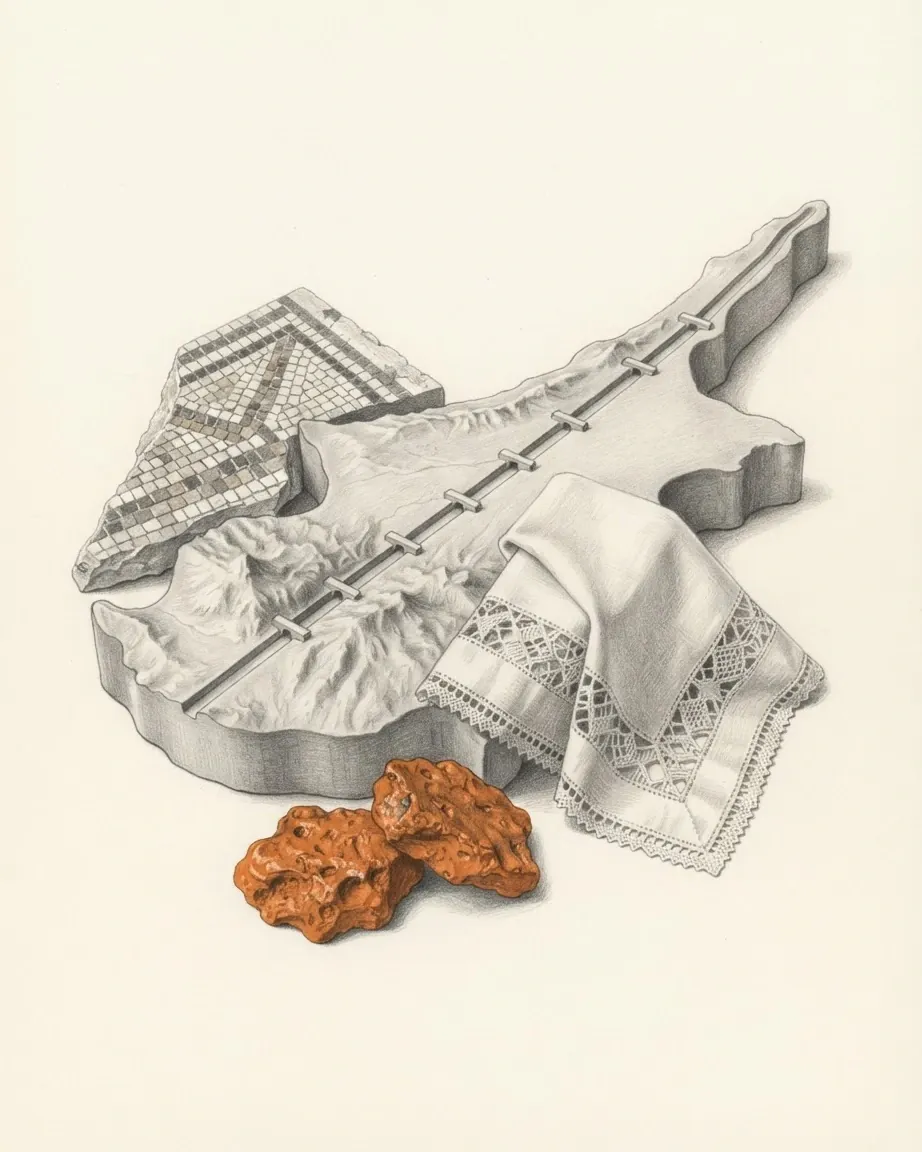
The everyday language of Greek Cypriots has never settled on a spelling. Cypriot Greek is the vernacular of the island's majority, unintelligible to a speaker of Standard Modern Greek without prior exposure, and it carries the folk poetry, the duelling verse, the television comedy and the rap while the standard language holds the schools and the courts. Much of what Cyprus counts as its own culture is held in forms that resist being written down, and most of what does survive in writing on the island was built there by the empires that governed it.
In short
- Official languages
- Greek and Turkish, with Armenian and Cypriot Maronite Arabic recognised as minority languages
- Everyday speech
- Cypriot Greek, the low variety in a diglossia with Standard Modern Greek
- Written form
- no established orthography; wide written use began with computer-mediated communication in the 2000s
- Tsiattista poetic duelling
- improvised rhyming couplets, inscribed by UNESCO in 2011
- Lefkara lace
- hand-worked cotton on linen from one village, inscribed by UNESCO in 2009
- World Heritage properties
- 3: Paphos, the Painted Churches in the Troodos Region, Choirokoitia
- Eastern Orthodox
- 94.8% of the population at the 2001 census of the government-controlled areas
- Students abroad
- 78.7% of Cypriot students attend a university outside Cyprus
Why the mother tongue counts as wrong
Greek-speaking Cypriot society is diglossic. Cypriot Greek, the vernacular acquired naturally as a first language by everyone who grows up in it, is the low variety, accepted in informal everyday communication. Standard Modern Greek, the Greek of Greece, is the high variety, and it holds education, administration and the formal media.
The gap between the two is wider than the word dialect suggests. Cypriot Greek differs from the standard in lexicon, phonetics, phonology, morphology, syntax and even pragmatics, and it is unintelligible to a speaker of Standard Modern Greek without adequate prior exposure. Ethnologue puts the lexical similarity between Cypriot Greek and Demotic Greek in the range of 84 to 93%.
What that arrangement produces is a hierarchy inside a single population. Speakers of Cypriot Greek report perceiving speakers of the standard as more intelligent, more educated, politer and more modern, and they associate their own first language with a rural way of life and a low level of education. Some describe it as incorrect. The school system sustains the judgement, with teachers actively discouraging Cypriot Greek in the classroom through explicit correction.
The language in which Cypriots argue, joke, court, mourn and improvise verse is therefore the one their own institutions treat as a fault to be repaired, and the language of their schools and courts is one many of them are uneasy speaking in public. Almost everything below rests on that arrangement.
| What the culture is made of | |
|---|---|
| Official languages | Greek and Turkish |
| Everyday language of Greek Cypriots | Cypriot Greek, the low variety in a diglossia |
| Recognised minority languages | Armenian and Cypriot Maronite Arabic |
| Lexical similarity with Demotic Greek | 84 to 93%, per Ethnologue |
| Intangible heritage inscribed | Lefkara lace in 2009, tsiattista poetic duelling in 2011 |
| World Heritage properties | 3: Paphos, the Painted Churches in the Troodos Region, Choirokoitia |
| Churches in the Troodos inscription | 10, all still used for worship |
| Eastern Orthodox share of the population | 94.8% at the 2001 census of the government-controlled areas |
| Students at a university abroad | 78.7% |
| Spending on education | nearly 7% of GDP, among the top three shares in the EU |
What the dialect kept from Attic Greek
The low variety is the older one. Cypriot Greek descends from Byzantine Medieval Greek rather than from ancient Arcadocypriot, and isolation shaped it: the island was cut off from the rest of the Greek-speaking world from the 7th to the 10th centuries AD by Arab attacks, reintegrated into the Byzantine Empire in 962, and cut off again in 1191 when it fell to the Crusaders.
The grammar it preserved is more conservative than the standard's. Where Standard Modern Greek uses one form, ekane, for both "he did" and "he was doing", Cypriot Greek keeps the distinction Classical Greek made, ekamen against ekamnen. Its third person plural present, kamnousin, is the Classical Attic form, which the standard has replaced with kanoun. Pothen survives for "from where", the equivalent of the archaic English whence, and thoro stands in for the standard vlepo, "I look".
Its sounds went the other way and added what the standard lacks: geminate consonants, palato-alveolars, and a contrast between a tapped and a trilled r. The vocabulary carries the island's own layers of borrowing from Old French, Italian, Occitan and English, alongside the Arabic mashallah and inshallah in everyday use.
None of it has a settled spelling. There is no established orthography for Cypriot Greek. The compilers of the Syntychies lexicographic database at the University of Cyprus proposed a combining caron for the sounds the Greek alphabet has no letters for, while other writers insert an epenthetic iota instead. Centuries of Greek Cypriot literature passed with the dialect written down only occasionally, and wide written use arrived with computer-mediated communication in the 2000s. It is now the only variety of Modern Greek besides the standard with a significant presence of spontaneous use online, and there is a form of Greeklish that reflects its phonology.
How two poets fight in verse
Tsiattista is impromptu oral poetry performed as a joust, in which one poet-singer sets out to outdo another with clever rhyming couplets, usually to the accompaniment of a violin or a lute. UNESCO inscribed it on the Representative List of the Intangible Cultural Heritage of Humanity in 2011.
The form is strict. The commonest metre is the iambic fifteen-syllable line in a rhyming couplet, though a poet may drop to eight, six or even nine syllables. A tsiattistaes has to be well versed in the Greek Cypriot dialect, know the popular poetry of the island, be able to retrieve well-known existing verses from memory, and above all improvise a new couplet on a set theme inside very tight time constraints while answering an opponent.
It has long belonged to wedding feasts, fairs and other public celebrations, where eager crowds press the poets to perform. The people who carry it have often been men of modest means and limited education who transmit their work only orally. The practitioners are now mostly old men, though talented female poets have recently begun to perform.
The medium is the thing worth holding on to. The one non-negotiable qualification for the island's most celebrated verbal art is command of the variety of Greek that the island's classrooms correct out of children, and the art has no written form because nobody performing it has ever needed one. The related tradition of the poiitaries, the bards, worked the same way, and the folk poets Vasilis Michaelides and Dimitris Lipertis wrote in the dialect at a time when almost nobody else was putting it on paper.
How a stitch passes to a daughter
Lefkara lace, or lefkaritika, comes from one village in the southeast of the island and goes back at least to the fourteenth century. UNESCO inscribed it in 2009.
The work combines four basic elements: the hemstitch, cut work, satin stitch fillings and needlepoint edgings, all of it cotton thread applied by hand to linen. Its designs draw on indigenous craft, on the embroidery of the Venetian courtiers who ruled the island from 1489, and on ancient Greek and Byzantine geometric patterns, which makes a tablecloth from Lefkara a compact record of who governed the place.
No pattern book governs any of this. Mastery passes to young girls through years of informal exposure and then formal instruction by a mother or grandmother, and once a lace-maker has learned the art thoroughly she designs work that embodies both the tradition and her own personality. It is made in company: the women of the village sit together and talk while they work, in the narrow streets or on covered patios, and lace-making remains their primary occupation.
The same village produces Cypriot filigree, known locally as trifourenio, jewellery made from twisted threads of silver, and silversmithing is practised across the island. Handicraft and folk art are common ground between the two Cypriot communities, and the lacework is the best known of any of it internationally.
Who built everything made of stone
Cyprus holds three World Heritage properties, and none of them was raised by anything resembling a Cypriot state. Paphos was inscribed in 1980, the Painted Churches in the Troodos Region in 1985, and the Neolithic settlement of Choirokoitia in 1998.
Paphos was a centre of the cult of Aphrodite and of pre-Hellenic fertility deities, and the temple there was erected by Myceneans in the 12th century BC. Choirokoitia was occupied from the 7th to the 4th millennium BC and ranks among the most important prehistoric sites in the eastern Mediterranean. Between them the two properties account for the island's population long before anyone recorded what it called itself.
The Troodos inscription is the one that carries the argument. Ten churches and monasteries hold Byzantine and post-Byzantine painting testifying to some 500 years of artistic influence, and their dated inscriptions, uncommon in the medieval eastern Mediterranean, make them unusually valuable for fixing the chronology of Byzantine painting. The murals came with metropolitan taste. The buildings did not: their steep-pitched wooden roofs with flat hooked tiles, set over Byzantine masonry domes and vaults, are confined to the Troodos range and almost certainly of indigenous origin. Local builders invented a roof to keep imported art dry.
Everything else monumental was put up by a ruler. The Gothic cathedrals of Nicosia and Famagusta, the Abbey of Bellapais above Kyrenia, the castles of Kyrenia, St Hilarion, Buffavento and Kantara and the Venetian fortifications of Nicosia and Famagusta all belong to the Latin domination that ran from 1191 to 1571.
The Troodos churches are not museums. All ten remain in use for worship, they are owned by the Church of Cyprus, and they charge no entrance fee. The institutional weight behind that is old and current at once: at the 2001 census of the government-controlled areas 94.8% of the population was Eastern Orthodox, 1.5% Latin Catholic, 1.0% Church of England, 0.9% Armenian and Maronite and 0.6% Muslim, and the Greek Orthodox, Armenian Apostolic, Maronite and Latin Catholic churches are constitutionally recognised and exempt from taxes. Makarios III, the republic's first president, was an archbishop.
What the kitchen took from its rulers
Geography left Cyprus heir to the culinary traditions of the Levant, Anatolia and Greece, and the meze, the spread of appetisers, frequently takes the place of a main course. Wine has been made on the island for thousands of years.
The medieval layer is the one that travelled outward. Under the French Lusignan monarchs an elaborate courtly cuisine developed, fusing French, Byzantine and Middle Eastern forms with the help of Syrian cooks the kings imported. Those recipes reached Western Europe as vyands de Chypre, foods of Cyprus, and the food historian William Woys Weaver has identified over one hundred of them in English, French, Italian and German recipe books of the Middle Ages. A stew of chicken or fish called malmonia became mawmeny in English.
Cauliflower took the same road. Writing in the 12th and 13th centuries, the Arab botanists Ibn al-Awwam and Ibn al-Baitar claimed the vegetable had its origins in Cyprus, Western Europe knew it as Cyprus cabbage or Cyprus colewart, and a trade in Cypriot cauliflower seed ran well into the sixteenth century.
Halloumi has the compound character of the lace. Some food writers place its origin in Byzantine Cyprus, academics take the name itself to be Arabic, and the earliest surviving documentary evidence dates from 1554, when the Italian historian Florio Bustron described a Cypriot sheep-milk cheese he called calumi. It is served sliced, grilled, fried and sometimes fresh, and Turkish Cypriots know it as hellim.
The rest of the table is plainer and just as old: pourgouri, the cracked wheat that is the traditional source of carbohydrate other than bread; hiromeri, a pressed, smoked and aged leg of pork; lountza, souvla and sheftalia over charcoal; and the lokum of Geroskipou, which holds a protected geographical indication.
What the line did to shared culture
The two communities start from a large shared inheritance. Souvla and halloumi, expressions and ways of life, hospitality and the habit of buying food and drink for guests run across both. Music, dance and art are integral to social life on either side, and dances such as the tsifteteli and the costumes worn for them are held in common. Folk music on the island shares elements with Greek, Turkish and Arabic music, all of which descend from Byzantine music, and it is played on the violin, called the fkiolin, the laouto, the pithkiavlin flute, the oud, the kanonaki and the tamboutsia.
Language crossed the line as well. In 1960 it was reported that 38% of Turkish Cypriots could speak Greek alongside Cypriot Turkish, and population records from the early twentieth century show Turkish Cypriots in Nicosia and Paphos with Cypriot Greek as a mother tongue.
Since 1974 the culture has been administered in two halves. The Turkish community in the north has promoted its own Turkish and Islamic culture, supported its own newspapers and periodicals and changed many place-names to Turkish, and it marks the anniversary of the proclamation of the Turkish Republic of Northern Cyprus on 15 November along with the Muslim holidays. The distinct religions of the two communities had partly hindered cultural exchange in any case.
Sport shows the division at its most administrative. Cypriot athletes first competed at the Olympic Games in 1924 as members of the Greek national team; the Cyprus National Olympic Committee was admitted to the International Olympic Committee in 1978, and the republic has sent its own team since 1980, made up of athletes from the Greek Cypriot sector alone. International sports governing bodies do not recognise the associations in the Turkish sector.
The arts have been readier to cross. Turkish Cypriot singers such as Acar Akalin and Nese Yasin have built a body of work out of oral tradition and classical forms such as the tekerleme, the rigmarole, and the mani, the quatrain, which is well known on the Turkish mainland and largely untranslated elsewhere. Poetry is also an important element in the growing peace culture movement that seeks social and cultural links across the island's ethnic divide.
Where the young go to study
Cyprus spends nearly 7% of GDP on education, among the top three shares in the EU alongside Denmark and Sweden, and the stock of qualifications that buys leads the union. It has the largest share of working-age citizens with higher education of any member state, ahead of Finland, and the largest share of tertiary qualifications among people in their late twenties and early thirties.
The peculiarity is where those qualifications are earned. Close to four in five Cypriot students attend a university outside Cyprus, in Greece, Britain, Turkey, elsewhere in Europe and North America. It shows in the arts, where the majority of Cypriot artists still train in England, following the pattern the founders of modern Cypriot painting set: Vassilis Vryonides studied at the Academy of Fine Arts in Venice, Adamantios Diamantis at the Royal College of Art in London and Christophoros Savva at Saint Martin's School of Art. Savva founded Apophasis with the Welsh artist Glyn Hughes in 1960, the first independent cultural centre of the new republic, and was among the artists in the island's inaugural pavilion at the Venice Biennale in 1968.
The older version of the same movement produced a diaspora. Britain has been the main destination of Cypriot migrants, most of whom left in the 1950s while Cyprus was still under British rule, and in the 1960s immediately after independence, settling in the major cities and above all in what is now North London.
There the argument closes on itself. London's Greek complementary schools teach Standard Greek and accept only Standard Greek for teaching and learning, though it forms no part of the students' own repertoires, which are English and Cypriot Greek. Teachers correct, recast and sometimes laugh at the Cypriot forms, and British-born speakers have learned to call their heritage language villagey, heavy or broken. By the third generation proficiency is low, and by the fourth the language is reduced to a handful of words kept for remembrance. The judgement that begins in a classroom in Cyprus is finishing its work in a classroom in London, on the grandchildren of the people who carried the words out. What that inheritance was made of, and who imposed each layer of it, is the subject of Cyprus: history.
Common questions
Questions about Cyprus
What language do Cypriots actually speak?
Greek and Turkish are the official languages, but the everyday speech of Greek Cypriots is Cypriot Greek, a variety that differs from Standard Modern Greek in lexicon, phonetics, phonology, morphology, syntax and pragmatics and is unintelligible to a standard speaker without prior exposure. Standard Modern Greek is the high variety, used in education, administration and formal media.
Why does Cypriot Greek have no fixed spelling?
The Greek alphabet has no letters for several sounds that Cypriot Greek uses, such as its palato-alveolars and geminates. Compilers of the Syntychies database at the University of Cyprus proposed a combining caron for them and other writers insert an epenthetic iota instead, so no single orthography has become established. Centuries of Greek Cypriot literature passed with the dialect written down only occasionally, and wide written use arrived with computer-mediated communication in the 2000s.
What is tsiattista?
Impromptu oral poetry performed as a duel, usually to violin or lute, in which one poet-singer tries to outdo another with rhyming couplets, most often in the iambic fifteen-syllable line. It belongs to wedding feasts and fairs, its practitioners have often been men of modest means and limited education who transmit their work only orally, and UNESCO inscribed it on the Representative List of the Intangible Cultural Heritage of Humanity in 2011.
What is Lefkara lace?
Hand-worked needlework in cotton thread on linen from the village of Lefkara in southeastern Cyprus, dating back at least to the fourteenth century and combining the hemstitch, cut work, satin stitch fillings and needlepoint edgings. Its patterns draw on indigenous craft, on the embroidery of the Venetian courtiers who ruled the island from 1489, and on ancient Greek and Byzantine geometry. It was inscribed by UNESCO in 2009.