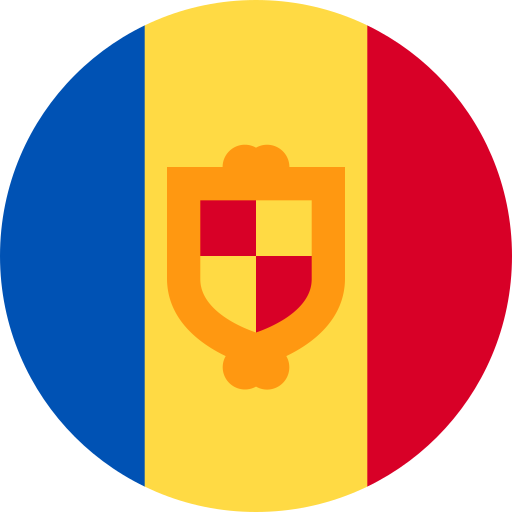
Most of what Andorra holds as a state it acquired after 14 March 1993, when voters approved a constitution that turned a lordship shared by the bishop of Urgell and the French head of state into a sovereign country. The United Nations admitted it on 28 July 1993 and the Council of Europe in 1994, a monetary agreement signed with the European Union in 2011 made the euro its official currency, and taxes on company profits and personal income arrived between 2012 and 2016. The two lords stayed on as co-princes, and defence remains with France and Spain. On 468 square kilometres of the eastern Pyrenees, Andorra counted 89,752 residents on 30 June 2026.
At a glance
Where it is
Where Andorra is, and what is around it
Andorra is landlocked. It shares a border with 2 countries, counted as shared borders, which includes neighbours across water.
 Spain
Spain France
How Andorra assembled a state after the referendum
Wikipedia's account of Andorran politics says that before 1993 the principality had no clear division of powers between its branches of government. The push to write one down came from outside. In 1990 the Council of Europe recommended that Andorra adopt a modern constitution guaranteeing the rights of those living and working there if it wanted full integration with the European Union. A Tripartite Commission of the co-princes' representatives, the General Council and the Executive Council was formed that year to draft the text, and on 14 March 1993 it was approved by 74.2% of voters on a turnout of 76%. The Government of Andorra's own history says the constitution turned the principality into an independent state under the rule of law.
The pieces that followed came one at a time, and several arrived by agreement with a neighbour.
| What Andorra acquired | When |
|---|---|
| Customs union with the European Community, for industrial goods | 1991 |
| Constitution, approved by referendum | 14 March 1993 |
| Treaty of Good Neighbourliness with France and Spain | 1993 |
| Membership of the United Nations | 28 July 1993 |
| Membership of the Council of Europe | 1994 |
| The euro as official currency, by monetary agreement | signed 2011, in force 2012 |
| Business tax of 10% | 1 January 2012 |
| Personal income tax, general indirect tax, end of banking secrecy | 2013 to 2016 |
| Association agreement with the European Union | signature authorised July 2026 |
Before the euro, Andorra had no currency of its own and banked in French francs and Spanish pesetas until 31 December 1999. The association agreement is the piece still open. In July 2026 the Council of the European Union authorised its signature and provisional application, and as a mixed agreement it also needs the European Parliament and all 27 member states. The Andorran government plans a consultative referendum before sending it to the General Council, where ratification takes a two-thirds majority.
Why a bishop and a French president head Andorra
The heads of state are older than the state by seven centuries. Two arbitration awards, the pariatges of 1278 and 1288, ended a feud between the bishop of Urgell, Pere d'Urtx, and the count of Foix, Roger Bernat III, and the Government of Andorra dates the principality to the first of them. The counts of Foix became kings of Navarre in the fifteenth century, and in 1589 Henry IV, king of Navarre and count of Foix, became king of France and brought the count's share of Andorra to the French crown. French republicans refused to keep the feudal tie in 1793, and Napoleon restored it in 1806. The bishop's share never moved from La Seu d'Urgell.
The Andorrans built their own institutions inside that arrangement. The bishop recognised the Consell de la Terra, the forerunner of the General Council, as the body of communal government in 1419, and the New Reform of 1866 gave the vote to every head of household. Under the 1993 constitution the co-princes remain heads of state and serve coequally, with powers Wikipedia describes as limited and excluding a veto over acts of government. The history of Andorra follows the pariatges and the council from the ninth-century documents to the referendum.
Where Andorrans live among the peaks
The country covers 468 square kilometres at an average elevation of 1,996 metres, with a border of 56.6 kilometres with France and 63.7 kilometres with Spain. The ground rises to Coma Pedrosa at 2,942 metres and falls to the point where the Gran Valira leaves for Spain. Settlement sits on the valley floors, where the capital, Andorra la Vella, stands at 1,023 metres and counted 24,042 residents on 1 January 2023.
The rest is mostly slope. The national land-cover map of 2012 classed about 40% of the country as dense woodland, 25% as meadow and grassland, 13% as scree and 9% as shrubland. The Observatori de la Muntanya d'Andorra puts forest at about 39% of the surface and ties its spread to fields and pastures going out of use.
Seven parishes divide the territory. In the year to 31 January 2026 Canillo added 427 residents, a rise of 7.0%, and Sant Julià de Lòria added 116, a rise of 1.1%, as counted by the statistics department and reported by Diari d'Andorra. Its landscape is traced valley by valley in the geography article.
Who votes for the General Council of Andorra
The General Council has 28 members. Fourteen are elected proportionally in one national constituency and fourteen by the seven parishes, two each, according to the Council's own description of itself. On 2 April 2023 the roll held 29,958 registered electors and turnout reached 66.95%, according to the government's count.
Most of the people who live in Andorra cannot vote in it. The statistics department counted 89,165 residents on 31 January 2026, and Wikipedia records that two thirds of residents lack Andorran nationality, which bars them from voting in communal elections, from becoming head of government and from owning more than 33% of a privately held company. Residents of other nationalities rose from 14,690 to 15,757 in the year to January 2026, a rise of 7.3%, with Colombian, Peruvian and Argentine residents accounting for a third of the change.
Andorra keeps no armed forces. Under the Treaty of Good Neighbourliness of 1993, France and Spain undertake to respect its sovereignty and territorial integrity and to consult its government if either is threatened. Order was kept by the parish Sometent, a communal militia, until a professional police service was created in 1931, and a decree of 1989 required every Andorran head of household to own a hunting shotgun; that decree has since been repealed, and the Civil Protection Act of 2022 now treats the Sometent as part of emergency relief. The politics article covers the two halves of the council and the co-princes' remaining powers.
What Andorra's economy was built on
Duty-free shopping came first. Wikipedia's article on Andorran politics describes the constitution as opening a shift from an economy based largely on duty-free shopping to one based on international banking and finance. The shopping still draws the crowds: the statistics department counted 9,646,656 visitors in 2024, of whom 5,479,042 came for a few hours and left the same day, and almost half gave shopping as the reason for the trip. More than 4.3 million tourists stayed at least one night in 2025, and overnight stays passed 12 million for the first time that year.
The banks grew beside the shops. The IMF put the consolidated assets of the Andorran banking sector at 17.5 billion euros at the end of 2022, 5.5 times the country's output. The World Bank puts output at about US$4.5 billion in 2025 and output per head at US$54,292 the same year, and Wikipedia gives unemployment at 1.5% in 2023.
Both rested on low taxes. Wikipedia describes a banking sector with tax haven status and public revenue raised through import tariffs, and pressure from the European Union changed that. In 2009 the French president Nicolas Sarkozy threatened to abdicate as co-prince unless Andorra changed its banking laws. A business tax of 10% came in on 1 January 2012 and a sales tax of 2% a year later, and between 2013 and 2016 Andorra introduced a personal income tax and ended banking secrecy. The economy article follows the price gap, the banks and the taxes in detail.
Why Catalan is the language of the Andorran state
Article 2 of the constitution makes Catalan the official language of the state. In a government survey of 2022, 44% of respondents named Catalan as their first language and 40.3% named Spanish, according to the Institut d'Estudis Catalans' summary of the results. Law 6/2024 of 25 April 2024 reaches into schools, broadcasting and the renewal of work permits, and ties a foreign worker's first and second permit renewals to Catalan at levels A1 and A2.
The rest of the culture is shared with the Catalan-speaking valleys across the border. Andorra built Romanesque churches, bridges and murals from the ninth to the fourteenth centuries. The patron is Our Lady of Meritxell, and Meritxell Day is the national day. UNESCO inscribed the Madriu-Perafita-Claror valley as a World Heritage Site in 2004, and in 2015 listed the summer solstice fire festivals of the Pyrenees as intangible heritage shared by Andorra, Spain and France. Andorran culture sets out the language law, the feasts and the food.
How visitors reach Andorra by road alone
Andorra has no airport for fixed-wing aircraft and no railway. Heliports at La Massana, Arinsal and Escaldes-Engordany carry commercial helicopter services, and since July 2015 Andorra-La Seu d'Urgell Airport, 12 kilometres south of the border in Spain, has flown commercial routes to Madrid and Palma de Mallorca. The international airports are Toulouse-Blagnac, 195 kilometres north, and Barcelona-El Prat, 198 kilometres to the south-east, both linked by hourly buses. The nearest railway station is Andorre-L'Hospitalet, 10 kilometres east of the border in France.
Once there, visitors sort themselves by height: the shops stand on the valley floors and the ski slopes and walking valleys lie above them. Travel in Andorra is arranged by altitude.
Each of the six articles takes one part of this page further: history, geography, politics, economy, culture and travel.
Read
Everything about Andorra
Six articles, each answering one question and each written to be read on its own.
The record
What is measured about Andorra
Pages that nobody writes, built from the record and from the data files beside it.
Common questions
Questions about Andorra
When did Andorra become an independent state?
The constitution approved by referendum on 14 March 1993, with 74.2% voting yes on a turnout of 76%, made the principality a sovereign state. The co-principality itself dates from the pariatges of 1278 and 1288, and before 1993 Andorra had no clear division of powers between its branches of government. The United Nations admitted it on 28 July 1993.
Is Andorra part of the European Union?
No. A customs union covering industrial goods has applied since 1991, and a monetary agreement signed in 2011 and in force since 2012 made the euro the official currency. An association agreement was authorised for signature by the Council of the European Union in July 2026 and still needs ratification, including a two-thirds majority in the General Council after a planned consultative referendum.
Who defends Andorra?
Andorra has no armed forces. Under the Treaty of Good Neighbourliness of 1993, France and Spain undertake to respect its sovereignty and to consult its government if it is threatened. A national police service has existed since 1931.
Why can most people living in Andorra not vote?
The vote in general elections belongs to Andorran nationals, and Wikipedia records that two thirds of residents lack Andorran nationality. The roll on 2 April 2023 held 29,958 electors, while the statistics department counted 89,165 residents on 31 January 2026. Residents without nationality also cannot become head of government or own more than 33% of a privately held company.
How do people get to Andorra?
By road. There is no airport for fixed-wing aircraft and no railway inside the border. The international airports at Toulouse-Blagnac and Barcelona-El Prat lie 195 and 198 kilometres away, with hourly buses, and the nearest railway station is Andorre-L'Hospitalet in France, 10 kilometres east. A small airport 12 kilometres south of the border in Spain has flown commercial routes since July 2015.
Nearby in the catalogue