Poland's politics: why the president can stop a government
1 938 words · 9 min · updated 2026-09-10
 Back to Poland
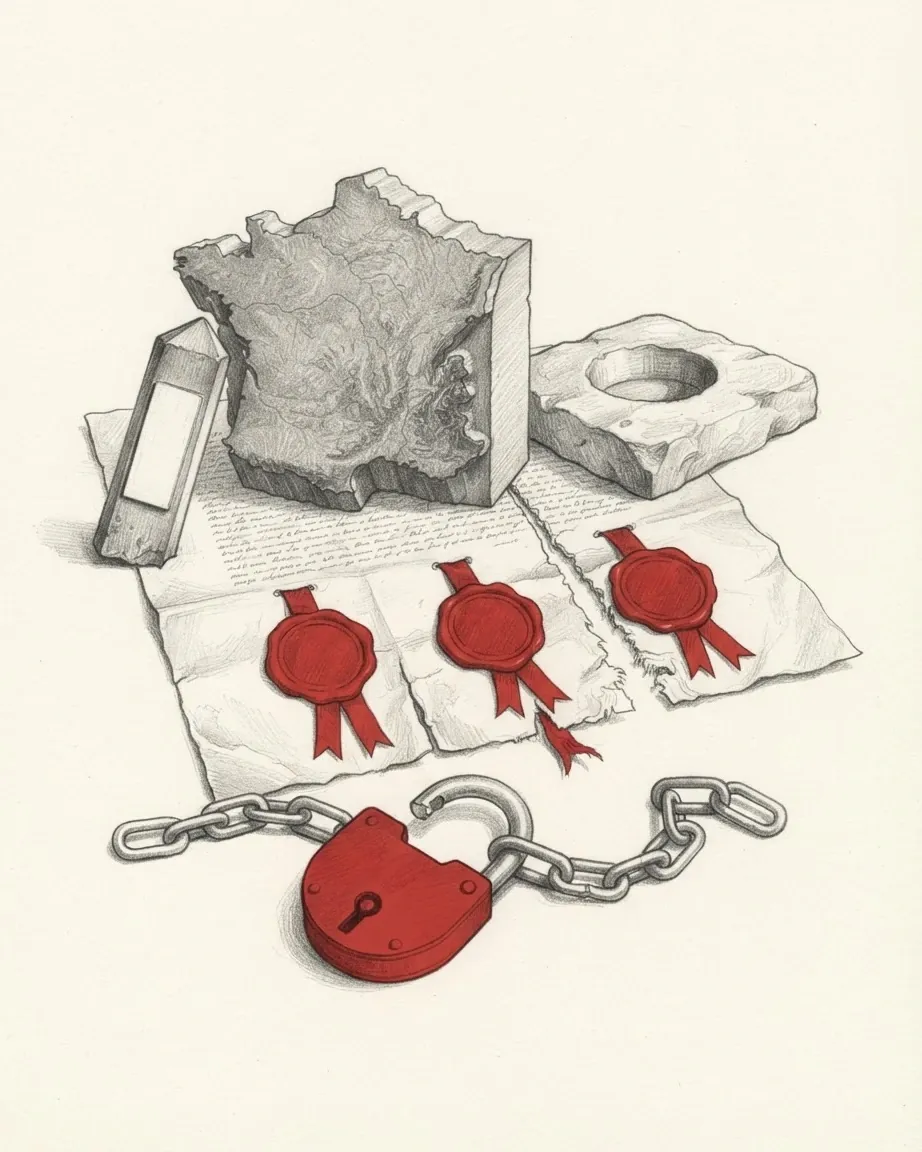
Poland elects a parliament that makes governments and a president who can block them, and the gap between those two mandates is the engine of Polish politics. A presidential veto stands unless three fifths of the Sejm overrides it, a government cannot be voted out without a successor named in the same motion, and the question of who selects judges has been an unresolved constitutional dispute since 2015.
In short
- Constitution
- Adopted 1997, confirmed by referendum
- Lower house
- Sejm, 460 seats, proportional representation
- Upper house
- Senate, 100 seats, single-member districts
- Electoral threshold
- 5% for a party, 8% for a coalition
- President
- Directly elected, five-year term
- Veto override
- Three fifths of the Sejm
- Constitutional Tribunal
- 15 judges, nine-year terms, elected by the Sejm
- Administrative divisions
- 16 voivodeships, 380 counties, 2,477 municipalities
What the constitution of the Third Republic sets up
Poland's present constitution was adopted in 1997 and it describes a parliamentary system with a directly elected president attached to it. The record classifies the arrangement as parliamentary and semi-presidential at once, which is fair: the government answers to parliament and the head of state is chosen by the whole electorate, and the balance between those two facts has been the recurring subject of Polish politics since 1989.
The document was written against the memory of what preceded it. The interwar republic changed its constitution twice and ended under an authoritarian government; the post-war state operated under a Soviet-model constitution; and the settlement of 1997 was the first drafted by a freely elected parliament and then put directly to the electorate.
That history explains the shape of the text. It guarantees an unusually wide range of individual freedoms, it distributes power across a president, a cabinet, two chambers and a constitutional court rather than concentrating it, and it makes its own amendment difficult. The drafters were designing against the two failure modes Poland had already lived through: a legislature that could not produce a stable government, and an executive that could not be checked.
How the Sejm and the Senate are elected
Parliament has two chambers with sharply different electoral logic, and comparing them is the fastest way to understand Polish results.
| Sejm | Senate | |
|---|---|---|
| Seats | 460 | 100 |
| Term | four years | four years |
| Elected by | proportional representation in multi-seat constituencies | first past the post in single-member seats |
| Seat allocation | the d'Hondt method | the largest single vote wins |
| Threshold | 5% nationally, 8% for a coalition | none |
| Threshold waived for | registered national minorities | not applicable |
The lower chamber is where governments are made and unmade. The upper chamber, elected in single-member districts on the same day, tends to amplify whichever bloc leads nationally, because a plurality in a district takes the whole seat.
The threshold does real work. A party under 5% of the national vote is eliminated from the Sejm entirely, and a coalition needs eight. Registered organisations of national minorities are exempt, which is how the German minority in Opole has held representation with a vote far below either bar.
When the two chambers sit together they form the National Assembly, which the constitution convenes for three purposes only: to receive a new president's oath, to indict a president before the State Tribunal, and to declare a president permanently incapable of exercising the office. Only the first has ever happened.
What the president can and cannot do
The president is elected directly for five years, by absolute majority, with a run-off between the top two candidates where no one clears half the vote in the first round.
The office is the supreme commander of the armed forces, represents the state abroad, ratifies and renounces international agreements, and appoints the chief of the general staff and the commanders of the service branches. It appoints the first president of the Supreme Court and the president of the Constitutional Tribunal, members of the monetary policy council, and requests the Sejm to appoint the head of the central bank.
Its sharpest domestic instrument is the veto. The president may refuse to sign an act of parliament, and the Sejm can override that refusal only with a three-fifths majority. A government with a working majority but without three fifths is therefore a government that can be stopped, and a president from the opposing camp turns the veto into the central fact of a legislative term.
Why a Polish government is hard to remove
A cabinet is proposed by the prime minister, appointed by the president and approved by the Sejm, and it must win a motion of confidence within a fortnight of being announced.
Removing one is deliberately harder than assembling one. A motion of no confidence in the whole cabinet has to name the replacement prime minister at the same time, so the chamber cannot vote a government out without having already agreed who follows it. That device, borrowed from German practice, converts what would be a destructive majority into a constructive one, and it is why Polish governments fall at elections rather than between them.
Individual ministers can be voted out on their own, and the president appoints and dismisses them on the prime minister's request.
The combination of a constructive no-confidence rule and a presidential veto produces the characteristic Polish situation: a government that cannot easily be removed and cannot easily legislate. Where the presidency and the Sejm majority belong to opposing camps, the term becomes an exercise in what can be done without primary legislation, and the machinery of the state slows to the pace of what both will sign.
Why the party landscape keeps consolidating
Five parties or blocs sit in the Sejm at present, which is few for a proportional system and is the threshold doing its work. A party that polls 4% nationally sends nobody, so smaller formations face a standing choice between merging into a larger list and disappearing, and most have chosen to merge.
The result is a chamber organised around two large camps with smaller formations attached to each, rather than the wide field of a system with no floor. Coalitions are assembled before the election as joint lists more often than after it as negotiated cabinets, because the 8% threshold for a formal coalition penalises the alliance that declares itself and rewards the one that runs as a single party.
The exemption for registered national minorities is the visible exception. An organisation representing the German minority concentrated in Opole has held Sejm representation on a national vote far below either bar, because the constitution treats a minority list as a different kind of thing from a small party.
The geography of the vote is older than any of the parties in it. The three partitioning powers, Russia, Prussia and Austria, governed their portions of Poland for well over a century with different legal codes, school systems, land tenure and railway networks, and the boundaries between those zones are still legible in electoral maps, in the density of the rail network and in patterns of land holding. A country that was reassembled in 1918 from three administrations inherited three sets of habits, and no government since has fully dissolved them.
Who decides what the constitution means
The Constitutional Tribunal was established in December 1985, four years before the end of communist rule, and it holds fifteen judges elected individually by the Sejm for nine-year terms. Its function is to test statutes against the constitution and to annul those that fail.
Two further judicial bodies sit outside the ordinary courts. The State Tribunal rules on the constitutional liability of the highest office-holders, covering the president, ministers, the head of the central bank and the president of the supreme audit office. The administrative courts, restored in stages from 1980 and given a two-instance structure by the 1997 constitution, test the legality of administrative decisions against both central government and local self-government, with voivodeship courts at first instance under a Supreme Administrative Court.
The National Council of the Judiciary sits between the courts and the political branches. It nominates judges for presidential appointment and may refer questions about the judiciary to the Constitutional Tribunal, and its composition is mixed by design: fifteen judges drawn from the supreme, common, administrative and military courts, the minister of justice, the first president of the Supreme Court, the president of the Supreme Administrative Court, a presidential appointee, four deputies and two senators, each elected member serving four years.
How the judicial members of that council are chosen, and by whom, became the central constitutional dispute of the years after 2015 and drew sustained objections from the European Commission and from European courts. The argument turns on whether a council whose judicial members are selected by parliament rather than by judges can perform the function the constitution assigns it, and it remains unsettled.
The two sides state it differently and both statements are coherent. One holds that the courts inherited from the previous system were never democratically legitimated and that an elected parliament choosing the judicial council restores accountability to an unaccountable branch. The other holds that a council selected by the majority of the day cannot shield judges from that majority, which is the only function the body has, and that appointments made on its nominations are therefore open to challenge. The practical consequence is a judiciary in which the standing of individual appointments can be contested case by case, which is a condition no constitutional design anticipated.
Judges themselves are appointed by the president on the council's nomination and hold office indefinitely. They may not belong to a political party or a trade union, they are bound only by the constitution and statute, and removing or suspending one requires a court decision rather than an administrative act. Lay judges sit alongside professional ones at first instance in the common and military courts.
How the country is administered below the state
Poland is a unitary state divided into sixteen voivodeships, which as of 2022 contain 380 counties and 2,477 municipalities. Large cities normally hold the status of both county and municipality at once.
The voivodeship level splits authority three ways on purpose. A voivode appointed by central government represents the state; an assembly elected by the region's voters holds the regional mandate; and a marshal elected by that assembly runs the regional executive. Central government and regional self-government therefore sit in the same building with separate legitimacies, and the boundaries between them are litigated in the administrative courts described above.
The provinces mostly follow the borders of historic regions or take the name of a leading city, which matters more in Poland than the administrative detail suggests: the partitions left three legal and infrastructural legacies that still show in voting patterns and in the railway map.
The present map dates from a reform that took effect in 1999 and cut the number of provinces sharply, replacing a fragmented system inherited from the communist period with larger units intended to be capable of running regional policy and of absorbing European structural funds. The counties were recreated in the same reform, having been abolished in 1975. Municipal self-government had been restored earlier, in 1990, and is the tier with the longest continuous democratic history in the country.
Where Poland stands internationally
Poland joined the Visegrád Group in 1991, NATO in 1999 and the European Union on 1 May 2004, following a referendum held in June 2003. It is in the Schengen area, the OECD, the Council of Europe and the World Trade Organization, and it has not adopted the euro.
Its position on NATO's eastern flank, sharing borders with Russia's Kaliningrad exclave, with Belarus and with Ukraine, has made defence spending and the alliance relationship a matter of continuous rather than periodic political attention. With 37,563,071 people the country carries a weight in the Council of the European Union that its economic size alone would not give it, because the voting rules there are built on population rather than on output.
Timeline
The dates in order
- 1918
- Poland recovers independence on 11 November after more than a century of partition.
- 1985
- A Constitutional Tribunal is established four years before the end of communist rule.
- 1989
- Partly free elections open the transition and the Third Republic follows.
- 1991
- Poland joins the Visegrád Group.
- 1997
- The present constitution is adopted and confirmed by referendum.
- 1999
- Poland joins NATO, and a reform creates the sixteen voivodeships.
- 2003
- A June referendum approves accession to the European Union.
- 2004
- Poland becomes a member of the European Union on 1 May.
- 2015
- Changes to judicial appointment open a constitutional dispute with the European institutions.
Common questions
Questions about Poland
Which system elects the Polish parliament?
The Sejm has 460 seats filled by proportional representation in multi-seat constituencies using the d'Hondt method, with a threshold of 5% nationally and 8% for a coalition, waived for registered national minorities. The Senate has 100 seats, each won by whoever leads in a single-member district.
How much power does the Polish president have?
The president is directly elected for five years, commands the armed forces, represents the state abroad and makes senior judicial and monetary appointments. The strongest domestic power is the veto, which the Sejm can override only with a three-fifths majority, so a president opposed to the government can block most of its legislation.
Why is it difficult to remove a Polish government?
A motion of no confidence in the whole cabinet must name the replacement prime minister in the same motion. The chamber cannot remove a government without having already agreed on its successor, which is why Polish governments generally fall at elections rather than between them.
What is the Polish rule of law dispute about?
It concerns how the judicial members of the National Council of the Judiciary are selected, and therefore whether judges appointed on its nominations were lawfully appointed. Selection by parliament rather than by judges drew sustained objections from the European Commission and European courts after 2015, and the question is unsettled.
How is Poland divided administratively?
Into sixteen voivodeships, containing 380 counties and 2,477 municipalities as of 2022. Each voivodeship has a governor appointed by central government, an assembly elected by its voters and a marshal elected by that assembly, so state administration and regional self-government operate side by side.