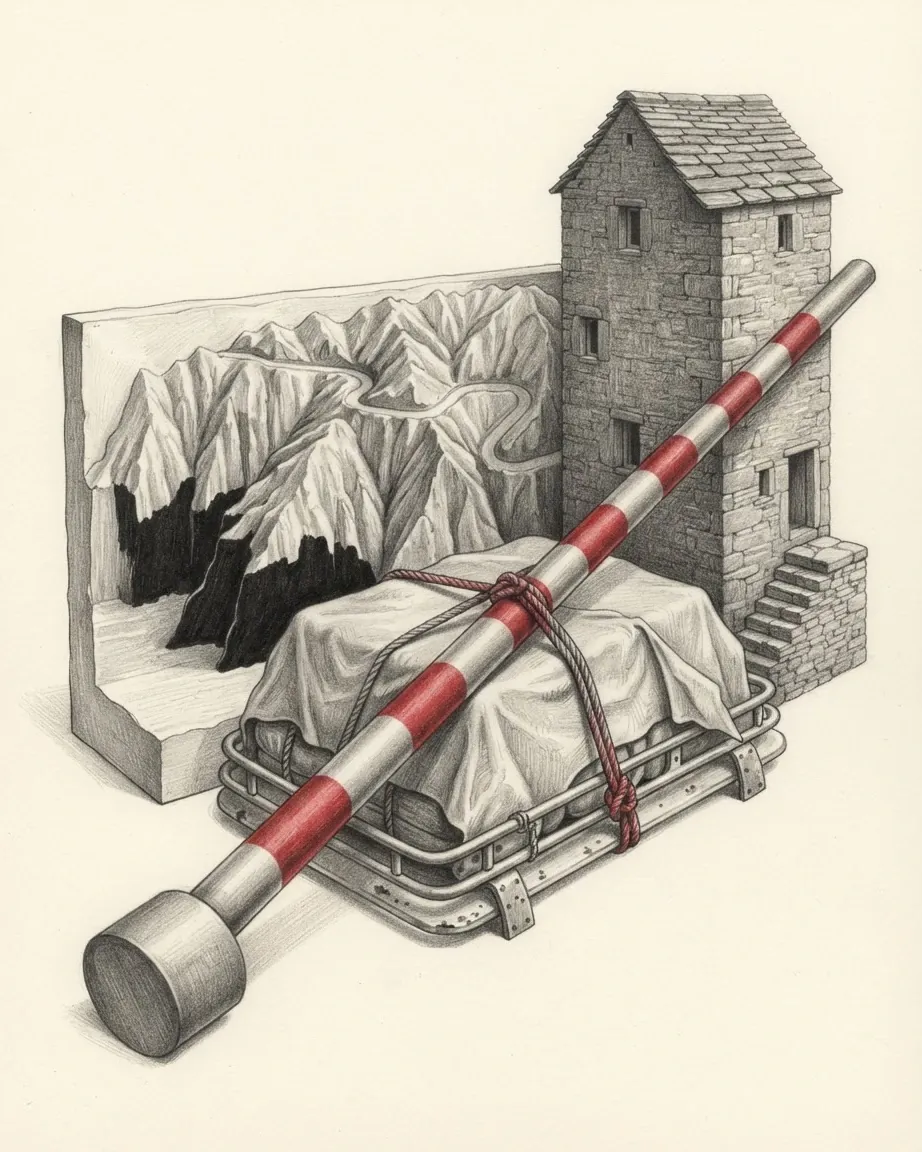
How Albania suspended its own constitution to clean out its courts
3 230 words · 15 min · updated 2026-09-10
 Back to Albania
An annex to Albania's constitution suspends parts of that constitution. Adopted in July 2016, it limits the articles protecting privacy, shifts the burden of proof onto the person being assessed, and subjects every sitting judge and prosecutor in the country to a re-evaluation that observers appointed by the European Commission sit inside. 47% of those assessed passed at first instance. Everything else in Albanian government, from the seats of the Kuvendi to the five ballots that can dissolve it, has been working around the hole that left.
In short
- Constitution
- approved by referendum on 22 November 1998
- Parliament
- the Kuvendi, one chamber, 140 deputies, four-year term
- Electoral system
- proportional in twelve districts, 1% national threshold
- Governing party
- Socialist Party, 83 of 140 seats since the 2025 election
- President
- elected by parliament over up to five ballots, five-year term
- Removing a prime minister
- only by electing a named replacement
- Judicial vetting
- every sitting judge and prosecutor re-evaluated from 2016
- Local government
- twelve counties, 61 municipalities since 2015
Why Albania suspended its own constitution
The text in force was approved by referendum on 22 November 1998 and promulgated six days later by President Rexhep Meidani, replacing an interim law on the main constitutional provisions passed in 1991 that had first sanctioned a multiparty system. Article 1 makes Albania a parliamentary republic and a unitary and indivisible state, Article 4 makes the constitution the highest law and directly applicable, and Article 7 sets the system of government on the separation and balancing of legislative, executive and judicial powers.
Article 10 sets the document apart from most of its neighbours. It states that there is no official religion, that the state is neutral in questions of belief and conscience, and that it recognises the equality of religious communities. A country whose Muslim majority is the inheritance of five centuries of Ottoman rule wrote religious neutrality into its basic principles instead of naming a faith.
Changing any of this is meant to be slow. A revision may be initiated by no fewer than one fifth of deputies and must be approved by no fewer than two thirds of all members. Parliament may send it to a referendum by a two thirds vote, and must send it if one fifth of members demand one. The president has no power to return a revision law for review, and once a revision is rejected the same question cannot be reopened for a year, or for three if the rejection came by referendum.
In July 2016 parliament turned that procedure on its own judiciary. Albania had applied for European Union membership on 28 April 2009 and received candidate status in June 2014, and reform of the courts was the condition attached to opening negotiations. Two amendments carry the weight. Article 6/1 forbids election or appointment to public office where circumstances impairing the integrity of the office holder are established under a law passed by three fifths of all members. Article 179/b orders a re-evaluation of the entire judiciary, in the words of the article, in order to re-establish the proper function of rule of law and true independence of the judicial system, and sends the detail to an annex headed Transitional Qualification Assessment.
The annex opens by limiting the constitution it is attached to. Article A states that, to the extent necessary to carry out the re-evaluation, the application range of some articles is partly limited: the privacy provisions at Articles 36 and 37, the provisions governing the burden of proof, and a list of articles on judicial tenure and the jurisdiction of the courts. The limitation was bounded by purpose and by clock. The commission running the process was given a five-year mandate, its appeal body nine years, and parliament was instructed to repeal the annex once the last decision became final.
How the vetting was run in practice
Nobody in the judiciary was exempt. Article 179/b subjects to re-evaluation, by force of the constitution itself, every judge including those of the Constitutional Court and the High Court, every prosecutor including the Prosecutor General, the inspectors of the High Council of Justice, and the legal advisers of the higher courts.
First instance sat as the Independent Qualification Commission, in four permanent panels of three members each. Two Public Commissioners could appeal a clearance as readily as the assessee could appeal a dismissal. Appeals went to a Specialized Qualification Chamber of seven judges deciding in panels of five, placed inside the Constitutional Court, which for the nine years of the transition consists of two chambers. Every assessee had three files opened at once.
| Assessment | What is examined | What triggers a presumption of dismissal |
|---|---|---|
| Assets | a new and fully detailed declaration, audited by the asset inspectorate | assets worth more than twice what legitimate income can justify, or steps taken to hide or misstate them |
| Background | a declaration covering the period from 1 January 2012 onwards | inappropriate contacts with persons involved in organised crime |
| Proficiency | judicial or prosecutorial capacity, organisational skill, ethics, personal quality | knowledge, skill or judgement inadequate to the post and unlikely to be remedied by a year of education |
The word presumption is the mechanism. In each assessment the adverse finding removes nobody by itself; it creates a presumption of the disciplinary measure of dismissal which the assessee carries the burden of dispelling. Income counts as legitimate only where it was declared and the tax on it paid, and a declaration filed late is dismissal without further argument. The reversal is fenced in by the same article that creates it: the shift of the burden of proof applies to this assessment alone, and the background declaration may never be used as evidence in a criminal case.
The proficiency track is the only one with a second chance. A deficiency judged remediable produces a year of suspension on 75% of salary and a course at the School of Magistrates designed against the specific weakness. The examination at the end is held under international supervision, and an assessee who fails it is dismissed.
Foreign officials were written into the process rather than consulted about it. The annex creates an International Monitoring Operation led by the European Commission, whose observers must have at least fifteen years of experience as judges or prosecutors in their own countries. They assess the candidates for the vetting bodies before parliament votes on them, may file findings, may ask the commission to take evidence or present evidence they have obtained themselves, and hold immediate access to all information, people and documents at every stage. An observer may recommend in writing that a Public Commissioner lodge an appeal, and a commissioner who declines must justify the refusal in writing. The working languages of all three bodies are Albanian and English.
The vetters were held to the standard they applied. Members of the commission and judges of the appeal chamber consent to yearly public disclosure of their assets, constant monitoring of their financial accounts and a waiver of privacy over communications connected to their work, and none could have been a judge, prosecutor or legal adviser in the two years before nomination.
Two exits were closed. An assessee who resigns during the procedure is assessed no further and is barred for fifteen years from serving as a judge or prosecutor at any level. The appeal chamber must decide each case rather than send it back, and may not call into question the constitutionality of the principles the re-evaluation rests on. Strasbourg stayed open. The European Court of Human Rights has since found parts of the process incompatible with the right to a fair hearing, in the case of a High Court judge dismissed in 2018 whose appeal was decided on the papers, in his absence and without a public hearing, on reasoning the court called excessively formalistic.
What the vetting cost the courts
Forty-seven per cent of those assessed passed at first instance, and many of the rest resigned rather than finish the process. The result was a judiciary with holes in it. By 2023 only 60.5% of the vacancies the vetting created had been filled, the backlog in second-instance courts grew, and the shortage was severe enough that cases were not always allocated at random. The Constitutional Court lost its quorum for a period after most of its judges resigned, leaving the country without the body that decides whether a law is constitutional. The High Judicial Council aims to fill the vacancies at the most understaffed courts by 2027 or 2028.
That council has its own bottleneck. It has eleven members: seven judges and prosecutors chosen by their peers, and four non-magistrates elected by parliament from a list already ranked by independent bodies. Election requires 84 votes out of 140, a majority the opposition can withhold, and the European Commission has criticised both the resulting delays and the lighter checks applied to the non-magistrate members. The Independent Qualification Commission ceased work in December 2024.
What the reform built alongside the vetting is the Special Structure against Corruption and Organized Crime, SPAK: a special prosecution office, a National Bureau of Investigation modelled on the American federal bureau, and dedicated courts of its own. Its convictions include a former prosecutor general and a former interior minister, and its investigations have reached a former prime minister. An amnesty law passed in April 2024 cut across it, releasing around 700 convicts and reducing more than 400 other sentences; 40 people convicted after SPAK investigations were fully amnestied, 65 had sentences reduced and 12 cases were dropped.
The scorecards record a state that has done the work and still has the problem. The World Bank's 2024 governance indicators put Albania at 54.9 for rule of law against 66.2 for political stability, and Transparency International scored the country 39 out of 100 in the 2025 Corruption Perceptions Index, ranking it 91st of 182. Freedom House rated Albania Partly Free in 2026 at 69 out of 100, calling elections competitive and the parties highly polarised and organised around personalities.
How Albanians choose a parliament
The Kuvendi has one chamber and has had two only once. The statute adopted by the Constitutional Assembly in 1925 gave the new republic a Chamber of Deputies of 57 elected members and a Senate of 18, one third of it appointed by the head of state, and the monarchy of 1928 replaced the arrangement. Every other Albanian legislature has sat as a single house.
Today that house has 140 deputies elected for four years by proportional representation in twelve multi-member districts corresponding to the counties. Seats are allocated by ranking the quotients produced when a party's vote is divided by successive divisors, and a party must clear a nationwide threshold of 1% to take a seat anywhere. Amendments to the electoral code passed in 2024 gave every party two lists per district: a closed list ordered by the party covering one third of the district's seats, and a preferential list in alphabetical order carrying exactly as many names as there are seats. Seats are filled from the closed list first, and only the remainder goes to candidates on preference votes. One in every three candidates on both lists must be of the less represented gender.
Small parties took the design to the Constitutional Court, arguing that it favours the two dominant parties and hollows out the preferential vote, and the court found it constitutional. The election observers were more pointed: because most mandates are allocated from closed lists whatever the open-list candidates poll, party leaders retain substantial control over who sits. The system was also amended close to polling day by agreement between the Socialists and the Democrats without public consultation, against the Venice Commission's advice that an electoral law should not be open to amendment less than a year before an election.
| The 2025 election | |
|---|---|
| Held | 11 May 2025 |
| Registered voters | 3.7 million, of whom 245,935 abroad by post |
| Turnout | 44.8% |
| Contestants | eight parties, three coalitions, 2,046 approved candidates |
| Socialist Party | 83 seats, up from 74 |
| Democratic Party-led Alliance for a Greater Albania | 50 seats |
| Women elected | 48 of 140, or 34.3%, as of December 2025 |
These were the first elections in which Albanians abroad could vote by post, and about 195,000 of them did; some 41,000 applications from abroad were rejected for want of acceptable proof of residence. Voting on 11 May 2025 ran through 5,225 voting centres in 93 administration zones, with biometric identification everywhere and electronic voting in two districts. The observation mission judged the elections competitive and professionally conducted, in a highly polarised environment where the contestants did not enjoy a level playing field, and recorded widespread use of administrative resources by the ruling party, pressure on public employees and vote-buying.
How a government is made and unmade
The president appoints as prime minister the person proposed by the party or coalition holding a majority of seats. If parliament refuses the appointee, the president names another within ten days; if parliament refuses again, it elects a prime minister itself within a further ten days, and failing that, the president dissolves it. The prime minister then has ten days to put the government's programme and its full composition to a vote.
Removing a prime minister works the other way round, and the asymmetry is the design. One fifth of deputies may table a motion of no confidence, but they must name a replacement in it, and parliament may carry the motion only by electing that replacement with the votes of more than half of all members. A majority that agrees the incumbent should go, without agreeing who follows, cannot remove him. The prime minister holds the opposite weapon: he may put a motion of confidence, and if fewer than half of all members vote for it he has 48 hours to demand a dissolution the president must grant within ten days.
Edi Rama has been prime minister since 2013, winning again in 2017, 2021 and 2025, which makes him the longest-serving head of government of the post-communist period. The Rama IV government was formed in September 2025, and in March 2026 he reshuffled it after dismissing the deputy prime minister and infrastructure minister, Belinda Balluku, during a corruption investigation; she denied wrongdoing. Between sittings the Council of Ministers can legislate alone in cases of necessity and emergency, issuing normative acts with the force of law that lapse retroactively unless parliament approves them within 45 days.
Politics outside the chamber has been loud throughout. The opposition resigned its parliamentary mandates in 2019 and boycotted that year's local elections, deputies disrupted a sitting in December 2025 over electoral fraud allegations and the Balluku case, and demonstrators clashed with police near parliament in February 2026. Later in 2026 a movement known as the Flamingo Revolution grew out of opposition to a luxury resort project linked to Jared Kushner near the Vjosa-Nartë Protected Landscape and Sazan Island, and widened into a campaign against public land transfers, strategic-investor legislation and opaque decision-making; the Financial Times reported on 20 June 2026 that tens of thousands had joined the protests. Albania: geography takes up the coast the argument is about.
Why electing a president can dissolve parliament
The Kuvendi chooses the head of state by secret ballot and without debate, from candidates each proposed by no fewer than twenty deputies. Parliament gets up to five rounds. In the first three a candidate needs three fifths of all members; in the fourth and fifth, more than half. The fifth is a run-off between the two candidates who polled highest in the fourth, with a lot drawn if there is a tie. If the fifth round produces nobody, or if no new candidate comes forward after a failed fourth, parliament is dissolved and a general election follows within 45 days, and the parliament that comes back elects the president by a simple majority of all its members.
A deadlocked chamber can therefore destroy itself over an office that has very little to do. The president promulgates laws, appoints the prime minister on the majority's proposal, and is commander in chief of the armed forces, which the constitution keeps neutral in political questions and under civilian control. The holder may not belong to a party, hold any other public post or carry on private business, and may be removed only on a proposal from a quarter of deputies, with two thirds of all members supporting it and the Constitutional Court finding culpability. Candidates must be Albanian by birth and at least 40 years old, and may serve two five-year terms. Bajram Begaj, a former chief of the general staff, has held the office since 24 July 2022.
Who runs the counties and the municipalities
The constitution founds local government on decentralisation and local autonomy, and the map beneath it has been redrawn twice since the fall of communism. Twelve counties were created on 31 July 2000, replacing the 36 districts that ceased to exist as administrative units the same year, and the territorial and administrative reform of 2015 abolished the communes and consolidated everything below the county into 61 municipalities, the old communes surviving inside them as administrative units, neighbourhoods and villages.
Municipalities are where local government happens: local services, urban planning and infrastructure, run by a directly elected mayor and a council elected every four years, for which only residents of the unit may stand. County councils are delegations rather than separate electorates. Municipalities send members in proportion to their population, always at least one, mayors sit by right, and the rest are elected from among municipal councillors by their own councils.
Each county also has a prefect appointed as the Council of Ministers' representative, who verifies the legality of the acts local bodies issue and monitors delegated functions. A United Nations review of the 2015 reform recorded the standing worry about it, that enlarged municipalities may not cope with the responsibilities transferred to them, and noted the consultative council of central and local government set up in 2017.
Where Albania looks for its partners
Foreign policy is run by the Ministry for Europe and Foreign Affairs, and its priorities have changed little since the 1990s: Euro-Atlantic integration, relations with the United States and the European Union, regional cooperation in the Western Balkans, support for the international recognition of Kosovo, and the protection of Albanians in neighbouring states. Albania joined the United Nations on 14 December 1955 and the Organisation of Islamic Cooperation in 1992, and sits in the Council of Europe.
NATO membership came in April 2009 and is treated as settled across the main parties. Accession to the European Union is the live project: the application went in that same month, candidate status followed in June 2014, the first intergovernmental conference opened in July 2022, and by November 2025 negotiations had been opened on all six clusters, the last being Cluster 5 on resources, agriculture and cohesion. Regionally, Albania takes part in the Berlin Process and promoted Open Balkan alongside Serbia and North Macedonia, an initiative criticised by some political actors in both Albania and Kosovo as weakening Kosovo's position or duplicating processes the European Union already runs.
All of which returns to the annex. A state that spent the twentieth century acquiring foreign protectors wrote a foreign monitoring operation into its own constitution, gave it access to every file in the judiciary and set an expiry date on it. When the appeal chamber closes in June 2026 the standard it enforced passes to ordinary Albanian institutions, the two judicial councils, the High Justice Inspector and the special courts, with no observers in the room. Albania: history sets out how the country got to that point, and Albania: economy what the accession the reform was for is expected to be worth.
Timeline
The dates in order
- 1912
- The National Assembly of Vlora declares independence and elects a provisional government under Ismail Qemali.
- 1925
- A Chamber of Deputies of 57 and a Senate of 18 give Albania its only bicameral parliament, replaced by the monarchy in 1928.
- 1991
- The first pluralist parliament in 67 years is elected on 31 March, with 250 members.
- 1998
- The present constitution is approved by referendum on 22 November and promulgated on 28 November.
- 2009
- Albania joins NATO in April and applies for European Union membership on 28 April.
- 2016
- Parliament amends the constitution in July and adds the annex ordering the re-evaluation of the judiciary.
- 2024
- The Independent Qualification Commission ceases work in December, first-instance vetting decisions complete.
- 2025
- The Socialist Party takes 83 of 140 seats on 11 May; the new parliament convenes on 12 September.
Common questions
Questions about Albania
What kind of government does Albania have?
A unitary parliamentary republic under the constitution approved by referendum in November 1998. The Kuvendi, a single chamber of 140 deputies elected for four years, holds legislative power; the Council of Ministers under the prime minister exercises executive power; and the president is head of state, elected by parliament rather than by voters.
Which system elects Albania's parliament?
By proportional representation in twelve multi-member districts corresponding to the counties, with a nationwide threshold of 1%. Since amendments passed in 2024, each party files two lists per district: a closed list ordered by the party covering one third of the district's seats, which is filled first, and a preferential list in alphabetical order for the remainder.
Who elects the president of Albania?
Parliament, by secret ballot and without debate, over up to five rounds. Three fifths of all members are needed in the first three rounds and more than half in the fourth and fifth. If the fifth round fails, parliament is dissolved and an election is held within 45 days, after which the new parliament elects the president by a simple majority.
What was the Albanian judicial vetting process?
A re-evaluation of every sitting judge and prosecutor, written into the constitution in 2016 and run by an Independent Qualification Commission with appeals to a specialised chamber, under an International Monitoring Operation led by the European Commission. Assets, background and professional competence were assessed, with the burden of proof placed on the person being assessed. 47% passed at first instance.