How to travel Iceland beyond the south-west corner
3 061 words · 14 min · updated 2026-09-10
 Back to Iceland
Close to six foreign visitors arrive for every person who lives in Iceland, and almost all of them land at one airport on a peninsula that has been erupting on and off since March 2021. The Icelandic Tourist Board counted 2,250,066 foreign departures through Keflavík in the twelve months to July 2026, with an average stay of 6.8 nights and 92.8% of them travelling on holiday. In July 2026, the busiest month of the year, the Capital Region and the South took 71% of every hotel night sold in the country.
In short
- Foreign departures through Keflavík
- 2,250,066 in the year to July 2026
- Share arriving through Keflavík
- 98.7% in 2025
- Average length of stay
- 6.8 nights in the year to July 2026
- Capital Region and South share of hotel nights
- 71% in July 2026
- Hotel occupancy swing
- 89.8% in August 2025, 43.0% in January 2026
- Ring road
- Route 1, 1,332 km, completed 1974, about thirty single-lane bridges
- Currency
- Icelandic króna
- Emergency number
- 112
- Driving
- on the right, vehicle code IS, no passenger railway
- Electricity
- 230 V, Europlug and Schuko
How many come and how long they stay
Close to six foreign visitors arrive for every person who lives in Iceland. The Icelandic Tourist Board, which counts departing passengers by hand at Keflavík before they reach the security check, recorded 2,250,066 foreign departures in the twelve months from August 2025 to July 2026, against a resident population of 376,248 at the start of 2022. That total was 1.7% below the same period a year earlier, and it was the fourth successive year above two million. The run reads 1,368,442 in 2021 to 2022, then 2,057,050, then 2,225,370, then 2,289,348, then 2,250,066.
The composition of that traffic is lopsided in a way that shapes everything downstream. The United States alone supplied 636,052 departures, 28.3% of the total, which is more than the next three markets put together. The United Kingdom followed with 244,637, Germany with 150,397 and China with 134,271. Ten countries account for 73.7% of everyone who leaves. The year-on-year movements are where the interest lies: Chinese departures rose 21.9%, Canadian ones 8.1% and Italian ones 5.2%, while American departures fell 4.0% and Polish ones 8.4%.
Almost nobody comes for a reason other than a holiday. Of the 2,250,066 departures counted in the year to July 2026, 2,088,016 or 92.8% gave a holiday as the main purpose of the visit. Another 65,252 were visiting friends or relatives, 45,001 came for health or educational reasons, and 29,251 on business. Underneath the tourist economy sits almost no business travel at all, which is why the seasonal swings described below land on the accommodation stock with nothing to cushion them.
The average stay over the year to July 2026 was 6.8 nights, and that national figure conceals a wide spread by market. German visitors averaged 8.8 nights and French visitors 8.7, Spanish visitors 8.1 and Italian visitors 7.4. British visitors averaged 4.9 and Americans 6.1, so the two largest markets are also the two shortest stays. The monthly average runs from 5.4 nights in the middle of winter up to 7.4 in autumn. Iceland is therefore visited for roughly twice as long as a central European city break, which is comfortably long enough to drive round the island, and the accommodation figures show that most of that time is spent within two hours of the airport.
| Figure | Value | Period |
|---|---|---|
| Foreign departures through Keflavík | 2,250,066 | August 2025 to July 2026 |
| Change on the previous year | down 1.7% | August 2025 to July 2026 |
| Share travelling on holiday | 92.8% | August 2025 to July 2026 |
| Average length of stay | 6.8 nights | August 2025 to July 2026 |
| Guest nights in registered accommodation | 9,922,496 | August 2025 to July 2026 |
| Largest market | United States, 636,052 | August 2025 to July 2026 |
Where the visitors actually go
Iceland has eight geographical regions and 103,125 square kilometres to spread them across. Two regions take most of the traffic.
In July 2026, the busiest month of the year, Statistics Iceland recorded approximately 648,335 hotel overnight stays in the country. The Capital Region took 281,401 of them and the South 180,107. Together that is 71% of every hotel night sold in Iceland in the one month when the whole island is open. The North took 70,630, the Southwest 47,687, the West and Westfjords together 46,654, and the East 21,856. The East, the region where the ferry from the Faroe Islands docks, took one hotel night in thirty.
The cause is mechanical rather than cultural. Around 2.27 million foreign visitors came through Keflavík International Airport in 2025, 98.7% of the total; 18,100 arrived on the Norröna ferry at Seyðisfjörður in the east, and an estimated 11,340 through Akureyri in the north. Keflavík stands 49 kilometres from the centre of Reykjavík on the Reykjanes peninsula, and the Blue Lagoon, the best known of the geothermal spas, is on that same peninsula a short drive from the terminal. A visitor who lands, bathes, drives the Golden Circle and flies home has covered a wedge of ground perhaps two hours across, and has done what the majority do.
Reykjavík has taken the pressure through its housing stock. Hotel rooms in the city rose 42% over a period in which visitor numbers rose 264%, and short-term rental platforms filled the gap, lifting residential property prices, pushing residents out of the central city and turning downtown amenities towards visitors. Hiking trails are degrading, roads now carrying tour buses routinely are deteriorating, and the moss at Þingvellir is regularly damaged by people walking on it. Akureyri saw cruise arrivals rise 91% between 2015 and 2019, and the local return was slight: cafés recorded a 3.5% lift in business on a cruise day and restaurants 1%. Cruise passengers count as day visitors and appear in none of the overnight figures above. About 322,000 of them landed at the Port of Reykjavík in 2024, the highest number the port has recorded, against 306,000 in 2023.
What the seasons do to the map
There are two tourist countries inside Iceland, and the calendar decides which one is open.
National hotel room occupancy reached 89.8% in August 2025 and 87.9% in July 2026. It fell to 45.3% in December 2025 and 43.0% in January 2026. The capital region held up far better in exactly those months, at 56.2% in January against the national 43.0%, and 57.7% in December against 45.3%. The gap between the two figures is the rest of the country, and in midwinter the rest of the country is close to shut.
Registered accommodation of every kind recorded 9,922,496 guest nights in the year to July 2026, a rise of 2.4%. Hotels took 54.9% of them, guesthouses 12.6% and other categories 32.5%, with that last group growing 8.8% while guesthouses shrank 3.5%. Foreign guests supplied 8,568,101 nights and Icelanders 1,354,395, and the domestic figure is the lowest of the past five years, against 1,588,437 in 2021 to 2022 and 1,420,653 in 2024 to 2025. In July 2026, foreign guests accounted for 92% of hotel nights, and Icelandic hotel nights fell 8.3% on the year.
The weather sets the shape of the year. The Icelandic Meteorological Office puts the summer tourist season from late May to early September, and through the first half of it the sun stays above the horizon for almost twenty-four hours. The same office warns that the sky is frequently cloudy or overcast even at midsummer and that the sunshine does not warm the air much, so daytime air stays cool and night air turns cold. A branch of the Gulf Stream keeps the island far milder than its position beside the Arctic Circle implies, at the price of frequent weather changes and storminess, and the south and west take more rain than the north. Reykjavík averages 12 °C in July and 1 °C in January. Winter brings long nights, severe storms and the aurora, which is what fills the capital in January while the countryside empties.
The packing list follows from that and is short. For summer: a windbreaker, rainwear, a thick wool or fleece pullover and sturdy walking shoes, with warm underwear, rubber boots and a warm sleeping bag for anyone camping or heading into the interior. For winter: warm clothing, a warm coat and mittens. In either season a swimsuit, because the geothermally heated pools are everywhere and are the one Icelandic institution a visitor can use daily.
| Month | National hotel occupancy | Capital region |
|---|---|---|
| August 2025 | 89.8% | 92.1% |
| October 2025 | 72.5% | 80.7% |
| December 2025 | 45.3% | 57.7% |
| January 2026 | 43.0% | 56.2% |
| April 2026 | 53.4% | 59.7% |
| July 2026 | 87.9% | 87.2% |
Why the ground keeps rearranging itself
The peninsula the airport stands on has been erupting since 2021, which makes it a planning question rather than a geological aside.
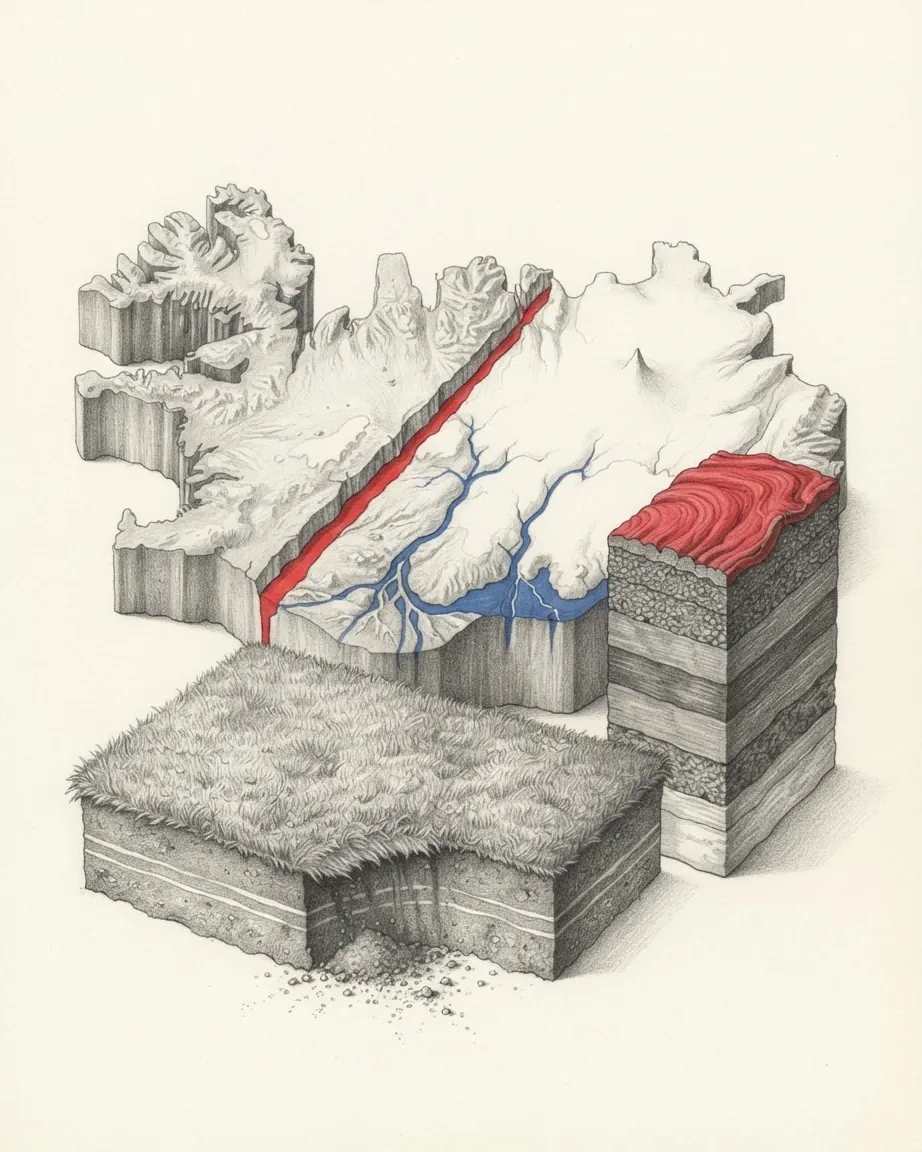
In February 2021 the Icelandic Meteorological Office recorded around 17,000 earthquakes in the Reykjanes region in a single week. A fissure opened near Fagradalsfjall on 19 March 2021, in the Geldingadalur area near Grindavík, and the 200-metre fissure first spotted from a coastguard helicopter had grown to 500 metres within hours. A near-identical eruption ran from 3 August to 21 August 2022. Another began at Litli-Hrútur on 10 July 2023. A fissure opened near Hagafell on 18 December 2023, and lava from that system destroyed three houses in the town of Grindavík in January 2024, with activity continuing into 2025.
The precedents for wider disruption are recent enough to matter to anyone holding a ticket. The eruption under Eyjafjallajökull in April 2010 closed the airspace of about twenty countries over six days and affected roughly ten million travellers. Grímsvötn in May 2011 disrupted about 900 flights. The Holuhraun eruption that began on 17 August 2014 ran for 180 days and was the largest in Iceland for 230 years; it threw out very little ash but produced large plumes of sulphur dioxide that affected breathing conditions across the country depending on the wind.
Iceland has hundreds of volcanoes and about thirty active volcanic systems, and across the past 500 years they have produced a third of the total global lava output. Two practical points follow. The first is that the Meteorological Office alert page belongs in the morning routine alongside the forecast. The second concerns walking on lava, which visitors do constantly and casually. Smooth pahoehoe, called helluhraun in Icelandic, forms surfaces that are quite easy to cross. Broken lava, apalhraun, has a loose, sharp, spiny surface where a foot slips into a hole and a leg breaks. The two look much alike in a photograph and behave completely differently underfoot.
How the ring road works
No passenger railway has ever operated in Iceland, and a single road carries almost all long-distance movement.
Route 1, the Hringvegur, was completed in 1974, runs 1,332 kilometres, is paved throughout, and carries one lane in each direction outside the larger towns. It crosses about thirty single-lane bridges, most of them in the southeast. The country holds 13,034 kilometres of administered road in total, of which 4,617 kilometres are paved and 8,338 kilometres are not. Speed limits are 30 and 50 km/h in towns, 80 km/h on gravel country roads and 90 km/h on hard surfaces. There is a car for every 1.5 inhabitants, and driving is the main form of transport for residents and visitors alike.
The interior offers no shortcut across the middle. The Highlands are about half the land area of the country, a mountainous lava desert rising to Hvannadalshnúkur at 2,110 metres, and they are uninhabited and largely uninhabitable. Glaciers cover 10.2% of the land, Vatnajökull alone accounting for 7,764 square kilometres. A four-wheel-drive vehicle widens the range of what can be reached, and roads anywhere in the country can be hard to navigate under snow or ice.
Public transport exists and thins out fast beyond the capital. Strætó runs both the Reykjavík city network and the long-distance coaches; Akureyri, Reykjanesbær and Selfoss have local services; and public and private buses connect Keflavík to the city. Flying is the fast alternative. Reykjavík Airport, 1.5 kilometres from the city centre, handles the domestic schedule, while Akureyri and Egilsstaðir take domestic traffic and limited international traffic, Akureyri having opened an expanded international terminal in 2024. There are 103 registered airports and airfields in the country, most of them unpaved and rural. The Smyril Line ship Norröna sails from Seyðisfjörður to the Faroe Islands and Denmark, which is the route for anyone bringing a vehicle.
What the protected landscapes hold
Iceland has three national parks, Vatnajökull, Snæfellsjökull and Þingvellir, and the first two of those carry World Heritage inscriptions. A fourth protected place, an island off the south coast, is closed to everybody but scientists.
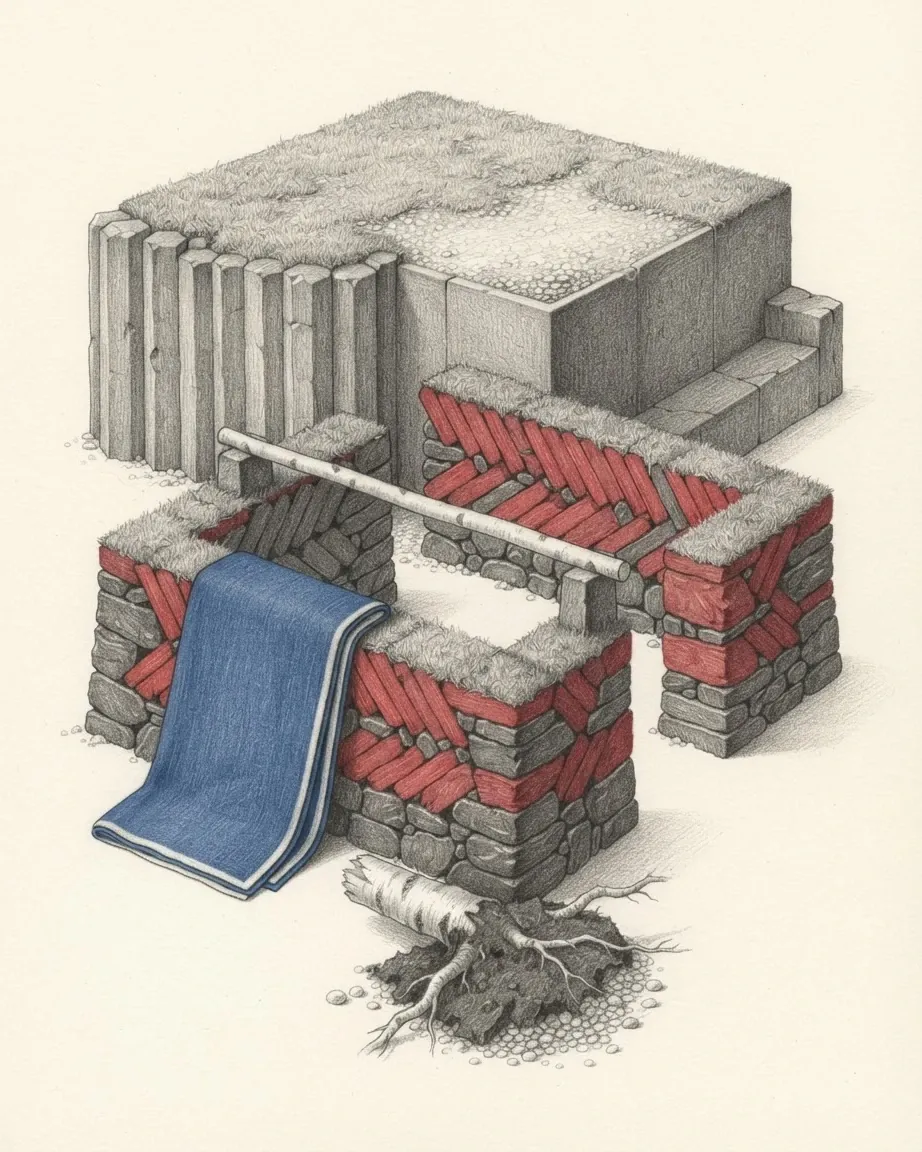
Þingvellir National Park was inscribed for the Althing, the open-air assembly representing the whole of Iceland, established in 930 and still meeting there in 1798. It sat for about two weeks a year, set laws understood as a covenant between free men, and settled disputes. What survives above ground is fragments of around fifty booths built of turf and stone, with tenth-century remains thought to lie buried beneath them, alongside traces of farming from the eighteenth and nineteenth centuries. The park is also where the rift is legible in the ground, forming a natural amphitheatre. A common misconception places Þingvellir on the join between the North American and Eurasian plates; it sits on the join between the North American plate and the smaller Hreppar microplate, an area of roughly 10,000 square kilometres.
Vatnajökull National Park was inscribed as the dynamic nature of fire and ice. It covers more than 1,400,000 hectares, nearly 14% of the territory of Iceland, and holds ten central volcanoes, eight of them under ice and two of those among the most active in the country. The characteristic event is the jökulhlaup, a sudden flood released when the margin of a glacier is breached during an eruption. Repeated over centuries, it has built the sandur plains, the river systems and the fast-changing canyons that give the southeast its appearance, and the volcanic areas shelter endemic groundwater fauna that survived the Ice Age.
That island is Surtsey. It rose out of the sea in a series of eruptions between 8 November 1963 and 5 June 1968, and access is restricted to scientists researching how life colonises new ground. It is worth knowing about precisely because it is the one place in Iceland that no amount of money opens.
Reykjavík itself carries a UNESCO designation of a different kind, joining the Creative Cities Network as a City of Literature in 2011. It is the most northerly capital in the world, holds about 200,000 people in its greater metropolitan area, and houses the Árni Magnússon Institute for Icelandic Studies, the centre for the sagas and other medieval manuscripts. The Harpa concert and conference hall on the harbour won the European Union's Mies van der Rohe Award in 2013.
What to eat and where to swim
Icelandic cooking rests on fish, lamb and dairy, with little or no use of herbs and spices. The climate kept fruit and vegetables out of the traditional repertoire, though greenhouses have since made them ordinary. The dishes worth knowing by name are skyr, a cheese with the texture of yoghurt; hákarl, cured shark; cured ram; singed sheep heads; black pudding; flatkaka; dried fish; and dark rye bread baked in the ground in geothermal areas. Þorramatur is the assembled winter selection of these, eaten around the month of Þorri, which begins on the first Friday after 19 January. Puffin is a local delicacy, usually broiled.
Drinking has its own history. The signature spirit is brennivín, a schnapps distilled from potatoes and flavoured with caraway seeds or angelica, whose strength earned it the nickname svarti dauði, black death. Strong beer was prohibited in Iceland until 1989, and the workaround during the ban was bjórlíki, legal low-alcohol pilsner mixed with vodka; Icelandic breweries now make several strong beers of their own. Modern distilleries turn out vodka under the name Reyka, gin as Ísafold, moss schnapps as Fjallagrasa, and birch schnapps and liqueur as Birkir and Björk.
The pools are the part of Icelandic daily life most easily joined. Geothermal spas and pools are found all around the country, the best known being Bláa Lónið, the Blue Lagoon, on the Reykjanes peninsula near the airport, and swimming is a widely practised sport in the country alongside tennis, chess and horseback riding, with football, athletics, handball and basketball the leading ones. Whale watching has been an important part of the economy since 1997, and commercial whaling is practised intermittently alongside scientific hunts, so the two industries work the same water. Puffins, skuas and black-legged kittiwakes nest on the sea cliffs. Ashore, the visible animals are the Icelandic sheep, the Icelandic horse and the Icelandic sheepdog, with Arctic foxes and reindeer in the wild and polar bears arriving occasionally on ice from Greenland without ever settling.
Why Iceland runs its own currency
The currency is the Icelandic króna, written ISK and abbreviated kr, and Iceland is the only country in the world with a population under two million to run a floating exchange rate and an independent monetary policy. A Capacent Gallup poll released on 5 March 2010 found 31% of respondents in favour of adopting the euro and 69% opposed, and a further poll in February 2012 found 67.4% would reject membership of the European Union in a referendum. Iceland belongs to the European Economic Area, joined on 1 January 1994, and to the Schengen Area, joined on 18 May 1999, so the border formalities are those of Schengen rather than those of a non-member state.
The country keeps a single time zone at Coordinated Universal Time all year and makes no seasonal change, which sharpens the contrast between the near-continuous daylight of June and the long darkness of December. The emergency number is 112. Icelandic sockets are 230 volts, Europlug and Schuko. Driving is on the right, the vehicle code is IS, and the international dialling code is +354. Icelandic is the language of the country and remains the closest of the modern Nordic languages to Old Norse.
Risk here is environmental rather than criminal. The listed natural hazards are volcanism, earthquakes, avalanches and glacial lake outburst flooding, the jökulhlaups described above. The United States places Iceland at its lowest travel advisory level, Exercise Normal Precautions, as checked on 31 August 2026. Intentional homicide ran at 1.3 per 100,000 people in 2023 and deaths from road traffic injury at 2 per 100,000 in 2019. The practical reading of those numbers is that the weather forecast and the volcano alerts deserve more attention than anything else. Iceland: geography sets out the ground the road runs over, and Iceland: culture takes up the sagas, the language and the literary institutions the capital is built around.
Common questions
Questions about Iceland
How many foreign visitors does Iceland count?
The Icelandic Tourist Board counted 2,250,066 foreign departures through Keflavík in the twelve months to July 2026, which is close to six for every resident. The figure was 1.7% down on the previous year, and 92.8% of those travellers gave a holiday as the main purpose of the visit.
Is it worth leaving Reykjavík and the south?
The figures argue for it. In July 2026, the peak month, the Capital Region and the South took 71% of the roughly 648,335 hotel overnight stays recorded in the country, while the East took 21,856 and the West and Westfjords together 46,654. Almost everybody arrives at Keflavík, 49 kilometres from Reykjavík, and never goes far from it.
Which season suits an Icelandic trip?
The Icelandic Meteorological Office puts the summer tourist season from late May to early September, and through the first half of it the sun stays above the horizon for almost twenty-four hours. Winter is the opposite trade: long nights, severe storms and the aurora, with national hotel occupancy at 43.0% in January 2026 against 89.8% in August 2025, so the countryside is close to shut while the capital stays busy.
Do the volcanoes affect travel in Iceland?
They do. The Reykjanes peninsula, where the international airport sits, has erupted repeatedly since a fissure opened near Fagradalsfjall on 19 March 2021, and lava from the Hagafell fissure of December 2023 destroyed three houses in Grindavík in January 2024. The wider precedent is Eyjafjallajökull in April 2010, which closed the airspace of about twenty countries for six days and affected roughly ten million travellers.
Does Iceland use the euro?
No. The currency is the Icelandic króna, and Iceland is the only country in the world with a population under two million to run a floating exchange rate and an independent monetary policy. It belongs to the European Economic Area since 1 January 1994 and to the Schengen Area since 18 May 1999, but not to the European Union.