How Finland got a state out of two empires
1 946 words · 9 min · updated 2026-09-10
 Back to Finland
A Finnish political identity and a distinctively Finnish politics first developed under Russian rule, which ran from 1809 to 1917, during which Finland held an autonomous position within the empire with its own legislative powers. Independence was declared on 6 December 1917, and the century that followed was spent keeping it.
In short
- Swedish rule
- from around 1100 to 1809
- Autonomous grand duchy under Russia
- 1809 to 1917
- Independence declared
- 6 December 1917
- First president
- K. J. Ståhlberg, 1919
- Winter War begins
- 30 November 1939
- Territory ceded
- Moscow Armistice of 1944, including Karelia and Petsamo
- European Union
- joined 1995
- NATO
- joined 4 April 2023
What came before the country
The territory that is now Finland spent the twelfth and thirteenth centuries as contested ground. The northern Baltic was violent, the Livonian Crusade was under way, and the Finnish tribes, among them the Tavastians and the Karelians, were in frequent conflict with Novgorod and with each other, while several crusades came from the west.
From that period the crown of Sweden began incorporating Finland, a process that ran from around 1100 to 1200 onwards, while Novgorod attempted to gain control from the east. Several wars followed between 1400 and 1700 in which Finland was fought over by Sweden, Novgorod, the Grand Duchy of Moscow and imperial Russia.
Six centuries of Swedish rule followed, and they left the institutions the country still has. Swedish law, Lutheran church organisation, a system of local self-government, land ownership by free peasants rather than by serfs, and Swedish as the language of administration and education all date from that period.
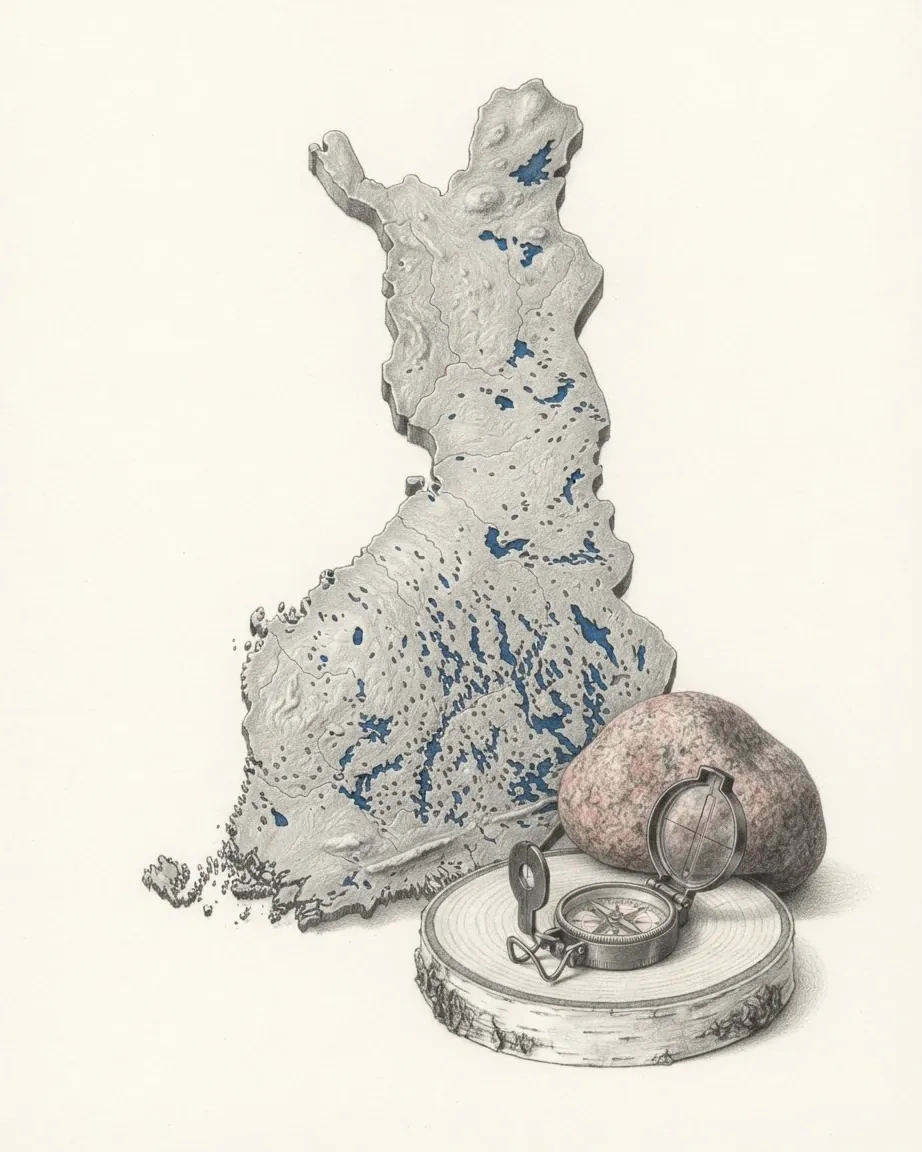
The eastern frontier moved throughout, which is the constant of Finnish history. A territory between two larger powers had its border adjusted by every war either of them fought, and Finland's map has never been stable for longer than a few generations at a time.
| The state through time | Date |
|---|---|
| Swedish incorporation begins | from around 1100 |
| Wars against Sweden, Novgorod, Moscow and Russia | 1400 to 1700 |
| Autonomous grand duchy under Russia | 1809 to 1917 |
| Independence declared | 6 December 1917 |
| Republican constitutional order | 17 July 1919 |
| Winter War begins | 30 November 1939 |
| Territory ceded under the Moscow Armistice | 1944 |
| European Union membership | 1995 |
| NATO membership | 4 April 2023 |
What Russian rule actually did
Russia took Finland from Sweden in 1809 and did something unexpected with it. Rather than absorbing the territory, the empire constituted it as an autonomous grand duchy with its own legislative powers, its own laws, its own currency and its own administration, though all significant decisions remained subject to imperial approval.
That arrangement is why a Finnish political identity and a distinctively Finnish politics developed during exactly this period. A territory with its own institutions and its own internal debate acquired the habits of self-government while remaining part of an empire, and the nineteenth century was spent building the cultural and administrative apparatus of a country that did not formally exist.
The language question was the substance of it. Swedish was the language of the state and Finnish the language of most of the population, and the movement to make Finnish a language of law, literature and science was simultaneously a cultural project and a political one, because it created a national public where none had existed, with newspapers, schools and courts operating in a language most people already spoke.
Russification attempts at the end of the century then converted a cultural movement into a political one. Efforts to bring the grand duchy under closer imperial control produced organised resistance, and by 1917 Finland had a national movement, functioning institutions and a reason to use them, which is a combination very few subject territories of that period could assemble.
How independence was won and nearly lost
Independence was declared on 6 December 1917, in the window opened by the Russian revolution, and it was immediately followed by a civil war between reds and whites that killed a large number of people in a few months and left divisions which took decades to close and which shaped party politics for two generations.
A brief experiment with monarchy came next. An attempt to make Prince Frederick Charles of Hesse the king of Finland failed, the German defeat that year removing the point of it, and a republican constitution was adopted instead. K. J. Ståhlberg was elected the first president in 1919, and the constitutional order was formally adopted on 17 July of that year.
The interwar republic held. It survived the civil war's aftermath, an authoritarian movement in the 1930s, and the economic conditions of the period, and by the end of the decade it had a functioning parliamentary system and a conscript army.
The interwar decades also settled the language question in law. Finnish and Swedish were made national languages on equal footing, which removed the most divisive domestic issue of the previous century from politics by giving both sides most of what they wanted, and the settlement has held with only minor adjustment since. A young state that had just fought a civil war chose not to fight a language war as well.
What it did not have was security. The Molotov-Ribbentrop Pact of 23 August 1939 divided Europe into spheres of influence between the Soviet Union and Nazi Germany, and Finland fell on the Soviet side of that line.
What the wars cost
In accordance with the pact, the Soviet Union launched the Winter War on 30 November 1939 in order to annex Finland. The country was not annexed. It fought a defensive campaign through an exceptionally cold winter against an enormously larger force, and the outcome was survival at a price.
The Continuation War followed, fought alongside Germany against the Soviet Union, and it ended in defeat. Under the Moscow Armistice of 1944 Finland ceded major land areas, including Karelia in the south-east and the Petsamo corridor that had given the country an Arctic Ocean coastline, and a substantial population had to be resettled from the ceded territory into the remaining country.
The terms went further than territory. Finland paid heavy reparations, largely in manufactured goods, which forced the development of metal and engineering industries that had not previously existed and which became the basis of the post-war economy. A punitive condition produced an industrial base, which is one of the stranger causal chains in twentieth-century European economic history.
Finland also fought a further campaign to expel German forces from Lapland, which was burned as they withdrew, so the northern towns a visitor sees today are almost entirely post-war construction, rebuilt to plans drawn in the 1940s.
The reconstruction that followed is the part of the period Finns are proudest of. A country that had lost a tenth of its territory, absorbed four hundred thousand refugees, paid reparations it could barely afford and fought a third campaign in its own north nonetheless held elections on schedule, kept its constitution, and had rebuilt to pre-war output levels within a decade.
What Karelia meant and still means
The territory ceded in 1944 was not empty ground. Karelia held around a tenth of the country's population, a substantial share of its industry and farmland, and the second city of the pre-war state, and the entire population left rather than remain under Soviet rule.
Resettling roughly four hundred thousand people into a country of under four million, while paying reparations and demobilising an army, is a logistical problem few states have faced at that scale. It was done by legislation that compulsorily purchased land from existing farmers to settle the displaced, which spread the cost across the whole society rather than leaving it with those who had lost everything.
The cultural consequences ran deeper than the economic ones. Karelia was the region the Kalevala had been collected in, the heartland of the Orthodox minority, and the source of a dialect, a cuisine and a set of traditions that were dispersed across the rest of the country with the people who carried them.
The territory has never been returned and the question of asking for it back surfaces periodically without going anywhere. What the loss produced instead was a settled national understanding that the border is where it is, that arguing about it is dangerous, and that the effort belongs elsewhere.
What the reparations built
The armistice terms required payment in goods rather than money, and the goods specified were machinery, ships and cable rather than the timber and paper Finland actually produced.
That was intended as a burden and functioned as an industrial policy. Finland had to build metalworking, shipbuilding and engineering capacity from a low base and to a deadline, financed domestically, and the plants constructed to meet the schedule did not disappear when the payments ended in the early 1950s.
What remained was an engineering sector with skills, equipment and a large customer next door. The bilateral clearing trade that followed exchanged Finnish machinery, ships and consumer goods for Soviet oil and raw materials, on terms that were reliable and politically useful to both sides, and it lasted until the Soviet Union did.
The two facts fit together in an uncomfortable way. The industrial base that made post-war Finland prosperous was created by a punitive settlement and sustained by trade with the state that imposed it, and when that state collapsed the sector it had built collapsed with it, which is the recession described in the economy article.
What the Cold War required
Finland kept its independence, its democracy and its market economy, which no other country bordering the Soviet Union in Europe managed, and the price was a foreign policy constrained by that neighbour for half a century.
The arrangement worked by not being tested. Finland maintained strict neutrality, avoided alliances, traded extensively with the Soviet Union under a bilateral clearing system, and avoided any position in international affairs that could be read as hostile, while remaining a Nordic democracy with a free press and free elections domestically.
What that cost is argued about. The practice of anticipating Soviet objections and adjusting domestic debate accordingly acquired a name abroad and is remembered inside the country with some discomfort, and the counter-argument is that it preserved everything that mattered while every neighbour on the same side of the line lost all of it.
Finland joined the United Nations and the Nordic Council in 1955, the OECD in 1969 and the Council of Europe in 1989, so the westward alignment was under way well before the Soviet Union ended, in every area where it was possible without provoking the neighbour.
What changed when the constraint lifted
The collapse of the Soviet Union removed the constraint and removed the trade at the same time. The bilateral clearing arrangement vanished, taking a large share of Finnish exports with it, and combined with a banking crisis and macroeconomic error it produced the deepest recession in modern Finnish history.
The reorientation was rapid. Finland joined the European Union in 1995 and adopted the euro in 2002, becoming the only Nordic country in the eurozone, and it built a technology sector that briefly made mobile telephony the country's signature industry.
Military non-alignment survived all of that and did not survive 2022. Finnish support for NATO membership had shown a narrow but decisive majority against before February of that year; by April a supermajority was in favour, and the country signed a mutual security arrangement in May and joined the alliance on 4 April 2023.
The border is where the whole history is legible. A frontier that moved with every war between two empires, that was fixed by force in 1944, that was a trading route for fifty years and is now closed, runs 1,300 kilometres through forest, and it is the reason a country of five and a half million maintains universal male conscription and a wartime strength most European states abandoned decades ago and are now trying to rebuild. Finland: politics takes up the institutions that resulted.
Timeline
The dates in order
- 1150
- The crown of Sweden begins incorporating Finland while Novgorod contests it from the east.
- 1809
- Russia takes Finland from Sweden and constitutes it as an autonomous grand duchy with its own legislative powers.
- 1852
- The first Finnish opera is written, and a national cultural movement gathers through the century.
- 1917
- Independence is declared on 6 December, followed by civil war.
- 1919
- A republican constitutional order is adopted on 17 July and K. J. Ståhlberg becomes first president.
- 1939
- The Soviet Union launches the Winter War on 30 November under the Molotov-Ribbentrop Pact.
- 1944
- The Moscow Armistice cedes Karelia and Petsamo and imposes heavy reparations.
- 1955
- Finland joins the United Nations and the Nordic Council.
- 1995
- Finland joins the European Union.
- 2002
- The euro replaces the markka.
- 2023
- Finland joins NATO on 4 April.
Common questions
Questions about Finland
What made Finland independent?
On 6 December 1917, in the window opened by the Russian revolution, after more than a century as an autonomous grand duchy within the Russian Empire from 1809. A civil war followed immediately, and a republican constitutional order was adopted on 17 July 1919.
What was the Winter War?
The campaign launched by the Soviet Union on 30 November 1939 to annex Finland, in accordance with the Molotov-Ribbentrop Pact of 23 August that year which divided Europe into spheres of influence. Finland was not annexed, and survived as an independent state at the cost of territory.
What did Finland lose in 1944?
Major land areas under the Moscow Armistice, including Karelia in the south-east and the Petsamo corridor that had given the country an Arctic Ocean coastline, together with heavy reparations paid largely in manufactured goods. A substantial population had to be resettled from the ceded territory.
Why did Finland stay neutral during the Cold War?
Because it shared a very long border with the Soviet Union and had already fought two wars against it. Finland kept its independence, democracy and market economy, which no other European country bordering the Soviet Union managed, at the cost of a foreign policy constrained by that neighbour for half a century.