How one small country produced three separate high points in painting
1 918 words · 9 min · updated 2026-09-10
 Back to Belgium
Belgian culture divides along the same language line as everything else, and the things it is known for abroad are the ones that crossed it. Painting is the clearest: Mosan art, Early Netherlandish painting, the Flemish Renaissance and Baroque painting are milestones in the history of art, all produced in the same small territory centuries before a Belgian state existed.
In short
- Official languages
- Dutch, French, German
- Cultural competence
- held by the communities, not the federal state
- Painting milestones
- Mosan, Early Netherlandish, Flemish Renaissance, Baroque
- Comic tradition
- Tintin, the Smurfs, Spirou, Lucky Luke
- Gastronomy
- beer, fries, chocolate, waffles
- World Heritage properties
- 16: fifteen cultural, one natural
- Distinctive urban heritage
- belfries and béguinages
- Notable painters
- Ensor, Permeke, Delvaux, Magritte
What a culture without a nation looks like
Belgium has three official languages, Dutch, French and German, and a cultural life that operates in the first two almost entirely separately. Newspapers, broadcasters, universities, publishers, theatre companies and arts funding all exist in Dutch-speaking and French-speaking versions, and a novelist or presenter in one has little professional contact with the other.
That separation is institutional rather than hostile, and it is the direct result of the constitutional settlement, which assigns culture and education to the communities rather than to the federal state. A country that decided its culture belonged to its language groups now has two of them.
What is described abroad as Belgian culture is therefore mostly the parts that predate the division or ignore it. The painting, the comics, the beer and the food travel under a single label because they were produced before the language question was settled, or because they are objects rather than texts and need no translation.
The imported view has a further distortion. Foreigners take Belgian culture to mean Brussels, Bruges and a set of consumable products, and the substantial French-language and Dutch-language literary, theatrical and musical cultures are almost invisible outside their own language areas.
Why the painting matters so much
Belgium's contributions to painting have been unusually rich, and the account of them lists four separate milestones in the history of art: Mosan art, Early Netherlandish painting, the Flemish Renaissance and Baroque painting. Each is a distinct period and each was produced in the same small territory.
Fifteenth-century art in the Low Countries is dominated by religious subject matter and by a technical revolution in oil painting that changed how light and fabric could be represented. The cities that produced it, Bruges, Ghent and Brussels among them, were rich enough to commission on that scale, and the patronage came from merchants and guilds as much as from courts.
The Baroque period produced the Antwerp school and a workshop model of painting on an industrial scale, exported across Catholic Europe. That was a business as much as an art movement, and it is one reason so much of the work left the country.
The nineteenth and twentieth centuries produced expressionist and surrealist painters including James Ensor and the other artists of the Les XX group, Constant Permeke, Paul Delvaux and René Magritte, and the avant-garde CoBrA movement afterwards. Magritte's images in particular were reproduced past the point of recognition, and the Royal Museums of Fine Arts in Brussels hold a large collection of his work alongside art of many other periods.
| Layer | Period |
|---|---|
| Mosan art | Romanesque, Meuse valley |
| Early Netherlandish painting | 15th century |
| Flemish Renaissance | 16th century |
| Baroque painting | 17th century, centred on Antwerp |
| Expressionism and surrealism | 19th and 20th centuries |
| Comic strip tradition | 20th century onwards |
What the comics did
The comic strip tradition is treated in Belgium as a serious art form with institutions attached, and the characters it produced are known worldwide: Tintin, the Smurfs, Spirou and Fantasio, Marsupilami and Lucky Luke among them.
The reason the form developed here rather than elsewhere is partly commercial and partly linguistic. Weekly magazines serialising comics reached a large francophone readership across Belgium and France, publishers were based in Brussels, and the studio system that grew around them trained several generations of artists in a house style with defined standards of drawing and page composition that were taught rather than improvised.
The consequence is a country where comics are shelved in bookshops as literature, taught in art schools, collected by museums and painted on the sides of buildings in the capital. A visitor walking through Brussels passes murals of characters that most other countries would treat as material for children.
The tradition also survived its own success. The classic albums are still in print and still selling, and the contemporary Franco-Belgian scene produces work for adult readers that has nothing to do with the characters the country is known for.
What the music and the stage carry
The musical tradition is older than the country by centuries and is one of the parts most completely detached from modern Belgian identity. The composers of the Franco-Flemish school dominated European polyphony for roughly two hundred years from the fifteenth century, working across the courts and chapels of the continent, and they are studied as Netherlandish rather than as Belgian for the good reason that Belgium did not exist.
The modern institutions belong to the communities like everything else. Each language area maintains its own orchestras, opera houses, conservatories and festivals, funded separately and programmed separately, and the two circuits overlap mainly in Brussels where both operate.
Theatre and dance are where contemporary Belgium has the strongest international reputation, and it is a recent one. Flemish and francophone companies working in physical theatre, contemporary dance and devised work built a presence on the European festival circuit from the 1980s onwards, and the country now exports performance in a way it did not for most of the twentieth century.
The pattern is worth noticing because it inverts the usual one. In painting and comics the reputation rests on historical work; in performance it rests on companies currently touring, and those companies are largely unknown to the general public in the other language community of their own country.
How religion shaped the map and stopped
Belgium was a Catholic country in the way Austria or Ireland were: the church ran education and welfare and much of social life, Catholic parties dominated politics for long periods, and the religious question structured the party system alongside language and class.
The physical inheritance is everywhere. Abbeys, béguinages, cathedrals, monastic breweries and the church schools that still educate a large share of pupils under public funding are all products of that period, and the school network in particular remains a substantial institution with its own place in the constitutional settlement.
Practice collapsed within two generations. Regular attendance fell steeply from the 1960s onwards, the country legislated liberal positions on questions the church opposed, and religious identification is now a minority position across both language communities.
What survived is the calendar and the buildings rather than the belief. Public holidays follow the Catholic year, the abbey breweries operate under religious authority, and the parallel school network continues, in a country where the number of people who attend a service in a given week is small. Belgium: history works through how the church's political role ended.
What is on the table
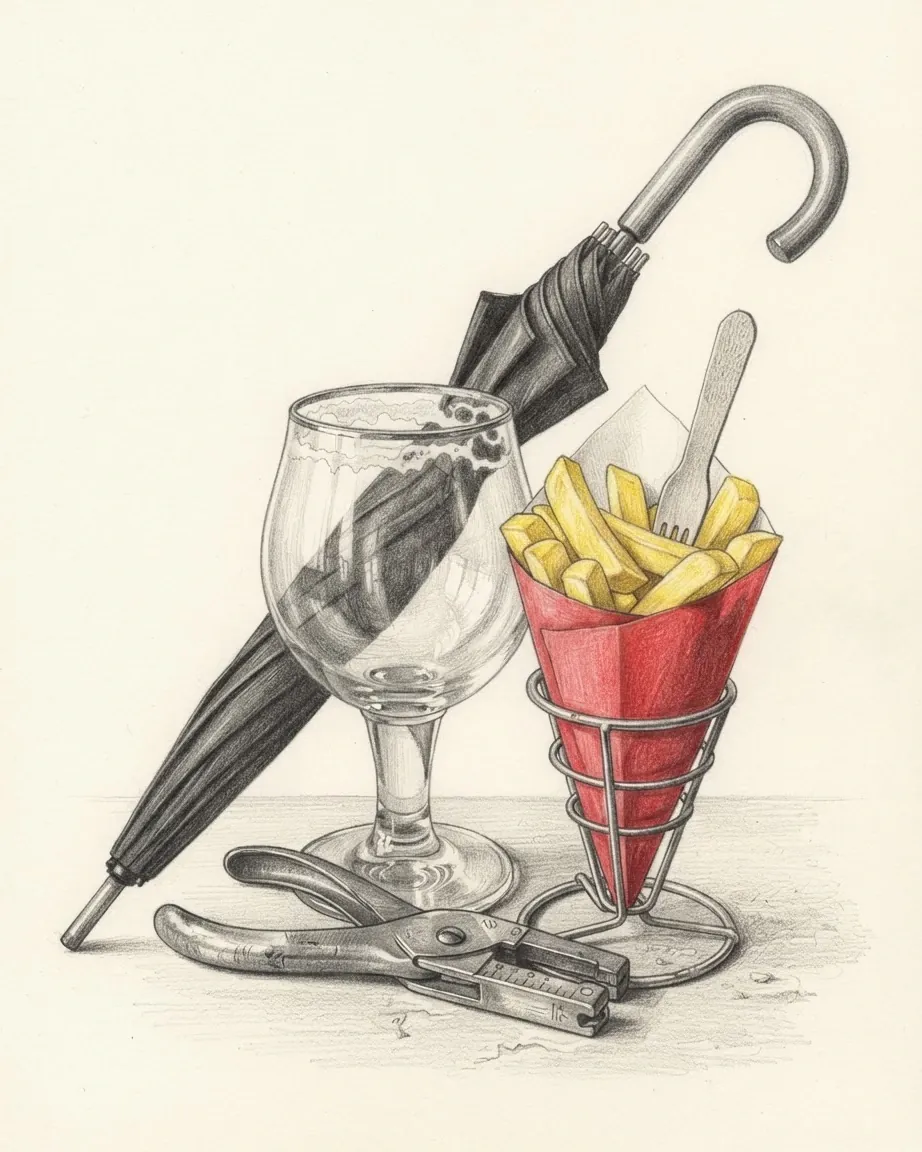
Belgian gastronomy is the most exported part of the culture and the list is short and specific: beers, fries, chocolate and waffles.
Beer is the one with real depth, and it is the product most often used to explain the country to outsiders. Belgium brews in a range of styles found nowhere else, including spontaneously fermented beers that depend on wild yeasts in a particular region and cannot be reproduced elsewhere, and monastic breweries operating under rules about who may brew and where. The variety is a product of the same fragmentation as everything else: hundreds of small breweries, each with its own tradition, in a country that never centralised.
Fries and chocolate are the popular exports and both are more Belgian than their reputation abroad allows. Fries are sold from dedicated stands, eaten with a wide range of sauces and treated as a national dish rather than a side, and the chocolate industry is built on a manufacturing and retail tradition rather than on cocoa the country does not grow, which is the transit economy appearing in a shop window.
The restaurant culture underneath is more substantial than the tourist products suggest. Belgian cooking draws on French technique and Flemish ingredients, the country supports a dense network of serious restaurants for its size, and the seafood of the coast, the mussels eaten across the country in season, and the game and beer-based stews of the interior are the regional traditions worth seeking out.
What the buildings say
Belgian architecture records the same history as the painting, and the World Heritage list is where it is concentrated. The country holds 16 properties, fifteen cultural and one natural.
The medieval urban entries are the distinctive group. Belfries, the towers built by towns rather than by lords or bishops, are inscribed as a group and are the physical statement of medieval urban independence: a town that could build its own tower and hang its own bell in it was governing itself. The béguinages, walled communities of religious women who took no permanent vows, are a form of settlement that existed almost nowhere else.
The Meuse and Scheldt valleys hold the industrial entries, and Art Nouveau in Brussels holds the modern one, in the town houses built around the turn of the twentieth century by architects who treated a private commission as a complete design problem down to the door handles. Those houses were built for a professional bourgeoisie in a city growing fast on industrial and colonial money, and a substantial number were demolished in the decades after the war before anyone decided they were worth keeping.
What links them is scale. Almost nothing on the Belgian list is monumental in the way a cathedral or a palace is monumental, and most of it was built by towns, guilds, communities and private clients rather than by a state that did not exist. A heritage list assembled from civic and private building rather than from royal and national projects is a fair record of how the territory was actually governed for most of its history: by cities that were rich before they were anyone's subjects.
What the two literatures do
Belgium has produced writers in both languages, and they are counted as Belgian abroad and as part of separate traditions at home.
The names include the poets Emile Verhaeren, Guido Gezelle and Robert Goffin, and the novelists Hendrik Conscience, Stijn Streuvels, Georges Simenon, Suzanne Lilar, Hugo Claus and Amélie Nothomb, with the poet and playwright Maurice Maeterlinck among the most internationally recognised. That list runs across both languages and two centuries.
The Dutch-language literature of Belgium sits inside a wider Dutch-language world it shares with the Netherlands, and the French-language literature sits inside a francophone world dominated by Paris. Each is therefore a minority within a larger linguistic market rather than the national literature of a country, which shapes what gets published, what gets prizes and where a writer builds a career.
Simenon is the clearest case of what follows. A Belgian writing in French, published in Paris, read worldwide, and claimed by both the country he came from and the literary culture he worked in. That double belonging is the normal condition of Belgian cultural production rather than an exception to it, and it is why the question of what counts as Belgian culture has no settled answer inside the country and a very confident one outside it, where the label is applied to whatever crossed the border regardless of which half of Belgium produced it. Belgium: politics covers the settlement that divided the institutions and Belgium: travel where the buildings and collections are.
Common questions
Questions about Belgium
Is there one Belgian culture?
Institutionally, no. Culture and education belong to the language communities rather than to the federal state, so broadcasters, universities, publishers, theatre and arts funding all exist in separate Dutch-speaking and French-speaking versions. What is known abroad as Belgian culture is largely what predates that division or needs no translation.
Why does Belgian painting matter?
Because the same small territory produced four separate milestones in the history of art: Mosan art, Early Netherlandish painting, the Flemish Renaissance and Baroque painting, followed in the modern period by expressionists and surrealists including James Ensor, Paul Delvaux and René Magritte.
Why are comics taken seriously in Belgium?
Weekly magazines serialising comics reached a large francophone readership across Belgium and France, publishers were based in Brussels, and a studio system trained several generations of artists. The form is now shelved as literature, taught in art schools, collected by museums and painted on buildings in the capital.
What is Belgian beer?
A brewing tradition of unusual variety, including spontaneously fermented beers that depend on wild yeasts in a particular region and cannot be reproduced elsewhere, and monastic breweries operating under rules about who may brew and where. The diversity follows from the same fragmentation as the rest of the country: hundreds of small breweries that never centralised.