The flag of Switzerland
Schweizerfahne · since 1889
 Back to Switzerland
A square red field with a free-standing white cross whose arms are each one sixth longer than they are wide. The white cross was the field sign of the Old Confederacy from 1339, and the Federal Assembly fixed its shape in 1889; the law of 2013 made the square form compulsory, fixed the cross at 5:8 of the flag and set the red in Pantone. Only ships, boats and aircraft fly it at 2:3.

At a glance
- Adopted
- 1889
- Proportion
- 1:1
- Colours
- Earlier flags
- 4
- Designers
- 2
The colours
The colours of the flag of Switzerland, in the order it has them
- 0180.1%
Red
rotThe field
- HEX
#FF0000- RGB
255 0 0- CMYK
0 100 100 0- Pantone
485 C
- 0219.9%
White
weissThe cross
- HEX
#FFFFFF- RGB
255 255 255
No law gives these codes. HEX and RGB are the colour this site draws the flag in; CMYK, Pantone and RAL are the values most often published for it.
Construction
How the flag is drawn
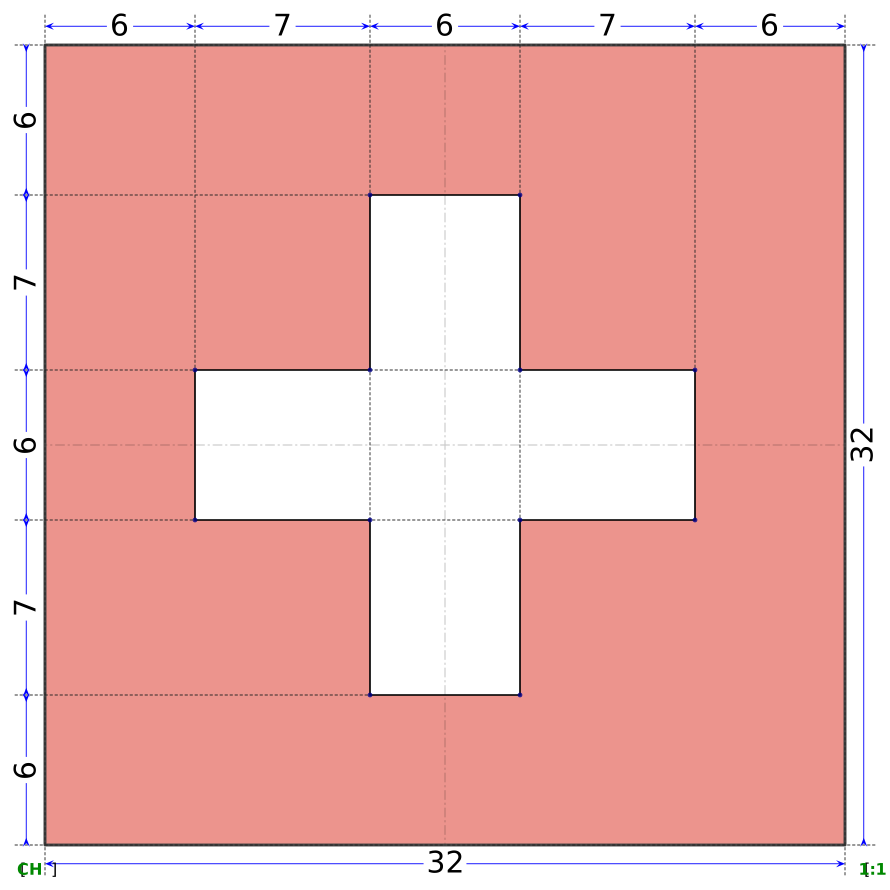
A square red field with an upright white cross in the centre, its four equal arms each one sixth longer than wide, the cross standing one arm's width in from every edge.
- Cross arms
- Each one sixth longer than wide: 6 wide, 7 long
- Cross
- Each bar 6 by 20
- Margin
- One bar width between the cross and every edge, so the cross spans 5/8 of the flag
- At sea and in the air
- 2:3
Other forms
- Flag at sea
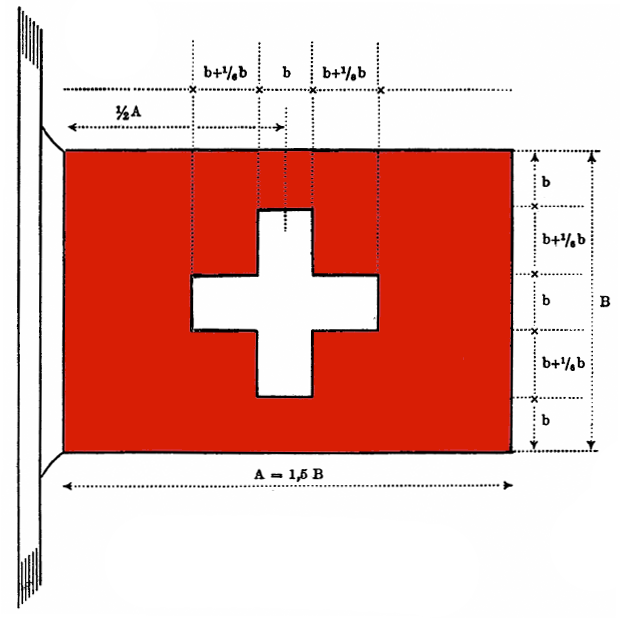
- The same cross on a rectangular red field at 2:3, flown by Swiss seagoing ships since 17 April 1941, by the army's patrol boats and by Swiss-registered aircraft. Ships on Lake Constance had flown a flag of about 2:3 since 1911.
Meaning
What each part stands for
- White cross
- In the words of the Federal Council in 1889, both the Christian cross and the field sign of the Old Confederacy. Its origin is unclear; one reading links it to the legendary Theban Legion
- Red field
- Came from flags whose colour was red, the flag of the canton of Schwyz above all
Who drew it
- Carl Stauffer
- Drew the federal military flag announced to the cantons on 11 October 1841, the free-standing cross on a square red field
- Guillaume-Henri Dufour
- General who proposed a single flag for all federal troops in 1839
History
How the flag of Switzerland got here
- 1339
The field sign of the Confederates
1339 → 1798
At Laupen in 1339 the Confederates wore white linen crosses on their clothing, the earliest documented use of the Swiss cross. Between 1450 and 1520 the white cross became their common mark, at first narrow and often running to the edges; the red field came from flags like that of Schwyz. The first pictures of it as a flag are in the Lucerne Chronicle of 1513.
- 1798
Helvetic Republic
1798 → 1803
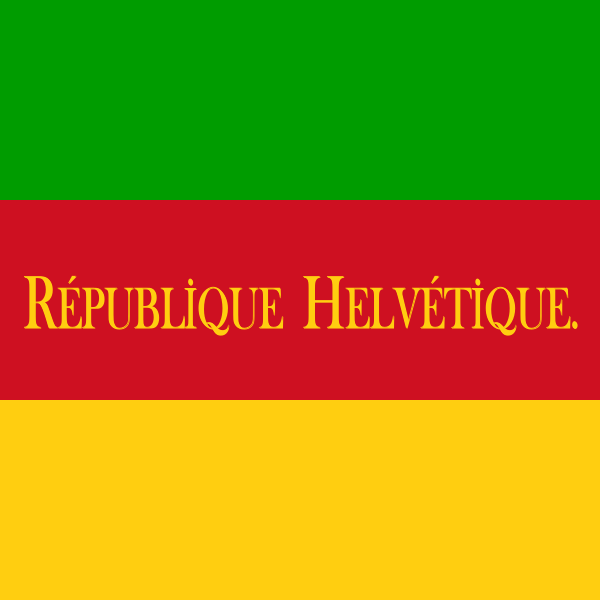
The French-backed republic confiscated the old flags and introduced a green, red and yellow tricolour, officially from 13 February 1799.
- 1815
The cross becomes the federal arms
1815 → 1841
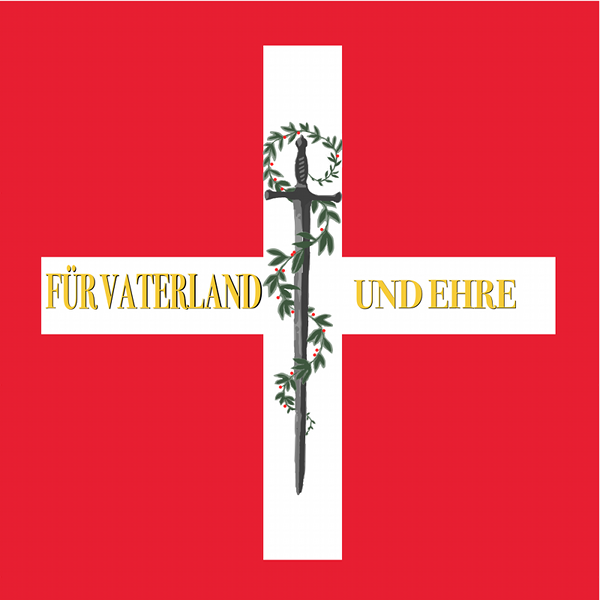
The white cross on red became the seal and arms of the Confederation in 1815. Cantonal troops under federal command wore it on an armband from 3 July 1815, and it appeared free-standing on federal battalion flags, while cantonal contingents kept their own.
Image: Dbachmann, CC BY-SA 4.0
- 1841
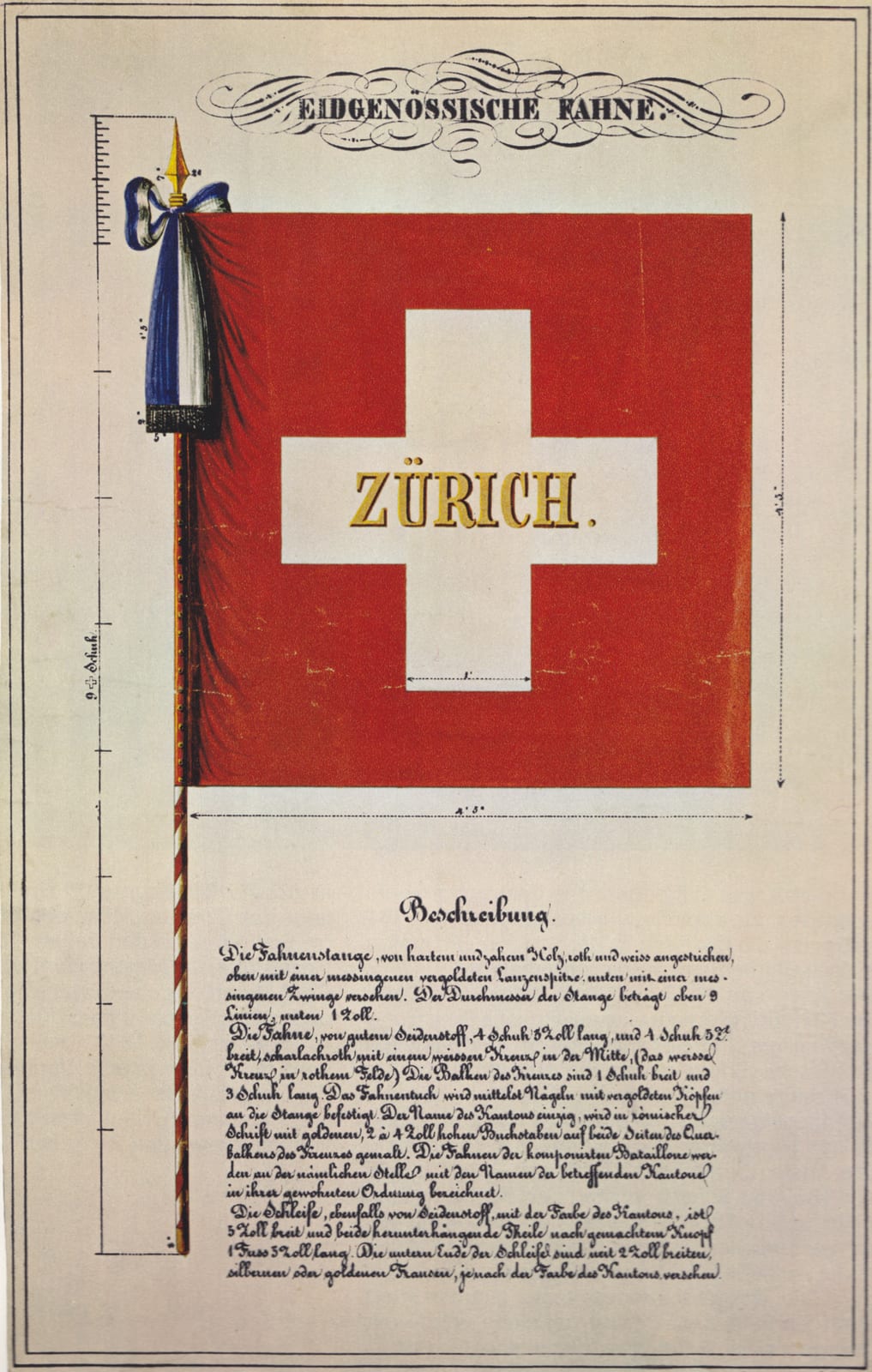
The federal military flag
11 Oct 1841 → 12 Dec 1889
The Diet agreed on a single flag for cantonal infantry in 1839 and adopted Stauffer's design in 1841: a bold cross of five equal squares on a square field, the cross two thirds of the flag's width. The federal state took it over in 1848, and the last flame-pattern flags of the Landwehr went in 1865.
- 1889

The cross of 1889In use
12 Dec 1889 → today
The Federal Assembly fixed the arms of the cross at one sixth longer than wide; a petition of more than 50,000 citizens in 1890 to return to the cross of five squares failed. The law of 2013, in force from 2017, made the square flag compulsory and fixed the cross at 5:8 of it.
The law
What defines it, and who flies it
- 12 December 1889
Federal Decree on the federal coat of arms (SR 111)
A white, upright, free-standing cross on red, its equal arms each one sixth longer than wide. The drawing attached was not binding, and the flag itself was not defined.
- 23 September 1953
Federal Act on maritime navigation under the Swiss flag, Annex 1
Defines the flag at sea at 2:3, to be flown only by ships registered in Switzerland.
- 21 June 2013
Federal Act on the protection of the Swiss coat of arms and other public signs (Wappenschutzgesetz, SR 232.21), Articles 1 to 3 and Annexes 1 and 2
In force since 1 January 2017. Makes the square form compulsory except on ships, fixes the size of the cross by a binding drawing, and sets the red.
In use
Flown through the year on private and commercial buildings, often beside the cantonal and municipal flags, and everywhere on National Day, 1 August
Public buildings follow no uniform rule; the flag flies on the cupola of the Federal Palace in Bern while the Federal Assembly sits
Destroying, removing or desecrating a flag put up by a public authority is punishable by a fine or up to three years in prison
Commercial use of the flag is allowed if it is neither misleading nor contrary to public order, morality or the law; the coat of arms is reserved
Coat of arms
The arms of Switzerland