Nicaragua's history: the route across that was never dug
3 184 words · 14 min · updated 2026-10-04
 Back to Nicaragua
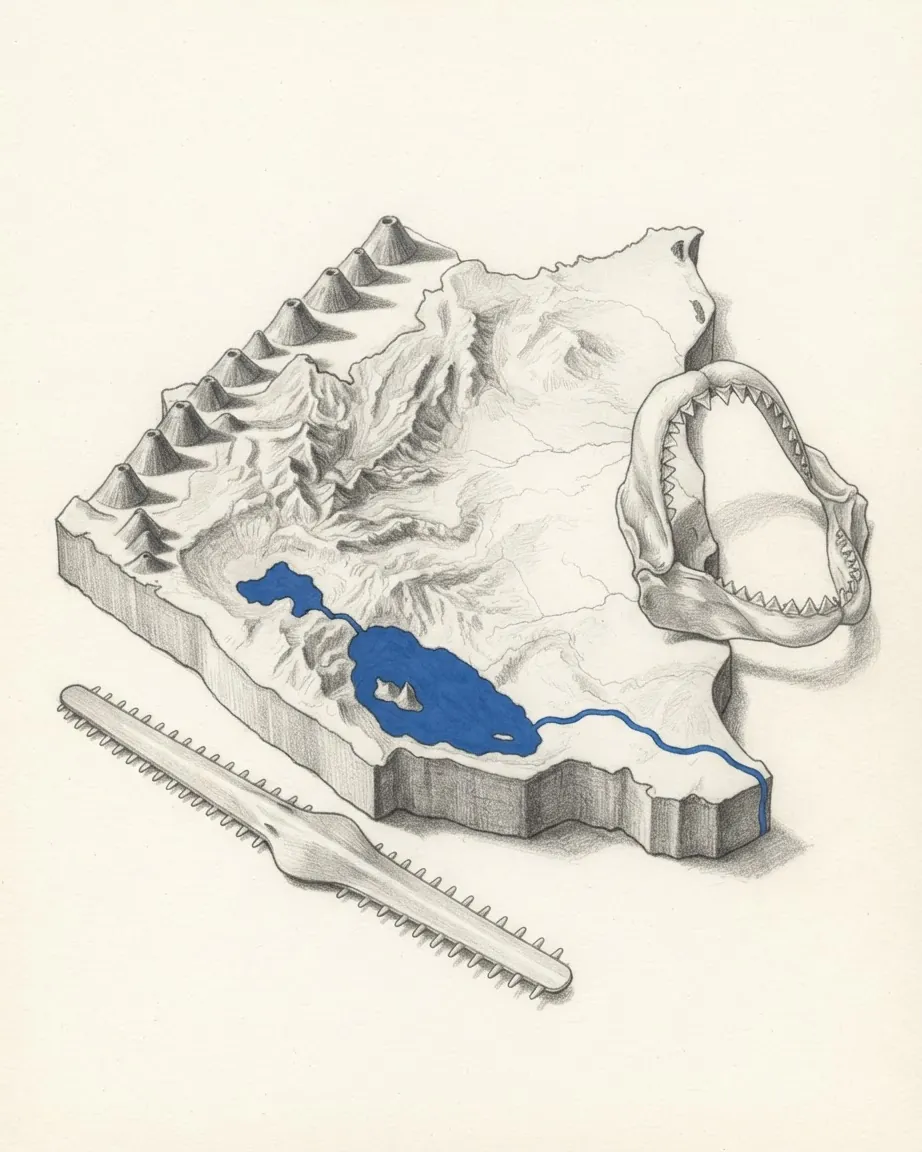
Lake Nicaragua and the San Juan River carry water most of the way from the Caribbean to the Pacific, and most of the foreign interventions in Nicaragua's history turned on that route. Horatio Nelson took a British expedition up the river in 1780. Cornelius Vanderbilt ran steamers along it for California-bound passengers from 1851, and William Walker seized them and made himself president in 1856. The United States backed the revolt against José Santos Zelaya in 1909 partly over canal terms, and its marines stayed for most of the years from 1912 to 1933. No canal was ever dug, and the last concession to build one was cancelled in 2024.
In short
- Granada and León founded
- 1524, by Francisco Hernández de Córdoba
- Left the Central American federation
- 1838
- Accessory Transit Company
- Greytown to San Juan del Sur, from 1851
- William Walker's presidency
- 12 July 1856 to 1 May 1857
- Mosquito Coast occupied
- 1894, under José Santos Zelaya
- United States marines stationed
- 1912 to 1933, nine months excepted
- Bryan-Chamorro canal treaty
- Signed 1914, abrogated 1970
- Last canal concession cancelled
- May 2024, with no waterway dug
Who lived around the lakes before the conquest
People have lived in what is now Nicaragua since about 12,000 BCE. By the end of the fifteenth century the country was split along a line that still shows in its history. The west belonged to peoples tied by language and culture to Mesoamerica: the Chorotega, or Mangue, an Oto-Manguean people who had come south from Mexico centuries earlier, and the Nicarao, a branch of the Nahuas who spoke Nawat and arrived around 1200 CE. They farmed maize, cacao, beans, squash and chili, and the Spanish who arrived found elaborate markets and permanent temples. Nicarao warriors fought in padded cotton armour with clubs edged in obsidian. The centre and the Caribbean side were held by Macro-Chibchan peoples, among them the Miskito, Rama, Mayangna and Matagalpa, who hunted, fished and cleared forest for cassava.
The country's name is traced to Nicānāhuac, the Nawat name for the western land the Nicarao held. Wikipedia's history of the country renders it as "here surrounded by water", meaning the Pacific, Lake Nicaragua, Lake Xolotlán and the rivers and lagoons between them.
Gil González Dávila reached the area that became the Rivas Department in 1522 and met the Nahua chief Macuilmiquiztli, whose name has sometimes been given wrongly as Nicarao. The Chorotega under Diriangén drove the Spanish off. In 1524 Francisco Hernández de Córdoba founded Granada on Lake Nicaragua and León west of Lake Managua. Pedrarias Dávila, the governor of Panama who had sent him, had him killed for defying him and made himself governor in 1527, and the feuding columns of conquistadors that fought over the territory became known as the War of the Captains. By 1529 the conquest was complete.
What followed was a collapse. Britannica estimates the Indigenous population of the Pacific region at about one million at contact and a few tens of thousands three decades later: about half died of Old World diseases and most of the rest were shipped as slaves to other Spanish colonies, above all Panama and Peru, between 1526 and 1540. Wikipedia's history of the country cites estimates of up to 500,000 people exported as slaves and a decline of up to 97% by the 1580s. Most Indigenous groups survived in the east, where the Spanish did not settle.
The first León survives as an excavation. UNESCO records that León Viejo, founded in 1524 opposite the Momotombo volcano at the western end of Lake Managua, was partly destroyed by an eruption in 1578 and finished by the earthquake of 1610, after which the city was rebuilt six leagues away. Gradual burial preserved what was left unaltered. Córdoba's tomb was found in the ruins in 2000.
How Granada and León divided the colony
After the depopulation Nicaragua became a backwater of the empire, and its two towns faced in opposite directions. Granada, on the lake, lived on agriculture and on trade with Spain down the San Juan River to the Caribbean. León lived on commerce with the Spanish colonies of the Pacific coast, and the Pacific shore became a port and shipbuilding site for the Manila galleons running to Acapulco. Both towns were small, and both were raided: Dutch, French and British pirates invaded Granada in 1658 and again in 1660.
The Caribbean side went another way. The English armed the Bawihka of the northeast, who intermarried with runaway slaves from Britain's Caribbean possessions; the population that resulted, known to Europeans as the Miskito, pushed other groups inland. Britain formed an alliance with the Miskito late in the seventeenth century and settled the Mosquito Coast around Bluefields. The sources date the arrangement differently: Wikipedia gives a formal British protectorate over the Kingdom of Mosquitia from 1655, and Britannica a British dependency from 1740 to 1786. Either way, Wikipedia's article on the country describes the Caribbean side as an independent kingdom under British protection from the seventeenth century to 1860.
The river drew foreign expeditions of its own. During the American Revolutionary War, Horatio Nelson led a British force up the San Juan in 1780; it had some success and was abandoned because of disease.
Independence divided the two towns again. Revolutionaries deposed the intendant in 1811, after which León returned to the royalists and Granada was punished for its disobedience. In 1821 León rejected the Guatemalan declaration of independence from Spain and Granada accepted it. Both took union with Mexico in 1822 and 1823 and then fought each other until 1826. Nicaragua left the Central American federation in 1838, and the rivalry became a party system: Liberals in León, Conservatives in Granada, with civil wars through the 1840s and 1850s. Managua was made capital as a compromise between them, in 1852 by Wikipedia's account and in 1857 by Britannica's.
Why the gold rush made Nicaragua a highway
The geography explains the traffic. The valley of the San Juan forms a passage close to sea level from the Caribbean to Lake Nicaragua, and from the southwest shore of the lake the land to the Pacific is narrow: nineteen kilometres by the figure in Wikipedia's geography of Nicaragua, within 24 kilometres by its main article on the country. In 1848 British officials working with the Miskito king seized the Caribbean port at the river mouth, San Juan del Norte, and renamed it Greytown. Gold was found in California the same year.
Before the transcontinental railroad and the Panama Canal, most travel and almost all commerce between the two coasts of the United States went by steamship to Central America and over one of two crossings: the Panama Railroad, or Nicaragua. Vanderbilt set up the Accessory Transit Company in 1851. Its riverboats ran from Greytown up the San Juan to the lake, and from the western shore a twelve-mile carriage road near Rivas came down to the Pacific port of San Juan del Sur. The company carried tens of thousands of passengers a year.
The lake and the river were proposed through the nineteenth century as the longest part of a canal across the isthmus, and the United States and several European powers studied schemes to dig one.
| Scheme | Years | What it produced |
|---|---|---|
| Accessory Transit Company, Cornelius Vanderbilt | 1851 to 1856 | River steamers and a carriage road. Walker's government revoked the charter and the route was never reopened |
| Canal schemes of the United States and European powers | Late nineteenth century | Proposals. Zelaya refused concessionary terms and the United States chose Panama |
| Bryan-Chamorro Treaty | Signed 1914, ratified 1916, abrogated 1970 | Exclusive United States canal rights and naval base leases. No canal |
| HK Nicaragua Canal Development Investment Company, a fifty-year concession | Ground broken December 2014, concession cancelled 2024 | Access roads. The waterway was never begun |
How William Walker made himself president
In 1855 a friend negotiated a contract for him to fight for the León Liberals in another round of their war with Granada, and on 4 May 1855 he sailed from San Francisco in the brig Vesta with fifty-seven followers. T. J. Stiles, writing for the Gilder Lehrman Institute, gives the reason in a sentence: Nicaragua held one of the transit routes between California and the rest of the United States.
What Stiles calls perhaps the only inspired manoeuvre of Walker's career used the route. He commandeered an Accessory Transit steamboat, landed behind Granada and took the city on 13 October 1855, holding the families of the Conservative leaders hostage. He set up a unity government with Patricio Rivas as provisional president and himself as commander of the army, then had the Conservative general Ponciano Corral tried for treason and shot on Granada's central plaza on 8 November 1855 by a firing squad of Americans. Franklin Pierce recognised the regime as the government of Nicaragua on 20 May 1856.
Two of the company's own officers financed him. Cornelius Garrison and Charles Morgan, then losing a fight with Vanderbilt for control of Accessory Transit, backed Walker; Walker revoked the company's charter, seized its riverboats and handed them to Garrison and Morgan, whose new line carried his recruits from the United States free of charge. Costa Rica invaded in April 1856 and beat him at Rivas, then withdrew when cholera spread through its army. Rivas denounced him as a usurper and fled, and a northern alliance of Honduras, El Salvador and Guatemala occupied León. On 12 July 1856 Walker became president after a rigged election, declared English the official language and issued an edict legalising slavery.
He held the transit line from Rivas to the forts on the San Juan, and to concentrate his men he evacuated Granada and had it burned. His men left a sign in the ashes: "Aqui fue Granada", here was Granada. Vanderbilt then went after the boats. Dispatched in October 1856, his agent Sylvanus Spencer reached San José with a plan of attack and $40,000 in gold for Costa Rica's expenses, led a Costa Rican force through the forest to the river and took the steamers and forts by sailing up in a captured boat and giving the right signals. Cut off from reinforcements, Walker was besieged in Rivas by the Central American armies and surrendered to an American naval officer on 1 May 1857.
He tried twice more. He landed at Greytown with 270 men on 25 November 1857 and the United States Navy forced him to surrender. In 1860 the Royal Navy took him prisoner on the Honduran coast and handed him to Honduras, where he was shot at Trujillo on 12 September 1860. The fight against him became part of the national story of Nicaragua, and the Conservatives who came back after it governed from 1857 to 1893. Vanderbilt never reopened the transit: Nicaraguans would not again let large numbers of North Americans into the country.
Why a canal cost Zelaya the presidency
The east came back to Nicaragua in stages. Britain gave the northern part of Mosquitia to Honduras in 1859 and, by the Treaty of Managua in 1860, the middle part to Nicaragua as an autonomous reservation. José Santos Zelaya, a Liberal who took power in 1893, occupied it in 1894 and named it after himself, the Zelaya Department; United States forces occupied Bluefields for a month the same year.
Zelaya also refused to grant the United States canal-building rights on concessionary terms, which pushed Washington toward Panama. Rumours that he meant to invite Japan to build a rival canal followed. In 1909 the United States encouraged a Conservative revolt against him. When two Americans who had confessed to laying a mine in the San Juan River to blow up the Diamante were executed on his orders, the marines landed at Bluefields and blocked a Liberal victory. Zelaya resigned that year.
Marines were stationed in Nicaragua from 1912 to 1933, apart from nine months beginning in 1925, in support of Conservative governments dominated by the Chamorro family. The Bryan-Chamorro Treaty of 1914, ratified in 1916, gave the United States exclusive canal privileges in Nicaragua and the right to establish naval bases. Britannica states its purpose plainly: to prevent a competing canal from being built. The United States had chosen Panama, and it took the Nicaraguan rights so that nobody else could build there.
A Liberal rising in 1926 brought 2,000 more marines in 1927. Henry Stimson negotiated the Pact of Espino Negro on 4 May 1927, under which both sides disarmed and a new National Guard was created, trained by the Americans. One general refused to sign. Augusto César Sandino took to the mountains of Las Segovias and fought the marines for more than five years, until they withdrew in January 1933. He then agreed terms with the new government of Juan Bautista Sacasa: an amnesty, land for an agricultural colony, and an armed band of 100 men for a year. On the night of 21 February 1934, after dining at the presidential house, he was seized by National Guard soldiers and killed, and hundreds of people from his colony were murdered afterwards.
How the Somoza family held Nicaragua for decades
The commander of that Guard was Anastasio Somoza García, who had taken it over in 1933. He used it to force Sacasa's resignation on 6 June 1936, won a rigged election and became president on 1 January 1937. A constituent assembly in 1938 lengthened the presidential term from four years to six. The Guard came to run the radio and telegraph networks, the post, the health services and the railways.
He was shot on 21 September 1956 by Rigoberto López Pérez, a 27-year-old poet, and flown to the Panama Canal Zone, where he died eight days later. His sons followed him. Luis Somoza Debayle was president from 1956 to 1963; Anastasio Somoza Debayle, a West Point graduate who had commanded the Guard, became president in 1967. The Bryan-Chamorro Treaty was abrogated in 1970. From 1945 to 1960 the Nicaraguan Long Leaf Pine Company paid the family millions of dollars for terms that spared it replanting, and by 1961 it had cut every commercially viable coastal pine in the northeast. In the early 1970s the younger Anastasio owned a slaughterhouse in Nicaragua and six meat-packing plants in Miami.
In 1961 Carlos Fonseca and two others founded the Sandinista National Liberation Front, named after Sandino. The earthquake of 23 December 1972 destroyed about 90% of Managua, killing 6,000 people and leaving 300,000 homeless by Britannica's count, over 10,000 and 500,000 by Wikipedia's. The United States Office of the Historian records that Somoza's businesses, associates and officers embezzled most of the international relief, and Wikipedia's history of the country records young Nicaraguans flooding into the Sandinista ranks afterwards.
The insurrection then came in steps. On 27 December 1974 Sandinista guerrillas raided a party in Managua and exchanged their hostages for a US$2 million ransom and the release of fourteen prisoners. Pedro Joaquín Chamorro, publisher of the opposition paper La Prensa, was murdered on 10 January 1978, and a general strike followed. On 22 August 1978 the Sandinistas took the National Palace. Britannica puts the hostages at more than 1,000 and the Office of the Historian at several hundred. Jimmy Carter ended military assistance to the Guard in February 1979. Somoza left for the United States on 17 July 1979 and the Sandinistas entered Managua two days later, in a country where more than 30,000 people had been killed and about 500,000 were homeless.
What the revolution and the Contra war cost
A five-member junta took office in July 1979, including Daniel Ortega and Violeta Barrios de Chamorro, Pedro Joaquín's widow. It expropriated the property of Somoza and his associates, nationalised the banks, and ran a National Literacy Crusade from March to August 1980. In 1981 Ronald Reagan authorised funds to recruit, train and arm the counter-revolutionaries who became known as the Contras. They fought from bases in Honduras and Costa Rica and numbered about 15,000 by the mid-1980s. Historians have documented the destruction of health centres, schools and cooperatives in Contra-held areas; the Inter-American Commission on Human Rights investigated Sandinista abuses, including the execution of 35 to 40 Miskitos in December 1981. The war killed about 30,000 people.
The United States mined the port of Corinto, and in 1986 the International Court of Justice, in Nicaragua v. United States, found by twelve votes to three that by arming and financing the Contras the United States had breached its obligation not to intervene in another state's affairs. The United States withdrew its acceptance of the court's jurisdiction. Congress had banned military aid to the Contras in 1984 with the second Boland Amendment, and the covert supply that continued through arms sales to Iran became the Iran-Contra affair.
The election of 4 November 1984 is read two ways. The Sandinistas took 67% of the vote by Wikipedia's history of the country and 63% by Britannica's, and most international observers judged it fair. The Reagan administration called it a sham, and opposition groups said Sandinista control of the state and the media had made it intimidating. A full United States embargo followed on 1 May 1985 and lasted to March 1990. Inflation ran above 30,000% in 1988.
The Sapoa ceasefire was signed on 23 March 1988. On 25 February 1990 the National Opposition Union, endorsed and financed by the United States, won the election with Violeta Barrios de Chamorro as its candidate, and she took office on 25 April 1990. Her government demobilised the Contras in June 1990 and cut the army from more than 80,000 soldiers to fewer than 15,000.
Why the canal came back after the Cold War
Hurricane Mitch in October 1998 killed several thousand Nicaraguans. The Sandinistas returned to government after the election of November 2006, which they won with 37.99% of the vote. In 2009 the International Court of Justice settled a long dispute with Costa Rica over the use of the San Juan River, which runs along the border between them.
The canal returned in the form of a fifty-year concession to the HK Nicaragua Canal Development Investment Company, owned by the Chinese businessman Wang Jing. Ground was ceremonially broken in December 2014 on a waterway of 278 kilometres, priced at $50 billion and roughly three times the length of the Panama Canal. It would have crossed Lake Nicaragua and, by an estimate the Guardian reported in 2024, displaced about 120,000 people, among them Rama and Creole communities from protected Indigenous territories on the Caribbean coast. Wang's fortune fell from $10.2 billion to about $1.1 billion in the Chinese stock market crash of 2015, and the project's effective start slipped to 2016 and then away altogether.
The fight over it outlasted the project. Thousands of farmers protested against land seizures along the route, and in 2019 three of their leaders were sentenced to 216, 210 and 159 years in prison. Wikipedia's history of the country names the canal, alongside forest fires in the Indio Maíz reserve and a reform of social security, among the grievances behind the protests that began on 19 April 2018. Britannica estimates that more than 300 people had died in the violence by mid-2018, and the Inter-American Commission on Human Rights that some 88,000 Nicaraguans had fled the country by January 2020.
In May 2024 the government cancelled the concession. Crews had cut access roads near the route, and the Guardian reported that digging of the waterway itself had never started.
Timeline
The dates in order
- 1524
- Francisco Hernández de Córdoba founds Granada and León.
- 1610
- An earthquake finishes León Viejo, and the city is rebuilt six leagues away.
- 1780
- Horatio Nelson leads a British expedition up the San Juan River.
- 1838
- Nicaragua leaves the Central American federation.
- 1848
- The British seize San Juan del Norte and rename it Greytown.
- 1851
- Vanderbilt's Accessory Transit Company opens the route across Nicaragua.
- 1856
- William Walker becomes president on 12 July and has Granada burned.
- 1857
- Walker surrenders at Rivas on 1 May.
- 1894
- Zelaya occupies the Mosquito Coast.
- 1909
- A revolt backed by the United States forces Zelaya to resign.
- 1912
- United States marines land and stay, with one break, until 1933.
- 1914
- The Bryan-Chamorro Treaty gives the United States exclusive canal rights.
- 1934
- Sandino is killed by the National Guard on 21 February.
- 1937
- Anastasio Somoza García becomes president on 1 January.
- 1972
- An earthquake on 23 December destroys about 90% of Managua.
- 1979
- The Sandinistas enter Managua on 19 July.
- 1986
- The International Court of Justice rules in Nicaragua v. United States.
- 1990
- The National Opposition Union wins the election of 25 February.
- 2014
- Ground is broken for a canal in December.
- 2024
- The canal concession is cancelled in May.
Common questions
Questions about Nicaragua
Why was no canal ever built across Nicaragua?
Each attempt failed for its own reason. Zelaya refused the United States canal rights on concessionary terms before 1909, and Washington built at Panama. The Bryan-Chamorro Treaty of 1914 then gave the United States exclusive rights to the Nicaraguan route, which Britannica says was meant to stop a competing canal, and it held them until 1970. The concession whose ground was broken in December 2014 saw its owner lose most of his fortune in 2015 and was cancelled in May 2024 with no waterway dug.
Why did William Walker go to Nicaragua?
For the transit route. Nicaragua carried one of the two main crossings between the coasts of the United States in the 1850s, and Walker came in 1855 under contract to the León Liberals. He made himself president on 12 July 1856, declared English the official language and legalised slavery. A Central American coalition, helped by Vanderbilt's agents on the San Juan River, forced him out on 1 May 1857.
How long did United States marines stay in Nicaragua?
From 1912 to 1933, apart from nine months beginning in 1925. They first came in support of Conservative governments after the revolt against Zelaya, returned in larger numbers in 1927 and left in January 1933 after Augusto César Sandino's guerrilla war, leaving behind the National Guard they had trained.
In what stages did Nicaragua absorb the Mosquito Coast?
In two. Britain had held a protectorate or dependency over the Miskito kingdom for much of the seventeenth and eighteenth centuries; the sources disagree on the dates. By the Treaty of Managua of 1860 its middle part came to Nicaragua as an autonomous reservation, while the north went to Honduras in 1859. Nicaraguan jurisdiction was made complete in 1894, when Zelaya occupied the coast militarily and renamed it the Zelaya Department.
What was the ruling in Nicaragua v. United States?
In 1986 the International Court of Justice found, by twelve votes to three, that the United States had breached customary international law by training, arming and financing the Contras, and that it was obliged to make reparation. The court also condemned the mining of the port of Corinto. The United States withdrew its acceptance of the court's jurisdiction, and the United Nations General Assembly passed a resolution pressing it to pay.