Nicaragua's economy: a currency held still by the people who left
3 127 words · 14 min · updated 2026-10-04
 Back to Nicaragua
Since January 2024, when the Central Bank of Nicaragua cut its scheduled devaluation to zero, the córdoba has stood at 36.6 to the United States dollar, held there by dollars from Nicaraguans who emigrated. Family remittances came to 5,243.1 million dollars in 2024, which the IMF puts at 26.6% of output that year, from a diaspora that grew from 650,000 in 2016 to 1.5 million by the count in the BTI 2026 report. Prices in the same currency rose at an annual rate of more than 30,000% in 1988. What keeps it still now is a balance of payments carried by emigrants, in an economy where the state has also been taking property from those it calls traitors.
In short
- Exchange rate
- 36.6 córdobas per US dollar, crawl at 0% since January 2024
- Family remittances
- 5,243.1 million USD in 2024
- Remittances as share of GDP
- 26.6% in 2024 (IMF)
- Gross domestic product
- 22.2 billion USD in 2025
- Per head
- 3,173 USD in 2025
- Gross international reserves
- 6,105.1 million USD at end of 2024
- Inflation
- 2.1% in 2025
- Currency
- Nicaraguan córdoba (NIO)
Why the córdoba stopped moving against the dollar
The córdoba is managed under a crawling peg, which ECLAC describes as a regime of pre-announced mini-devaluations: the central bank publishes in advance the rate at which the currency will lose value against the dollar over the coming year. The published crawl stood at 2% a year until 2023, when the Banco Central de Nicaragua cut it to 1%, and from January 2024 it set it at 0%. The regime was kept in name, and the bank said it would adjust the crawl if conditions in the currency market changed, but in practice the rate was fixed at 36.6 córdobas to the dollar through the first months of 2024. The IMF records the same average, 36.6, for 2024 and for 2025, and in November 2025 its mission called the announced crawl of 0% for 2026 appropriate.
ECLAC gives the reason in one paragraph. A strong inflow of foreign currency, above all family remittances from Nicaraguans in the United States, let the central bank make net purchases of dollars at its exchange desk throughout 2023. Gross international reserves rose from 4,404 million dollars at the end of 2022 to 5,447 million at the end of 2023, the equivalent of 7.9 months of imports, and that accumulation is what led the authority to slow the crawl and then stop it. By April 2024 reserves stood at 5,778 million dollars. The central bank's annual report put them at 6,105.1 million at the close of 2024, an increase of 658.1 million in the year, covering the monetary base 2.9 times and eight months of imports. The IMF counted 7.5 billion in September 2025.
ECLAC also measured the córdoba in real terms: by March 2024 the index of the real effective exchange rate showed an appreciation of 3% accumulated since 2021. Inflation itself has come down. Consumer prices rose 8.4% in 2023, 4.6% in 2024 and 2.1% in 2025 on the World Bank series in the record, and the central bank put the year-on-year rate at 2.84% in December 2024.
How the bank pushed payments into córdobas
The central bank used the fixed rate as the base for a push towards the córdoba. In 2024 it approved regulations requiring prices to be stated and payments settled in córdobas, and the BTI 2026 report records an announcement in late 2024 that all transactions were to be in córdobas from 1 January 2025. The same report judges that little changed in practice. The IMF described the shift as smooth and asked for more of it, together with deeper capital markets, to make monetary policy more effective. The British government's travel advice still notes that the dollar, in cash or travellers' cheques, is the only foreign currency freely exchangeable in Nicaragua.
In December 2024 the Law on the Administration of the Monetary and Financial System put the central bank and the Superintendency of Banks under a single governing board. The BTI report notes that it gives the authorities access to the financial data of individuals and businesses without clear limits.
How emigrants came to carry the Nicaraguan economy
Net secondary income in the balance of payments, which is mostly family remittances, came to 3,075 million dollars in 2022 and 4,543 million in 2023. ECLAC attributes the jump to a humanitarian migration status the United States granted to Nicaraguan nationals for two years. In the first quarter of 2023 remittances grew 61.3% on the same quarter a year earlier, and in the first quarter of 2024 they grew 11.8%, to 1,141 million dollars. For the whole of 2024 the central bank counted 5,243.1 million dollars, 12.5% more than in 2023.
As a share of output the IMF puts remittances at 26.6% in 2024 and projects 29.5% for 2025, before an assumed fall to 26.1% in 2026. Those figures turn the external accounts around. The current account was in deficit by 2.9% of GDP in 2022 and in surplus by 8.2% in 2023 and 4.2% in 2024, on the World Bank series in the record, and the IMF projects a surplus of 9.3% for 2025. ECLAC found that remittances, wages and credit had together become the main driver of growth in 2023, when household consumption rose 6.4%.
The money follows people out. The BTI 2026 report counts a diaspora of 650,000 in 2016 and 1.5 million by the time of writing, most of it in the United States, Costa Rica and Spain, with 94,000 departures in 2024 alone and approximately 850,000 people gone since 2017. Its authors name the parole programme the United States opened to Nicaraguans in 2023 as the pull, and political repression as the push. The exiles stripped of citizenship since 2023 belong to the same years, and Nicaragua: politics covers them.
The state has written itself into this flow. In September 2024 the National Assembly amended the Financial Analysis Unit Law, giving the government access to remittances and the power to freeze and seize electronic transfers it considers suspicious, as Freedom House and the Wikipedia account of Nicaraguan politics both record.
The dependence cuts the other way when policy in the United States changes. The IMF's November 2025 statement had migrants sending more because immigration rules were tightening, and its baseline for 2026 assumes lower remittances once the parole and temporary protected status programmes for Nicaraguans end. Over the medium term it expects returning migrants to enlarge the labour force at home, and it ties the gain to skills and to bringing workers and firms into the formal economy.
What Nicaragua grows and sells abroad
Coffee became the principal crop in the 1870s. Beef and animal by-products had been the main agricultural export for three centuries before that, and cotton gained ground in the late 1940s. Bananas stayed smaller than elsewhere on the isthmus because early twentieth-century Nicaraguan governments were reluctant to grant concessions to the large United States banana companies. Nearly two-thirds of the coffee crop comes from the northern central highlands, north and east of Estelí, and tobacco, grown in the same hills, has become a larger cash crop since the 1990s, for leaf and for cigars. Cocoa is a smaller and more particular trade: the International Cocoa Organization recognised Nicaragua as a 100% fine cocoa origin in 2015, and 98% of its growers are smallholders.
Agriculture produced 14.5% of value added in 2024, industry 27.4% and services 46.8%, on the World Bank figures in the record. Exports of goods and services came to 41.0% of GDP that year and imports to 58.2%.
Where the free zones send their goods
Part of what Nicaragua exports is assembled in free zones, mostly textile maquila and wiring sets for cars, as ECLAC describes them. That sector slowed in the first decade of the century as competition from China and other Asian producers rose, and it remains sensitive to demand abroad: in the first quarter of 2024 goods exports fell 4.5% because the free-zone plants were importing less to process. Over 2024 as a whole the central bank counted free-zone exports up 0.4% and merchandise exports up 3.9%.
Trade policy has stayed open across changes of government. The Central America and Dominican Republic free trade agreement with the United States entered into force in April 2006, and the BTI report gives the average applied tariff as about 5.6% in 2023. A free trade agreement with China was ratified in November 2023 and took effect on 1 January 2024, with preferential tariffs on 91.4% of Nicaraguan exports. ECLAC expected coffee, sugar, fish, shrimp, lobster, peanuts, rum, leather, wood and car wiring to benefit. In the first three quarters of 2024 China took less than 2% of exports, according to the central bank figures the BTI report cites, and the United States remained the destination by a wide margin. In November 2025 the IMF was working from United States tariffs of 18% on Nicaraguan goods and noted uncertainty over additional trade actions recommended by the United States Trade Representative.
Gross inflows of foreign direct investment reached 3,039.9 million dollars in 2024, for a net inflow of 1,352.3 million.
Where the gold and lobster come from
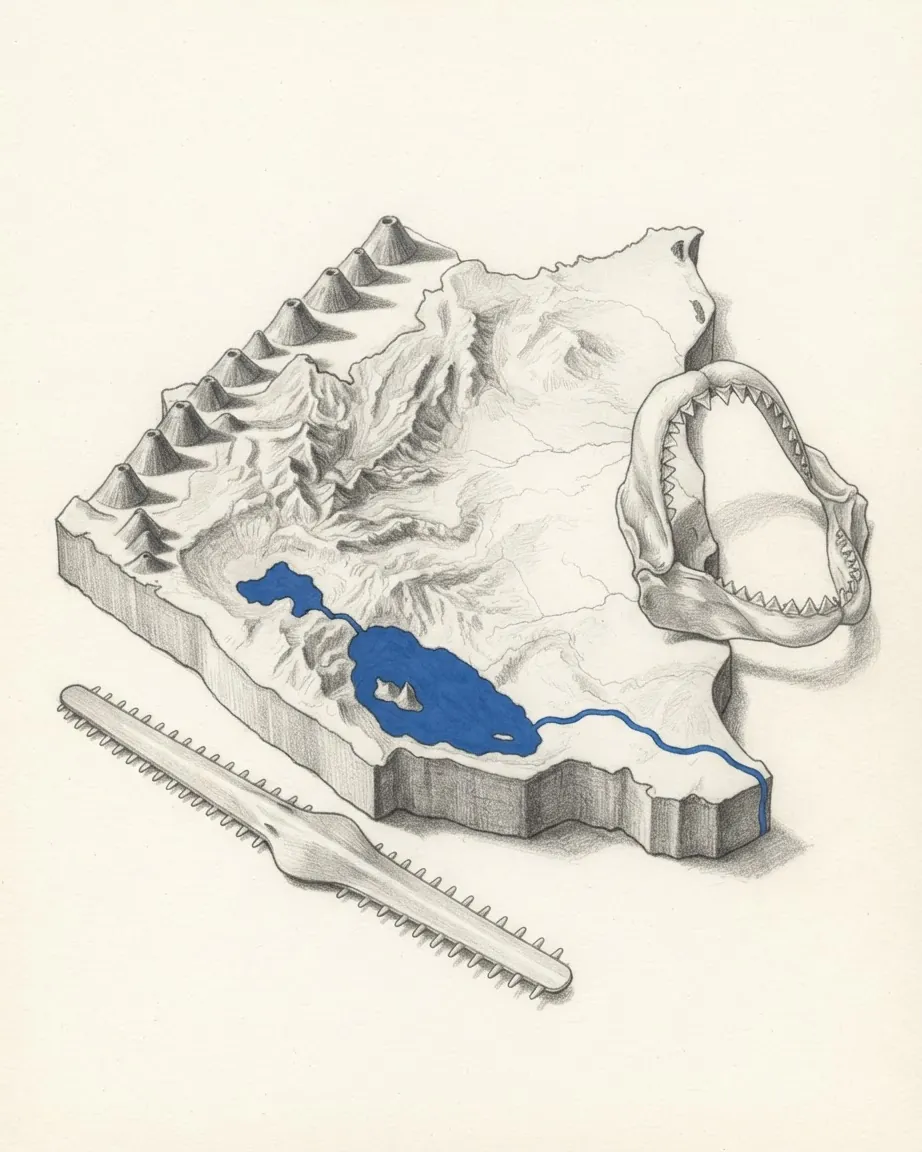
The minerals are on the Caribbean side, a region Wikipedia gives as 57% of the national territory and the holder of most of its mineral resources. Envío, the review of the Central American University, counting the two autonomous regions alone in 2003, gave about 46% of the territory and 53% of its natural resources. The municipalities of Siuna, Rosita and Bonanza in the North Caribbean Coast Autonomous Region are known together as the Mining Triangle. Bonanza still has an active gold mine, owned by HEMCO; Siuna and Rosita have no working mines, and panning for gold is still common around them. The IMF's 2025 mission asked gold sector agents to report suspicious transactions.
Fishing boats on the Caribbean side bring shrimp and lobster to processing plants at Puerto Cabezas, Bluefields and Laguna de Perlas. A road between Nueva Guinea and Bluefields, completed in 2019, gave the coast a regular bus service to the capital.
Most electricity now comes from renewable sources. Renewables supplied 69.5% of electricity in 2021 on the World Bank series in the record, against 17.6% in 2000, with wind turbines along the south-western shore of Lake Nicaragua and a number of geothermal plants.
How the córdoba was wrecked in the eighties
The Somoza family held power from 1936 to 1979, and Britannica records that it took over the ownership of large areas of land and many businesses. Anastasio Somoza García had built a fortune estimated at 60 million dollars by the end of the Second World War, mainly through coffee and cattle, and his holdings ran from sugar mills and rum distilleries to the national airline, Lanica. His son Anastasio Somoza Debayle owned a slaughterhouse in Nicaragua and six meat-packing plants in Miami. The family's wealth is speculated to have reached about 533 million dollars by 1979, a third of that year's GDP. Until the late 1970s the agricultural export system produced 40% of GDP, 60% of employment and 80% of foreign exchange earnings. The earthquake of 23 December 1972 killed about 10,000 people and destroyed 80% of the commercial buildings in Managua, by the country study's count.
The revolutionary government of 1979 set out a mixed economy, about 60% private and 40% public, which grew from 1980 through 1983. Then the Contra war, price controls, subsidies to state enterprises and a United States embargo pulled it apart. President Reagan's executive order of 1 May 1985 imposed a full embargo that stayed in force until March 1990. The Contras destroyed or disrupted coffee harvests, private investment in farming stopped, Hurricane Joan struck in 1988 and drought followed in 1989, by when farm output had fallen for five years running. By 1990 agricultural exports were less than half their 1978 level.
The currency took the rest. Britannica gives annual inflation of more than 30,000% in 1988, followed by austerity measures the Sandinista government itself introduced. The Wikipedia economic history gives 33,603% for the later Sandinista years and 55,000% in the first year of the Chamorro government after the election of 1990. The two accounts give neither the same year nor the same figure.
What the nineties rebuilt
The governments elected from 1990 privatised more than 350 state companies and followed market and export policies agreed with the international lenders. Inflation averaged 9.5% a year over the decade from 2000 to 2010 on World Bank figures. Debt relief came in stages: Nicaragua reached the decision point of the Heavily Indebted Poor Countries initiative in late 2000, secured some 4.5 billion dollars of foreign debt reduction under it in early 2004, and saw further cancellation agreed by the finance ministers of the G8 in 2005. Foreign assistance was worth almost 25% of GDP in 2001. In 2007 exports passed one billion dollars for the first time. Government debt on the IMF series in the record stood at 110.4% of GDP in 2002 and at 34.8% in 2025.
The government that took office in 2007 kept the market and export model and reintroduced means-tested welfare programmes, funded in large measure by aid from Venezuela, and the economy grew steadily until the crisis of 2018. Nicaragua: history follows the political story that runs under these figures.
What happened to private property after the protests
Protests began on 19 April 2018 over the canal concession, forest fires in the Indio Maíz reserve and a planned reform of social security. The government answered with force, and the economy contracted in each year from 2018 to 2020, by 3.4% in the first of them, before a rebound of 10.4% in 2021 on the World Bank series in the record. Growth was 3.6% in 2024 and 4.9% in 2025 by the same count.
The government kept its model and moved against organised business. In March 2023 it closed COSEP, the principal business chamber, together with 18 other private sector organisations representing fishing, small finance, coffee, farming, mining, industry and tourism. In August 2023 it confiscated the Jesuit-run Universidad Centroamericana with all its property and bank accounts, and in August 2024 the Interior Ministry closed the remaining binational chambers of commerce, the American Chamber of Commerce in Nicaragua among them. A 2024 law placed the expropriation of the property of people declared traitors in the constitutional framework. The IMF's 2026 press release describes the economy as operating under targeted international sanctions and transfers of private property to the state since 2022, and it asks for legal recourse over property rights, including those of third parties.
The BTI 2026 report reads the same years in two halves. Private enterprise remains the model, and the growing prominence of members of the presidential family in construction, advertising, communications and energy has reinforced the market framework. At the same time the report judges that business owners hold their property on weaker terms than before, and that neither privatisation nor expropriation now follows market principles. ECLAC put the share of informal employment at 76% in 2023.
The banks came through intact on the IMF's measures. Non-performing loans were 1.4% of the total in 2024 and regulatory capital 18.4% of risk-weighted assets, and the BTI report finds four banks, Banpro and LAFISE among them, holding more than three-quarters of the market. Social security is the strained part of the public sector: the Nicaraguan Social Security Institute had 787,000 active affiliates in November 2022 against 914,000 at the end of 2017, and the central government has been covering its deficit at 0.5% of GDP a year from 2023 to 2025.
The public finances are in surplus. The non-financial public sector closed 2024 with a surplus of 2.5% of GDP after grants, by the central bank's count, and the IMF estimated the 2026 draft budget to be consistent with a surplus of 1.5%. Tourism went the other way: receipts fell from 739.2 million dollars in 2023 to 510.8 million in 2024 in the central bank's tourism satellite account, as visitor arrivals dropped 9.7%, although tourism still accounted for 5.5% of value added in the economy that year.
Who still counts the Nicaraguan economy
The record has thinned at the same time as the money has grown. The Fundación Internacional para el Desafío Económico Global, FIDEG, which published independent poverty data, was raided in 2021 for statistics that contradicted the official account and has since been shut down. Government data cited by the World Bank put poverty at 12.5% of the population in 2023 on a line of 3.65 dollars a day; FIDEG's estimate from its 2019 data was as high as 44%. The IMF calls the data it receives broadly adequate and asks for more timely poverty rates and fuller publication of the balance of payments, remittances included.
The same year can carry several figures depending on who measured it and how. Unemployment and public debt are the two that differ most, and the definitions behind them are not the same:
| Measure | Figure | Year | Published by |
|---|---|---|---|
| Unemployment, annual average | 3.1% | 2024 | Central Bank of Nicaragua |
| Unemployment | 3.4% | 2024 | IMF Article IV table |
| Unemployment | 4.8% | 2024 | BTI 2026 report |
| Unemployment | 5.0% | 2024 | World Bank |
| Public debt | 51.7% of GDP | 2024 | Central Bank of Nicaragua |
| Non-financial public sector debt | 45.1% of GDP | 2024 | IMF Article IV table |
| General government gross debt | 37.9% of GDP | 2024 | IMF, in the record |
| Poverty, 3.65 dollars a day | 12.5% | 2023 | Government data via the World Bank |
| Poverty | up to 44% | 2019 data | FIDEG |
Why the canal route never became an economy
The idea that Nicaragua's fortune lies in moving other people's cargo across it is older than the coffee economy. After gold was found in California in 1848, travellers from the eastern United States went by sea to Nicaragua, up the San Juan River and across Lake Nicaragua, and Cornelius Vanderbilt's Accessory Transit Company ran steamships and carriages between Greytown and the Pacific. William Walker, who made himself president in 1856, seized the company's property on the pretext of a charter violation and handed it to two of Vanderbilt's subordinates. Later, by Britannica's account, President José Santos Zelaya's refusal to grant the United States canal rights on concessionary terms encouraged it to choose Panama.
The most recent attempt was the largest. A 50-year concession went to HK Nicaragua Canal Development Investment Company, owned by the Chinese businessman Wang Jing, for a canal of 278 kilometres with an estimated cost of 50 billion dollars. The government said it would create tens of thousands of jobs and could raise growth to an average of 8% a year. Ground was ceremonially broken in December 2014 and no waterway was ever dug. The route would have crossed Lake Nicaragua and was estimated to displace 120,000 people. Wang was reported to have lost up to 85% of his fortune in the Chinese stock market crash of 2015, and in May 2024 the government cancelled the concession. Nicaragua: history tells the longer story of the route.
Common questions
Questions about Nicaragua
Why is the córdoba fixed at 36.6 to the dollar?
Formally it is on a crawling peg, a pre-announced schedule of small devaluations. The Central Bank of Nicaragua cut the annual crawl from 2% to 1% during 2023 and to 0% from January 2024, after remittance inflows let it buy dollars and lift gross reserves from 4,404 million dollars at the end of 2022 to 6,105.1 million at the end of 2024. The IMF considered a crawl of 0% for 2026 appropriate.
How much money do Nicaraguans abroad send home?
The central bank counted 5,243.1 million dollars of family remittances in 2024, up 12.5% on 2023. The IMF puts that at 26.6% of GDP and projected 29.5% for 2025. Most of it comes from the United States, where a humanitarian parole programme opened in 2023.
What happened to the plan for a Nicaraguan canal?
A 50-year concession went to a Hong Kong company owned by the businessman Wang Jing, for a canal of 278 kilometres estimated at 50 billion dollars across Lake Nicaragua. Ground was broken ceremonially in December 2014, but the waterway was never dug, and the government cancelled the concession in May 2024. Farmers had protested against land seizures along the route, and the plan was one of the grievances behind the protests of April 2018.
Why do estimates of poverty in Nicaragua differ so much?
They come from different counters. Government data cited by the World Bank give 12.5% in 2023 on a line of 3.65 dollars a day. The independent foundation FIDEG estimated up to 44% from its 2019 data, before it was raided in 2021 and later closed, so no independent series continues. The IMF has asked for more timely official poverty figures.