How Guatemalan culture is carried in women's dress
2 542 words · 12 min · updated 2026-10-04
 Back to Guatemala
Most women of Guatemala's Maya, Garífuna, Xinka and Afro-descendant peoples wear their people's dress and few of the men do, by the count of a 2018 census that asked about clothing for the first time. It found 2,174,546 women who wore it regularly, 64.7% of the women in those peoples, and 244,290 men, or 7.7%. Over the sixteen years since the 2002 census the Maya share of the population rose and the share learning a Maya language first fell, so the clearest sign of indigenous culture in Guatemala is now something women put on each morning.
In short
- Women wearing indigenous dress
- 2,174,546, 64.7%, at the 2018 census
- Men wearing indigenous dress
- 244,290, 7.7%, at the 2018 census
- Maya self-identification
- 6,207,503, 41.7%, at the 2018 census
- Maya linguistic communities
- 22 in the 2018 census
- Learned to speak in a Maya language
- 29.6% of those aged four and over in 2018
- Official language
- Spanish, under Article 143
- National instrument
- the marimba
- UNESCO intangible heritage elements
- five, the first two in 2008
What the census found when it asked about dress
The 2018 census of population put a new question to the 6,518,846 people who identified themselves as Maya, Garífuna, Xinka or Afro-descendant, Creole or Afro-mestizo: whether they regularly wore the clothing of their people. 2,418,836 of them said yes in 2018, which is 37.1% of the four peoples taken together.
The split by sex is the finding. Of the 3,363,041 women in those four peoples, 2,174,546 wore the dress regularly, or 64.7%. Of the 3,155,805 men, 244,290 did, or 7.7%. Women therefore accounted for close to nine in ten of the people the 2018 census found wearing indigenous dress.
| People, 2018 census | Identified | Regularly wear the dress | Share |
|---|---|---|---|
| Maya | 6,207,503 | 2,406,042 | 38.8% |
| Garífuna | 19,529 | 3,646 | 18.7% |
| Afro-descendant, Creole, Afro-mestizo | 27,647 | 1,435 | 5.2% |
| Xinka | 264,167 | 7,713 | 2.9% |
| Women of the four peoples | 3,363,041 | 2,174,546 | 64.7% |
| Men of the four peoples | 3,155,805 | 244,290 | 7.7% |
The law names both sexes. Article 66 of the 1985 constitution, revised in 1993, says that the state "recognizes, respects, and promotes" the forms of life, customs and traditions of the indigenous groups of Mayan descent, and lists among them "the use of the indigenous attire by men and women". Article 58 recognises the right of persons and communities to their cultural identity "in accordance to their values, their language, and their customs". The census measured what the constitution protects, and found it worn by most women of those peoples and by few of the men.
The Maya figure carries most of the total. The Xinka figure is the opposite case: 264,167 people identified as Xinka in 2018 and 7,713 wore Xinka dress. Among the Garífuna, 43.2% gave no answer to the question at all, a larger share than gave either answer.
Why a Guatemalan blouse can name its town
The textiles in question are woven from yarn and made into capes, shirts, blouses and dresses. Women's clothing is a blouse and a long skirt; men's, where it survives, is a white shirt and coloured trousers with a jacket. The whole outfit is called the traje, and the work of making it has fallen on women: weaving was taught to girls young because the trade is hard, and it took years to master the embroidery.
What makes the traje more than costume is that it is local. Each village has its own distinctive pattern, so that a person's home town can be read on sight, and the colours and designs also carried information about social status. The clothing is hand-woven and hand-embroidered cotton or wool with complex designs. Western dress, jeans and a T-shirt, came to stand for wealth and modernisation, which is part of why the choice to wear the traje has meaning in the first place.
The craft is older than the colonial state. Weaving, ceramics and basketry continued in Maya villages after the Spanish conquest, and the colonial administration at times encouraged them so that tribute could be taken in cotton textiles, although these were usually made to European specifications. The museum that collects the result, the Ixchel Museum of Indigenous Textiles and Clothing, stands on the campus of the Universidad Francisco Marroquín in Guatemala City, beside the Museo Popol Vuh.
A garment that names a town also names its wearer to anyone looking, and that is the reason the war of the early 1980s reached into clothing, which a later section sets out.
How Guatemalans identify themselves to the census
The census does not assign a person to a people. It asks which people each person feels part of and records the answer. The 2018 count of 14,901,286 people added two categories to the question for the first time: Afro-descendant, Creole or Afro-mestizo, and foreign.
| People | 2002 census | Share | 2018 census | Share |
|---|---|---|---|---|
| Maya | 4,411,964 | 39.3% | 6,207,503 | 41.7% |
| Ladino | 6,750,170 | 60.1% | 8,346,120 | 56.0% |
| Xinka | 16,214 | 0.1% | 264,167 | 1.8% |
| Garífuna | 5,040 | 0.0% | 19,529 | 0.1% |
| Afro-descendant, Creole, Afro-mestizo | not asked | 27,647 | 0.2% | |
| Foreign | not asked | 36,320 | 0.2% |
Ladino is the Guatemalan word for the mixed and Spanish-speaking population, and it is the only group whose share fell between the two censuses, by four points. The Maya population grew by 1,795,539 between 2002 and 2018. The Xinka grew at an intercensal rate of 17.8% a year, from 16,214 to 264,167, a sixteenfold rise in a people whose language was the first language of 2,755 people aged four and over in 2018.
The groups are not spread evenly. In 2018, 18.2% of the Maya population lived in Alta Verapaz, 13.6% in Quiché and 12.3% in Huehuetenango, and the departments with the highest Maya shares were Totonicapán at 98.0%, Sololá at 96.4% and Alta Verapaz at 93.0%. At the other end, El Progreso was 98.2% Ladino and Zacapa 97.4%. The Xinka live in the south-east, with 41.1% of them in Jalapa, 35.7% in Jutiapa and 21.1% in Santa Rosa. The Garífuna, whose ancestors reached the Central American coast from the Caribbean islands in the 18th century, are found in the port towns of Livingston and Puerto Barrios, and in 2018 15.4% of them lived in Izabal and 23.5% in the department of Guatemala.
Which languages Guatemalan children learn first
Article 143 of the constitution makes Spanish the official language and says that "the vernacular languages, form part of the cultural heritage of the Nation". The Language Law of 2003 recognises the Mayan languages, Xinka and Garífuna as national languages. The news agency AGN counted 22 languages of Maya origin in 2025, alongside Xinka, Garífuna and Spanish, and the 2018 census enumerated 22 Maya linguistic communities, one of them recognised as a community only after the census of 2002.
The census asks in which language each person aged four and over learned to speak. In 2018, 9,488,838 people, or 69.9%, learned in Spanish and 4,021,870, or 29.6%, in a Maya language, a share one point lower than in 2002. Of the 5,584,885 Maya aged four and over, 28.3% learned to speak in Spanish, 20.1% in Q'eqchi' and 18.8% in K'iche'.
| First language, people aged four and over | 2002 census | 2018 census |
|---|---|---|
| Spanish | 6,850,544 | 9,488,838 |
| All Maya languages | 3,062,696 | 4,021,870 |
| Mam | 459,928 | 590,641 |
| Ixil | 79,843 | 114,997 |
| Itza' | 966 | 406 |
| Garífuna | 3,430 | 2,856 |
| Xinka | 1,229 | 2,755 |
The small languages are where identity and speech part most clearly. 2,926 people identified as Itza' in 2018 and 406 had learned Itza' first. The Uspanteka were the only community to shrink in absolute terms, from 7,494 to 4,909. Some languages remain tied to one department: in 2018, 98.1% of the Chuj and 96.3% of the Jakalteko or Popti' lived in Huehuetenango, and 94.0% of the Ixil in Quiché.
Maya speakers carry the country's bilingualism. Of the 3,711,432 people aged seven and over with a Maya mother tongue in 2018, 59.9% spoke two languages and 38.6% only one; of the 8,766,476 whose mother tongue was Spanish, 92.0% spoke only Spanish. Article 76 requires that schools in predominantly indigenous regions teach preferentially in bilingual form, and bilingual education was made official in 1987.
How Guatemalan worship joins saints to the Maya calendar
Roman Catholicism combined with Maya religion into a syncretic practice that still prevails in rural Guatemala. The 260-day tzolk'in ritual calendar remains in use in Maya communities in the highlands of Guatemala, and the Xukulem, the Maya ceremony, is performed, in the description of the Espiritualidad Maya group carried by AGN, by burning resins or incense in a fire as a way of approaching the Creator and Former. The government has a policy of providing altars at Maya ruins so that ceremonies can be held there, and indigenous religious practice has grown under the cultural protections of the peace accords.
The figure best known outside the country is Maximón, a local saint associated with masculine fertility and known to his devotees as San Simón. He is always shown in black, in a black hat, seated on a chair. The national tourism plan lists the Cofradía de San Simón in Santiago Atitlán among the attractions of Lake Atitlán, which puts a religious brotherhood inside state tourism policy.
The Catholic share fell over the decade the figures cover. Between 2001 and 2012 it went from 55% to 47.9%, while the Protestant share grew from 30% to 38.2% and those with no affiliation went from 12.7% to 11.6%. Pentecostalism, from negligible roots before the 1960s, became the predominant religion of Guatemala City and of other towns down to the mid-sized ones, and its growth has been strong among the Maya as well.
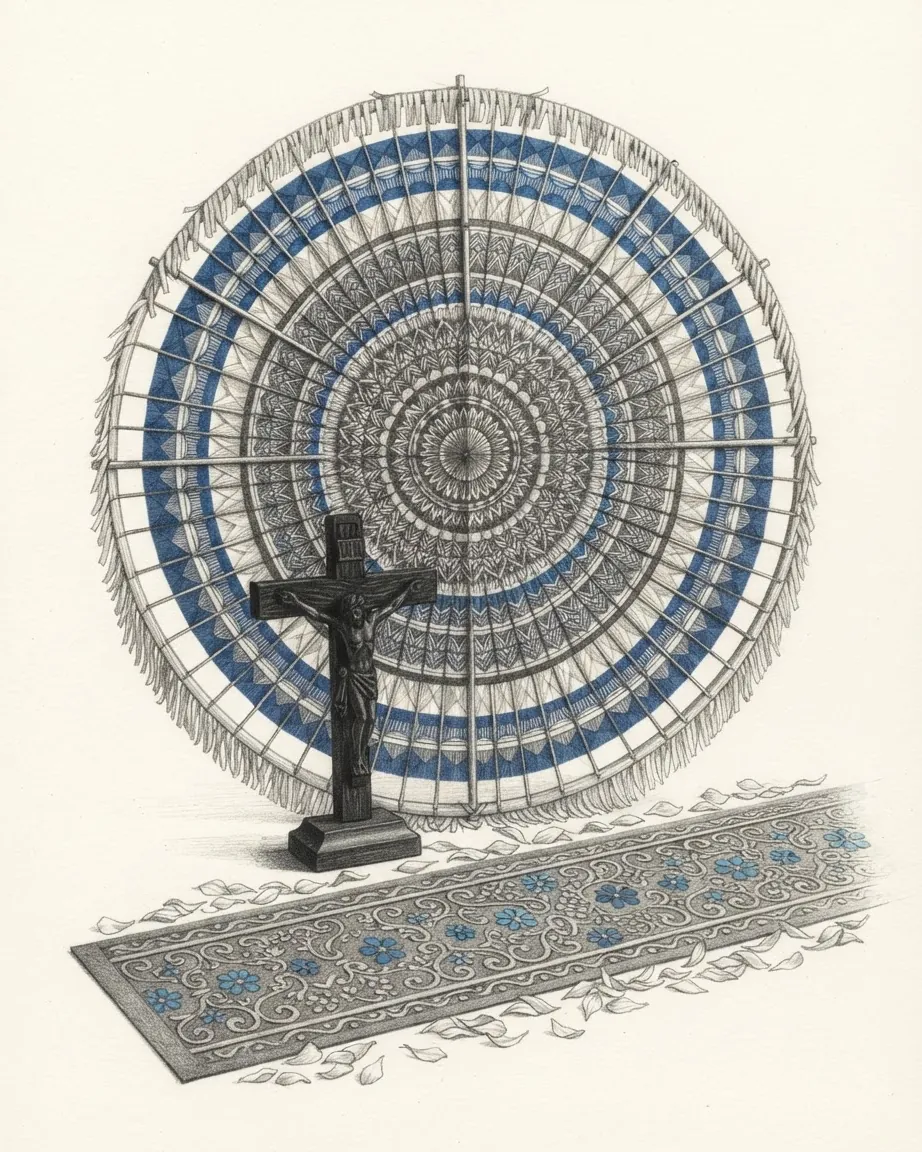
The Catholic calendar remains the public one. Holy Week processions are accompanied by wind and percussion bands, and Holy Week in Guatemala was inscribed by UNESCO in 2022. The image of the Black Christ of Esquipulas, in the east of the country, dates from 1595 and was carved by Quirio Cataño of Antigua Guatemala, a city that exported religious images and statues to the rest of the Americas and to Spain in the 17th and 18th centuries.
What the war did to Maya dress and ritual
The Commission for Historical Clarification registered 42,275 victims of the armed conflict that began in 1962, among them 23,671 victims of arbitrary execution and 6,159 of forced disappearance. Of the victims it fully identified, 83% were Maya and 17% Ladino, and combining its data with other studies it estimated the dead and disappeared at more than two hundred thousand.
Its conclusions on culture name the traje directly. In certain regions and years, the commission found, the Maya were forced by terror and persecution to hide their ethnic identity, which was expressed in their language and their dress. The militarisation of communities disrupted their cycle of celebrations and ceremonies and drove their rituals further into secrecy. The commission recorded the destruction of maize and the killing of elders as attacks on elements of deep symbolic content, and noted that the army used Maya names and symbols for its task forces.
From 1982, the commission found, traditional Maya authorities were replaced as a general practice by military commissioners and the heads of the civil patrols, which broke the oral transmission of knowledge inside communities. Between 500,000 and one and a half million people were displaced in 1981 to 1983, and about 150,000 sought safety in Mexico.
The commission concluded that agents of the state committed acts of genocide against groups of the Maya people in the four regions it analysed, in counterinsurgency operations between 1981 and 1983. The finding is the commission's, set out against the text of the 1948 genocide convention. In 2013 the genocide charges tried in Guatemala against Efraín Ríos Montt, head of state in 1982 and 1983, over the killing and disappearance of more than 1,700 Ixil Maya, were based on its report. In 1992 the Nobel Peace Prize went to Rigoberta Menchú, a K'iche' Maya, for drawing international attention to the violence against the indigenous population.
Read beside these findings, the 2018 clothing question measures something that was dangerous to show within living memory.
What UNESCO has inscribed from Guatemala
Guatemala ratified the convention on intangible cultural heritage on 25 October 2006, and by 2026 five elements were inscribed:
| Year | Element | List |
|---|---|---|
| 2008 | Rabinal Achí dance drama tradition | Representative |
| 2008 | Language, dance and music of the Garifuna | Representative |
| 2013 | Nan Pa'ch ceremony | Urgent Safeguarding |
| 2022 | Holy Week in Guatemala | Representative |
| 2024 | Giant kites of Santiago Sacatepéquez and Sumpango | Representative |
The Nan Pa'ch ceremony is the only Guatemalan element on the list of heritage in need of urgent safeguarding. Two more nominations were pending in 2026: the pilgrimage to the Black Christ of Esquipulas, put forward jointly with Panama, and the knowledge of preparing traditional sauces of the Maya cultures.
The World Heritage list holds the built record. Tikal National Park, in Petén, protects 57,600 hectares around a Maya city inhabited from the 6th century BC to the 10th century AD, and is inscribed under both cultural and natural criteria; it was declared a national monument in 1931 and a national park in 1955. Antigua Guatemala was founded in 1524 as Santiago de Guatemala, moved to its third site in March 1543 and served as capital for 230 years, until the Santa Marta earthquakes of 1773 led the authorities to move the capital to what became Guatemala City. Its churches are built in a regional style, the Barroco antigueño, with massive walls and low bell towers designed to withstand earthquakes.
Where Guatemalan music and food come from
The marimba, a wooden idiophone of the xylophone family, is the national instrument and is played across the whole country. Liturgical chant and polyphony arrived in 1524, and much of the music written in Guatemala between the 16th and 19th centuries has only recently been recovered by scholars and returned to performance. The Garífuna of the Caribbean coast have their own popular and folk music, and Garífuna-influenced punta is part of what contemporary groups play.
The kitchen rests on maize, chillies and black beans, the base of Maya cooking. Guatemalans distinguish maize, the non-sweet corn used for dough, from elote, the sweet corn eaten on the cob. Stews include kak'ik, a tomato-based turkey stew, and pepián. Tamales in Guatemala are more often wrapped in plantain, banana or mashan leaves than in corn husks, and they vary by what goes into the dough, what goes into the filling and what wraps them.
Food also keeps the calendar. Paches, a tamale made with a potato base, are a Thursday dish and tamales a Sunday one. Fiambre belongs to All Saints' Day on 1 November, and tamales and ponche to Christmas. Some dishes share a name with those of a neighbouring country and are quite different, the enchilada among them. RECIPESpec catalogues the dishes themselves.
What Guatemalan writers have made of the record
Miguel Ángel Asturias won the Nobel Prize in Literature in 1967, and his novel El Señor Presidente is based on the government of Manuel Estrada Cabrera. Rigoberta Menchú is known abroad for her books I, Rigoberta Menchú and Crossing Borders. The Ministry of Culture and Sports has awarded the Guatemala National Prize in Literature every year since 1988, once to each writer, for a whole body of work.
The Popol Vuh recounts the Hero Twins playing a ballgame against the gods of the underworld and winning, and the Museo Popol Vuh, a museum of Maya archaeology in the capital, carries its name. In film, Jayro Bustamante reached an international audience with Ixcanul in 2015 and with Temblores and La Llorona in 2019, work centred on contemporary Guatemalan society. Guatemala: history takes up the conquest and the war that this culture outlasted.
Common questions
Questions about Guatemala
What is the traje in Guatemala?
The traje is the indigenous dress of Guatemala's Maya and other peoples, hand-woven and embroidered cotton or wool. For women it is a blouse and a long skirt, for men a white shirt and coloured trousers with a jacket. Each village has its own pattern, so a wearer's home town can be read on sight, and Article 66 of the constitution protects its use.
How many Mayan languages does Guatemala recognise?
The 2018 census enumerated 22 Maya linguistic communities, and the Language Law of 2003 recognises the Mayan languages as national languages beside Xinka and Garífuna. Spanish is the only official language.
Why did the number of Xinka rise so fast?
Because the census counts by self-identification. 16,214 people identified as Xinka in 2002 and 264,167 in 2018, a growth rate of 17.8% a year, while only 2,755 people aged four and over had learned Xinka as their first language in 2018. The rise records people claiming the identity, in a population where the language has very few first speakers left.
Who is Maximón?
Maximón, known to his devotees as San Simón, is a local saint of Guatemala's syncretic Catholic and Maya practice, associated with masculine fertility. He is always shown in black, with a black hat, seated on a chair. The national tourism plan lists the Cofradía de San Simón in Santiago Atitlán among the attractions of Lake Atitlán.
What does Guatemalan Holy Week involve?
Processions through the streets accompanied by wind and percussion bands, during Lent and Easter week. UNESCO inscribed Holy Week in Guatemala on its representative list of intangible heritage in 2022, the fourth of the country's five elements.