Why an economy this good at exporting stopped growing
1 922 words · 9 min · updated 2026-09-10
 Back to Germany
Growth in 2025 was 0.2%, and the OECD's explanation puts a decade of under-investment before any of the recent shocks. The economy turned over 5.05 trillion United States dollars that year, or 60,496 dollars a head, on exports of 1.66 trillion dollars of goods and services in 2024 against a trade surplus of 255 billion.
In short
- Gross domestic product
- 5.05 trillion USD in 2025
- Per head
- 60,496 USD in 2025
- Growth
- 0.2% in 2025
- Unemployment
- 3.7% in 2025
- Exports
- 1.66 trillion USD in 2024, 50.3% of output
- Trade surplus
- 255 billion USD in 2024
- Industry share of output
- 29.1%
- Net zero target
- 2045; coal phased out, nuclear ended in 2023
What the German economy produces
Germany produced 5.05 trillion United States dollars of output in 2025, which is 60,496 dollars a head, or 75,407 dollars at purchasing power parity. Growth was 0.2%, inflation 2.2% and unemployment 3.7%. Income is distributed at a Gini coefficient of 33.7 in 2022.
The structure is more industrial than any comparable economy. Services contribute around 70% of output, industry 29.1% and agriculture 0.9%, and that industrial share is roughly double what the United States or the United Kingdom carry. Exports amounted to 1.66 trillion dollars of goods and services in 2024 and account for 50.3% of national output, with a trade surplus of 255 billion dollars in 2024.
| Figure | Value | As of |
|---|---|---|
| Gross domestic product | 5.05 trillion USD | 2025 |
| Per head | 60,496 USD | 2025 |
| Per head at purchasing power parity | 75,407 USD | 2025 |
| Growth | 0.2% | 2025 |
| Inflation | 2.2% | 2025 |
| Unemployment | 3.7% | 2025 |
| Exports of goods and services | 1.66 trillion USD | 2024 |
| Exports as a share of output | 50.3% | 2024 |
| Trade surplus | 255 billion USD | 2024 |
Why the Mittelstand matters more than the giants
The firms outsiders name are the listed ones. In 2024, 29 of the five hundred largest listed companies by revenue worldwide were headquartered in Germany, and 26 of Europe's hundred largest are German. That is not where the distinctive part of the economy sits.
Nearly all German companies belong to the Mittelstand, mostly family-owned small and medium-sized enterprises, and they account for 48% of the global market leaders in their individual product segments, the firms usually described as hidden champions. A German manufacturer of a specific industrial component may be unknown to the public and supply most of the world market for it.
The model has particular properties. Family ownership means long investment horizons and reluctance to sell; deep specialisation means pricing power in a narrow niche; and the combination produces an export economy that does not depend on consumer brands. It also produces vulnerability, because a firm making one thing extremely well has nowhere to go when demand for that thing changes. A conglomerate can close a division; a family firm employing four hundred people in one town making one component cannot become something else, and the German industrial map is made of several thousand such towns.
That vulnerability arrived. The Mittelstand has seen a significant downturn through the 2020s under competition from China, which has moved from buying German industrial goods to making them, and the segments where German firms were unchallenged for decades are now contested.
What went wrong after a decade of growth
The German economy grew strongly on exports for a decade and then stopped. The OECD's account names three shocks and one pre-existing condition. The pandemic disrupted supply chains an export economy depends on. Russia's war against Ukraine removed the cheap gas that energy-intensive German industry had been built around. Rising trade tensions hit a country that sells half its output abroad.
The pre-existing condition is the more serious part. Productivity growth had already slowed before the pandemic, on weak public and private investment, declining business dynamism and skilled labour shortages made worse by rapid population ageing. A country running large trade surpluses had been under-investing at home for years, and the bill arrived at the same moment as the shocks.
Growth of 0.2% in 2025 is what that produces. The OECD projects 0.7% in 2026 and 1.1% in 2027 with working day adjustments, supported by public investment rising strongly following increased flexibility in the fiscal rules, and by private consumption backed by rising wages, though higher energy prices and inflation are reducing real income growth. Private investment is expected to pick up gradually, held back by policy uncertainty in export-oriented manufacturing.
What reunification cost and what it left
With reunification on 3 October 1990 Germany took on the task of reconciling two economic systems that had diverged for forty years. Interventionist planning brought eastern Germany up towards western levels of development, and it succeeded far enough that the comparison is now about degree rather than kind.
It did not close the gap. The standard of living and annual income remain significantly higher in the west, three and a half decades after unification and after transfers on a scale no comparable country has attempted. The east has fewer corporate headquarters, fewer large firms, a thinner Mittelstand and an older population, because the working-age cohort that left in the 1990s largely did not come back.
That geography matters to every problem above. The regions with the weakest municipal administrative capacity, the sharpest demographic decline and the greatest dependence on the industries being restructured are disproportionately eastern, so an economic policy addressed at national averages misses where the pressure actually is.
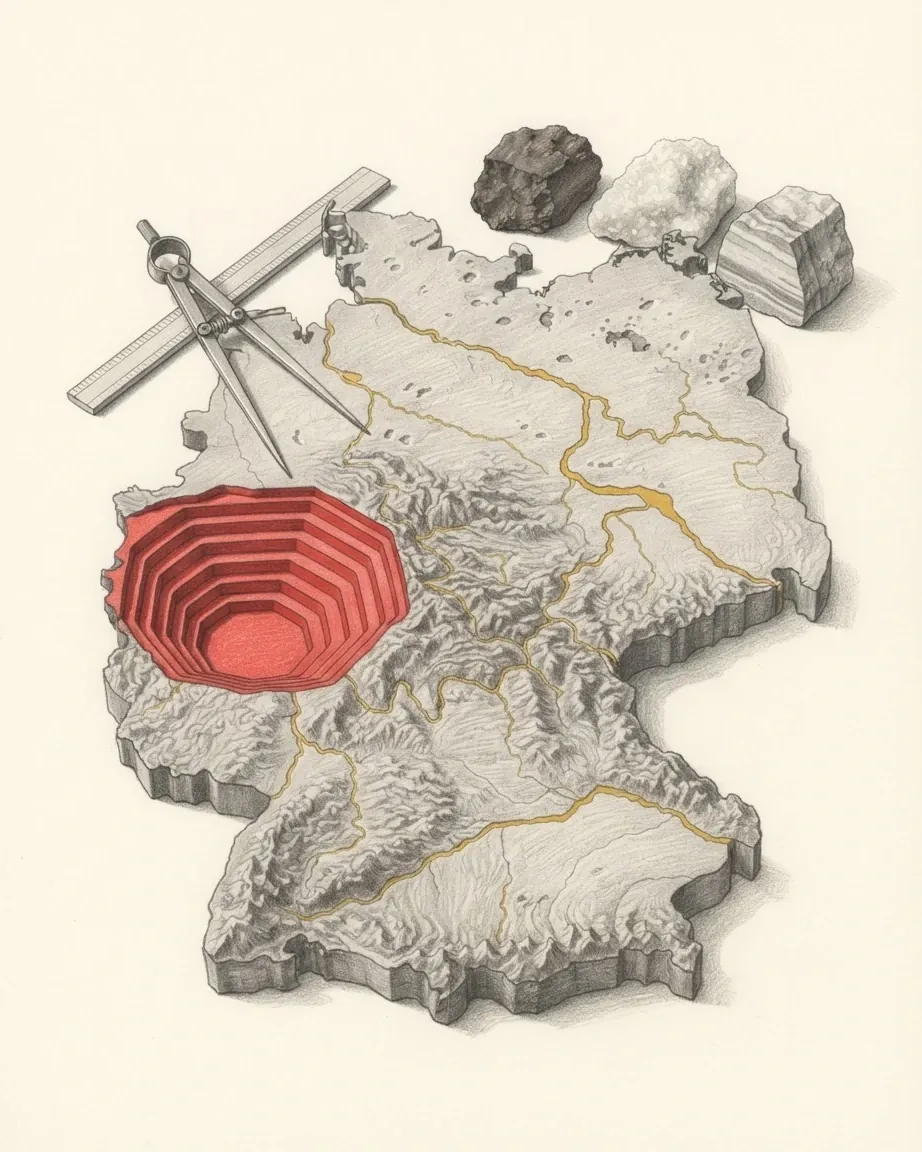
Natural resources are distributed the same way. Germany holds timber, lignite, potash and salt, with minor natural gas in Lower Saxony, and lignite is the resource that most shaped eastern industry and is the one being phased out. A coal exit is a national climate policy and a regional employment problem, and the two are not experienced by the same people.
What the OECD actually recommends
The recommendations are administrative rather than macroeconomic, and that is the striking thing about them. The list is: simplify infrastructure planning and approval procedures; improve the financial and administrative capacity of municipalities; reduce high administrative burdens and regulatory barriers to competition; digitalise the public administration; improve infrastructure implementation capacity, particularly at municipal level.
The reason those appear ahead of tax or spending measures is that Germany's constraint has become its ability to execute. Money has been made available by the reform of the fiscal rules, and the difficulty is converting it into built infrastructure through a planning and approval system that takes years and a municipal administration that is understaffed and largely paper-based. An economy can be told to invest and still not manage to. The bottleneck is measured in years of permitting rather than in percentage points of the deficit, and it is not the kind of problem a budget decision fixes.
The fiscal recommendations exist alongside them. Medium-term sustainability requires improving spending efficiency, reallocating spending and broadening the tax base, and addressing the spending pressures created by rapid ageing. On the labour side the recommendation is to improve labour supply incentives in the tax and transfer system for women and older workers, which is the same demographic problem approached from the other end.
How the energy transition became the economic question
Germany's Climate Law targets net zero emissions by 2045. To reach the Energiewende milestones, 80% of electricity supply must come from renewables by 2030 and 100% by 2035, and coal is to be phased out completely. Germany was an early leader in offshore wind and solar, and it phased out nuclear power in 2023. Legislative reforms to renewable planning and siting support targets of 100 to 110 gigawatts of onshore wind and 30 gigawatts offshore.
Doing all of that simultaneously is the hardest form the transition can take. Leaving nuclear removed dispatchable low-carbon capacity at the moment coal was also being retired and Russian gas had become unavailable, so the replacement has to cover three things at once rather than one.
The economic consequence is direct rather than theoretical. Energy-intensive manufacturing is the part of German industry with the least room to absorb higher input prices, and it is also the part that anchors the supply chains the rest depends on. Higher energy prices reduce real household income, weigh on investment in export manufacturing and appear in every OECD projection as a drag.
The way out is the same as the way in. Accelerating the green transition reduces dependency on imported fossil fuel, which is the exposure that caused the problem, and the constraint on accelerating it is the same planning, permitting and municipal capacity constraint that limits everything else.
What the fiscal rules do
Germany wrote a debt brake into its constitutional framework in the aftermath of the financial crisis, limiting structural federal borrowing and binding the states more tightly still. It was among the major German political projects of the early twenty-first century, alongside European integration and the energy transition, and for a decade it did what it was designed to do.
What it also did was constrain public investment at the moment the country most needed it. The OECD's diagnosis of the productivity slowdown names weak public as well as private investment, and a rule that treats all borrowing alike does not distinguish between financing consumption and financing a bridge.
The rules have since been reformed to allow more flexibility, and the OECD expects public investment to rise strongly as a result. Its condition is that the new flexibility be complemented by structural reforms, because money that cannot be spent is not investment. That returns the argument to planning procedures, approval times and municipal capacity, which is where every strand of German economic policy currently ends up.
The demographic pressure runs underneath all of it. Rapid population ageing is raising spending commitments at the same time as it shrinks the working-age population paying for them, and the OECD's fiscal advice, improving spending efficiency, reallocating spending and broadening the tax base, is aimed at a gap that widens every year regardless of the growth rate.
What the country still sells
The export list is industrial and it holds up better than the growth figures suggest. Vehicles, machinery, chemicals, electrical equipment and pharmaceuticals are the categories, produced by a combination of listed multinationals and Mittelstand suppliers feeding them, and 1.66 trillion dollars of exports in 2024 against a 255 billion dollar surplus describes an economy still very good at making things.
Tourism is a larger part of the picture than its reputation suggests. Tourism contributed 122.3 billion euros directly to the economy in 2022, 3.1% of output, and employed 1.9 million people, 4.2% of total employment, with travel exports at 8.5% of total service exports in 2024. More recent estimates compiled jointly by the German Chamber of Industry and Commerce, the Federal Association of the German Tourism Industry and the German Tourism Association put the sector at 3.7% of gross value added in 2024, only slightly below the pre-pandemic 3.8%, with 2.7 million people employed. The gap between the 1.9 million recorded in the official 2022 statistics and the 2.7 million in the 2024 industry estimate is partly recovery and partly a difference in what each count includes, which is the normal condition of tourism statistics everywhere.
The service sector at 70% of output includes the parts of the economy that have grown while manufacturing struggled, and that is the transition the country has not yet decided whether it wants. Germany's institutions, training system and export model are all built around industry. The dual vocational system that supplies skilled workers to manufacturing, the works councils that co-determine inside industrial firms, and the supplier networks that make the Mittelstand possible have no direct equivalents in a service economy, and an economy rebalancing towards services would need different institutions rather than the same ones applied more loosely. Germany: politics sets out the institutions that would have to make that choice.
Common questions
Questions about Germany
How big is the German economy?
5.05 trillion United States dollars of output in 2025, which is 60,496 dollars a head, or 75,407 dollars at purchasing power parity. Services contribute around 70% of output, industry 29.1% and agriculture 0.9%.
Why has German growth stalled?
Growth was 0.2% in 2025. The OECD attributes it to the pandemic, Russia's war against Ukraine and rising trade tensions striking an economy that exports half its output, on top of a productivity slowdown that predated all three and came from weak investment, declining business dynamism and skilled labour shortages worsened by ageing.
What is the Mittelstand?
The mostly family-owned small and medium-sized firms that nearly all German companies belong to. They account for 48% of the global market leaders in their individual product segments, the firms often called hidden champions, and they have seen a significant downturn through the 2020s under competition from China.
What is the Energiewende?
Germany's energy transition. The Climate Law targets net zero emissions by 2045, with 80% of electricity from renewables by 2030 and 100% by 2035 and a complete coal phase-out. Nuclear power was phased out in 2023, and the targets include 100 to 110 gigawatts of onshore wind and 30 gigawatts offshore.