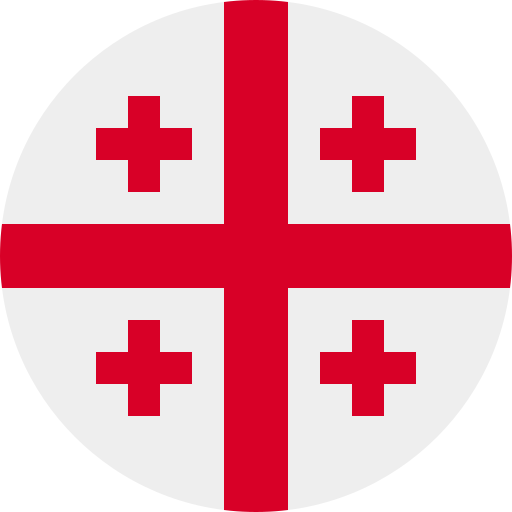
Georgians call their country Sakartvelo, the land of the Kartvelians, a name taken from the central region of Kartli and stretched over the whole medieval kingdom. The English name came from the Persian Gurj, and the Russian Gruzia is the form Georgian diplomacy has asked other governments to drop. Georgia lies on the east coast of the Black Sea, south of the Greater Caucasus, and its census of 14 November 2024 counted 3,929,581 people. That count leaves out Abkhazia and South Ossetia, which the constitution names as Georgian territory and which passed out of Tbilisi's control in wars fought in the early 1990s and in 2008.
At a glance
Where it is
Where Georgia is, and what is around it
Georgia has a coast. It shares a border with 4 countries, counted as shared borders, which includes neighbours across water.
 Armenia
 Azerbaijan
 Russia
 Türkiye
Where the names Sakartvelo and Georgia come from
The native name is built from two parts. The root is kartvel-i, a Kartvelian, and around it sits the circumfix sa-X-o, the standard Georgian way of naming the area where a people lives. The name is recorded from the ninth century, and before the thirteenth it had been extended from the region of Kartli to the whole medieval kingdom. The medieval Georgian Chronicles gave the Kartvelians an eponymous ancestor, Kartlos, a great-grandson of Japheth. Scholars instead derive Kartli from the Karts, a proto-Kartvelian tribe.
The outside name has a different line of descent. It first appears in Italian on the mappa mundi of Pietro Vesconte, dated 1320, and early Latin sources often spelled it Jorgia. Jacques de Vitry traced it to the popularity of Saint George; Jean Chardin to the Greek word for a tiller of the land. Modern scholarship derives it from the Persian Gurj, a historical name for Georgians, which passed into Byzantine Greek, the Slavic languages and then Western Europe, helped along by its resemblance to George.
The English form is the official one, fixed by the English-language text of the constitution adopted in 1995; between the end of the Soviet Union and that constitution the state was the Republic of Georgia. In Abkhaz, the country's second official language, the name is Kərttʷʼəla. Several languages still use the Russian variant, Gruzia, and Georgian authorities have campaigned to replace it. Israel, Japan, South Korea and Hungary have switched to forms of the English name since 2006, and in 2020 Lithuania adopted Sakartvelas in all official communication. The culture article follows the Kartvelian language and the alphabets it is written in.
Where Georgia sits between two seas
Georgia lies almost entirely south of the watershed of the Greater Caucasus, with a few slivers on the northern side. Russia lies to the north and north-east, Türkiye and Armenia to the south and Azerbaijan to the south-east. The country record and Britannica give its area as 69,700 square kilometres; the Wikipedia article on the country prints 67,900, and the two figures have not been reconciled in the sources on file.
A low ridge down the middle, the Likhi Range, splits the country into halves that historians still call by their ancient names: Colchis in the west, Iberia on the eastern plateau. Rivers west of it run to the Black Sea and rivers east of it to the Caspian, and rainfall and farming divide along the same line. The geography article takes that division apart region by region.
| The record in short | |
|---|---|
| Population | 3,929,581, census of 14 November 2024 |
| Area | 69,700 km², per the record and Britannica |
| Capital | Tbilisi, 1,331,485 people on 14 November 2024 |
| Highest point | Shkhara, 5,193 m in the record |
| Official languages | Georgian; Abkhaz in Abkhazia |
| Currency | Georgian lari |
| Independence declared | 9 April 1991 |
| Council of Europe | joined 27 April 1999 |
Tbilisi held 1,331,485 of the 3,929,581 counted in November 2024, about a third. Georgia is usually counted as part of Europe, and it joined the Council of Europe on 27 April 1999.
How often Georgia has been a single state
The name Sakartvelo spread across the whole kingdom in the same centuries that the kingdom was first assembled. Bagrat III became the first king of a united Abkhazia and Iberia in 1008 and annexed Kakheti-Hereti to the east in 1010. After 1466 the unified kingdom ceased to exist and was divided into several political units.
The Russian Empire began annexing the Georgian lands in 1801. A Democratic Republic declared independence on 26 May 1918, and the Red Army advanced into Georgia in February 1921. Seventy years later a referendum held on 31 March 1991 was followed by a declaration of independence on 9 April, the first by a Soviet republic outside the Baltic, and the record dates the state from 25 December 1991. Georgia: history runs through the whole sequence, including how often the unified kingdom and an independent state have coincided.
What the Georgian census leaves out
Two regions fall inside the borders Georgia claims and outside the statistics it publishes. Abkhazia is an autonomous republic under the Georgian constitution and declared independence in 1999. South Ossetia, which the Georgian government calls the Tskhinvali region, voted for independence in a 2006 referendum that was not recognised. Russia recognised both after the war of August 2008, and on 26 August 2008 Georgia broke off diplomatic relations with Russia. Georgia regards the two regions as occupied, and most countries treat them as Georgian territory.
Wikipedia's account of Georgian demography names the exclusion of Abkhazia and South Ossetia from the statistics as one reason the recorded population fell, alongside net emigration that took more than a million people off the total, breakaway regions included, between 1990 and 2010. Freedom House states that its 2025 scores for Georgia do not reflect conditions in the two regions, which it assesses in separate reports.
The census has been corrected before. Later research put the 2002 count at 8 to 9% too high, partly because families kept listing emigrants as residents, and the census of October 2014, run with the United Nations Population Fund, found 3,713,804 people and a gap of roughly 700,000 against the official running estimate. The 2024 census raised the count to 3,929,581; preliminary results had first given about 3,914,000.
How Georgia's constitution holds it together
The constitution of 1995, revised through 2018, keeps both regions in the text. The Electoral College that chooses the president has 300 members and includes the supreme representative bodies of the Autonomous Republics of Abkhazia and Ajara as well as the whole parliament; the president serves five years. Parliament has 150 members, elected for four years by proportional representation in a single national district.
Article 78 instructs every constitutional body to take all measures within its competence to secure Georgia's full integration into the European Union and NATO. Georgia applied for EU membership on 3 March 2022 and received candidate status in December 2023. In November 2024 the government announced that the accession process would be paused until 2028, and protests followed. Georgia: politics sets out how the institutions have been redesigned since 1995 and how the pause divided them.
What the Georgian economy earns
Geostat's preliminary figures put nominal output at 104.6 billion lari in 2025, or 38.1 billion United States dollars, with real growth of 7.5%. Two per-head figures are published for 2025. The World Bank gives 9,692 dollars for 2025, and Geostat's own table gives 10,296.5 dollars. At purchasing power parity the World Bank figure was 29,414 dollars in 2025. Inflation ran at 3.9% and unemployment at 12.1% in the same year.
Personal remittances equalled 11.2% of GDP in 2025 by the World Bank's figure, and oil and gas pipelines run from Baku through Tbilisi to Ceyhan in Türkiye. Georgia: economy traces the trade in cars and fuel and the reforms that followed 2003.
Which languages and faiths Georgia counts
Georgian belongs to the Kartvelian family together with Svan, Mingrelian and Laz, and it is neither Indo-European, Turkic nor Semitic. The religion figures reported with the 2024 census put Eastern Orthodox Christians at 82% and Muslims at 11.1%, and the Georgian Orthodox Church holds a special status under the constitution and a concordat of 2002.
UNESCO has inscribed three Georgian practices on its intangible heritage list: polyphonic singing, proclaimed in 2001 and inscribed in 2008; winemaking in the clay qvevri, in 2013; and the living use of three alphabets for the one language, in 2016. Georgia: culture explains how each alphabet kept a job after the next one arrived.
How visitors arrive in Georgia
The Georgian National Tourism Administration counted 6,856,809 international visits in 2025. Land borders carried 3,951,850 of them, 57.6%, and air borders 2,854,412, with Tbilisi International Airport handling 65.4% of the air traffic. Visitors from the neighbouring countries mostly drive or walk across, and those from further away mostly fly.
Four properties are on the World Heritage List: Gelati Monastery and the Historical Monuments of Mtskheta, both from 1994, Upper Svaneti from 1996, and the Colchic Rainforests and Wetlands from 2021. Georgia succeeded to the World Heritage Convention on 4 November 1992. Georgia: travel follows the border crossings, the Georgian Military Road over the Caucasus and the regions visitors cannot enter.
Read
Everything about Georgia
Six articles, each answering one question and each written to be read on its own.
The record
What is measured about Georgia
Pages that nobody writes, built from the record and from the data files beside it.
Common questions
Questions about Georgia
Why do some languages still call Georgia Gruzia?
Gruzia is the Russian form of the name, and several languages took it from Russian. Georgian authorities have run diplomatic campaigns to replace it. Israel, Japan, South Korea and Hungary switched to variants of the English Georgia from 2006 onwards, and Lithuania went further in 2020, adopting Sakartvelas, from the native Sakartvelo, in all official communication.
Does the Georgian census include Abkhazia and South Ossetia?
No. Georgian statistics leave out both regions, which the government in Tbilisi does not administer, so the census of 14 November 2024 counted 3,929,581 people in the rest of the country. Freedom House likewise scores Georgia without them and reports on the two regions separately.
Which language family does Georgian belong to?
The Kartvelian family, a small group that also includes Svan, Mingrelian and Laz. Georgian is neither Indo-European, Turkic nor Semitic, and it sets Georgians apart linguistically from the neighbouring nations. It has its own alphabet, in three historical forms, and UNESCO inscribed the living use of all three on its intangible heritage list in 2016.
How much of Georgia's population lives in Tbilisi?
About a third. The census of 14 November 2024 counted 1,331,485 people in Tbilisi out of 3,929,581 nationally. The capital stands on the Kura in the eastern half of the country, and its airport handled 65.4% of international air visits in 2025.
Nearby in the catalogue