What to know before travelling around France
2 052 words · 9 min · updated 2026-09-10
 Back to France
France received more than 100 million international visitors in 2024 according to the ministry responsible for tourism, who spent 71 billion euros. They concentrate in three places, Paris, the Riviera and the Loire Valley, which leaves a country of four separate climates, 56 World Heritage properties and a high-speed rail network of nearly thirty thousand kilometres largely to itself.
In short
- International visitors
- more than 100 million in 2024
- International receipts
- 71 billion euros in 2024
- World Heritage properties
- 56, of which 47 cultural
- Railway network
- 29,473 km as of 2008, high-speed services to 320 km/h
- Currency
- euro, and the CFP franc in the Pacific
- Emergency number
- 112, or 15, 17 and 18 for medical, police and fire
- Driving
- on the right, vehicle code F
- Time zone
- one hour ahead of UTC in winter, two in summer
How many people already go and where they go
France received more than 100 million international visitors in 2024 according to the ministry responsible for tourism, who spent 71 billion euros, 12% more than in 2023, leaving a travel surplus in the balance of payments above 15 billion euros. Five countries supply most of that spending: Belgium, the United Kingdom, Germany, Switzerland and the United States. Visitors from North America have driven the long-haul recovery since the pandemic, while Chinese and Japanese arrivals have returned in numbers without returning in spending. Those visitors concentrate heavily. The Paris region takes the largest share, the French Riviera draws more than ten million a year on its own, and the castles of the Loire Valley take around six million. Everything else is spread across a country large enough that the crowding in the first three places does not describe the rest of it.
There are 56 properties on the UNESCO World Heritage List, 47 of them cultural, seven natural and two mixed, and they are distributed across every region, including whole working territories such as the Causses and the Cévennes, an agro-pastoral region inscribed in 2011. Two of them are on Corsica alone.
What the seasons actually do
France has four distinct climates rather than one, and the choice of month depends entirely on which of them a trip is aimed at.
The north-west is oceanic. Brittany varies little across the year, with Brest averaging 6 °C in January and 16 °C in July, high humidity, 890 mm of rain spread through the year, and west winds that blow almost constantly and sometimes hard. It is a region for late spring and summer, and the summers are mild rather than hot. The north-east is continental. Strasbourg has the widest temperature range in the country, with around 83 days of frost in an average winter, several weeks of snow cover and a good deal of winter sunshine, then storms bringing the year's heaviest rain in June and July. The Paris Basin falls between the two, averaging 11 °C across the year with about 580 mm of rain, most of it arriving in summer storms.
The south-east is Mediterranean, reaching along the coastal plains and up the lower Rhône as far as Montélimar. Nice averages 8 °C in January, which makes the Riviera a winter destination as well as a summer one, and the same climate touches the southern Alps, the south-eastern Cévennes and the eastern Pyrenees. The Aquitaine Basin in the south-west sits between oceanic and Mediterranean, with oceanic winters and warm springs and summers. The mountains run on their own calendar. Snow cover lasts from December to the end of April above 900 metres, and is permanent above 2,700 metres in the Alps and 3,000 metres in the Pyrenees. West-facing slopes in the Pyrenees take some of the heaviest rainfall in the country.
| Region | Climate | What it means for a visit |
|---|---|---|
| Brittany and the north-west | oceanic | Mild all year, wet and windy, best from May to September |
| Paris Basin | between oceanic and continental | 11 °C on average, summer storms, workable year round |
| Alsace and the north-east | continental | Cold sunny winters, about 83 frost days, wet early summer |
| Riviera and the lower Rhône | Mediterranean | Mild winters at around 8 °C in January, hot dry summers |
| Alps and Pyrenees | mountain | Snow from December to late April above 900 metres |
What Paris holds and what it costs
Paris holds the concentration of museums and monuments that most first visits are built around. The Louvre occupies the former royal palace that the revolutionary regime turned into a public museum in 1793. The Musée d'Orsay is a converted railway station holding the Impressionist collection, and the Musée de l'Orangerie exists largely to house eight of Monet's water lily murals in two oval rooms built for them.
| Site | Reported annual visitors |
|---|---|
| Louvre | 7.7 million in 2022 |
| Eiffel Tower | about 6.2 million |
| Musée d'Orsay | about 3.3 million |
| Château de Versailles | about 2.8 million |
| Muséum national d'Histoire naturelle | about 2 million |
| Pont du Gard | about 1.5 million |
| Musée de l'Orangerie | about 1 million |
The practical consequence of those figures is that timed entry and advance booking are the difference between a visit and a queue, and that the second rank of Parisian museums is often emptier and better for the same afternoon. Disneyland Paris sits east of the city and drew 15 million visitors across its two parks in 2009, which puts it in a different category of crowding again.
Where to go once Paris is done
The French Riviera runs along the Mediterranean between Marseille and the Italian border, with Nice, Antibes and Cannes as the main towns and Cap Ferrat as the expensive one. The regional development agency counts 300 days of sunshine a year, 115 kilometres of coast and beaches, 18 golf courses and 3,000 restaurants, and Cannes hosts its film festival each May, which is worth avoiding unless it is the reason for the trip. Port-Cros National Park lies offshore, one of several protected areas along a coast otherwise given over to resorts. The Riviera season runs long precisely because the winters are mild, so the shoulder months either side of summer are the ones with the weather and without the crowds.
Provence sits inland and west of it, with Marseille as its main city and the Gorges du Verdon among its best-known natural sites. The Loire Valley, between Orléans and the Atlantic, is a World Heritage site as a whole rather than as a set of monuments, and its towns, Amboise, Angers, Blois, Chinon and Saumur, are as much of the point as the châteaux themselves. Many of those castles were built as residences rather than fortresses from about 1450, and a good number were sacked during the Revolution and used as military headquarters during both world wars.
The French Alps span the Rhône-Alpes and Provence-Alpes-Côte d'Azur regions and hold more than twenty ski resorts, which makes the winter season a second peak entirely separate from the summer one. Corsica, 183 kilometres long and 83 across, is two thirds mountain and a fifth forest, and holds the Calanques de Piana and the Scandola Nature Reserve on the World Heritage List. Bordeaux, Lyon, Toulouse and Strasbourg are the cities most often visited for themselves rather than as bases, and each anchors a region worth several days on its own: Bordeaux the Atlantic wine country, Lyon the Rhône corridor and the approach to the Alps, Toulouse the south-west and the Pyrenees, and Strasbourg the Rhine border where French and German building traditions sit in the same streets.
How to get around the country
The railway is the reason France can be crossed casually. The network covered 29,473 kilometres as of 2008, operated by SNCF, and the high-speed services run at up to 320 km/h, which puts Lyon, Bordeaux and Marseille within a few hours of Paris. Eurostar and Thalys connect the network to London, Brussels and Amsterdam, and LeShuttle carries cars through the Channel Tunnel.
The structure of the network is the thing to plan around. It radiates from Paris, so a trip between two provincial cities on different spokes can take longer than either would take to the capital, and cross-country trips are often better done by car or by connecting through Paris deliberately rather than by accident.
Driving is on the right, the international vehicle code is F, and the motorway network is extensive and largely tolled. Distances are larger than visitors expect: the country runs roughly a thousand kilometres north to south and the same east to west, so a summer itinerary attempting the Alps, the Riviera and Brittany will spend most of itself in transit.
Which currency a French trip needs
France uses the euro in Europe and in the overseas departments, and the CFP franc in the Pacific collectivities, so a trip to New Caledonia or French Polynesia needs a different currency from a trip to Réunion or Martinique. Metropolitan France keeps one time zone, an hour ahead of Coordinated Universal Time in winter and two ahead in summer, while the overseas territories are scattered across many others.
Emergency numbers are worth memorising before arrival. The European general number 112 works everywhere, and the national services are reachable directly: 15 for medical emergencies, 17 for the police, 18 for the fire service and 114 for text-based access by deaf and hard-of-hearing callers.
Plugs are the European two-pin pattern, taking Europlug and Type E fittings, so most continental European appliances work unchanged and British and North American ones need an adapter. The same pattern applies in the overseas departments, which follow metropolitan standards on electricity as on everything else. French is the language of the state and of most public signage, and while the tourist economy in the main destinations operates in English, the further a trip gets from those destinations the less that holds.
What is worth eating where
French cooking is regional before it is national, and the appellation system exists to keep it that way. A cheese or a wine carrying a protected name is legally tied to the ground it came from, which means that ordering the local thing in the region that makes it is not a romantic gesture but a different product from the same name bought elsewhere.
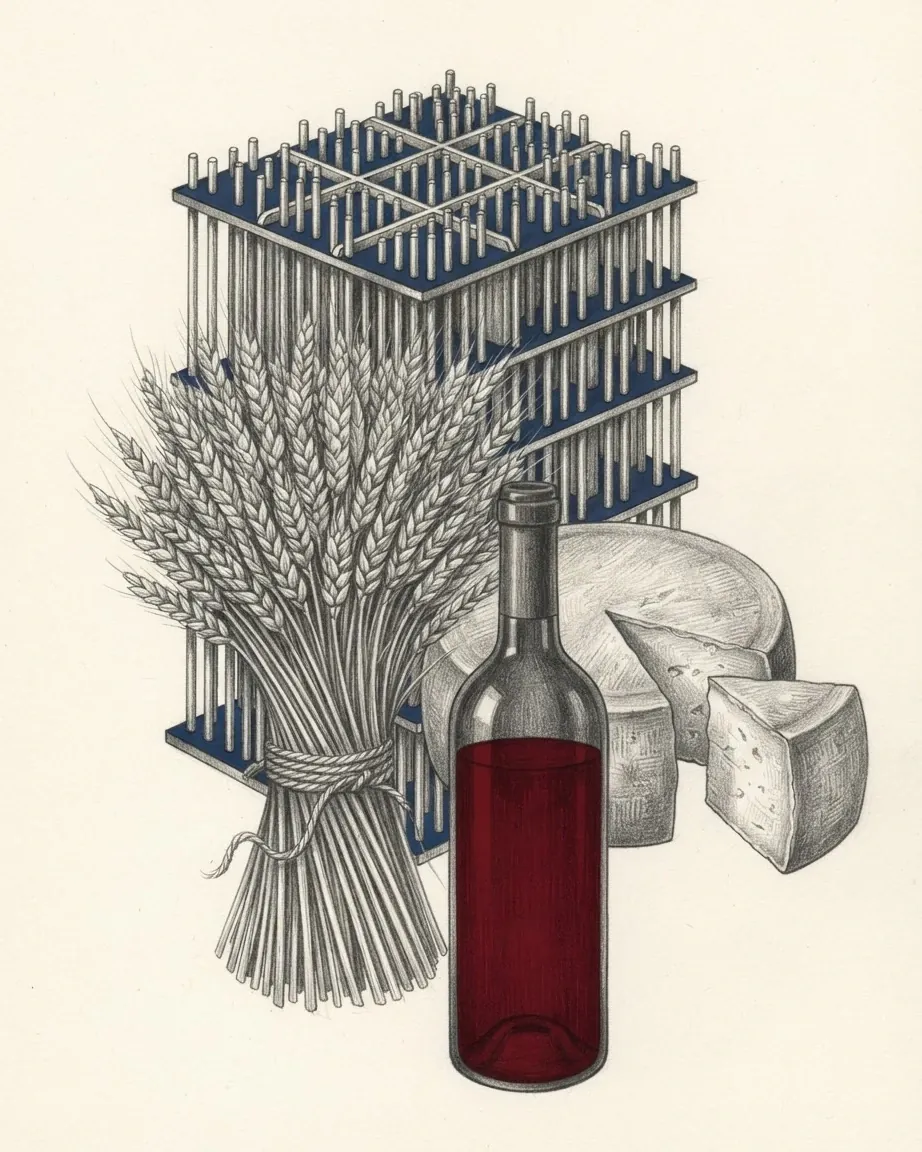
The divisions follow the farming. The north grows cereals and the west runs on dairy, pork, poultry and apples, which is why Norman and Breton cooking rests on butter, cream and cider rather than on olive oil and wine. Central France is beef country. Fruit, vegetables and wine run from the centre south, and the Mediterranean coast cooks accordingly. The wine regions are destinations in their own right, and Bordeaux, Burgundy, the Loire and the Rhône each support a visitor economy built on tastings, cellars and the villages between them.
The classical restaurant tradition is a separate thing from the regional one. Georges Auguste Escoffier codified professional French cooking in the early twentieth century into a written method of defined sauces and station roles, and that system now runs kitchens worldwide, but it deliberately flattened much of what was provincial. The Michelin guide and the gastronomic tourism it created sent people back into the countryside to find what the codification had left out, and that remains the best argument for eating outside the cities.
What has changed is the daily pattern rather than the cooking. Fast food and global chains have taken share, meals are shorter than they were, and the differences in diet that once made France a subject of foreign study have narrowed towards the northern European norm. The long regional meal is still available everywhere; it is now a choice rather than the default. France: culture deals with how the state protects the food names as well as the language.
Where the overseas territories fit
A visit to overseas France is a visit to the same country under substantially different conditions. Guadeloupe, Martinique, Mayotte, Réunion and French Guiana are integral regions of the republic, using the euro and applying French law, which for a European visitor means no currency change and no customs formalities on arrival from the metropolitan territory.
The Pacific collectivities work differently. New Caledonia, French Polynesia and Wallis and Futuna have their own statuses and keep the CFP franc, and the flying times involved make them long-haul destinations reached from Asia or North America as often as from Paris.
What all of them share is the reason France holds an exclusive economic zone of 11,035,000 square kilometres across three oceans. For a visitor that translates into reefs, volcanoes and rainforest inside the same passport regime as the Loire Valley, and into prices inflated by the distance every imported item has travelled. France: geography takes up the physical extent and France: overview the constitutional arrangement behind it.
Common questions
Questions about France
When is the best time to visit France?
It depends which France. The Mediterranean south is mild in winter, averaging 8 °C in January at Nice, and hot in summer. Brittany and the north-west are mild all year and wettest in the west winds, best between May and September. The Alps and Pyrenees hold snow from December to late April above 900 metres, which makes the winter season a separate one entirely.
How many tourists visit France each year?
More than 100 million international visitors in 2024, according to the ministry responsible for tourism, spending 71 billion euros. That was 12% more revenue than in 2023, with Belgium, the United Kingdom, Germany, Switzerland and the United States supplying most of it.
What are the emergency numbers in France?
112 is the general European emergency number and works everywhere. The national services can also be called directly: 15 for medical emergencies, 17 for the police, 18 for the fire service and 114 for text-based contact by deaf and hard-of-hearing callers.
Is it easy to travel around France by train?
Yes on the main routes and harder across country. The network covered 29,473 kilometres as of 2008 and high-speed services run at up to 320 km/h, but it radiates from Paris, so a trip between two provincial cities on different lines can take longer than either would take to the capital.