Salvadoran history: the common lands, the coffee estates and the land clause
3 222 words · 15 min · updated 2026-10-04
 Back to El Salvador
Two laws of 1881 and 1882 abolished El Salvador's native communities and its common lands, and the ground that indigenous villages had held together passed to single owners and was planted with coffee. On 22 January 1932 the coffee towns of the west rose against the military government, and within three days the revolt was crushed; in the reprisals that followed, the army killed between 10,000 and 40,000 people, most of them Pipil peasants. Sixty years later the agreement that ended a twelve-year civil war opened its economic chapter, after a preamble, with "the agrarian problem" and the farms held above a constitutional limit of 245 hectares. Salvadoran history since independence is a contest over who may hold the farmland of a small and crowded volcanic country, and the state has answered it in turn by statute, by massacre and by treaty.
In short
- Joya de Cerén buried
- Around AD 600, by the Loma Caldera eruption
- San Salvador permanently founded
- 1528
- Common lands abolished
- Laws of 1881 and 1882
- Revolt in the west
- 22 to 25 January 1932
- Killed in La Matanza
- 10,000 to 40,000, by the usual estimates
- War with Honduras
- 14 to 18 July 1969
- Chapultepec Agreement signed
- 16 January 1992
- Farmland ceiling per owner
- 245 hectares, Constitution of 1983, Article 105
What the volcanic ash kept at Joya de Cerén
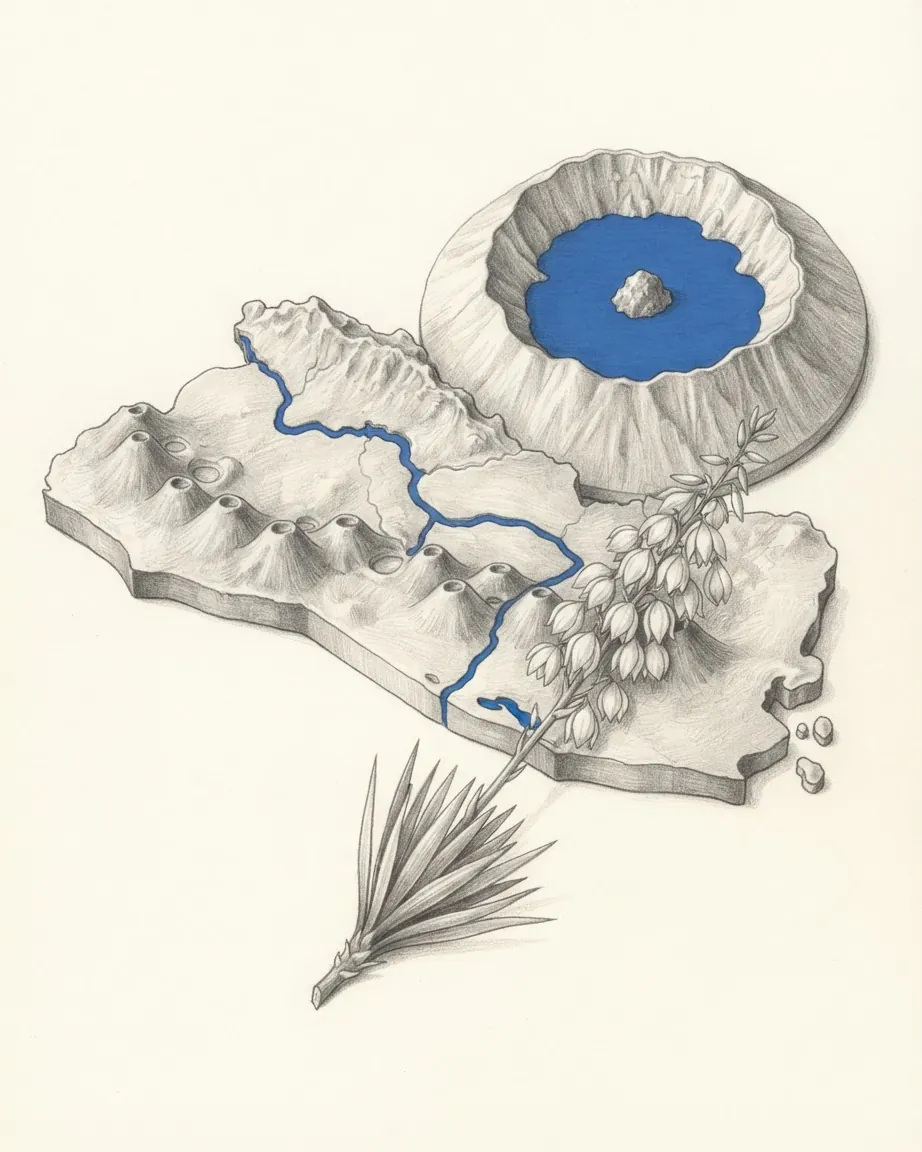
A dense population leaves little open ground to dig in El Salvador, and repeated eruptions have laid thick ash over the sites; several about 1,400 years old lie preserved beneath six metres of it.
Tazumal, in the west, was first settled around 1200 BC and grew into a major urban settlement on the periphery of the Maya world, trading ceramics, obsidian, cacao and hematite. An eruption around AD 430 damaged it, and it never regained its former standing.
Around AD 500, ash from the Ilopango volcano buried the central and western parts of the territory, and the area stayed empty until that layer had weathered into fertile soil. A farming village was then founded at Joya de Cerén, and not long afterwards an eruption of the Loma Caldera buried it in turn, around AD 600. A bulldozer cutting ground for grain silos exposed one of its clay buildings in 1976. Excavation resumed in 1989, the year the State took ownership of the site.
Eighteen structures have been identified and ten excavated, among them dwellings, storehouses, a kitchen and a sweat bath. The ash kept what the tropics normally destroy. Garden tools, pots still full of beans and sleeping mats survive as carbonised material or hollow casts. So do the fields: young and mature maize plants, a herb garden, a garden of henequen agave, and guava and cacao trees. The oldest detailed record of this territory is a record of ordinary farmers and their plots.
By the time of European contact the territory was divided. The Pipil, Nahua-speaking groups from central Mexico who began arriving around 800, held the centre and west and called their domain Kuskatan, a Nawat name commonly written Cuzcatlán. The Lenca governed the east, and the Chʼortiʼ, a Maya people, held the land north of the Lempa River.
How Cuzcatlán resisted conquest and was parcelled out
Pedro de Alvarado crossed into Pipil territory from Guatemala in 1524. At Acajutla, Pipil warriors under Atlácatl and Atonal forced him back, and Alvarado, wounded, withdrew. A second expedition in 1525 founded a town called San Salvador near Cuzcatlán, Pipil fighters drove its settlers out, and the town was moved several times before it was fixed in 1528. In the east the Lenca destroyed the garrison of San Miguel, founded in 1526, and it was rebuilt only in 1537, after their commander Lempira was killed in battle.
The conquerors found little gold and a great deal of volcanic soil, and the crown granted land under the encomienda system in what became the agricultural heartland of the Captaincy General of Guatemala. Cacao was the main source of wealth in the sixteenth century until competition from other colonies cut its value by 1590, and after a century of stagnation, indigo carried the recovery of the 1700s and created large estates run by families whose members led provincial affairs. The western districts the Pipil called Izalcos were governed separately from 1558 as the province of Sonsonate and joined the rest of El Salvador in 1823.
The indigo economy split the country's indigenous population in two. In the centre, the east and along the coast, dangerous work on the plantations, forced recruitment of village labour, disease and the loss of communal lands, the ejidos, broke communities apart and absorbed their members into Ladino society. In the west, where the economy ran on cacao and balsam, communities kept their farming, their social structures and their language. That west, with its communities and their common land still standing, is where the land question came to a head in 1932.
Why San Salvador held on to the federation
The indigo planters led the push for independence, moved by a sharp decline in indigo output after 1800 and by resentment of the Guatemalan merchants who controlled much of San Salvador's trade. In November 1811 the priest José Matías Delgado rang the bells of the church of La Merced in San Salvador to call a rising, with his nephew Manuel José Arce beside him. Both that rising and a second in 1814 were suppressed.
After 1821 the province refused incorporation into Iturbide's Mexican empire, and facing defeat late in 1822 a Salvadoran congress sought annexation to the United States, a plan dropped when Iturbide fell in 1823. The Salvadorans backed Francisco Morazán in the federation's civil war and were rewarded with the federal capital in 1834.
Land was already the grievance underneath. In 1832 Anastasio Aquino led an indigenous revolt in Santiago Nonualco, in what is now La Paz, against abuse and the lack of land to cultivate. The state kept its attachment to the federation longest and assumed sovereign powers in 1841, a year after the other four members had left. The date is recorded differently by different authorities: the United States Office of the Historian gives 1839 for the declaration of an independent republic, other accounts give 30 January 1841, and the United States recognised Salvador as a separate state on 1 May 1849.
How coffee took the common lands
The overthrow of Francisco Dueñas in 1871 opened sixty years of liberal rule focused on growth. Synthetic dyes then cut deeply into the income from indigo, and the planters answered with what Britannica calls a coffee revolution. Coffee needed new land, and the land available was what the indigo planters had left to poor and indigenous communities for subsistence farming, much of it around old volcanic eruptions.
Rafael Zaldívar, president from 1876 to 1885, authorised the sale of indigenous land. The Law of Abolition of Native Communities of 1881 barred indigenous peasants from settling on indigenous land without the owner's permission, and the Law of Abolition of Common Lands of 1882 forbade collective ownership outright: land held in common had to pass to one person, which in practice meant a planter. The historian Rodolfo Cerdas-Cruz called it a seizure "concealed behind a legal facade". Indigenous uprisings against the sales were put down by a newly created rural mounted police force, and the National Guard followed in 1912.
Vagrancy laws then turned the dispossessed into a workforce. Workers were paid in tokens redeemable only at the landlord's store, the tienda de raya, where prices ran high enough to keep them in debt, and a worker's debt passed to his descendants when he died. By 1929 coffee made up between 75% and 95% of all exports, and most of the plantations and their profits belonged to a small group known as the Fourteen Families. Two of them, the Meléndez and the Quiñónez, held the presidency between them from 1913 to 1927.
The instruments that decided who held Salvadoran farmland, and who answered for what was done over it, run from these laws to the peace agreement of 1992.
| Year | Instrument | What it decided |
|---|---|---|
| 1881 | Law of Abolition of Native Communities | Barred settlement on indigenous land without the owner's permission |
| 1882 | Law of Abolition of Common Lands | Ended collective ownership; common land passed to single owners |
| 1932 | Directive 121 of the Legislative Assembly | Unconditional amnesty for every act committed in suppressing the revolt |
| 1979 | Land reform of the Revolutionary Government Junta | Capped holdings at 100 hectares; nationalised banking, coffee and sugar |
| 1983 | Constitution, Article 105, as cited in 1992 | Capped one owner's farmland at 245 hectares, cooperatives and communal associations exempt |
| 1992 | Chapultepec Agreement, Chapter V | Land above 245 hectares and state farmland outside forest reserves to go to landless peasants and former combatants |
What La Matanza did to the western towns
Why the coffee districts rose
The Depression broke the coffee economy. Prices collapsed after 1929, plantations failed, and national income fell by half in a year. The election of 1931 is treated by historians as the first free and fair one in Salvadoran history. Arturo Araujo, an engineer and coffee planter whose voters expected economic reform and the redistribution of land, took office on 1 March 1931 with General Maximiliano Hernández Martínez as vice president and minister of war. Junior officers overthrew him on 2 December 1931, Martínez was declared acting president two days later, and the United States withheld recognition until 26 January 1934 under a 1923 treaty against governments brought in by revolution.
When the Communist Party of El Salvador won several municipal elections in the west in January 1932, the government cancelled the results, and a party commission went to the National Palace to demand concessions for the peasants. Alfonso Luna reportedly told Colonel Joaquín Valdés, the minister of national defence, that the peasants would win with their machetes the rights being denied them, and Valdés replied that the peasants had machetes and the army had machine guns. Farabundo Martí, Luna and Mario Zapata were arrested on 18 January.
How the revolt was crushed
Late on 22 January 1932, thousands of peasants in the west, armed with sticks, machetes and shotguns, took Juayúa, Nahuizalco, Tacuba, Colón, Salcoatitán and Sonzacate. Pipil rebels under Feliciano Ama took Izalco on 23 January. A Sonsonate resident later put the number the rebels killed at about 2,000. The army retook the towns, and by the afternoon of 25 January the revolt was over, at a cost of about 100 soldiers.
The killing came afterwards. Reinforcements under General José Tomás Calderón arrived in Sonsonate on 25 January and spent two weeks on reprisals against peasants, Pipil above all. In several towns the entire male population was gathered in the centre and shot with machine guns, and soldiers used indigenous appearance, dress and language to decide who to kill. Francisco Sánchez was shot on 25 January, Ama was lynched in a plaza in Izalco on 28 January, and Martí, Luna and Zapata were executed by firing squad on 1 February. Refugees who reached the Guatemalan border were handed back to the Salvadoran army.
The death toll has never been fixed. The estimates most often cited run from 10,000 to 40,000. Colonel Osmín Aguirre y Salinas, chief of the National Police, said no more than 6,000 to 7,000 people were executed; John Beverly put the figure at about 30,000, or 4% of the population. On 11 July 1932 the Legislative Assembly passed Directive 121, declaring the rebellion over and granting unconditional amnesty to anyone, rebel or soldier, for crimes committed in suppressing it.
What is still argued about
Why it happened is contested. One reading, which Martínez promoted at the time, puts the Communist Party at the centre and treats the killing as the defeat of an insurrection. Héctor Lindo-Fuentes argues that the party's leaders did not believe the country was ready for revolution and that its real support lay among the peasants themselves. The rebel Abel Cuenca held that Martínez let the revolt happen in order to crush it. Jeffrey Gould attributes the survivors' divided memory partly to the regime's own programme afterwards, Mejoramiento Social, which rebuilt damaged buildings and declared a moratorium on debts.
The lasting effect is the one least in dispute. In the decades after 1932, indigenous Salvadorans abandoned native dress and language for fear of further reprisals, and spoken Nawat was almost entirely lost. The census of 2024 counted 68,148 people who identified themselves as indigenous, 1.2% of the population, against 0.2% in the census of 2007; in the western department of Sonsonate the share was 2.2% in 2024. Izalco commemorates the uprising every 22 January, and in 2010 President Mauricio Funes apologised to the indigenous communities on behalf of the state.
How soldiers governed on behalf of the coffee estates
The revolt convinced the landed elite that a military government was worth having, and the army governed from the coup of December 1931 until 1979. Martínez stood as the only candidate in the presidential elections of 1935, 1939 and 1944, and was forced out in May 1944 by a general strike begun by university students. The young officers of the Majors' Revolution of 1948 brought Major Óscar Osorio to power, and Osorio's party, followed from the early 1960s by the National Conciliation Party, held the government until 1979. Their programmes built hydroelectric plants and urban housing, and in the countryside a later military government organised ORDEN, a large and secretive rural paramilitary force.
Why the war with Honduras was about land
The land shortage pushed people out across the border. By 1969 more than 300,000 Salvadorans were living in Honduras, more than a tenth of its population, many of them working on banana plantations or farming land they did not own. In El Salvador before the war of 1969, 5% of farms occupied 70% of the land and an estimated 200,000 peasants had none. In 1969 El Salvador had 3.5 million people against 2.6 million in Honduras, which has more than five times its area.
Honduras passed a land reform law in 1962 and had it fully enforced by 1967. It gave land occupied by Salvadoran immigrants to native-born Hondurans, and thousands of Salvadoran labourers and settlers were expelled. The qualifying matches for the 1970 World Cup in June 1969 brought violence around both games and anti-Salvadoran riots across Honduras, El Salvador broke off relations on 26 June, and its army attacked on 14 July 1969. The Organization of American States arranged a cease-fire on 18 July and threatened sanctions until Salvadoran troops withdrew on 2 August.
El Salvador recorded 107 dead. Between 60,000 and 130,000 Salvadorans were displaced, and those who came home met overpopulation and extreme poverty. A peace treaty followed in Lima on 30 October 1980.
Military candidates won the presidential elections of 1972 and 1977 amid fraud, and José Napoleón Duarte was exiled to Venezuela after the first. An agrarian reform was proposed in 1976 and withdrawn almost at once, and by 1979 several guerrilla organisations were operating.
Why the civil war ended on a land clause
What the junta's reform set off
The Revolutionary Government Junta that took power in a coup on 15 October 1979 restricted landholdings to a maximum of 100 hectares, nationalised banking and the coffee and sugar industries, and disbanded ORDEN on 6 November 1979. Landowners answered by slaughtering their own livestock and moving farm machinery across the border into Guatemala, where many of them owned more land. Cooperative leaders were assassinated or disappeared soon after their election.
The civilian members of the junta resigned on 3 January 1980. Archbishop Óscar Romero of San Salvador, who had written to President Carter in February asking him to stop military aid, was shot dead while saying Mass on 24 March 1980; a United Nations investigation confirmed in 1993 that the former army major Roberto D'Aubuisson had ordered the killing. The guerrilla groups united as the Farabundo Martí National Liberation Front, named after the man shot in 1932, and opened their first offensive on 10 January 1981.
Through the 1980s the United States gave the government about US$4 billion in aid. In December 1981 the Atlácatl Battalion killed 936 civilians at El Mozote, by the figure Britannica gives. A constituent assembly elected in 1982 wrote the constitution promulgated in December 1983. Its Article 105, which the peace agreement of 1992 cites, holds the farmland any one owner may keep to 245 hectares. In practice the reform stalled: the Assembly's Decree No. 6 suspended its third phase, cooperatives sank under debt, and landlords often took the land back from bankrupt peasants. By 1989, 1% of landowners held 41% of the tillable land, and 60% of the rural population held none.
What the agreement at Chapultepec settled
In November 1989 the FMLN carried an offensive into San Salvador, and on 16 November soldiers of the Atlácatl Battalion killed six Jesuit priests and two women at the Central American University. Talks under United Nations mediation began in 1990, and the agreement was signed at Chapultepec Castle in Mexico City on 16 January 1992. The United Nations puts the dead at more than 75,000 between 1979 and 1992, with about 8,000 more disappeared.
The security clauses abolished the National Guard, the Treasury Police and the National Police, and by 1993 the army had gone from a wartime 63,000 to the 32,000 the agreement required. Chapter V is what makes the agreement Salvadoran. After its preamble, its first subject is "the agrarian problem", and its first clause orders the transfer of farmland held above the constitutional limit of 245 hectares. The next gives state farmland outside the forest reserves to landless peasants, with preference for former combatants of both sides, and a later section protects the people farming in the conflict zones from eviction until a legal settlement is reached.
Land then held up the peace itself. The FMLN suspended its demobilisation on 30 September 1992 over delays in the transfers, and by March 1995 only about 45% of the eligible former combatants had legal title. By the end of the programme in January 1997, close to 35,000 people had received titles to more than 140,000 manzanas, about 235,200 acres, and the United Nations closed its observation mission on 30 June 1998 with the land and resettlement programmes still incomplete.
What the peace left for later decades
The Commission on the Truth reported on 15 March 1993. It had received more than 22,000 complaints of violence between January 1980 and July 1991 and attributed almost 85% of it to the army and the security forces, and 5% to the FMLN. Within a week the Legislative Assembly passed a general amnesty, as it had in July 1932 and again in October 1987. That amnesty stood until 2016, when the Supreme Court ruled it unconstitutional and ordered prosecutors to proceed with cases, among them El Mozote and the killings at the Central American University.
Emigration continued on a larger scale. In 2019, 2.35 million Salvadorans lived in the United States and about a third of households in El Salvador received money from relatives abroad. Deportations from the United States brought the street gangs into the postwar country, and a state of emergency declared on 27 March 2022 suspended several rights of arrest and association; by February 2024 some 75,000 people had been detained under it.
The descendants of the coffee families moved from agricultural exports into capital, much of it now held through eight business groups. The constitution, as revised through 2014, still caps the farmland any one owner may hold at 245 hectares in Article 105, and it exempts from that cap the cooperatives and communal peasant associations, the form of landholding that the law of 1882 abolished.
Timeline
The dates in order
- c. 500
- Ash from the Ilopango volcano buries the central and western territory.
- c. 600
- The Loma Caldera eruption buries the farming village of Joya de Cerén.
- 1524
- Pipil warriors force Pedro de Alvarado back at Acajutla.
- 1528
- San Salvador is permanently established after several moves.
- 1811
- José Matías Delgado rings the bells of La Merced and calls a rising in November.
- 1832
- Anastasio Aquino leads an indigenous revolt over land in Santiago Nonualco.
- 1841
- The State of Salvador assumes sovereign powers after leaving the federation.
- 1881
- The Law of Abolition of Native Communities.
- 1882
- The Law of Abolition of Common Lands ends collective ownership.
- 1931
- Junior officers overthrow Arturo Araujo on 2 December; military rule begins.
- 1932
- The western revolt of 22 January is crushed and La Matanza follows.
- 1944
- A general strike forces Martínez from office in May.
- 1969
- War with Honduras from 14 July over the expulsion of Salvadoran settlers.
- 1979
- The coup of 15 October; the junta caps landholdings at 100 hectares.
- 1980
- Archbishop Óscar Romero is assassinated on 24 March.
- 1981
- The Atlácatl Battalion kills civilians at El Mozote in December.
- 1983
- The new constitution caps farmland per owner at 245 hectares.
- 1992
- The Chapultepec Agreement is signed on 16 January.
- 1993
- The Truth Commission reports on 15 March; a general amnesty follows.
- 1997
- The land transfer programme ends in January.
- 2016
- The Supreme Court rules the 1993 amnesty unconstitutional.
Common questions
Questions about El Salvador
What were the Salvadoran laws of 1881 and 1882?
Two land laws passed during the presidency of Rafael Zaldívar, who authorised the sale of indigenous land to open ground for coffee. The Law of Abolition of Native Communities of 1881 barred indigenous peasants from settling on indigenous land without the owner's permission. The Law of Abolition of Common Lands of 1882 ended collective ownership, so land held in common had to belong to a single person, usually a planter. Indigenous uprisings against the sales were put down by a newly created rural mounted police.
How many people died in La Matanza?
Nobody knows. The estimates most often cited run from 10,000 to 40,000 for the killings in western El Salvador after the revolt of 22 January 1932. The chief of the National Police at the time said no more than 6,000 to 7,000 were executed, and John Beverly put the toll at about 30,000, 4% of the population. A legislative amnesty of 11 July 1932 closed off any prosecution.
Why did El Salvador and Honduras go to war in 1969?
Over land and migration more than football. More than 300,000 Salvadorans were living in Honduras by 1969, many of them farming land they did not own, and a Honduran land reform enforced by 1967 gave that land to native-born Hondurans and expelled thousands of settlers. Riots around the World Cup qualifying matches of June 1969 set off the break, and the fighting ran from 14 to 18 July.
What land provisions are in the Chapultepec Peace Accords?
Chapter V of the agreement signed on 16 January 1992 opens, after its preamble, with the agrarian problem. It orders the transfer of farmland held above the constitutional limit of 245 hectares, gives state farmland outside the forest reserves to former combatants of peasant origin who owned none, and protects the people already farming in the conflict zones from eviction. By January 1997 almost 35,000 people had received titles.
Who was Farabundo Martí?
A founder of the Communist Party of El Salvador and a leader of International Red Aid in the country, who had fought alongside Augusto César Sandino in Nicaragua between 1928 and 1932. He was arrested on 18 January 1932, days before the western revolt, and shot by firing squad on 1 February. The guerrilla coalition formed in 1980 took his name as the Farabundo Martí National Liberation Front.