Costa Rica's history: the barracks that became a museum
3 150 words · 14 min · updated 2026-10-04
 Back to Costa Rica
On 1 December 1948, at the Cuartel Bellavista in San José, José Figueres Ferrer broke a wall with a mallet to mark the end of the Costa Rican army. His rebels had won a civil war of 44 days that spring, against a force of about 1,000 regular soldiers, and so the institution was dissolved by the man who had just beaten it in the field. The Constitution of 1949 made the decision permanent in Article 12, which proscribes the army as a permanent institution, and the barracks became the National Museum. Everything before that morning explains why a former Spanish province could afford to do it, from a colony too poor to keep a labour force to a century in which its quarrels with Nicaragua and Panama went to arbitration and to court. Everything after it is a state that answered a Nicaraguan troop deployment in 2010 with police officers and a brief to the International Court of Justice.
In short
- First permanent Spanish settlement
- Cartago, 1564
- Independence declared
- 15 September 1821, from Guatemala for all Central America
- Left the Central American federation
- 1838
- Only foreign war
- 1856, against William Walker
- Civil war
- 12 March to 24 April 1948, about 2,000 dead
- Army abolished
- 1 December 1948, at the Cuartel Bellavista
- Current constitution
- 1949, army proscribed in Article 12
- Joined the OECD
- 25 May 2021
Who lived in Costa Rica before the Spanish arrived
Stone tools in the Turrialba Valley, at sites called Guardiria and Florence, are the oldest evidence of people in the territory, left by hunter-gatherers about 10,000 to 7,000 years BCE. Clovis-type spearheads sit beside arrows of South American type, which opens the possibility that two cultures shared the valley. The bands of the period numbered twenty to thirty people and hunted megafauna, giant armadillos and sloths among them, until those animals died out about 8,000 years before the modern era. Agriculture appears about 5,000 years ago, built on tubers and roots, and the first pottery between about 3,000 and 2,000 BCE.
By the sixteenth century the land was split between two cultural worlds. The Nicoya Peninsula in the north-west was the southern edge of Mesoamerican influence, and the Nicoya culture was the largest chiefdom on the Pacific coast. The centre and the south belonged to the Isthmo-Colombian area, where speakers of Chibchan languages lived under strong Muisca influence. Historians place the whole territory in what they call the Intermediate Area, the zone where the peripheries of the Mesoamerican and Andean cultures overlapped.
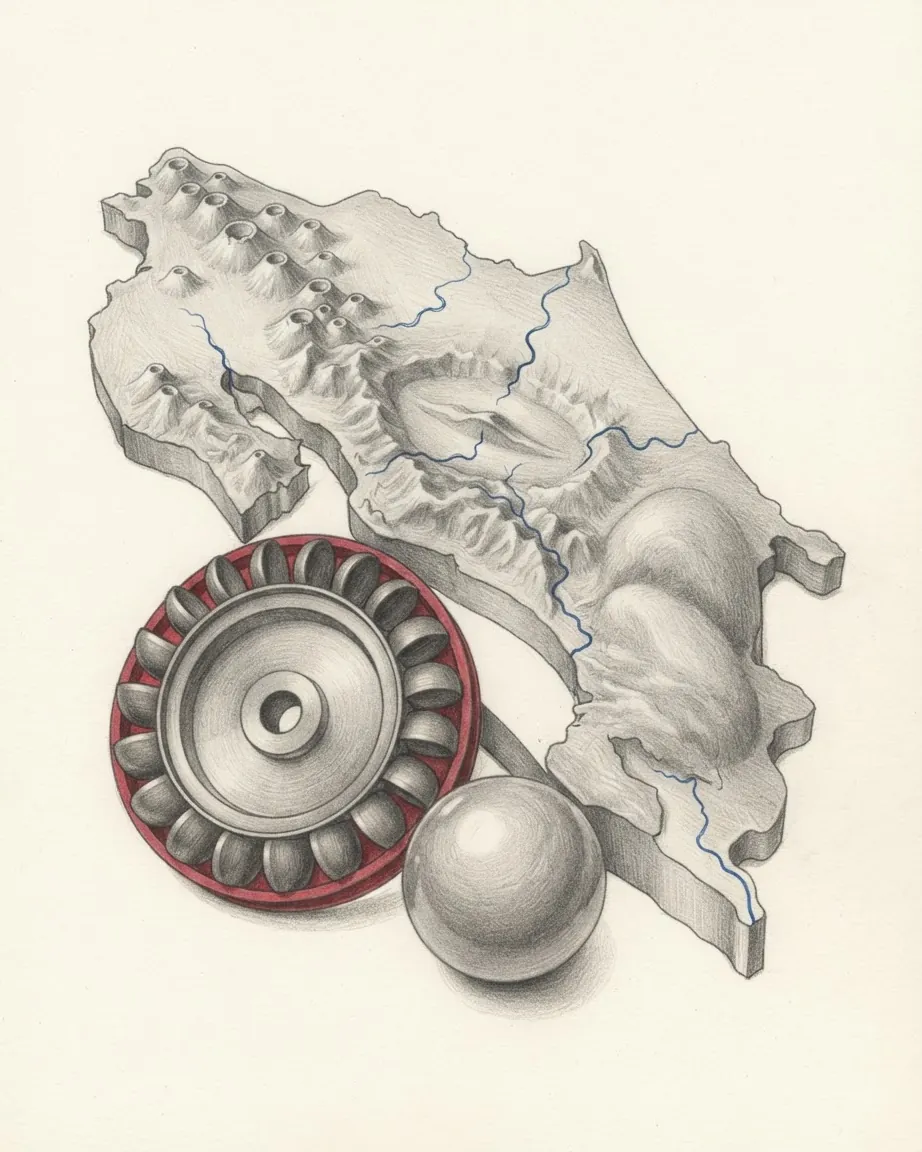
The Diquís culture of the south, which the history of Costa Rica dates from 700 to 1530 CE, left the objects that now identify the period. Four chiefdom settlements in the Diquís Delta, at Finca 6, Batambal, El Silencio and Grijalba-2, hold mounds, paved areas, burials and a collection of stone spheres between 0.7 and 2.57 metres across. UNESCO's World Heritage listing records that the method and tools used to make them are still not understood, and that the spheres escaped the looting that stripped most of the country's archaeological sites because thick layers of sediment kept them buried for centuries. Finca 6 is the only site where spheres still stand in lines.
Why Spain left its poorest province to farm alone
Christopher Columbus reached the Caribbean coast on 18 September 1502, on his fourth voyage, and stayed eighteen days refitting his ships. The people he met gave him gold items, and that may be why the land was called the rich coast, although some accounts credit the name to Gil González Dávila, who landed on the Pacific side in 1522. The first Spanish colony, Villa de Bruselas, was founded in 1524. Juan de Cavallón's expedition of 1561 began permanent occupation, and in 1564 Juan Vásquez de Coronado established Cartago in the Central Valley as the seat of government.
The conquest destroyed the people it found. Britannica's historians estimate about 400,000 indigenous inhabitants before it; the history of Costa Rica counts as many as twenty distinct societies speaking many languages, and records a native population of about 120,000 in 1569 that had fallen to 10,000 by 1611. Disease, war, reprisals and forced relocation account for most of the fall. Survivors who escaped the encomienda, the Spanish system of forced labour, did it by withdrawing into the forest.
What followed was a colony with no gold or silver and no workforce to compel. The province was the southernmost part of the Captaincy General of Guatemala, governed at a long distance and forbidden by Spanish law to trade with Panama, which belonged to another viceroyalty. Few taxes were collected, so Spain spent little on it. In 1719 a Spanish governor described it as "the poorest and most miserable Spanish colony in all America", and the record has the governors themselves growing their own crops. Settlers worked their own land, which kept the large hacienda from forming, and by the eighteenth century the province lived on a peasant economy of cacao and tobacco. Historians often trace Costa Rica's later democratic habits to this society of small landowners. Britannica adds the qualification that a small estate-based oligarchy also formed and supplied the country's political leadership well into the twentieth century.
How independence reached Cartago in a letter
Nobody in Costa Rica fought for independence. The authorities in Guatemala declared it for all of Central America on 15 September 1821, the date still kept as Independence Day, and the documents reached Cartago on 13 October. Governor Juan Manuel de Cañas called an emergency meeting at which joining Mexico, Guatemala and New Granada were all proposed, and a provisional junta was set up to govern "while the clouds of the day clear up", a phrase the record preserves. Independence was ratified by the colonial authorities on 29 October 1821, and then by San José, Cartago, Heredia and Alajuela in turn through November.
The province's first civil war came out of that choice. Cartago and Heredia favoured joining the Mexican Empire, San José and Alajuela wanted full independence, and on 5 April 1823 the two sides fought at Ochomogo in the Central Valley. The republicans won and the capital moved from Cartago to San José, where it has stayed. Costa Rica then joined the United Provinces of Central America, and in 1838, long after the federation had stopped working in practice, it withdrew and proclaimed itself sovereign.
The borders moved in the same years. Nicoya voted in an open town meeting on 25 July 1824 to join Costa Rica, with 77% of the district in favour, citing trade, schools and the war then running in Nicaragua; Britannica dates Guanacaste's secession from Nicaragua to 1825 and records the question as contested until a boundary treaty of 1896. Chiriquí, in the south, belonged to Costa Rica until it passed to Panama in 1849.
What coffee and the oxcart paid for
Coffee arrived early and took over quickly. The history of coffee production in Costa Rica dates the first planting in the Central Valley to 1779, and the main history of the country gives 1808; both agree that coffee had overtaken tobacco, sugar and cacao by the 1820s. The government gave plots of land to anyone willing to plant it. Britannica's historians note the consequence that mattered politically: coffee could support a family on a small holding in a way that sugar and indigo could not.
Getting it to Europe was the problem. The growing districts had access only to Puntarenas on the Pacific, and before the Panama Canal a ship from Europe had to round Cape Horn to reach it. From 1832 Costa Rican coffee went to Chile and was rebagged there for England as Café Chileno de Valparaíso. In 1843 William Le Lacheur, a Guernsey shipowner and captain of The Monarch, carried a cargo direct to Britain, and British money followed: the Anglo-Costa Rican Bank was founded in 1863, and Britain remained the principal buyer until the Second World War.
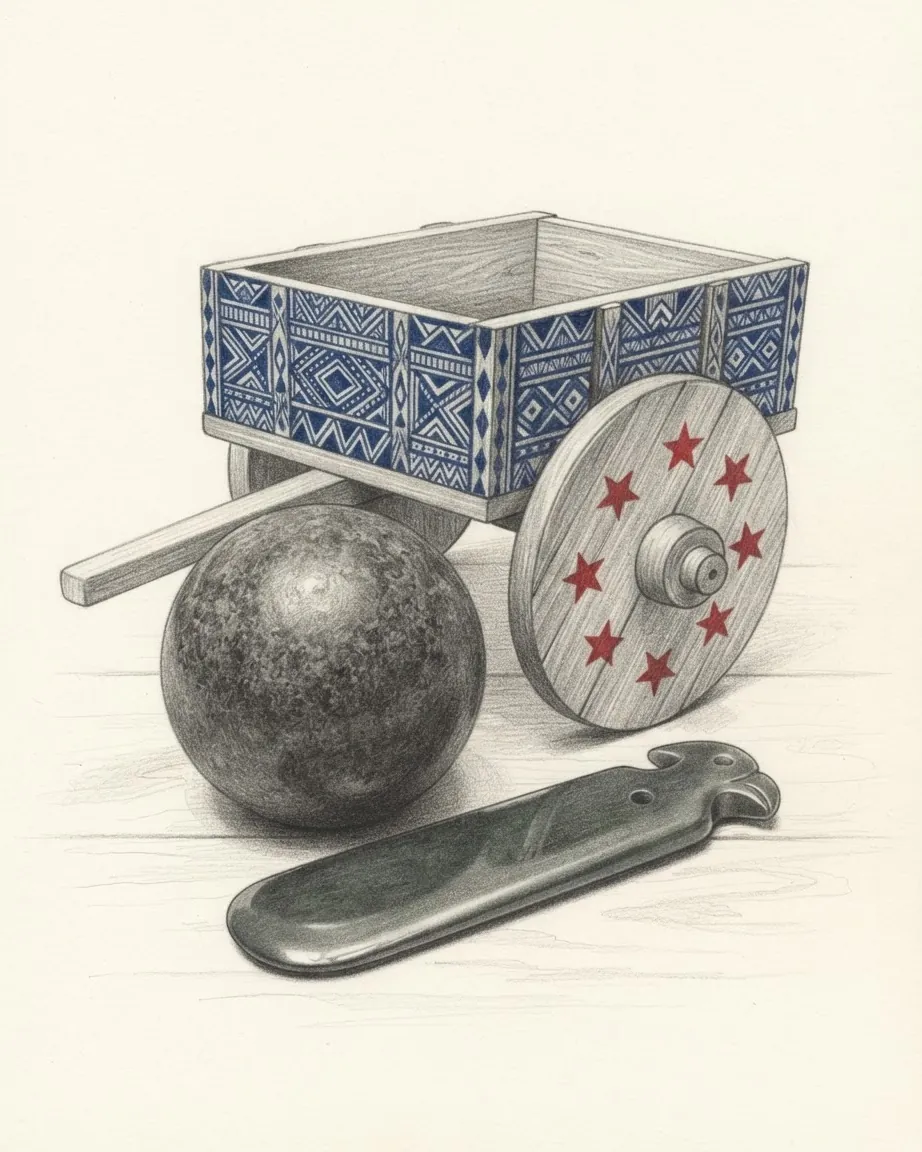
Between the farms and the port ran the oxcart. UNESCO's description of the tradition records carts on spokeless wheels, a hybrid of the solid disc and the Spanish spoked wheel that cut through mud without sticking, taking ten to fifteen days to cross the mountains to Puntarenas; the main road was built in 1846. Painted decoration began in the early twentieth century, each region with its own patterns on the wheels, and the oxherding and oxcart traditions were inscribed on UNESCO's Representative List in 2008.
The railway came next. In the 1870s the government contracted the American Minor C. Keith to build a line from San José to the Caribbean port of Limón, and it was completed in 1890 after years of disease and trouble over financing. Jamaican labourers built much of it, and most Afro-Costa Ricans descend from them. Keith was paid partly in land, planted it with bananas, and by the late nineteenth century bananas rivalled coffee for foreign exchange, especially after his holdings were merged into the United Fruit Company in 1899. The company signed a collective agreement with its workers in 1938 after the Great Banana Strike, a step in the formation of Costa Rican trade unions.
Coffee money also built the institutions. General Tomás Guardia, who dominated the country from 1870 to 1882, curtailed liberty and added to the debt while building schools, and the constitution adopted in 1871 stayed in force, apart from 1917 to 1919, until 1949. Free public education became compulsory in 1886. The election of 1889, won by José Joaquín Rodríguez, is described in Britannica as "the first entirely free and honest election in all of Central America".
How Costa Rica fought and then sued its neighbours
The one foreign war came in 1856. William Walker, an American filibuster, had made himself president of Nicaragua and reinstated slavery there, and when he moved into Costa Rican territory the country declared war. About 10,000 men were levied, roughly 10% of the population at the time, and coffee growers paid an exceptional war tax. Under President Juan Rafael Mora Porras, Costa Rican forces pushed the filibusters back into Nicaragua and fought the last battle at Rivas, where Juan Santamaría, a drummer from Alajuela, died setting fire to the filibusters' stronghold. He is remembered as the national hero.
After that, disputes went to arbitration and to court more often than to the field. In the early twentieth century Costa Rica and four other republics set up the Central American Court of Justice, first in Cartago and, after the earthquake of 1910 destroyed its building, in San José. When the Bryan-Chamorro Treaty of 1916 gave the United States the right to use the San Juan River on the border as part of a canal route, Costa Rica took Nicaragua to that court and won. Nicaragua refused to accept the ruling and withdrew, and the court dissolved in 1918. Its San José building, paid for partly by Andrew Carnegie and known as the Casa Amarilla, became the Ministry of Foreign Relations.
The southern border followed the same course with one lapse. Arbitration awards by France in 1900 and the United States in 1914 favoured Costa Rica and were rejected by Panama, and in 1921 Costa Rica tried to occupy the disputed Pacific coast by force before the United States intervened. Relations were restored in 1928 and the boundary was agreed in 1941.
| Year | Episode | Who acted for Costa Rica | How it ended |
|---|---|---|---|
| 1823 | Battle of Ochomogo | Republican militia of San José and Alajuela | Capital moved to San José |
| 1856 | War against William Walker | About 10,000 levied men | Filibusters driven back at Rivas |
| 1916 | San Juan River case | Government, before the Central American Court of Justice | Ruling for Costa Rica, rejected by Nicaragua |
| 1921 | Pacific border with Panama | Army | Halted by United States intervention |
| 1948 | Civil war | National Liberation Army against the government | Army abolished |
| 2010 | Nicaraguan dredging of the San Juan | Police, then a brief to the International Court of Justice | Provisional ruling to withdraw forces |
Why the army had already lost its standing
The country's army had already been diminished once. The first election under direct suffrage, in 1913, gave no candidate a majority, the Legislative Assembly chose Alfredo González Flores, and in 1917 General Federico Tinoco Granados removed him in one of the country's few coups. Tinoco ruled as a military dictator until 1919, when revolts, the refusal of the United States to recognise him and the threat of intervention forced his resignation. His unpopularity brought a considerable decline in the size, wealth and political influence of the military. A literacy test for voters followed in 1920 and the secret ballot in 1925.
The 1940s produced the crisis that finished it. Rafael Ángel Calderón Guardia, a doctor elected president in 1940, began on the right and allied with the Church and the business elite, then lost the elite over his measures against the German community during the war and rebuilt his base with the communist Popular Vanguard Party of Manuel Mora and Archbishop Víctor Manuel Sanabria. That coalition passed labour rights and a welfare state. His successor from 1944, Teodoro Picado, used the army to keep order, and pro-Calderón soldiers took part in the street violence, while Mora's militia was deployed against the opposition. The strike known as the Huelga de Brazos Caídos halted commerce for seven days and ended with police and soldiers patrolling a capital that looked as if it were under siege.
For the election of 8 February 1948 Picado's government placed the count, for the first time, under an independent electoral tribunal. Otilio Ulate took 55.28% of the vote and the tribunal declared him elected by two votes to one. Calderón alleged fraud, and on 1 March the Congress, where his party and the Popular Vanguard held a majority, annulled the result. The same day police surrounded the house of Carlos Luis Valverde, Ulate's acting campaign manager, and Valverde was shot dead on his doorstep. Ulate was captured and imprisoned.
How Figueres won the civil war
Who fought on each side
José Figueres Ferrer, a landowner who had been exiled to Mexico on 12 April 1942 after criticising Calderón on the radio, had been preparing for a war before the vote. He trained the Caribbean Legion, an irregular force of 700 that intended to move against other authoritarian governments in the region, on his farm. His National Liberation Army joined anti-communists, economic conservatives of Ulate's kind and a social democratic intelligentsia. Against it the government had, by the count in a study for the United States Army War College, a regular army of 1,000 men, 500 soldiers sent by the Nicaraguan dictator Anastasio Somoza and 3,000 communist militiamen. The alliances crossed ideology: the government allied with communists had Somoza's help, and the anti-communist rebels, tacitly backed by the United States, received significant aid from the Guatemalan president Juan José Arévalo.
How the fighting ended
Fighting began on 12 March 1948. The rebels moved up the Pan-American Highway from the south and took towns and ports with little difficulty; the army, commanded by Picado's brother, never organised an effective defence. Cartago fell on 12 April. Picado wrote to Mora and Calderón that holding San José "would be futile and catastrophic", and on 19 April he and Father Benjamín Núñez, a labour leader, signed the Pact of the Mexican Embassy. Picado resigned the next day, Santos León Herrera became interim president, Picado and Calderón left for Nicaragua, and on 24 April Figueres' forces entered San José. About 2,000 people died in 44 days.
What the junta abolished and what it kept
The junta took over on 8 May 1948 and governed for eighteen months under Figueres. It survived an attempted overthrow by its own Minister of Public Safety, Édgar Cardona, and arranged the election of a Constitutional Assembly that December. The abolition of the army came on 1 December, with the mallet at the Cuartel Bellavista, and the barracks were given to the National Museum. The UNESCO Memory of the World register, which holds the documents and inscribed them in 2017, dates the junta's own abolition decree, number 249, to 11 October 1949.
The constitution of 1949 wrote the rest. Article 12 proscribes the army as a permanent institution and provides for police forces to keep public order. The same text gave women the vote, strengthened the electoral tribunal into what the Bertelsmann Transformation Index describes as an autonomous fourth branch of government, abolished institutionalised racism, nationalised the banks and gave wide powers to state corporations known as autonomous institutions. The junta then handed the presidency to Ulate on 8 November 1949, as it had promised. Figueres was elected in his own right in 1953 and again in 1970, and presidential elections have been held every four years since 1958.
What replaced the army was a set of police bodies. In 1996 the Ministry of Public Security merged the Civil Guard, the Rural Assistance Guard and the Frontier Guards into the Public Force, with the coast guard alongside it, and a law numbered 8115 made 1 December the Day of the Abolition of the Army. The money that had gone to the military went, in the record's words, to security, education and culture.
How an unarmed Costa Rica met its neighbours' wars
The state built under the 1949 constitution ran a mixed economy from 1949 to 1978, financed by indirect taxes and by foreign debt that rose sharply after 1970. Coffee prices fell in 1978, oil prices rose sharply in 1979, and the crisis of 1980 and 1981 forced structural reforms; Luis Alberto Monge, president from 1982, accepted austerity from the International Monetary Fund and the World Bank in return for an extension of the debt. Indigenous Law 6172 of 1977 created the reserves on which most indigenous Costa Ricans live, and declared them closed to purchase by outsiders.
The wars arrived as refugees and as pressure. Costa Rica's government supported the Sandinista insurgency against Somoza in Nicaragua, and opinion turned against the new regime once it was in power. Thousands of refugees from Nicaragua and the rest of Central America crossed the border. Monge declared official neutrality while, by Britannica's account, cooperating in secret with the United States against the Sandinistas. Óscar Arias, president from 1986, refused to aid the contras and spent most of his term leading a regional peace effort to end the contra war and the guerrilla conflicts in El Salvador and Guatemala, and he received the Nobel Peace Prize in 1987.
The disputes since have gone the way of 1916. A constitutional chamber of the Supreme Court, the Sala IV, was created in 1989. The country's first national referendum approved the Central America-Dominican Republic Free Trade Agreement by a narrow margin in 2007. On 13 July 2009 the International Court of Justice confirmed Costa Rica's right of free navigation on the San Juan River for commerce and tourism. When Nicaragua began dredging the river in late 2010 and sent troops, Costa Rica mobilised its police and filed a brief with the same court, which the following March ordered both sides to withdraw their forces. Costa Rica became the 38th member of the OECD on 25 May 2021, at the end of an accession process that began in April 2015.
Timeline
The dates in order
- 1502
- Columbus reaches the Caribbean coast on 18 September and stays eighteen days.
- 1564
- Juan Vásquez de Coronado establishes Cartago as the seat of government.
- 1611
- The native population, about 120,000 in 1569, has fallen to 10,000.
- 1821
- News of independence reaches Cartago on 13 October; ratified on 29 October.
- 1823
- Republicans win at Ochomogo on 5 April and the capital moves to San José.
- 1838
- Costa Rica withdraws from the Federal Republic of Central America.
- 1843
- William Le Lacheur carries the first direct coffee cargo to Britain.
- 1856
- About 10,000 men are levied against William Walker's filibusters.
- 1890
- The railway from San José to Limón is completed.
- 1917
- Federico Tinoco Granados seizes power; he resigns in 1919.
- 1948
- Civil war from 12 March to 24 April; the army is abolished on 1 December.
- 1949
- The new constitution proscribes the army; power passes to Ulate on 8 November.
- 1987
- Óscar Arias receives the Nobel Peace Prize for the Central American peace effort.
- 2007
- The first national referendum approves CAFTA-DR.
- 2010
- Costa Rica answers Nicaraguan troops on the San Juan with police and a case at the ICJ.
- 2021
- Costa Rica becomes the 38th member of the OECD on 25 May.
Common questions
Questions about Costa Rica
Does Costa Rica have an army?
No. Article 12 of the 1949 constitution proscribes the army as a permanent institution and allows police forces for public order. Internal security and border control belong to the Public Force, created in 1996 by merging the Civil Guard, the Rural Assistance Guard and the Frontier Guards, with a coast guard under the same ministry. A small special intervention unit of about 70 is organised along military lines but is officially a civilian police unit.
Why did the winner of the 1948 civil war abolish the army?
The army had fought for the government Figueres overthrew, and its part in the street violence of the Picado years had already damaged its standing, as Tinoco's dictatorship of 1917 to 1919 had done before. The sources record the decision and its symbolism, the mallet and the museum, more fully than a motive. The money it had cost went, by the record's account, to security, education and culture.
What started the Costa Rican Civil War?
The annulment of an election. Otilio Ulate won on 8 February 1948 with 55.28% of the vote, confirmed by the electoral tribunal two to one, and on 1 March a Congress controlled by Calderón's party and the communist Popular Vanguard voted to void it. Ulate's campaign manager was shot dead the same day. Figueres, who had been training a force for months, opened the fighting on 12 March.
Who was Juan Santamaría?
A drummer from Alajuela who died at Rivas, in Nicaragua, in 1856, setting fire to the stronghold of William Walker's filibusters during the campaign that drove them out. He is remembered as Costa Rica's national hero, and the war he died in, which levied about 10,000 men, is the only foreign war in the country's record.
When did Costa Rica become independent?
The authorities in Guatemala declared independence for all of Central America on 15 September 1821, and that is the date kept as Independence Day. The news reached Cartago on 13 October and the province ratified it on 29 October. It then passed through the Mexican Empire and the Central American federation, and left the federation in 1838 to stand alone.