Costa Rica's economy: catheters from the free zones
3 080 words · 14 min · updated 2026-10-04
 Back to Costa Rica
Needles, catheters and other medical devices made up 48% of the goods Costa Rica exported between January and July 2025, a sector worth US$6,305 million in those seven months. The same devices had been 12% of goods exports in 2007. Nearly every plant that makes them operates inside a free trade zone, where Law 7210 waives income tax for the first eight years and import duty on machinery and raw materials with no end date. The IMF put growth at 4.6% in 2025 and credited goods exports from the zones. Outside them sits a domestic economy that still provides most of the jobs, and a central government whose revenues came to 15.1% of GDP in 2024 and whose debt stood at 61.1% of GDP at the end of May 2026.
In short
- Medical devices
- 48% of goods exports, January to July 2025
- Medtech exports
- US$10.9 billion in 2025, on CINDE figures
- Free zone tax
- No income tax for eight years under Law 7210
- Growth
- 4.6% in 2025, IMF estimate
- Households in poverty
- 15.2% in 2025, from 18.0% in 2024
- Central government debt
- 61.1% of GDP, end of May 2026
- Renewable electricity
- 98.6% of generation in 2025
- Inflation
- Minus 2.7% year on year, February 2026
What Costa Rica sells abroad
PROCOMER, the state agency that promotes exports and administers the free trade zones, reports goods exports by sector every month. Its figures for January to July 2025 put precision and medical equipment at 48% of the total, worth US$6,305 million and 34% more than in the same months of 2024. All goods exports rose 17% over that comparison, an increase of US$1,879 million, so the medical sector accounted for most of the gain. The agency has recorded growth of 30% or more in the sector over January to July on three occasions, in 2021, 2023 and 2025.
| Sector | Share of goods exports, January to July 2025 |
|---|---|
| Precision and medical equipment | 48% |
| Agriculture | 17% |
| Food industry | 12% |
| Chemicals and pharmaceuticals | 5% |
| Electrical and electronic goods | 5% |
| Metalworking | 3% |
| Livestock and fishing | 2% |
| Other sectors | 5% |
By product the picture narrows further. Medical devices were 48% of goods exports in those seven months of 2025, pineapple 6% and bananas 4%, with syrups and concentrates for soft drinks and green coffee at 3% each. Inside the medical sector, needles, catheters and similar instruments grew 98% against January to July 2024, other medical devices 17% and prostheses 7%. PROCOMER named the United States, the Netherlands and Belgium among the markets where the sector grew.
CINDE, a private non-profit body that by its own count in 2026 has advised foreign manufacturers on setting up in Costa Rica for 44 years, puts medical technology exports at US$10.9 billion for the whole of 2025. Its figure for 2024 is US$8,675 million, when 164 products went to 88 markets, and it gives the sector an average annual growth rate of 18% from 2017 to 2025. In CINDE's description the product mix began with disposables in the early 2000s and now covers catheters, structural heart valves, neurovascular devices, orthopaedic implants and Class III therapeutics.
Services keep a separate ledger. Services made up 75.9% of GDP in 2016, industry 18.6% and agriculture 5.5%. Corporate services for foreign companies employed about 54,000 people in 2016 and generated US$4.6 billion that year, close to what tourism earned.
How Costa Rica's exports moved from coffee to catheters
What the coffee trade built
The two Wikipedia accounts used here disagree on when coffee reached the Meseta Central, 1779 in one and 1808 in the other, and agree that it had passed tobacco, sugar and cacao as an export by the 1820s. In the nineteenth century the government offered plots of land to anyone willing to plant it.
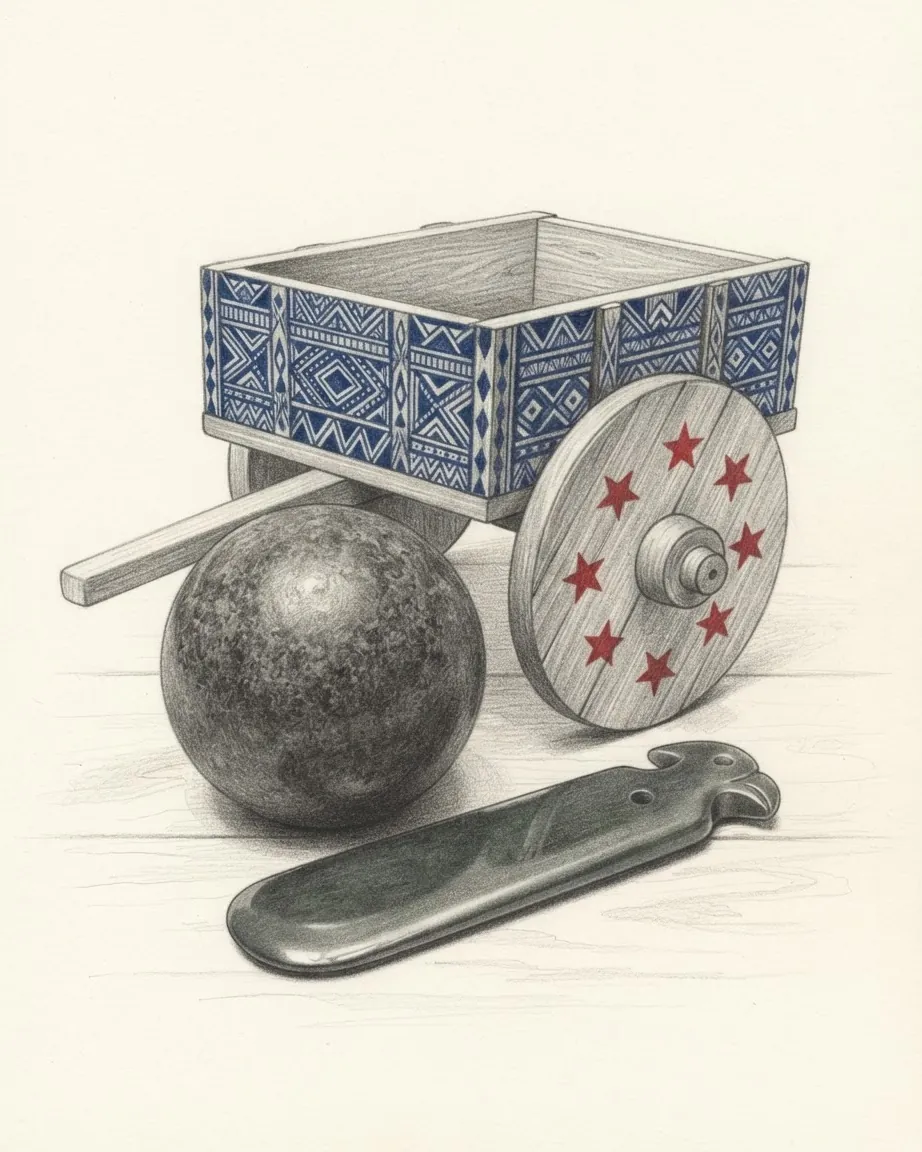
The crop left the Central Valley by oxcart. From the middle of the nineteenth century the carreta carried coffee beans over the mountains to Puntarenas on the Pacific coast, a trip of ten to fifteen days, on spokeless wheels built to cut through mud without sticking. The main road to Puntarenas was finished in 1846. A Pacific port was a long way from the buyers: before the Panama Canal opened, ships from Europe had to sail round Cape Horn to reach it. In 1832 Costa Rican coffee went to Chile, where it was re-bagged and sold on to England as "Café Chileno de Valparaíso". In 1843 William Le Lacheur, a Guernsey captain, took a cargo straight to Britain on The Monarch, and British buyers remained the principal customer until the Second World War. The Anglo-Costa Rican Bank was founded in 1863 to finance the trade.
The cart outlived the job. Painting the wheels began in the early twentieth century, each region with its own design, so that a driver's home could be read from the pattern on his wheels. UNESCO inscribed Costa Rica's oxherding and oxcart traditions on its Representative List of the Intangible Cultural Heritage of Humanity in 2008, having first proclaimed them in 2005.
What the railway and bananas added
To reach the Caribbean, the government contracted Minor C. Keith in the 1870s to build a railway from San José to the port of Limón, and the line was completed in 1890 with the help of coffee revenue. Keith was paid in land and a lease on the route, and he used both to grow bananas for the United States. Bananas came to rival coffee, foreign-owned companies including the United Fruit Company took a large part in the national economy, and after the Great Banana Strike the company signed a collective agreement with its workers in 1938. Most Afro-Costa Ricans descend from Jamaican workers who built that railway.
Why the coffee and banana model broke down
Between 1949 and 1978 the state grew through autonomous institutions funded by indirect taxes and a foreign debt that rose sharply between 1970 and 1978. In 1978 coffee prices fell, in 1979 the price of oil, a main import, rose steeply, and the government borrowed abroad to close the gap. A severe recession followed in 1980 and 1981. Tariffs came down in the 1980s and 1990s, and an export promotion strategy drew in foreign investment, first into nontraditional farm exports and then into high-technology plants in the free trade zones. By 2013 coffee earned 2.5% of exports.
What the Intel plant showed
Intel's microprocessor facility alone accounted for 20% of Costa Rican exports and 4.9% of GDP in 2006. In 2014 the company announced that it would end manufacturing in the country and cut 1,500 jobs, keeping a test and design centre with about 1,600 staff. By 2017 it employed 2,000 people in Heredia, at a plant that assembles and tests processors for distribution, and at a Global Innovation Center. One plant had carried a fifth of the export bill. The medical sector that followed was spread across more than 100 multinational manufacturers in 2025, by CINDE's count. In 2015, total exports of US$12.6 billion included US$2 billion of medical instruments, US$1.24 billion of bananas, US$841 million of integrated circuits and US$555 million of orthopaedic appliances.
Why the free trade zones carry the growth
Law 7210 sets the terms of the free zone regime and PROCOMER administers it. As CINDE summarised them in 2026, a qualifying company pays no income tax for its first eight years and a reduced rate for four more, a period that can be reset through reinvestment. It pays no value added tax and no import duty on machinery and raw materials, with no end date, and no tax on profits sent abroad. The minimum initial investment is US$150,000 in fixed assets inside a park. Nearly every medical device plant in the country operates under the regime.
The plants sit in a handful of parks. Coyol Free Zone in Alajuela held about 34 companies in 2026, sits five to ten minutes from Juan Santamaría International Airport, and generated more than US$4.4 billion of exports in 2023. La Lima in Cartago, Global Park in Heredia, and Evolution and Green Valley in Grecia make up most of the rest. Boston Scientific had about 10,000 employees across Coyol, Global Park and La Lima in 2026, and opened its third Costa Rican plant at La Lima that year. Establishment Labs, a Costa Rican company listed on NASDAQ, keeps its global headquarters in Coyol. CINDE lists more than 20 new plants and expansions, service centres among them, due to open between 2025 and 2027.
What the plants pay for is mostly labour, about 70% of medical device production cost in CINDE's estimate, and CINDE puts a fully loaded operator wage at US$4.50 to US$6.50 an hour for 2024 to 2026. The regulatory side was arranged to match the main market: the Ministry of Health recognises United States FDA clearances under decree DM-F-1518-2011, and 70 establishments in the country were registered with the FDA for device manufacturing in 2026.
The zones supported more than 82,000 direct jobs and 43,000 indirect ones in 2015, by the government's count, and average wages inside them were 1.8 times the private sector average in the rest of the country. Foreign direct investment passed US$4 billion in 2023, 3.7 times the current account balance that year. In 2023 the government also moved responsibility for promoting foreign investment from CINDE to PROCOMER, a change that, in the BTI report's account, some criticised and others praised. CINDE says it facilitated 19 new projects and 48 reinvestments across sectors in 2025.
The dependence shows in the forecasts. The IMF mission that visited San José from 25 February to 9 March 2026 attributed the 4.6% growth of 2025 to goods exports from the zones, and projected 3.8% for 2026 because tariffs and the closure of several key businesses inside the zones would more than offset rising investment. The Banco Central de Costa Rica cut its own forecast in July 2026 to 3.4% for 2026 and 3.5% for 2027, and gave the main reason for the slowdown in the second quarter as weaker manufacturing under the special regimes. The current account deficit narrowed to 0.7% of GDP in 2025.
Who works outside the free trade zones
The Bertelsmann Transformation Index country report for 2026 describes the result as a dual labour market. Investment in the zones created skill-intensive jobs that are well paid and few in number, because the export plants buy little from local suppliers, and most of the workforce remains in low-productivity, low-paid jobs in informal work or services. The sectors serving the domestic market still provide most jobs. Spending on research and development was 0.32% of GDP in 2021, more than 60% of the country's research is carried out by public universities, and the OECD has recorded weak collaboration between those universities and business. The IMF's 2026 statement asks for closer research links between domestic firms and multinationals, and for export growth and diversification beyond the free trade zones.
Unemployment was 6.9% in the fourth quarter of 2024. In the second quarter of 2026, the central bank reported, unemployment held roughly steady while participation and employment rates fell, underemployment rose, and incomes from main jobs contracted in April and May.
The household survey shows the same split by place. INEC's Encuesta Nacional de Hogares, carried out from 7 July to 13 August 2025, found 15.2% of households in poverty, down from 18.0% in 2024, and 3.8% in extreme poverty. That came to 286,365 households in 2025. The BTI report notes that the poverty rate had stayed near 20% from 1994 until the period its 2026 edition reviews.
| Planning region | Households in poverty, 2025 |
|---|---|
| Central | 10.8% |
| Chorotega | 18.7% |
| Pacífico Central | 20.5% |
| Huetar Norte | 21.1% |
| Brunca | 23.8% |
| Huetar Caribe | 24.9% |
The Central region was the only one below the national rate in 2025. Average household income was ₡1,209,825 a month in 2025, ₡1,355,642 in urban areas and ₡827,547 in rural ones, a gap INEC put at 39.0%. The Gini coefficient fell from 0.524 to 0.492 in 2024, and the 2024 Informe Estado de la Nación found that 54% of all pay went to the highest fifth of households and 84% of capital income to the wealthiest families.
How the Costa Rican state pays its bills
Public debt rose from 29.8% of GDP in 2011 to 45% in 2016. In early August 2017 President Luis Guillermo Solís said the country faced a liquidity crisis and set the Treasury's order of payment: public debt first, then salaries, then pensions. The fiscal reform of 2018 introduced a fiscal rule that caps the growth of public spending, turned the sales tax into a value added tax on a broader base, added a 15% tax on capital gains and two new income tax brackets for higher earners. The Public Employment Law followed in 2022, covering a payroll that absorbs more than half of government revenue.
The deficit narrowed from 8.3% of GDP in 2020 to 3.3% in 2023. In 2024 revenues came to 15.1% of GDP and spending to 18.9%, and interest on the debt alone took 4.8% of GDP, so a primary surplus of 1.1% of GDP still left an overall deficit. Central government debt was above 60% of GDP in 2025, in part because cash was set aside for repayments due in early 2026, and it stood at 61.1% of GDP at the end of May 2026.
The tax side is where the IMF looks. Its 2026 mission found that policy changes had eroded the tax base and recommended fewer tax expenditures, a single rate of corporate income tax, a more progressive personal income tax and a constitutional change letting the executive issue external debt within the limit the Legislative Assembly approves. It also found the reserves of the CCSS pension and health insurance schemes insufficient for long-term demand.
Article 78 of the constitution sets public spending on education at no less than 8% of GDP a year. The country spent about 6.5% in 2023 and about 5.2% in 2024, and the BTI report records a constitutional court order to meet the floor that had gone unmet by the close of its review period. Public infrastructure investment, which the BTI report calls the adjustment factor for containing deficits and debt, was 1.3% of GDP in 2023.
What the state still owns and runs
The 1949 constitution and the reforms after it kept banking, electricity and telecommunications as state monopolies, and much of that structure survived liberalisation without a privatisation programme. CAFTA-DR, ratified in 2007 and in force since 1 January 2009, opened telecommunications and insurance to competition, and two private mobile operators began service in 2011. The state firms kept their place in those markets.
The Instituto Costarricense de Electricidad holds the monopoly on electricity transmission, distribution and export. It reported that 98.6% of electricity generated in 2025 came from five renewable sources, namely water, geothermal heat, wind, biomass and sun, a figure that includes exports to the rest of the isthmus; domestic demand was met at 97.3% from those sources. The share was 99.62% in 2019, a year in which the grid ran on renewable sources alone for 300 consecutive days. Drought forced electricity rationing in 2024, and about 600 megawatts of new plants, geothermal as well as solar and wind, built by ICE and private generators, are due by 2030. Apart from minor coal deposits no fossil fuel has been found in the country, and refined petroleum was 8.41% of imports in 2015.
The state also keeps monopolies on alcohol distillation and on importing, refining and distributing petroleum, and it runs railways, ports and airports, the last offered as concessions to private operators. The National Insurance Institute held 69.9% of workplace risk insurance premiums in July 2024. Four state-owned banks held 46% of credit providers' assets in a World Bank report of June 2023, out of 15 banks in the system. Costa Rica became the 38th member of the OECD on 25 May 2021, after an accession that began in April 2015 and passed through 22 committee reviews, including a reform of competition policy.
How tourism and farming earn foreign currency
Tourism has earned more foreign exchange than bananas, pineapples and coffee together since 1999. The ICT recorded 2.68 million international tourists arriving by air in 2025, 0.8% more than in 2024, and 1,195,271 between January and April 2026, 10.5% more than a year earlier. Of the 1,324,015 tourists who arrived by every route in the second half of 2025, 688,890 came from the United States. Tourism supported 110,000 direct jobs in 2016 on estimates by the World Travel and Tourism Council.
Its main competitive advantage, in the Wikipedia account of the sector, is the system of national parks and protected areas. Protected areas covered 26.59% of the national territory in 2022. Under Forest Law 7575, passed in 1996, FONAFIFO pays owners of forest and plantations for four environmental services: mitigating greenhouse gas emissions, protecting biodiversity, protecting water for towns, the countryside and hydroelectric plants, and natural scenic beauty for tourism and science. The programme describes the payment as an economic recognition of what the forest provides.
Farming is a smaller share of a larger total. Agricultural exports came to US$2.7 billion in 2015, of which coffee was US$305.9 million, and the country supplies under 1% of the world's coffee. Coffee has paid an export tax since 1955, levied today at 1.5%. In January to July 2025 the agricultural sector rose 2%, or US$49 million, with pineapple up 3% and green coffee up 46%.
Why prices in Costa Rica have been falling
Headline inflation was minus 2.7% year on year in February 2026, the tenth consecutive month of deflation and the 34th month below the central bank's tolerance range of 2 to 4%, according to the IMF. Cheaper food and fuel did most of it, along with lower prices for most services and a stronger colón. Inflation and core inflation were both negative again in the second quarter of 2026, even after the price of West Texas Intermediate, the oil benchmark Costa Rica uses, peaked at US$113 a barrel on 4 April 2026.
The BTI report links the stronger currency to the inflow of foreign investment, which puts upward pressure on the colón, and the central bank reported a relative abundance of foreign currency through 2026 and a continued appreciation of the colón. It held its policy rate at 3.25% from December 2025 and cut it by 25 basis points to 3.0% in July 2026, keeping its inflation target at 3% with a tolerance of one percentage point either side. The IMF has asked for further cuts and for efforts to reduce dollarisation, a concern it had already raised in 2017 over the heavy dollarisation of bank assets and liabilities. The colón traded at 526.46 to the dollar on 27 March 2015 and at 677 in May 2022. The World Bank reclassified Costa Rica as a high-income economy in 2025.
Common questions
Questions about Costa Rica
Which products make up Costa Rica's goods exports?
Medical devices made up 48% of goods exports between January and July 2025, worth US$6,305 million, according to PROCOMER. Pineapple followed at 6% and bananas at 4%, with syrups and concentrates for soft drinks and green coffee at 3% each. The medical share was 12% in 2007.
What happened when Intel stopped manufacturing in Costa Rica?
Intel's microprocessor plant had accounted for 20% of Costa Rican exports and 4.9% of GDP in 2006. When the company announced in 2014 that it would end manufacturing in the country, it cut 1,500 jobs and kept a test and design centre with about 1,600 staff. By 2017 it employed 2,000 people in Heredia, assembling and testing processors beside a Global Innovation Center. Integrated circuits were still US$841 million of exports in 2015.
What does a company gain by locating in a Costa Rican free zone?
Under Law 7210, as CINDE described the regime in 2026, a qualifying company pays no income tax for its first eight years and a reduced rate for four more. It pays no value added tax or import duty on machinery and raw materials, and no tax on profits sent abroad. The minimum initial investment is US$150,000 in fixed assets inside a park.
How much coffee does Costa Rica still export?
Coffee exports were worth US$305.9 million in 2015, out of agricultural exports of US$2.7 billion, and coffee earned 2.5% of all exports in 2013. The country supplies under 1% of world production. Green coffee rose 46% in January to July 2025 and made up 3% of goods exports in those months. An export tax has applied since 1955 and is levied today at 1.5%.
Why did Costa Rica have deflation in 2025 and 2026?
Prices fell for ten consecutive months to February 2026, when headline inflation was minus 2.7%. The IMF attributed it to cheaper food and fuel, lower prices for services and a stronger colón, which the central bank linked to an abundance of foreign currency. The central bank cut its policy rate to 3.0% in July 2026.