The Swiss franc
Currency · CHF · 2 countries and territories
The Swiss National Bank issues the franc's banknotes and the federal mint, Swissmint, strikes its coins. The Federal Coinage Act of 7 May 1850 made the franc the monetary unit of Switzerland, at par with the French franc. Liechtenstein gave up the Austrian krone for it in the early 1920s, informally at first and then by a law of 1924.
No sign of its own
The franc has no sign of its own. Federal law names CHF as the official abbreviation in every language: CH stands for Confoederatio Helvetica, the Latin name that favours none of the four national languages. Shops and advertisers write Fr. in German and fr. in French, Italian and Romansh. SFr. and fr.sv. have gone out of use.
- ISO code
- CHF
- ISO number
- 756
- Subunit
- rappen, or centime in French, 1/100
An amount, written out
CHF 1,234.50
- CHF 1,234.50English
- CHF 1'234.50GermanLiechtenstein
- 1'234.50 CHFFrenchSwitzerland
In English the code comes before the amount. Where the Swiss franc is used, it comes after the amount in Switzerland and before it in Liechtenstein.
Where the Swiss franc is the official currency
Switzerland issues it, and Liechtenstein has used it by law since 26 May 1924. Outside those two it is legal tender in Campione d'Italia, an Italian exclave surrounded by Swiss territory.
- Liechtenstein160 square kilometres bought by a Viennese family in 1699 and 1712, in a Swiss customs union since 1924, with more jobs than residents since 2017.
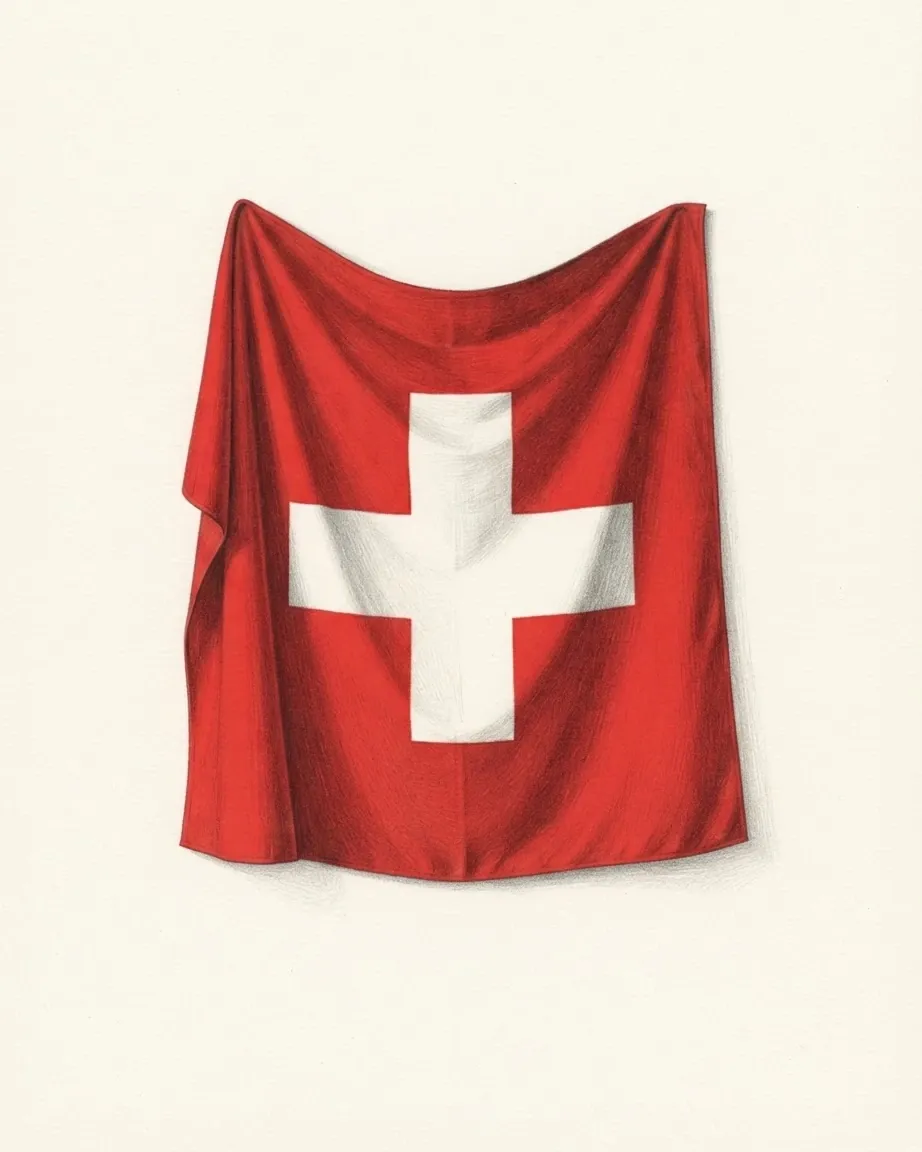
- SwitzerlandA landlocked federal republic of 26 cantons and four national languages, with no legal capital, no single head of government and no constitutional court.
About the Swiss franc
Who took the right to issue Swiss francs
Before the federal state, more than 8,000 different coins and notes circulated among the cantons, and people often preferred a South German silver coin, the kronenthaler, to any of them. The Federal Constitution of 1848 gave the federal government the sole right to issue money. The Federal Assembly passed the first Federal Coinage Act on 7 May 1850, and the cantonal currencies were converted into the new franc.
Banknotes stayed with the cantons and various banks until 1907, when the Swiss National Bank took over. It had no time to design notes of its own before opening its counters. Its first notes, issued on 20 June 1907, copied the pattern of the earlier issuing banks and carried an overprint: a red rosette with the Swiss cross.
How the franc was tied to gold
The new franc held 4.5 grams of fine silver or 0.29032 grams of fine gold. France, Belgium, Italy and Switzerland formed the Latin Monetary Union on that standard in 1865. The union ended officially in 1927. Switzerland kept the standard until 27 September 1936, when, after the pound, the US dollar and the French franc had all been devalued, it cut the franc's gold content by 30%. From 1945 the rate to the dollar stayed fixed under the Bretton Woods system until 1970.
The law also required gold to back at least 40% of the franc. A referendum ended that link, and the franc became fiat money on 1 May 2000. Voters rejected the Swiss Gold Initiative in November 2014, which would have restored gold backing of 20%.
Why Liechtenstein pays in Swiss francs
Liechtenstein used the Austrian krone under an economic and currency agreement with Austria, and the First World War left that krone in hyperinflation. In 1920 the principality printed emergency vouchers of 10, 20 and 50 heller, valid only on its own territory. They lost value as fast as the krone did. People switched to Swiss francs by themselves, and in March 1920 the Liechtensteiner Volksblatt wrote that nobody wanted to be paid in kronen any more.
The government in Vaduz had wanted Liechtenstein franc notes of its own. It gave way in 1923 and signed a customs treaty with Switzerland. The Landtag passed a currency act on 11 April 1924 that made the Swiss franc the only lawful currency, and it took effect on 26 May 1924. Every sum in the principality's laws kept its number: the krone became the franc and the heller became the rappen.
The franc also circulates as legal tender in Campione d'Italia, an Italian exclave surrounded by Swiss territory. In the German exclave of Büsingen am Hochrhein the euro is the only legal currency, yet shops there often quote prices in francs.
What Swiss coins and notes carry
The coins avoid the four national languages. They carry numerals, the abbreviation Fr., the Latin words Helvetia or Confoederatio Helvetica, or Libertas on the small pieces. The 10-centime coin has kept one composition, size and design since 1879, apart from 1918 to 1919 and 1932 to 1939. Swissmint struck the 1-centime coin until 2006, in shrinking numbers. Up to 100 circulating coins are legal tender in one payment, and notes for any amount.
The National Bank has printed nine series of notes and released seven. The fourth and the seventh stayed in reserve and never reached the public. For the ninth series it chose designs by the graphic designer Manuela Pfrunder in November 2005, and put the notes out one at a time, from the 50-franc note on 12 April 2016 to the 100-franc note on 12 September 2019.
Recalled notes keep their value. In 2016 notes of the sixth series worth 1.1 billion francs were still unexchanged, sixteen years after they stopped being legal tender. The Federal Council and the National Bank proposed in April 2017 to drop the deadline for exchanging recalled series, and by 2020 the change was law.
Common questions
Questions about the Swiss franc
Does Liechtenstein have its own currency?
No. Liechtenstein uses the Swiss franc, and has done so by law since 26 May 1924. Its Landtag passed the currency act on 11 April 1924, after hyperinflation in Austria had ruined the krone it used before. The act made the Swiss franc the only lawful currency and accepted as payment every coin and note that is legal tender in Switzerland.
What does CHF stand for?
Confoederatio Helvetica franc. Confoederatio Helvetica is the Latin name of Switzerland, used because it belongs to none of the country's four national languages. Swiss federal law makes CHF the official abbreviation in English too, and banks use it as the ISO 4217 code.
When did the Swiss franc stop being backed by gold?
On 1 May 2000. Until then the law required gold to cover at least 40% of the franc, a link that dated from the 1920s. A referendum removed it and the franc became fiat money. By March 2005, after a programme of gold sales, the Swiss National Bank still held 1,290 tonnes, a fifth of its assets. A popular initiative to restore 20% gold backing failed at the vote in November 2014.
Can old Swiss banknotes still be exchanged?
Yes. The Swiss National Bank exchanges notes from recalled series at face value at its branches and through its agents, and it also accepts them by post against a deposit into a bank account. The sixth series, recalled on 1 May 2000, was due to lose its value after 30 April 2020, and in 2016 notes worth 1.1 billion francs had not come back. The Federal Council and the National Bank proposed in April 2017 to scrap the time limit for the sixth series and every later recalled series, and the change was in force by 2020, so recalled notes no longer expire.