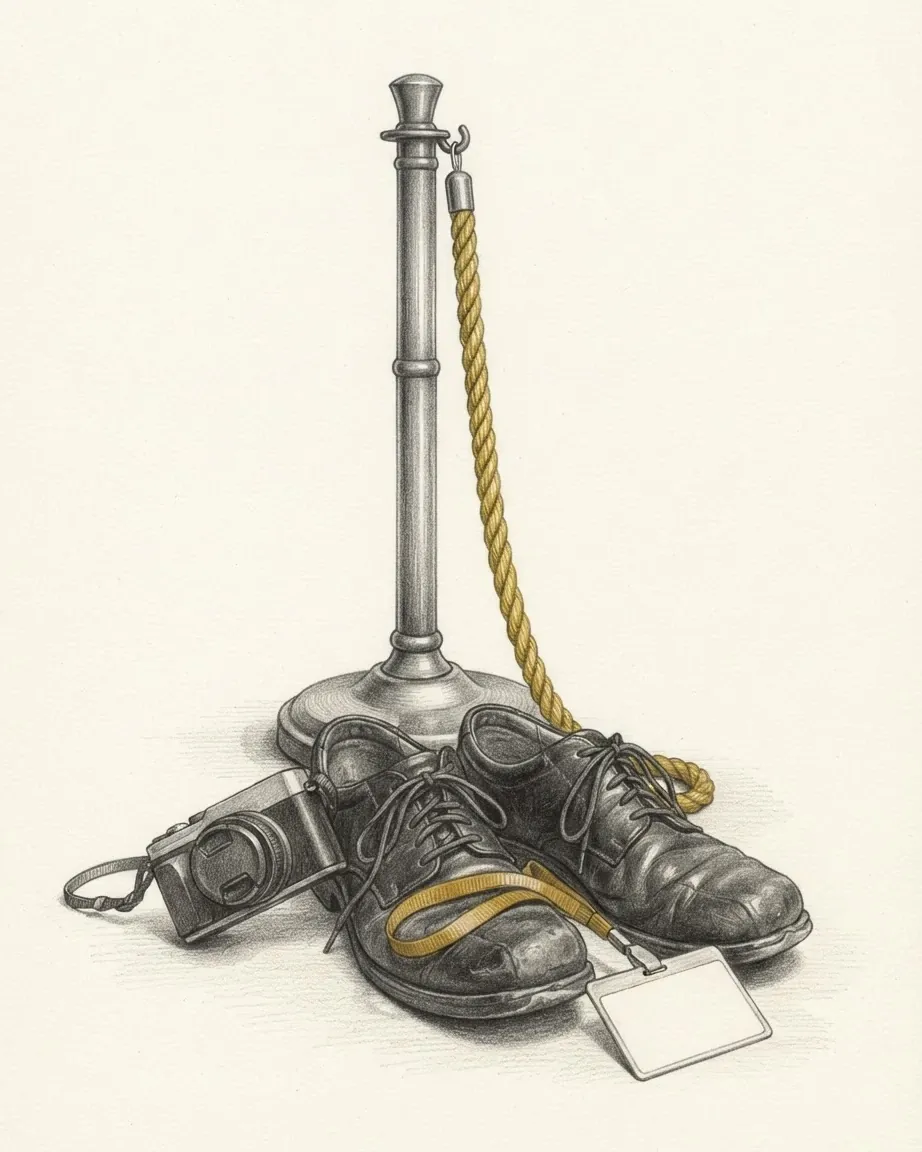
Vatican City's culture: kept by offices, carried by people who leave
2 528 words · 11 min · updated 2026-09-26
 Back to Vatican City
Vatican citizenship is granted by appointment to an office in the service of the Holy See and usually lapses when the appointment ends, so the culture of Vatican City belongs to institutions that outlast the people who staff them. Nobody becomes a citizen by being born there. The 882 residents counted on 31 December 2024 were clergy, members of religious orders, lay staff and their families, and another 372 citizens lived outside the walls in 2024. What stays in place is older than any of them: a library founded in 1475, a guard founded in 1506, sculpture collected from the reign of Julius II onward, and a Holy See that still issues the authoritative versions of its documents in Latin.
In short
- Basis of citizenship
- appointment to an office (jus officii), usually lapsing with it
- Residents
- 882, on 31 December 2024
- Citizens living outside the state
- 372, in 2024
- Language of state law
- Italian; the Holy See issues authoritative texts in Latin
- Vatican Library founded
- 1475, by Sixtus IV
- Swiss Guard founded
- 22 January 1506, by Julius II
- World Heritage inscription
- 1984, covering the whole territory
- Vatican Museums visitors
- 6.9 million in 2025
Why nobody is born a Vatican citizen
Vatican law recognises neither descent nor birthplace as a ground for citizenship. Wikipedia's account of the citizenship law names the principle as jus officii: citizenship follows an appointment to work in a certain capacity for the Holy See. Cardinals living in the state or elsewhere in Rome hold it. So do the Holy See's diplomats, and so does anyone whose job requires them to live inside the walls. It usually ends when the appointment does.
A citizen's spouse and children receive it as long as they live with the citizen in the city. Some people are authorised to live there without qualifying for citizenship, or choose not to request it. Under the citizenship law the pope alone holds it for life.
The Lateran Treaty of 1929 closed the gap this system would otherwise leave. Anyone who loses Vatican citizenship and holds no other becomes an Italian citizen automatically, so the state never produces stateless former members. The Holy See, which is not a state, issues only diplomatic and service passports; ordinary passports for citizens come from Vatican City.
The population turns over by design. The 882 residents counted on 31 December 2024 were clergy, members of religious orders, lay people serving the state, among them the Swiss Guard, and the families of those lay people. Another 372 Vatican citizens lived outside the state in 2024: the Holy See's diplomats abroad and cardinals living in Rome. Britannica describes most inhabitants as priests or nuns, with several hundred lay people doing secretarial, domestic, trade and service work.
Families are few. Wikipedia records 13 families of Holy See employees living in the city in 2013 and 20 children of Swiss Guards in 2019. Because most of the posts that carry citizenship are reserved for men, there are several men for every woman among Vatican citizens. Every citizen, every resident and every place of worship in the state is Catholic.
Most national cultures pass from parents to children, and here that route barely exists. Children of a guard hold citizenship while they live with him in the city. What persists from one generation to the next is carried by offices, collections and rules, and the people who serve them are replaced as their appointments end.
Which languages Vatican City works in
No official language has been formally enacted for Vatican City. In practice the state works in Italian: its legislation and official communications are in Italian alone, and Italian is the everyday language of most of the people employed there. A state law takes effect once it is published in the Italian-language supplement of the Acta Apostolicae Sedis, the Holy See's official gazette. The Holy See and the state both run their official websites mainly in Italian, with pages in many other languages to varying extents.
The Holy See works differently from the state that shares its ground. It most often issues the authoritative version of its official documents in Latin, and the state's own name has a Latin form, Status Civitatis Vaticanae, which the Holy See, the Church and the pope use in official documents. Two bodies on 44 hectares thus keep two languages of record, and the language a text is issued in usually says which of them issued it.
A third language belongs to one corps. Commands in the Swiss Guard are given in Swiss German, and each guard takes his oath of loyalty in his own language: German, French, Italian or Romansh.
| Language | What it is used for inside the state |
|---|---|
| Italian | state legislation, official communications and everyday work |
| Latin | authoritative texts of the Holy See and the official form of the state's name |
| Swiss German | commands in the Swiss Guard |
| German, French, Italian or Romansh | each guard's oath of loyalty, in his own language |
The institutions that speak for the Vatican outside the walls reach much further. L'Osservatore Romano, the daily newspaper, was founded in 1861, and Vatican Radio has broadcast since 1931, organised by Guglielmo Marconi. The Vatican Printing Press dates from 1587. In 2015 the newspaper, the radio, the Vatican News portal and the television centre, now Vatican Media, were brought together under the Holy See's Dicastery for Communication. Britannica's entry, as fetched in September 2026, records that the Vatican has produced its own television programming since 1983, that its press can print in any of 30 languages from old Ecclesiastical Georgian to Tamil, and that its radio is heard in some 40 languages.
How the popes assembled a museum of antiquities
The sculpture collections began as one pope's possessions. Julius II, pope from 1503 to 1513, kept classical statues in the Cortile delle Statue, now the Octagonal Court, and the Vatican Museums trace the core of the papal sculpture collection to that courtyard. In the second half of the 18th century the collections grew sharply, fed by excavations in Rome and Lazio and by gifts from collectors and antiquaries.
The purpose changed with the scale. The museums' own account credits Enlightenment thinking with producing "a museum in the modern sense", open to the public and charged with safeguarding antique art and promoting its study. It took the name Pio Clementino from Clement XIV, pope from 1769 to 1774, and Pius VI, pope from 1775 to 1799, and it occupies halls adapted from rooms in and around the small Belvedere Palace of Innocent VIII, built between 1484 and 1492. Ancient Roman pieces brought into it often had their missing parts completely restored.
What Napoleon took and Canova recovered
The Treaty of Tolentino in 1797 obliged the Papal States to hand the principal masterpieces of the museum to Napoleon, and they were taken to Paris. After his defeat and the Congress of Vienna of 1815, the diplomatic efforts of the sculptor Antonio Canova brought the greater part of them back. UNESCO treats the conversion of the popes' private collections into public museums from the mid-18th century as the origin of the Vatican Museums, calls the Pio-Clementine "a milestone in the history of European culture", and reads the collections and buildings added in the 19th and 20th centuries as a continuation of papal patronage.
Who painted the rooms the popes lived in
The palace grew around a building of Nicholas III, pope from 1277 to 1280, enlarged in the 15th, 16th and 17th centuries. Sixtus IV had the chapel that carries his name built between 1477 and 1480, and its walls were painted by Perugino, Botticelli, Ghirlandaio and others. Michelangelo painted its ceiling between 1508 and 1512 and the Last Judgement behind the altar between 1536 and 1541. Under Julius II's patronage from 1506 Raphael and his pupils decorated the Stanze, while Pinturicchio frescoed the Borgia Apartment and Fra Angelico the chapel of Nicholas V.
Britannica dates the completion of years of restoration on the Sistine frescoes to 1994. UNESCO's first criterion describes the whole ensemble as "a continuous artistic creation whose progress spreads over centuries", and its second records that the buildings, the frescoes of Raphael and Michelangelo and the antiquities of the museums were copied and imitated in Europe and beyond it from the 16th century on.
What the library and the archive keep
Sixtus IV founded the Vatican Library in 1475, and UNESCO describes it as the first library in Europe open to the public. Its holdings grew over the following centuries to take in manuscripts and printed books, prints, drawings, coins and decorative arts. Britannica, in its entry as fetched in September 2026, gives the collection as some 150,000 manuscripts and 1.6 million printed books, many of them from pre-Christian and early Christian times.
The Vatican Apostolic Archive keeps a large part of its historical documents in a vault known as the Bunker, opened in 1980. It is a two-storey structure of reinforced concrete under the Cortile della Pigna, fitted with fire protection, climate and humidity control and physical security.
UNESCO's sixth criterion ties the library to the site itself: "For more than a thousand years, mankind has accumulated, in this privileged site, the treasures of its collective memory (manuscripts and books of the Library) and of its universal genius." The Vatican Observatory keeps an extensive library of its own, which includes a meteorite collection.
Why UNESCO inscribed the whole state
The World Heritage Committee inscribed Vatican City in 1984, and the boundaries of the property coincide with the entire territory of the state. UNESCO lists it under four cultural criteria, numbered i, ii, iv and vi. The whole territory is also entered on the International Register of Cultural Property under Special Protection, which brings it under the Hague Convention of 1954 for the protection of cultural property in armed conflict.
What UNESCO stresses is continuity of use. Its statement of integrity says the civil and sacred buildings, in use for centuries, keep "their religious, cultural, institutional and diplomatic functions unaltered", and its statement of authenticity says most features still "perform their primary functions". Beneath the basilica lie the remains of Constantine's first church of the 4th century, ruins of the circus of Caligula and Nero, and a Roman necropolis of the 1st century AD in which the tomb of Saint Peter is located. The new basilica above them was completed in 1626.
Protection rests on Vatican law. UNESCO names law no. 355 of 25 July 2001 on the protection of cultural heritage, and the Fabbrica di San Pietro, founded in 1506 to preserve and maintain the basilica, is still active.
The law on the government of the state of 25 November 2018 gives the day-to-day work to a Directorate of Museums and Cultural Heritage. Article 14 charges it with the conservation, management and public use of the state's artistic and museum complex, with restoration and research, and with oversight of the cultural property of the Holy See and of the properties covered by Articles 15 and 16 of the Lateran Treaty. It proposes new acquisitions for approval and draws up projects for reproducing the collections and for their economic use. The museum work at the papal villas of Castel Gandolfo is reserved to the same directorate.
How the Swiss Guard lives inside the walls
The Pontifical Swiss Guard is the state's clearest case of a culture that arrives with the job. Julius II founded it on 22 January 1506 as the pope's personal bodyguard, and it still does that work. The Annuario Pontificio lists it under the Holy See, not under the state. In 2005 it had 134 members.
Recruitment runs through a special agreement between the Holy See and Switzerland. Every recruit must be a Catholic, unmarried Swiss man aged 19 to 30, at least 174 centimetres tall, who has completed basic training in the Swiss Armed Forces and holds certificates of good conduct. Guards carry small arms alongside the traditional halberd and are trained in bodyguard tactics, and they share the border controls between Italy and the Vatican with the Gendarmerie. Guards are entitled to hold Vatican passports and nationality.
The Governorate's own history of the state records that the guards' uniform was, by tradition, designed by Michelangelo. The corps outlived the rest of the papal military: Paul VI disbanded the Palatine Guard and the Noble Guard in 1970, and the Gendarmerie became a civilian police force.
The guard also fields a football side, FC Guardia, in the Vatican City Championship.
Who plays sport and does science in Vatican City
The Vatican Amateur Sports Association organises football. Its national championship has eight teams, among them FC Guardia and sides drawn from the police and the museum guards, and it also runs the Coppa Sergio Valci and the Vatican Supercoppa. The national team it controls is affiliated with neither UEFA nor FIFA. Vatican City is not a member of the International Olympic Committee and does not compete at the Olympic Games, though it has entered the World Cycling Championships, the Championships of the Small States of Europe and the Mediterranean Games. Athletics has its own association, Athletica Vaticana.
Science is organised through academies. Pius IX founded the Pontifical Academy of New Lincei in 1847, and Pius XI founded the Pontifical Academy of Sciences in 1936, housed in the Casina Pio IV. Its members have included Ernest Rutherford, Alexander Fleming and the Nobel chemistry laureates Jennifer Doudna and Emmanuelle Charpentier. A Pontifical Academy of Social Sciences also sits inside the state.
The Vatican Observatory traces its origins to the 16th century. Its first telescopes in the Vatican Gardens and near the basilica took part in the Carte du Ciel star-mapping project, and by the 1930s light pollution had made them useless for research, so Pius XI moved the observatory to the papal palace at Castel Gandolfo. It now works with the University of Arizona and uses the Vatican Advanced Technology Telescope there.
Food has no separate record. Britannica notes that almost all supplies, food included, must be imported, and no cooking of the state's own is recorded apart from that of the city around it.
How many visitors the Vatican's collections receive
Visitors outnumber residents by several orders of magnitude. The Art Newspaper's survey, published on 31 March 2026, counted 6.9 million visitors to the Vatican Museums in 2025, about 7,800 for every resident counted at the end of 2024. Wikipedia's article on tourism records about 4.3 million museum visitors in 2007 and more than five million a year by 2011. The same article puts summer traffic through the Sistine Chapel at about 20,000 people a day, with photography forbidden inside.
Access to the basilica and the square costs nothing. Papal general audiences and major ceremonies in the basilica and the square need tickets, issued free of charge in advance.
Jubilee years multiply the crowd. Vatican News reported on 5 January 2026 that almost 33.5 million pilgrims came to Rome during the 2025 Holy Year, from 185 countries, against an early projection of about 31 million by Roma Tre University. Europe supplied 62% of them and North America 17%. The year had 35 major events, 5,000 volunteers served throughout it, and 2,000 members of the Order of Malta provided first aid at the four papal basilicas. The closing of the Holy Door of Saint Peter's Basilica was set for 6 January 2026.
UNESCO's statement on protection and management records that the state of conservation is monitored with "special attention paid to the impact of the huge number of pilgrims and visitors".
Common questions
Questions about Vatican City
What language do people speak in Vatican City?
Italian, for almost every purpose. No official language has been formally enacted, but the state's legislation and official communications are in Italian only, and it is the everyday language of most people who work there. The Holy See most often issues the authoritative versions of its documents in Latin, and the Swiss Guard gives its commands in Swiss German.
Can a child be born a citizen of Vatican City?
No. Vatican citizenship follows appointment to an office in the service of the Holy See, a principle called jus officii, and neither descent nor birthplace confers it. The children and spouse of a citizen hold it while they live with that citizen in the city. It usually ends with the appointment, and anyone left with no other citizenship becomes Italian automatically under the Lateran Treaty of 1929.
How old is the Vatican Library?
Sixtus IV founded it in 1475, and UNESCO describes it as the first library in Europe open to the public. Britannica, as fetched in September 2026, gives its holdings as some 150,000 manuscripts and 1.6 million printed books.
Does Vatican City have a football team?
It has a national team and a domestic league, both run by the Vatican Amateur Sports Association. The championship has eight teams, including the Swiss Guard's FC Guardia and sides drawn from the police and the museum guards, and the association also organises the Coppa Sergio Valci and a Supercoppa. The national team is affiliated with neither UEFA nor FIFA, and Vatican City is not a member of the International Olympic Committee.
What did Napoleon take from the Vatican Museums?
The Treaty of Tolentino of 1797 forced the Papal States to give up the principal masterpieces of the Pio Clementino sculpture museum, and they were taken to Paris. After Napoleon's defeat and the Congress of Vienna of 1815, the sculptor Antonio Canova negotiated the return of the greater part of them, according to the Vatican Museums' own account of the collection.