How the canal corridor and Azuero made Panamanian culture
3 093 words · 14 min · updated 2026-10-04
 Back to Panama
Nine-tenths of the roughly 40,000 workers on the French canal across Panama in 1888 came from the West Indies, and most of the 5,600 who died building the American canal that opened in 1914 were West Indian labourers, many of them from Barbados. Many of the Caribbean workers stayed, and Panamanians of African descent, 313,289 in the 2010 census, numbered 1,286,857 in 2023, or 31.7% of the population. Panama's official folklore comes from the Azuero interior, whose pollera, painted hat and mud-walled house the state promotes as national, and much of the population descends from the people brought in to work the canal corridor.
In short
- Afro-descendant population
- 1,286,857, 31.7% of the total, at the 2023 census
- Indigenous population
- 698,114, 17.2%, in eight recognised peoples, at the 2023 census
- Official language
- Spanish, under Article 7 of the constitution
- Catholic share
- 65% in a 2022 INEC survey
- Museo Afroantillano
- founded 22 December 1980
- Dule Revolution
- 25 February 1925
- Pollera
- about 13 yards of white cotton or cambric
- World Heritage properties
- five, two cultural and three natural, as of 2025
Who came to Panama to work the crossing
The crossing has been worked by people brought in from elsewhere for as long as it has been a crossing. Under Spanish rule silver from Peru was landed on the Pacific coast and carried overland on the Camino Real to Portobelo or Nombre de Dios on the Caribbean side, and the porterage and the port work were done by enslaved Africans, drawn mainly from Senegambia and the Congo-Angola basin. A census of Panama City in 1610 recorded 3,500 enslaved Africans against 548 white male citizens. By 1625 the Afro-Panamanian population of the isthmus had reached about 12,000.
Some of them left the road. Escaped Africans, the cimarrones, lived in palenques around the Camino Real and on islands off the Pacific coast. Bayano, a Mandinka man brought to Panama in 1552, commanded up to 1,200 fugitives from the fortified palenque of Ronconcholon and fought Spanish forces for more than five years until his capture in 1556. Cimarrones helped Francis Drake in his raids of 1572 and 1573, and in 1582 the Spanish authorities settled with them by an alliance that guaranteed their freedom in exchange for military support.
The second migration came with the railway and the canal. The Panama Railway was finished across the isthmus from Colón to Panama City in 1855, and between the 1840s and 1914 workers came from Jamaica, Barbados, Trinidad and Tobago, Martinique, Guadeloupe and Saint Lucia to build it and then the canal. The French company had about 40,000 workers in 1888, nine-tenths of them Afro-Caribbean, and its death toll from 1881 to 1889 was estimated at over 22,000. The American project of 1904 to 1914 brought Caribbean workers in large numbers again, and many of them settled permanently. Chinese and Indian workers were also brought to work on the canal, and most Chinese Panamanians live in Panama City.
The arrivals from the islands brought English and Protestant churches into a Spanish-speaking Catholic country. Britannica records a long Protestant tradition among the African population of Bocas del Toro and among West Indian immigrants, and about 14% of Panamanians speak English. A French creole, San Miguel Creole French, was also once spoken in Panama and has since gone extinct.
The state keeps a museum for this history. The Museo Afroantillano de Panamá was founded on 22 December 1980 as a tribute to the Antillean immigrants who came to work on the railway and the canal, and in 2022 it had six staff working as guides and administrators.
The 2023 census is where the scale of all this became visible. It counted 1,286,857 Afro-descendants, 31.7% of the total, where the 2010 census had counted 313,289. The BTI country report of 2026 sets that change beside a rise in the Indigenous count over the same period, from 417,559 to 698,114, and treats both as differences between the two censuses. Most Afro-Panamanians live in the Panama City and Colón metropolitan area, in Darién, in La Palma and in Bocas del Toro, and in the capital the districts of Río Abajo and Casco Viejo carry their imprint.
How Portobelo keeps the Congo tradition
Portobelo was a Caribbean end of the silver road, and its fortifications, with those of San Lorenzo, were inscribed on the World Heritage List in 1980, a year before Darién National Park. In 2025 UNESCO added the Colonial Transisthmian Route of Panamá. It is estimated that 60% of the gold entering Spain from the Americas between 1531 and 1660 had come through the fleet and fair system at Nombre de Dios and Portobelo.
The town is also where Congo culture is performed. The Ministry of Culture describes it as an intangible heritage kept since the colonial period, and the patronato that organises the Festival de la Pollera Congo says the festival is about the contribution of the Black and cimarrona woman to the survival of every practice that makes up Congo culture since slavery. The sixth festival, in April 2024, opened with more than twenty craft and food stalls in the old Aduana of Portobelo, selling textiles, beadwork and the accessories of Congo dress alongside saus and drinks of ginger and saril. The groups then paraded by boat across Portobelo Bay before coming ashore to dance and drum in the central plaza.
The Congo pollera is a version of the national dress, and it walks in the same parades as the Azuero ones. At the Desfile de las Mil Polleras in Las Tablas in January 2026, the variants on show included the pollera de gala, the montuna, the blanca, the zurcida and the congo.
What the pollera carries in Panamanian dress
The pollera is a long full dress, usually white cotton or fine cambric, and it takes about 13 yards of material. It originated in sixteenth-century Spain and was typical in Panama by the early 1800s, worn by female servants and especially by wet nurses, and the upper classes adopted it later. A high-quality pollera may take a year to make.
The full dress is a sum of named parts. The blouse is ruffled and worn off the shoulders. The skirt is ruffled too, so that when it is lifted it opens like a peacock's tail or a mantilla fan, and the embroidery on both is usually of flowers or birds. Two large matching pompoms, the motas, sit at front and back, four ribbons hang from the waist, and five gold chains run from neck to waist. A gold cross or medallion on a black ribbon is worn at the throat and a silk purse at the waist. The hair is gathered in a bun and held by three large gold combs set with pearls and worn like a crown, and girls wear the tembleques in their hair.
The everyday version is the pollera montuna, with a skirt of one solid colour, a single gold chain, pendant earrings and a natural flower in the hair, and a fitted white jacket in place of the off-the-shoulder blouse. The man's counterpart is the montuno, a white cotton shirt worn with short trousers and a woven straw hat.
The day that belongs to the dress is the Tuesday of Carnival. Carnival in Panama was once a festival of costumes of every kind, and the queens wore fantasy costumes on every day of it. Between the 1960s and the 1970s, mainly in Azuero, the tunas of Calle Arriba and Calle Abajo in Las Tablas began reserving the last day for the pollera de gala, and the women of the town followed their queens out of costume and into the family pollera. The historian and folklorist Eduardo Cano attributes the custom to the towns themselves, with no decree behind it. Television broadcasts in the 1980s spread the look of the Las Tablas carnival far beyond Azuero. The Ministry of Culture now calls the Tuesday the unofficial Day of the Pollera and credits it with keeping alive the needle techniques of mundillo and sombreado.
Why the Azuero towns became national folklore
The constitution of 1972, revised in 2004, has a chapter on national culture. Article 87 recognises folkloric tradition as an essential element of that culture and directs the state to study, preserve and publish it, establishing its primacy over manifestations or tendencies that adulterate it. Article 82 gives the state the defence, dissemination and purity of the Spanish language, and Article 100 requires education to be given in the official language, with a foreign language allowed only in specially qualified cases. The Instituto Nacional de Cultura was created on 6 June 1974 by Law 63, and it is now the Ministry of Culture.
What the state has put forward as national heritage comes heavily from the plains and low hills between the Azuero Peninsula and the Tabasará Mountains, thickly settled farm country. The Festival Nacional del Sombrero Pintao in La Pintada reached its thirteenth edition in October 2025 with more than 150 artisans, and the craft of the hat was declared intangible cultural heritage of humanity by UNESCO in 2017. In December 2025 UNESCO put the building techniques of the quincha house, walls of trodden mud raised on a timber structure, on its List of Intangible Cultural Heritage in Need of Urgent Safeguarding. It was the first Panamanian element on that list.
The quincha nomination describes a house raised by a work party. Neighbours gather for the junta de embarra, a festive day of treading the mud and raising the walls together, on the understanding that the help given today is returned tomorrow. The file warned of scarce raw materials, attributed to climate change and to land taken for intensive cattle ranching, and of a break in oral transmission between generations. Panama committed to a four-year plan in Los Santos, Herrera, Veraguas and Coclé, with nurseries of the timber trees the frames need.
The interior keeps its own museums. The Museum of Nationality in Los Santos occupies an original colonial house, and the Herrera Museum in Chitré holds a reconstruction of the burial of the cacique Parita.
The categories do not stay apart for long. The dances and expressions of Corpus Christi, inscribed on UNESCO's Representative List in December 2021 as Panama's third element on it, were documented in seven provinces, from Parita, Chitré and La Villa in the interior to Portobelo in Colón and Garachiné in Darién. In communities of Indigenous descent the dancers appear as diablitos cucuás, in costumes of the bark of the cucuá tree painted with natural dyes. In Afro-descendant communities the influence shows in the music and the movement, and in mestizo communities the songs and instruments are Hispanic. The inventory covers the dances of the clean devils, or devils of mirrors, and of the dirty devils, and the staged fight between an angel and the devils over a lost soul.
| Element | UNESCO list | Year |
|---|---|---|
| Fortifications of Portobelo and San Lorenzo | World Heritage, cultural | 1980 |
| Craft of the sombrero pintao | Intangible heritage | 2017 |
| Dances and expressions of Corpus Christi | Representative List | 2021 |
| Sea turtle festival of Armila, Guna Yala | Good Safeguarding Practices | 2023 |
| The Colonial Transisthmian Route | World Heritage, cultural | 2025 |
| Building techniques of the quincha house | Urgent Safeguarding | 2025 |
How the Guna kept their islands and their cloth
The name of the country may itself be Guna. One theory derives Panamá from the Guna word bannaba, meaning distant, against others that take it from the Panama tree or from a fishing village said to mean an abundance of fish. Under the encomienda and the military campaigns of the colony the Guna largely withdrew to the San Blas archipelago, hundreds of low sandy islands strung for more than 160 kilometres along the Caribbean coast, now the Guna Yala comarca. Large parts of the isthmus resisted conquest and the missions until late in the colonial era, and the Spanish called their peoples indios de guerra.
The Guna also keep a date of their own. On 25 February 1925 the Guna rose in what is now commemorated as the Dule Revolution, in defence of their identity, autonomy and culture, and the Ministry of Culture marked its 101st anniversary in 2026 with forums, craft workshops and dance. The centrepiece that February, the Bila Iba in the Parque Urracá in the capital, was organised by the community group Aili Kalu, and the programme ran in Panama City, Panamá Oeste and Colón.
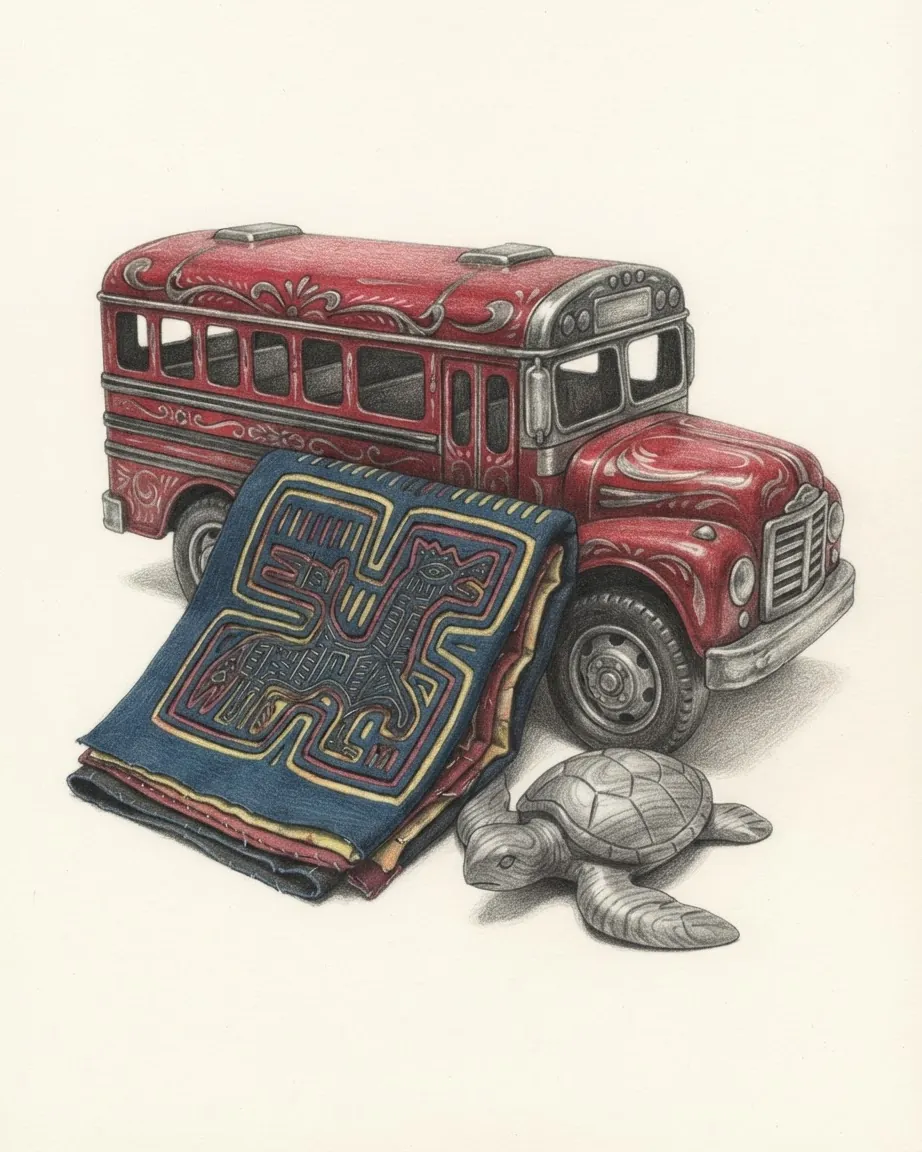
The mola is the Guna object most often seen outside Guna Yala. Mola is the Guna word for blouse, and it has come to mean the embroidered panels made by Guna women that form the front and back of it: several layers of cloth of different colours, stitched together and cut through by reverse appliqué so that the lower colours show in the channels of the upper. The nuchukana, carved wooden figures, are used in rituals to cure illness. When not in use they are kept wrapped in a bundle in the house, only young girls or elderly grandmothers may wash them, and they are inherited. A figure that has worn out is thrown away, sometimes with a chant.
Armila, a community of Guna Yala, has protected nesting sea turtles since 1992, when Ignacio Crespo began the effort. Its turtle festival was entered on UNESCO's Register of Good Safeguarding Practices on 6 December 2023, Panama's fourth intangible heritage inscription and the first on an Indigenous subject. The delegation from Armila gave the minister a mola worked with maracas, for the ancestral chants.
The Guna are one of eight Indigenous peoples recognised in the 2023 census, with the Ngäbe, Buglé, Emberá, Wounaan, Naso Tjër Di, Bribri and Bokota, 698,114 people or 17.2% of the population. Many live in the comarcas, the legally recognised Indigenous territories. Article 88 of the constitution makes the Indigenous languages an object of special study and conservation and commits the state to bilingual literacy programmes, and Article 90 recognises the ethnic identity of each community. Ngäbere is spoken in its own territories. The Guna practise Ibeorgun and the Ngäbe Mamatata.
What Panamanians believe and what the constitution assumes
Article 35 of the constitution lets every religion be professed freely within the limits of Christian morality and public order, and records that the Catholic religion is practised by the majority of Panamanians. In a 2022 survey by the National Institute of Statistics and Census, 65% identified as Catholic, 22% as evangelical, 6% as practising no religion and 4% with other religions. A government survey of 2015 had put Catholics at 63.2% and evangelical Protestants at 25%.
The BTI report of 2026 calls the tie between state and church evident in practice. Religious invocations open public events, clergy are seated in places of honour, public funds go to religious organisations and Catholicism is taught in public schools. In 2024 the police motto was changed from Protecting and serving to God and fatherland. The same report says the Catholic and evangelical churches have consolidated their standing as the social institutions Panamanians trust.
The minorities were built by the same crossings as everything else. Spanish and Portuguese Jews fleeing the Inquisition settled in the colony and often practised in secret, and the community grew in the mid-nineteenth century with arrivals from Curaçao. Jewish leaders put the community at about 15,000 people, mostly in Panama City, and three synagogues serve it. Muslim leaders estimate about 14,000 Muslims, Shia and Sunni, mostly in Panama City, Colón and Penonomé. Some Panamanians practise Santería, which combines Catholic and West African belief, and there are a few Rastafarians.
Which games and dishes Panamanians share
In a 2024 survey 48% of Panamanians named baseball as their favourite sport and 30% football. The professional winter league was first played in 1946, with interruptions over several decades, and the national team has won one silver and two bronze medals at the Baseball World Cup. Football has a domestic top flight founded in 1988. The men's team reached the World Cup in 2018 and lost to Belgium, England and Tunisia, and the women's team qualified for 2023, where Marta Cox scored against France.
Boxing produced the names that travelled. Panama Al Brown, Ismael Laguna, Roberto Durán, Eusebio Pedroza and Hilario Zapata are all in the International Boxing Hall of Fame. Flag football came in through the canal: Americans living in the Canal Zone introduced it, and they held a festival for it called the Turkey Ball.
Panamanian food is mildly flavoured, without the heat of some neighbouring cuisines in Latin America and the Caribbean, and it is built on maize, rice, wheat flour, plantains, yuca, beef, chicken, pork and seafood. The fish market known as the Mercado de Mariscos sells ceviche, small street shops called kioscos sell fried empanadas, and pastelitos filled with meat are eaten at holidays. On the Caribbean coast the Congo festival serves saus with drinks of ginger and saril.
The capital's Christmas parade on 25 December runs on the same pairing as the rest of the national culture. The floats are decorated in the national colours, the women wear the pollera and the men the montuno, and a band of drummers marches with them.
How Panamanian writing and painting began
Rodrigo Miró, the historian and essayist, dated the first Panamanian literary work to 1535, a story about a character named Andrea de la Roca in Gonzalo Fernández de Oviedo's Historia general y natural de las Indias. Literature written in Panama begins in the seventeenth century, with the anthology Llanto de Panamá a la muerte de don Enrique Enríquez, most of whose poems were by authors born on the isthmus.
The republic's own literature runs through the romantic poets of the nineteenth century, among them Amelia Denis de Icaza, the modernists including Ricardo Miró, and an avant-garde that included Rogelio Sinán. A modern literary movement appeared from the mid-nineteenth century, and Panamanian novels have been heavily influenced by the canal and what it did to the country's growth and society.
Painting has a colonial start in Hernando de la Cruz, who lived from 1592 to 1646, and a modern line through Roberto Lewis, Alberto Dutary and Etanislao Arias Peña. The older art is mostly lost, and what survives was preserved by burial. A pedestal plate in the Conte style, dated to between AD 600 and 800, is painted in black, dark red and brown, and Mary W. Helms reads its black figure as a serpent, a boa constrictor.
The Museum of the Panamanian in Panama City gives the broad view, and the Museum of Religious Colonial Art, the Museum of Contemporary Art and the Museum of the Interoceanic Canal each take one part of the record, as the Afro-Antillean museum does for the islanders. Five properties in Panama were on the World Heritage List by 2025, two cultural and three natural, and the Archaeological Site and Historic Centre of Panamá City has stood on the tentative list since 2015.
Common questions
Questions about Panama
What is a mola?
Mola is the Guna word for blouse. It now means the panels Guna women make for the front and back of the blouse: several layers of cloth in different colours, stitched together and cut through by reverse appliqué so that the lower colours show in the channels of the upper one.
Why do Panamanian women wear the pollera on Carnival Tuesday?
Carnival queens in Azuero once wore fantasy costumes on every day of the festival. Between the 1960s and the 1970s the rival tunas of Calle Arriba and Calle Abajo in Las Tablas began keeping the last day for the pollera de gala, and the women of the town followed. The historian Eduardo Cano traces it to the towns, with no decree involved, and the Ministry of Culture now calls it the unofficial Day of the Pollera.
Where did Afro-Panamanians come from?
From two migrations. Enslaved Africans, mainly from Senegambia and the Congo-Angola basin, were brought to carry silver across the isthmus under Spanish rule, and a 1610 census of Panama City counted 3,500 of them. Between the 1840s and 1914 workers came from Jamaica, Barbados, Martinique and other islands to build the railway and the canal, and many settled. The 2023 census counted 1,286,857 Afro-descendants.
What was the Dule Revolution?
The Guna rising of 25 February 1925, which the Ministry of Culture describes as a defence of Guna identity, autonomy and culture. Its anniversary is marked each February with forums, craft workshops, dance and parades in Panama City, Panamá Oeste and Colón as well as in Guna Yala, and in 2026 it reached its 101st year.