Kyrgyz culture: an epic, a felt carpet and a yurt that outlasted nomad life
2 105 words · 10 min · updated 2026-10-02
 Back to Kyrgyzstan
UNESCO's intangible heritage lists held 16 Kyrgyz elements in 2026, and most of them are things a nomadic household made or did. They include felt carpets, the white felt ak-kalpak and the bride's elechek, the yurt, a fermented flour drink and a horse game fought over a goat's carcass. At the centre stands the Manas trilogy, recited for up to thirteen hours by tellers who say a dream called them to it, in a country where Russian was still the home language of 55.6% of Bishkek's residents in a 2020 survey.
In short
- State language
- Kyrgyz; Russian is an official language
- National epic
- Manas, Semetey, Seytek (UNESCO 2013)
- UNESCO intangible heritage
- 16 elements in 2026
- On the urgent safeguarding list
- Ala-kiyiz and shyrdak felt carpets, 2012
- Instrument
- Komuz, a three-stringed plucked lute
- National dish
- Paloo (pilaf)
- Horse game
- Kok boru (UNESCO 2017)
- Novelist
- Chingiz Aitmatov
Who keeps the Manas epic alive
The founding text of Kyrgyz culture was never written down by its makers. Manas is an orally transmitted epic told by performers called manaschis; the Wikipedia culture article gives it close to half a million lines and says tradition sets the hero's wars against the Chinese and the Kalmyks in the 9th century. UNESCO inscribed the trilogy of Manas, Semetey and Seytek on its Representative List in 2013, describing it as the historical memory of the Kyrgyz people and a story of scattered tribes united into one nation.
The tellers are men and women of all ages, and UNESCO's account of how they work is specific. A narrator accepts the calling after a prophetic dream, understood as a sign from the heroes of the epic. In performance the teller enters a near-trance state and uses particular forms of rhythm and gesture, and a continuous narration of the trilogy can last up to thirteen hours. Recitals are given at village events and national holidays, and the tellers also offer support to communities after conflicts or disasters. The art is passed from master to apprentice outside formal schooling, although the trilogy is also taught in schools.
The state has written the epic into its law: the preamble of the 2021 constitution speaks of living "based on the precepts of Manas the Magnificent".
UNESCO had already listed the art of the akyns, the Kyrgyz epic tellers, in 2008, and improvised verse is the other half of the oral tradition. Aitysh, inscribed in 2015 as a practice shared with Kazakhstan, is a contest in which two akyns sit facing each other and improvise sung or spoken verse on topics chosen by the audience, accompanied on the Kazakh dombra or the Kyrgyz komuz, the three-stringed instrument that Britannica describes as plucked like a lute and played to accompany Manas. The winner is judged on music, rhythm, wit and wisdom. It was performed only by men; UNESCO notes that many women now take part and use it to speak for women's concerns.
What do the Kyrgyz make from felt
Felt was the material of nomad life, and it is still the material of Kyrgyz craft. Two kinds of felt carpet carry the tradition, ala-kiyiz and shyrdak. The Wikipedia culture article says the carpets are now made by hand mainly in two provinces, Naryn and Issyk-Kul, mostly from the wool of local sheep, and that shyrdak cushions sit on almost every chair in pairs.
UNESCO placed the art of ala-kiyiz and shyrdak on its List of Intangible Cultural Heritage in Need of Urgent Safeguarding in 2012. Its reasons were blunt: the number of practitioners was falling, most of them were over forty, the young were not interested, cheap synthetic carpets dominated the market and good raw materials were scarce. Ala-kiyiz carpets, it said, had practically disappeared from Kyrgyz homes. A further nomination for traditional felt making was under way in 2026.
The same craft dresses the head. The ak-kalpak, the white felt hat of Kyrgyz men, was inscribed in 2019; UNESCO counts more than eighty kinds, made by craftswomen who felt, cut, sew and embroider them, and describes its shape as a snow peak with four sides for the four elements and tassels on top for the memory of ancestors. Members of other ethnic groups sometimes wear it on holidays or days of mourning as a sign of sympathy. The elechek, inscribed in 2023, is the married woman's headwear: a hair cap wrapped in a very long white cloth like a turban. The bride's first elechek is wrapped at her family's house before she leaves with the groom, while elders speak blessings for the health and harmony of the new family.
Embroidery fills the walls. Tush kiyiz are large embroidered hangings made in Kyrgyzstan and Kazakhstan by older women to mark the marriage of a son or daughter, and hung over the couple's bed in the yurt; some take years to finish and are signed and dated.
How the yurt shapes Kyrgyz symbols
The yurt is a collapsible circular wooden frame covered with felt and bound with ropes, built so it can be put up and taken down quickly. UNESCO's 2025 inscription of the knowledge and skills of making Kyrgyz, Kazakh and Karakalpak yurts describes a division of labour: men and their apprentices make the wooden frame by hand, and women make the felt coverings and interior decoration in community groups led by experienced craftswomen. Festivities, births, weddings and funerals are held in yurts, which are kept in the family and passed from parents to children.
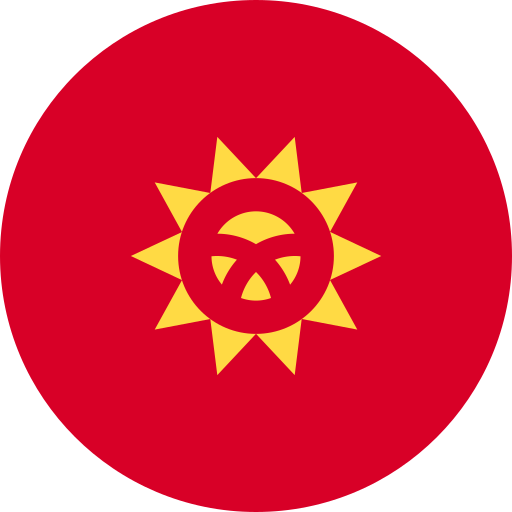
Its crown is on the national flag: the lines inside the yellow sun represent the tunduk, the wooden ring at the top of a yurt, and the sun's 40 rays stand for the 40 tribes, a number the Wikipedia country article links to one proposed meaning of the word Kyrgyz and to the 40 clans of Manas. Even the capital's name comes from the household: Bishkek is said to be named after the paddle used to churn fermenting mare's milk.
Most Kyrgyz now live in houses or apartment blocks, the Wikipedia tourism article notes, but the yurt is still lived in seasonally, when herding families move up to the high summer pastures, the jailoo, with their sheep, horses and yaks, while the sedentary Uzbeks and Tajiks of the Fergana Valley have traditionally farmed the irrigated lowland.
Which languages do people speak at home
The 2021 constitution makes Kyrgyz the state language and says Russian is used as an official language. Kyrgyz is a Turkic language of the Kipchak branch, close to Kazakh. It was written in an Arabic-based alphabet from 1924, in Latin from 1928 and in Cyrillic from 1941, and Britannica notes that Kyrgyz has taken a primary place in education since it was made the state language in 1989, after generations were taught largely in Russian.
Which language people speak at home depends on where they live. In the World Values Survey of 2020, cited in the Wikipedia country article, Russian was the home language of 55.6% of Bishkek's residents and Kyrgyz of 43.6%; across the whole country Kyrgyz was the home language of 70.9%, Russian of 16.3% and Uzbek of 10.7%. In April 2023 a proposal by the head of the state language commission to move from Cyrillic to Latin script was followed by a Russian suspension of dairy exports to Kyrgyzstan, and the president then said there were no plans to replace Cyrillic.
The population itself has changed. Ethnic Kyrgyz were about 50% of the population in 1979 and over 70% in 2013, while the share of Russians, Ukrainians, Germans and Tatars fell from 35% to about 7%. Germans, who numbered 101,000 in 1989, have largely emigrated to Germany. Britannica puts the Uzbek share at about one-seventh, concentrated in the south.
How do Kyrgyz people practise their faith
Most Kyrgyz are Sunni Muslims of the Hanafi school, but how they describe it varies. The CIA World Factbook estimated in 2017 that 90% of the population was Muslim and 7% Christian, while a Pew survey of 2012 found that only 23% of respondents chose to call themselves Sunni and 64% volunteered that they were "just a Muslim". Britannica writes that Islam was adopted gradually through contact with Kokand and that for the Kyrgyz it has remained merely a veneer on the national culture. The constitution defines the state as secular.
Older practice runs alongside, and the Wikipedia country article records that some animistic traditions survive, such as tying prayer flags to sacred trees, which some attribute to Buddhist influence and others to Sufi Islam. At Sulaiman-Too in Osh, UNESCO describes 17 places of worship still in use, venerated for cures for barrenness, headaches and back pain, in a cult that blends pre-Islamic and Islamic belief.
Smaller communities include Russian Orthodox Christians, Lutheran and Anabaptist Germans, about 200 Mennonites in 2022 with one community at Rot-Front, and Bukharian and Ashkenazi Jews. A law of 2009 raised the number of members needed to register a religion from 10 to 200 and banned religious activity in schools and by unregistered groups.
What do Kyrgyz households eat and drink
The cooking follows the herd: traditional Kyrgyz food is built on mutton, horse meat and dairy products, with techniques suited to keeping food for a long time; the Wikipedia culture article names pilaf, called paloo, as the national dish and green tea as the national drink. Britannica records the taste for koumiss, fermented mare's milk, which is also used in courses of treatment at health resorts.
Two foods are on UNESCO's lists. Maksym, inscribed in 2025, is a thick fermented drink made by roasting wheat, barley or maize flour in sheep fat, mixing it with water and salt and leaving it to ferment with natural cultures; UNESCO quotes a blessing said while it is made, wishing that the household never runs out of the fermenting culture. Jupka, the Kyrgyz flatbread, is part of a shared inscription of 2016 for the making and sharing of flatbread.
| Year | UNESCO listing | List |
|---|---|---|
| 2008 | Art of Akyns, Kyrgyz epic tellers | Representative |
| 2012 | Ala-kiyiz and shyrdak felt carpets | Urgent safeguarding |
| 2013 | Epic trilogy of Manas, Semetey and Seytek | Representative |
| 2015 | Aitysh, the art of improvisation | Representative |
| 2016 | Flatbread making and sharing, including jupka | Representative |
| 2017 | Kok boru, the horse game | Representative |
| 2019 | Ak-kalpak craftsmanship | Representative |
| 2020 | Toguz korgool and related board games | Representative |
| 2021 | Falconry; the Nomad Games programme | Representative; good practices |
| 2022 | Telling of Nasreddin Hodja anecdotes | Representative |
| 2023 | Elechek; midwifery | Representative |
| 2024 | Nowruz, called Nooruz in Kyrgyz | Representative |
| 2025 | Maksym; yurt making | Representative |
Which games are played on horseback
Kok boru is the horse game Kyrgyzstan inscribed in 2017: two mounted teams fight for a goat's carcass, replaced by a mould in modern games, and score by carrying it into the other side's goal. Experienced players referee, and elders called kalystar watch over the fairness of play; the National Kok-Boru Federation was founded in 1998. The Wikipedia country article lists other games on horseback: at chabysh, a long-distance race that can exceed 50 kilometres; oodarysh, wrestling in the saddle; tyin emmei, picking a coin off the ground at full gallop; and kyz kuumai, in which a rider chases a girl for a kiss and may be chased and whipped in turn if he fails.
Revival was deliberate. UNESCO describes Soviet-era settlement as having endangered traditional games, and records that practitioners first met in 2007 to plan how to document them, the start of a programme UNESCO listed as a good safeguarding practice in 2021. The first three World Nomad Games were held at Cholpon-Ata on Issyk-Kul. Toguz korgool, a board game played by moving pellets between rows of pits, and falconry are on the lists too.
Modern sport keeps a shorter record. Kyrgyzstan won its first Olympic medal at Sydney in 2000, a bronze in judo. Its wrestlers took three medals at the 2008 Games and three more in 2020. Football has had its own federation since 1992, and ice hockey a national championship since 2009.
Who wrote modern Kyrgyz literature
Chingiz Aitmatov is the writer the country claims. Britannica describes him writing mainly in Russian but also in Kyrgyz, and names Tales of Mountains and Steppes of 1963, The Day Lasts More than a Hundred Years of 1980 and The Place of the Skull of 1986; his play The Ascent of Mt. Fuji, written with the Kazakh playwright Kaltay Muhamedjanov, discussed moral compromises under Stalin and caused a sensation when it was staged in Moscow in 1973. The Wikipedia culture article also names Kenesh Jusupov and Kasymaly Jantöshev, whose novel Kanybek it describes as widely read.
Not every practice called traditional is accepted as one. Bride kidnapping, ala kachuu, is illegal but still practised, and the Wikipedia country article records the dispute over whether it is traditional at all: arranged marriages were, and a consensual kidnapping was one way to escape them.
Common questions
Questions about Kyrgyzstan
How long does a Manas recital last?
UNESCO records that a continuous narration of the trilogy of Manas, Semetey and Seytek can last up to thirteen hours. The tellers enter a near-trance state during recitals, and say they took up the calling after a prophetic dream.
What is the difference between a shyrdak and an ala-kiyiz?
Both are Kyrgyz felt carpets, inscribed together by UNESCO in 2012 on its list of heritage in urgent need of safeguarding. UNESCO reported that ala-kiyiz had practically disappeared from Kyrgyz homes and that shyrdaks were under serious threat, with most makers over forty. Naryn and Issyk-Kul are the two provinces where the carpets are still made by hand, mostly from local wool, and visitors meet shyrdaks most often in bright red and green.
What does the white felt hat ak-kalpak mean?
UNESCO, which inscribed ak-kalpak craftsmanship in 2019, describes the hat as shaped like a snow peak, with four sides for air, water, fire and earth, edging lines for life and tassels for the memory of ancestors. More than eighty kinds are distinguished by their patterns. Craftswomen make them, and other ethnic groups sometimes wear them on holidays or days of mourning.
Do people in Kyrgyzstan speak Russian or Kyrgyz?
Both. Kyrgyz is the state language under the 2021 constitution and Russian an official one. In the 2020 World Values Survey Kyrgyz was the home language of 70.9% of people nationwide and Russian of 16.3%, but in Bishkek Russian led with 55.6% against 43.6% for Kyrgyz. Uzbek was spoken at home by 10.7%.
What is kok boru?
A team game on horseback in which riders fight for a goat's carcass, now usually a mould, and score by carrying it into the opponents' goal. Elders called kalystar oversee fair play. UNESCO inscribed it in 2017, and the National Kok-Boru Federation has organised the game since 1998.
What is maksym?
A thick fermented drink made by roasting wheat, barley or maize flour in sheep fat, mixing it with water and salt and leaving it to ferment for several hours with natural cultures. UNESCO inscribed the knowledge of making it in 2025, and records that it is shared across all ages, backgrounds and regions as a sign of care and hospitality.