Travel in Hong Kong: a harbour city ringed by country parks
2 021 words · 9 min · updated 2026-10-02
 Back to Hong Kong
Hong Kong received 49.9 million visitor arrivals in 2025, and 37.8 million of them came from the mainland, according to the Hong Kong Tourism Board. They cross a boundary with its own immigration control, by road, rail, ferry or air, and overnight visitors stayed 3.1 nights on average. What they find is a dense city on the two shores of one harbour, an underground railway of about 271 kilometres, trams on Hong Kong Island since 1904 and a ferry across the harbour since 1898, and country parks and outlying islands that cover about 40% of the land. The total was still below the 65.1 million recorded in 2018.
In short
- Visitor arrivals, 2025
- 49.9 million, 37.8 million from the mainland
- Average overnight stay
- 3.1 nights (2025)
- Visa-free access
- about 170 nationalities, 7 to 180 days
- Railway network
- about 271 km, 99 stations (2024)
- Trams
- since 1904, 165 double-deck cars
- Long-distance trails
- MacLehose 100 km, Wilson 78 km, Lantau 70 km, Hong Kong 50 km
- Hotels
- 333 with about 93,500 rooms (end of 2025)
- Typhoon season
- May to November
Who travels to Hong Kong
The mainland supplies three quarters of the visitors. Of the 49.9 million arrivals in 2025, the Tourism Board counted 37,833,784 from the mainland, 11% more than in 2024, and 12,061,048 from everywhere else, 15% more. Short-haul markets in Asia accounted for 6.6 million of the second group and long-haul markets for 3.5 million.
| Market | Arrivals in 2025 | Change on 2024 |
|---|---|---|
| Mainland China | 37,833,784 | +11% |
| Short-haul markets | 6,568,278 | +15% |
| Long-haul markets | 3,544,181 | +20% |
| New markets | 763,807 | +17% |
| All visitors | 49,894,832 | +12% |
Most mainland visitors travel independently. The Individual Visit Scheme, introduced in July 2003, lets residents of designated mainland cities come without joining a tour group; it covered 59 cities in 2025, including every provincial capital, and 57% of mainland arrivals came under it that year. Arrivals from Taiwan, Japan, Viet Nam, Australia and the Middle East grew by 25% or more in 2025, and the Philippines, Thailand, Viet Nam and India sent as many visitors as before the pandemic or more.
The numbers have not returned to their peak. Hong Kong Free Press records more than 65.1 million visitors in 2018 and nearly 55.9 million in 2019, before the pandemic closed the borders. Tourism accounted for 2.8% of GDP in 2024 and employed about 159,700 people, 4.3% of the workforce.
How visitors enter Hong Kong
Hong Kong keeps its own immigration control, separate from the mainland's. The government says nationals of about 170 countries and territories may visit without a visa for between seven and 180 days. The British government's advice for holders of a full British citizen passport gives up to six months without a visa, a passport valid for at least a month after departure, and a warning that the Hong Kong authorities no longer accept British National (Overseas) passports for immigration clearance or as proof of identity.
There are three main ways in. Hong Kong International Airport at Chek Lap Kok handled 53 million passengers in 2024 and brought its Three-runway System into operation in November that year. The Hong Kong section of the Guangzhou-Shenzhen-Hong Kong Express Rail Link, opened in September 2018, runs 26 kilometres underground from West Kowloon to the mainland network, and from July 2025 it served 96 mainland destinations, 11 of them short trips into Shenzhen, Dongguan and Guangzhou. Ferries from the terminals at Sheung Wan and Tsim Sha Tsui carried 6.78 million passengers to and from Macao and 1.49 million to and from mainland ports in 2024, and the Hong Kong-Zhuhai-Macao Bridge carries road traffic.
Every route from the mainland or Macao passes a control point. Travellers between Hong Kong, mainland China and Macao clear immigration whatever their nationality, and mainland residents have no right of abode in Hong Kong. The traffic is heavy in both directions: in 2024 cross-boundary passengers by land and sea averaged 815,600 a day, residents and visitors together, with Shenzhen Bay Port alone handling about 94,200 passenger trips a day and the bridge port about 77,800.
How the city moves people
The railway does most of the work. In 2024 rail carried about 44% of the journeys made on public transport, over a network of about 271 kilometres: nine heavy rail lines, the Airport Express, the Light Rail in the north-west New Territories and the express rail link, with 99 stations and 68 Light Rail stops. The East Rail Line dates from 1910, when it was the Kowloon-Canton Railway, and the first passenger trains of the Mass Transit Railway ran on the Kwun Tong Line in late 1979. The Airport Express carried about 35,900 passenger trips a day in 2024.
Older systems still run beside it. Trams have run on Hong Kong Island since 1904, and in 2024 Hong Kong Tramways operated seven routes on 16 kilometres of track with 165 double-deck cars. The Star Ferry, founded in 1898, runs two cross-harbour routes between the island and Kowloon, and other companies run ferries to the outlying islands. The Peak Tram, which the government's history dates to 1885, is the other fixed-track survivor of the colonial city.
The streets carry the rest: franchised buses, minibuses, the green ones on fixed routes and frequencies, and taxis. Traffic drives on the left. The British government notes that a visitor may drive with a valid British licence for up to 12 months, and that hire companies often ask for an international permit and more experience.
How the territory divides for a visitor
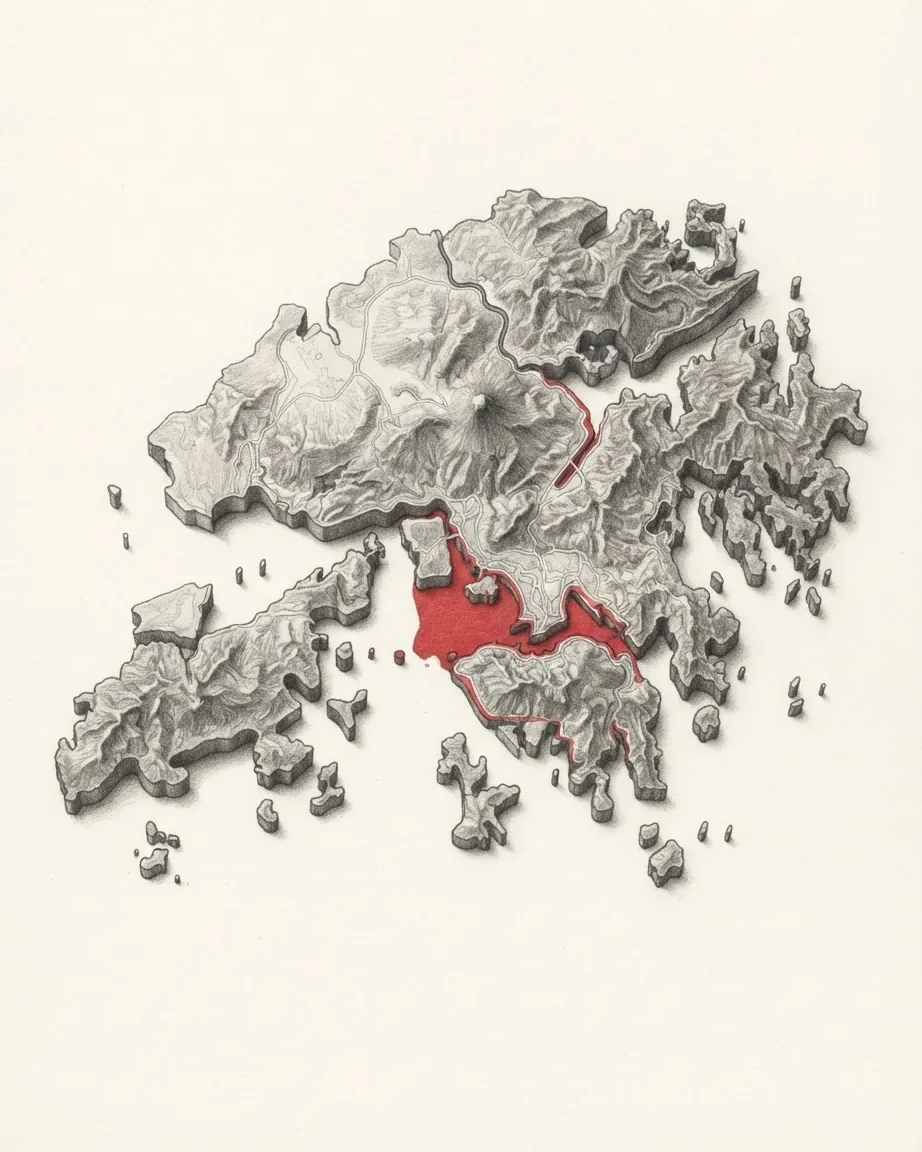
Hong Kong falls into three parts, and they were acquired at different times for different reasons, which still shows on the ground. Hong Kong Island holds the Victoria district on its north-west coast, where the British landed in 1841 and which has been the centre of administration and business ever since; the island's five country parks, crossed end to end by the Hong Kong Trail, cover much of the upland behind it. Urban Kowloon, the peninsula south of Boundary Street ceded in 1860, faces it across the harbour, and Tsim Sha Tsui at its tip has hosted the International Chinese New Year Night Parade since 2004. Further north, Sham Shui Po is one of the neighbourhoods the Tourism Board promotes to visitors.
The New Territories, leased in 1898, are most of the land. They hold the new towns, which housed about 47% of the population in 2021, and the older settlements around them, among them the walled villages where Hakka and Weitou were spoken. The Mai Po Marshes in the north-west, part of a Ramsar wetland of 1,500 hectares, are a restricted area open only to permit holders, kept as a habitat for migratory birds.
Lantau carries the Po Lin Monastery and its seated bronze Buddha, and the Lantau Trail circles the island. Chi Lin Nunnery in Diamond Hill, built in the style of the Tang dynasty, and the Wong Tai Sin temple in Kowloon are the urban counterparts. How these parts came together is told in Hong Kong: history.
What visitors buy and celebrate
Shopping is one reason to come. Hong Kong is a free port with no general sales tax, and Wikipedia's account of its tourism notes that visitors from elsewhere in China buy cosmetics, jewellery and designer goods there for that reason. Duty is charged on only four kinds of goods: strong liquor, tobacco, hydrocarbon oil and methyl alcohol.
The calendar adds its own reasons. The International Chinese New Year Night Parade, first held in 1996, drew more than 150,000 spectators in 2018, half of them visitors, and the Lunar New Year fireworks over the harbour are a separate event. In January 2026 the government announced that the Hong Kong Jockey Club would fund the display for the first time. Arrivals by sea have their own terminal at Kai Tak: Hong Kong recorded 150 cruise ship calls and 517,000 cruise passengers in 2024, and the government published an action plan for cruise tourism that December. The Tourism Board runs seven visitor centres, two of them at the airport and others at the Star Ferry pier in Tsim Sha Tsui, West Kowloon Station, the bridge port and the cruise terminal.
Where the countryside begins
The country parks cover about 40% of the land and drew some 11 million visits in 2024. Four long-distance trails run through them, waymarked and maintained by the Agriculture, Fisheries and Conservation Department.
| Trail | Length | Route |
|---|---|---|
| MacLehose Trail | 100 km | across the New Territories from Sai Kung in the east to Tuen Mun in the west |
| Wilson Trail | 78 km | from Stanley on Hong Kong Island to Nam Chung in the north of the New Territories |
| Lantau Trail | 70 km | a circuit of Lantau Island |
| Hong Kong Trail | 50 km | through the five country parks on Hong Kong Island |
The British government advises hikers to stay on the marked trails and not to carry valuables. The geopark in the east has its volcanic columns in the Sai Kung region, at High Island, Tai Long Wan and Sharp Island, and its sedimentary coast in the north-east New Territories; in September and October 2026 a trial reservation system with visitor quotas ran on part of the High Island geo trail. The Tourism Board counts more than 250 islands, and the island destinations it promotes include Cheung Chau, Lamma, Ma Wan and Po Toi. Diving and snorkelling are allowed in the marine parks.
What the neighbourhoods and venues offer
The Tourism Board promotes the city district by district. Its neighbourhood campaigns cover Old Town Central, Sham Shui Po and West Kowloon, where the Hong Kong Palace Museum, M+ and the Xiqu Centre stand along the harbour, and it lists the Hong Kong Museum of Art among the main art destinations. Temple festivals such as the Cheung Chau Bun Festival and the Hung Shing festival on Ap Lei Chau are promoted alongside events with fixed international calendars: French May, Art Basel, the Hong Kong Sevens and the tennis opens.
The Kai Tak Sports Park, at Kai Tak, the site of the former airport, was commissioned on 1 March 2025 for large sporting and entertainment events. Ocean Park on the south side of the island combines a theme park with an oceanarium, and Hong Kong's giant pandas, including twins born locally and a pair given by the central government in 2024, are promoted as an attraction in their own right.
At the end of December 2025 there were 333 hotels with about 93,500 rooms, and average occupancy over 2025 was 87%. The culture visitors meet in these places, its language, food and temples, is described in Hong Kong: culture.
When the weather suits a visit
The Hong Kong Observatory's own description makes November and December the months many people regard as the best of the year, with breezes, sunshine and comfortable temperatures. January and February are cloudier, with cold fronts that can bring urban temperatures below 10 degrees Celsius. March and April are milder but humid, with drizzle and fog that occasionally stop flights and ferries.
From May to August the weather is hot and humid, afternoons often pass 31 degrees and nights stay near 26, and showers and thunderstorms are common. About 80% of the rain falls between May and September. The British government's advice gives the typhoon season as May to November, with flooding and landslides, and asks visitors to follow local warnings issued in advance. The land and the climate are covered in Hong Kong: geography.
What the law expects of visitors
The British government's travel advice sets out what applies to visitors. The 2020 national security law and the 2024 ordinance apply to everyone in Hong Kong, whatever their nationality, and to conduct outside the territory as well; offences include secession, subversion, collusion with a foreign country, treason and sedition, some can carry life imprisonment, and investigators can demand full access to electronic devices. It notes that people have been prosecuted for publishing or supporting statements critical of the Hong Kong or Chinese authorities, including online. The Hong Kong government's position is that the laws target only a very small minority.
Ordinary rules are enforced firmly too. On-the-spot fines apply to littering, jaywalking and spitting. All cannabis products are illegal, including those containing CBD, and the drug laws apply to passengers in transit at the airport. Importing and re-exporting elephant ivory, souvenirs included, is illegal, and photographing military installations is forbidden. The British government describes violent crime as low and warns of pickpocketing in crowded places.
Common questions
Questions about Hong Kong
Does Hong Kong have its own visa rules?
Yes. Hong Kong is part of the People's Republic of China but runs its own immigration control as a Special Administrative Region, and sets its own entry rules. The government says nationals of about 170 countries and territories can visit Hong Kong without a visa for 7 to 180 days, and travellers between Hong Kong, the mainland and Macao pass border controls whatever their nationality.
Are British National (Overseas) passports accepted in Hong Kong?
No. The British government's travel advice states that the Hong Kong authorities no longer accept BN(O) passports for immigration clearance and do not recognise them as proof of identity.
How do travellers get from Hong Kong to the mainland by train?
By the Hong Kong section of the Guangzhou-Shenzhen-Hong Kong Express Rail Link from West Kowloon Station, opened in September 2018. From July 2025 it connected to 96 mainland destinations with at least 208 trains a day, including direct services to Futian, Shenzhenbei and Guangzhounan and long-distance trains to Beijing and Shanghai. The older East Rail Line also runs to the boundary crossing at Lok Ma Chau.
How long is the MacLehose Trail?
About 100 kilometres, across the New Territories from Sai Kung in the east to Tuen Mun in the west. It is one of four waymarked long-distance trails maintained by the Agriculture, Fisheries and Conservation Department, with the Wilson Trail at 78 kilometres, the Lantau Trail at 70 and the Hong Kong Trail at 50.
When is the best time of year to visit Hong Kong?
The Hong Kong Observatory says many people regard November and December as the best months, with plenty of sunshine and comfortable temperatures. Summer from May to August is hot, humid and wet, and tropical cyclones can strike from May to November, most often from July to September.