Hong Kong's history: a lease on one part that set the date for the whole
2 553 words · 12 min · updated 2026-10-02
 Back to Hong Kong
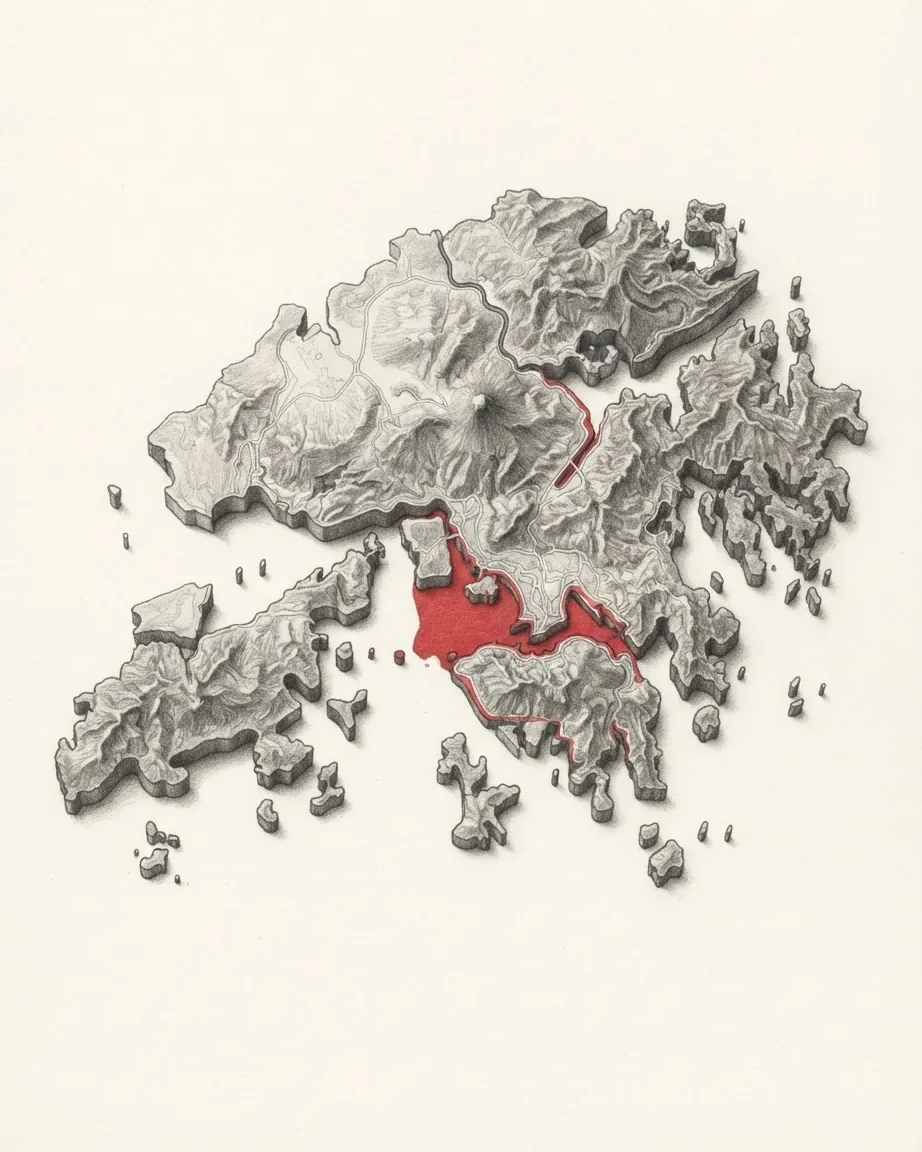
The date on which Hong Kong passed from British to Chinese rule, 1 July 1997, was set by a lease on only part of the territory. Hong Kong Island had been ceded to Britain outright in 1842 and the tip of the Kowloon Peninsula in 1860, but the New Territories, the land running north to the Shenzhen River together with 235 islands, were leased in 1898 for 99 years. China's government regards all three as unequal treaties and the whole of Hong Kong as Chinese territory, and the Joint Declaration of 1984 returned the ceded and the leased parts on the day the lease ran out. Between those dates a harbour with a few thousand villagers and boat people became a city filled by successive waves of refugees, an industrial port and then a financial centre.
In short
- British flag raised
- 26 January 1841, Possession Point
- Hong Kong Island ceded
- Treaty of Nanking, 29 August 1842
- Kowloon ceded
- Convention of Peking, 24 October 1860
- New Territories leased
- 9 June 1898, for 99 years
- Japanese occupation
- 25 December 1941 to 30 August 1945
- Joint Declaration signed
- 19 December 1984
- Basic Law adopted
- 4 April 1990
- Special Administrative Region established
- 1 July 1997
Who lived on Hong Kong's shores before the British
Archaeological digging in Hong Kong began in the 1920s, and the government's yearbook for 2021 reports traces of human activity along the shoreline spanning more than 6,000 years. The earliest cultures emerged from about 4,000 BC as the sea rose from a level 100 metres below the present one and drowned a wide coastal plain, leaving roughly the shoreline that exists now. Bronze appeared around the middle of the second millennium BC, and stone moulds found at Kwo Lo Wan, Tung Wan, Sha Lo Wan, So Kwun Wat, Tai Wan and Sha Po Tsuen show that it was cast locally. An older date is claimed for stone tools found at Wong Tei Tung on the Sai Kung Peninsula in 2003, which some researchers place 35,000 to 39,000 years ago.
The Qin dynasty brought the area into China in 214 BC. The yearbook singles out one trace of that period: a brick tomb with Eastern Han grave goods, found near Li Uk and Cheng Uk villages in Sham Shui Po in 1955. In the 13th century the last court of the Southern Song dynasty sheltered briefly at what is now Kowloon City before its defeat at Yamen in 1279, and tradition ties the Sung Wong Toi inscription in Kowloon City to that episode. Britannica records Cantonese settlers arriving from about 100 BC, the Hakka later and the Hoklo by the middle of the 17th century.
The coast was emptied once by order. Under the Great Clearance of 1661 to 1683, the Qing state cleared most of the population out of the area. Potters at Wun Yiu in Tai Po probably began making blue-and-white porcelain in the Ming dynasty, and the local industry ran for more than 300 years. When British settlement began in 1841, the yearbook counts about 3,650 people in 20 villages and hamlets, and about 2,000 fishermen living on boats in the harbour.
How opium brought British ships into the harbour
The harbour mattered before the island did. Britannica dates British use of it to 1821, when merchants began anchoring opium ships there; the deep water had entrances at both ends and lay on the main trade routes along the China coast. China had outlawed opium in 1799. The yearbook describes the trade reversing the flow of silver after 1800 and widening after 1834, when the East India Company lost its monopoly of the China trade.
In March 1839 the Qing government sent Lin Zexu to Canton as special commissioner to end the trade. He surrounded the foreign factories, stopped their food and held the merchants until they gave up their stocks. After a six-week siege, Captain Charles Elliot, the British Superintendent of Trade, authorised the surrender of 20,283 chests of opium. The British community moved to Macao and then, in the summer of 1839, onto ships in the Hong Kong harbour. An expeditionary force arrived in June 1840.
On 20 January 1841 Elliot demanded the cession of Hong Kong Island under the Convention of Chuenpi, agreed with the Qing commissioner Qishan, and on 26 January a naval landing party raised the British flag at Possession Point in what is now Sheung Wan. Neither government accepted the terms. Qishan was taken to Peking in chains, and the Foreign Secretary, Lord Palmerston, dismissed the island as "a barren island with hardly a house upon it" and replaced Elliot with Sir Henry Pottinger. Pottinger fought on up the Yangtze and ended the war with the Treaty of Nanking on 29 August 1842, which ceded the island and opened five Chinese ports to trade.
How the colony was assembled treaty by treaty
Hong Kong reached its present size in stages, and each stage came out of a war or a crisis on the mainland. The Second Opium War, which the yearbook calls the Second Anglo-Chinese War, began in 1856 over the reading of the earlier treaties. British troops camped on the Kowloon Peninsula during it and, finding it healthy, wanted to keep it; the consul at Canton, Harry Parkes, first secured a lease, and the Convention of Peking turned it into an outright cession.
| Instrument | Date | Territory | Terms |
|---|---|---|---|
| Treaty of Nanking | 29 August 1842 | Hong Kong Island | Ceded outright |
| Convention of Peking | 24 October 1860 | Kowloon south of Boundary Street, and Stonecutters Island | Ceded outright |
| Convention Respecting an Extension of Hong Kong Territory | 9 June 1898 | The New Territories north to the Shenzhen River, and 235 islands | Leased for 99 years |
The third instrument followed demands for concessions from China by European powers and Japan after China's defeat by Japan in 1895. It let Chinese authority continue in Kowloon City except where it conflicted with the defence of Hong Kong, but an order in council of 27 December 1899 revoked that clause and Britain took Kowloon City over. The British met some opposition when they occupied the New Territories in April 1899, and the area was then run separately from the urban districts.
The two governments have never described these agreements in the same words. The Basic Law's preamble says Hong Kong "was occupied by Britain after the Opium War in 1840". A white paper issued by China's State Council Information Office on 20 December 2021 calls them three unequal treaties imposed through British aggression, never recognised as valid by any Chinese government after the revolution of 1911, and notes that the rent for the 99-year lease was zero. Britannica records that the Chinese government consistently maintained that the whole of Hong Kong was Chinese territory, so talks about a lease on one part were talks about all three.
Why refugees kept arriving in the colony
The new settlement started badly, with fever, typhoons and crime, and the yearbook notes that nobody expected Chinese families to choose so small a place. They did. The population rose from 32,983 in 1851, 95% of them Chinese, to 878,947 in 1931, 97.8% Chinese. Movement across the boundary was free, and Britannica describes the colony as a refuge for people and capital leaving China whenever conditions there turned, and a stopping point for emigrants bound for South East Asia and beyond. Ocean-going ships using the port rose from 2,889 in 1860 to 23,881 in 1939.
Trade with the mainland set the money. Hong Kong adopted the silver dollar in 1862 and, when China left silver in 1935, followed with a managed dollar of its own. The government had the shape of any British colony of the time: a governor chosen in London and nominated executive and legislative councils with official majorities. Ng Choy, a lawyer born in Singapore, became the first Chinese member of the Legislative Council in 1880. The China white paper of 2021 describes the governor as answerable only to London, appointed without the people of Hong Kong ever being consulted.
Each upheaval on the mainland reached the colony. A seamen's strike in 1922 was followed by a general strike in 1925 and 1926. After Japan invaded China in 1937 and Canton fell in 1938, the yearbook estimates arrivals at about 100,000 in 1937, 500,000 in 1938 and 150,000 in 1939, which took the population to about 1.6 million by the outbreak of the Second World War. At the peak of that influx some 500,000 people were thought to be sleeping in the streets.
What the Japanese occupation took from Hong Kong
Japanese forces attacked across the land border on 8 December 1941, Hong Kong time, at about the same time as the raid on Pearl Harbor. They pushed the British and the Hong Kong Volunteer Defence Corps out of the New Territories and Kowloon and onto the island, and after a week of fighting there the colony surrendered on Christmas Day.
The occupation lasted three years and eight months. Trade virtually stopped, the currency lost its value and food ran short, and towards the end the occupiers organised mass deportations to ease the shortage. Many residents left for neutral Macao or for the interior of China. The two counts of what was left differ: the yearbook puts the population at about 600,000 by August 1945, and Britannica at about 650,000 when Japan surrendered, against 1.6 million in 1941.
Resistance came from the New Territories. In February 1942 the Hong Kong-Kowloon Independent Battalion of the East River Column was formed at Wong Mo Ying, a village in Sai Kung, and it attacked Japanese bases and shipping and helped rescue prisoners of war. After the surrender, the Colonial Secretary Frank Gimson, who had spent the occupation in Stanley Gaol, set up a provisional government, Rear Admiral Sir Cecil Harcourt arrived with the British Pacific Fleet on 30 August 1945, and civil government returned on 1 May 1946.
How factories replaced the entrepôt after the embargo
People returned from the mainland at almost 100,000 a month, and the population reached an estimated 1.8 million by the end of 1947. As the Nationalist government lost the civil war in 1948 and 1949, hundreds of thousands more came from Guangdong, Shanghai and other commercial cities, and by mid-1950 the estimate was 2.2 million. The yearbook gives 4 million by 1971, 5 million by 1980 and 6 million by 1994.
The port lost its trade first. The United Nations embargo on China in 1951, during the Korean War, cut the entrepôt business on which the colony had lived, and manufacturing took its place, beginning with textile mills set up by immigrant industrialists. Through the 1960s textiles and clothing made up about half of domestic exports by value. Housing came out of disaster: a fire in a squatter settlement on Christmas Day 1953 left 53,000 people homeless, and the emergency rehousing that followed was the start of the public housing programme.
Britannica describes the labour behind that growth as cheap and the conditions as very poor, and unrest spread through the early 1960s. In May 1967 a dispute at a plastic flower factory turned into riots, which Britannica describes as largely inspired by followers of the Cultural Revolution on the mainland. As many as 51 people were killed and 802 injured. Labour laws, large housing estates and public works followed. In 1972 the government decided to build new towns in the New Territories, nine of them over the next two decades, and the Country Parks Ordinance of 1976 set land aside for conservation.
Another wave came by sea after 1975. By the time the last camp closed in 2000, more than 200,000 Vietnamese had reached Hong Kong; more than 143,000 were resettled overseas and some 72,000 sent back to Vietnam.
Why the lease decided the date of the handover
The lease was the problem everyone could date. Contacts between London and Beijing on the future of Hong Kong began in March 1979, the same year the governor, Murray MacLehose, raised the question with Deng Xiaoping, and formal negotiations opened after the British prime minister, Margaret Thatcher, visited Beijing in September 1982. Two years later, on 19 December 1984, the two governments signed the Sino-British Joint Declaration, under which China would resume the exercise of sovereignty over the whole of Hong Kong from 1 July 1997. The British government reads it as guaranteeing the region, for 50 years from 1997, a high degree of autonomy except in foreign and defence affairs.
The National People's Congress adopted the Basic Law on 4 April 1990, and it promises that the capitalist system and way of life will remain unchanged for 50 years. After the Tiananmen Square protests and massacre of 1989, Beijing ousted members of the drafting committee who had voiced support for the student protesters. Emigration, already running high, reached its peak year in 1992, when 66,000 people left, and over half a million left between 1987 and 1996. More than 100,000 people queued overnight on the eve of a deadline for British National (Overseas) application forms.
The last governor, Chris Patten, appointed in July 1992, introduced reforms that increased the number of elected members of the Legislative Council, and the Chinese government viewed them as a breach of the Basic Law. The council elected in 1995 was the first wholly elected one; it did not survive the handover, and a Provisional Legislative Council chosen by a selection committee set up under Beijing's authority replaced it. British rule ended at midnight on 1 July 1997, 156 years after the flag went up at Possession Point.
What became of the arrangement after the handover
The new region met a run of shocks at once. The government spent heavily from its reserves to hold the currency peg in the Asian financial crisis of 1997, and severe acute respiratory syndrome killed some 300 people in Hong Kong in 2003. The same year the government tried to pass the national security law that Article 23 of the Basic Law requires the region to enact itself, and the bill failed after marches by as many as 750,000 people. By the election of 2004, half the Legislative Council's seats were directly elected.
The argument over how far to go towards universal suffrage, which Articles 45 and 68 of the Basic Law set as the ultimate aim, ran through the next fifteen years. A decision by the central government to screen nominees before any election of the chief executive brought the occupation protests of 2014. In 2019 a bill allowing extradition to the mainland drew months of marches, which organisers said reached more than three million people, and clashes with the police; the bill was withdrawn in October 2019.
Beijing then legislated over the region's head. The Standing Committee passed the Law on Safeguarding National Security in the Hong Kong Special Administrative Region on 30 June 2020 and added it to Annex III of the Basic Law, and it took effect at 11 pm that night. On 11 March 2021 the National People's Congress decided to rewrite the region's electoral system, and on 23 March 2024 Hong Kong promulgated its own Safeguarding National Security Ordinance under Article 23. The 2021 white paper describes these steps as putting democracy in Hong Kong back on track after an extended period of unrest caused by anti-China agitators. Britannica records widespread international criticism that the 2020 law effectively ended "one country, two systems", and since the electoral overhaul of March 2021 the British government has assessed China to be in a state of ongoing non-compliance with the Joint Declaration. How the region is now governed is the subject of Hong Kong: politics.
Timeline
The dates in order
- 214 BC
- The Qin dynasty brings the area into China.
- 1279
- The last Southern Song court, which had sheltered at Kowloon City, is defeated at Yamen.
- 1661
- The Great Clearance moves most of the coastal population inland until 1683.
- 1839
- Lin Zexu forces the surrender of 20,283 chests of opium at Canton.
- 1841
- A British naval party raises the flag at Possession Point on 26 January.
- 1842
- The Treaty of Nanking cedes Hong Kong Island on 29 August.
- 1860
- The Convention of Peking cedes Kowloon south of Boundary Street.
- 1898
- The New Territories and 235 islands are leased for 99 years from 1 July.
- 1941
- Japan attacks on 8 December; Hong Kong surrenders on Christmas Day.
- 1945
- British forces return on 30 August.
- 1953
- A squatter fire on Christmas Day leaves 53,000 homeless and starts public housing.
- 1967
- Riots follow a labour dispute at a plastic flower factory in May.
- 1984
- The Sino-British Joint Declaration is signed on 19 December.
- 1990
- The National People's Congress adopts the Basic Law on 4 April.
- 1997
- The Hong Kong Special Administrative Region is established on 1 July.
- 2003
- A national security bill under Article 23 is withdrawn after mass marches.
- 2019
- Protests against an extradition bill run from June; the bill is withdrawn in October.
- 2020
- The national security law takes effect on 30 June.
- 2021
- The National People's Congress decides on a new electoral system on 11 March.
- 2024
- The Safeguarding National Security Ordinance is promulgated on 23 March.
Common questions
Questions about Hong Kong
Why was Hong Kong returned in 1997 if the island had been ceded for ever?
Only the New Territories were leased, for 99 years from 1 July 1898. Hong Kong Island and southern Kowloon had been ceded in 1842 and 1860, but Britannica records that the Chinese government held the whole territory to be Chinese and the earlier agreements to be unequal treaties. The Joint Declaration of 1984 settled the question by returning all of Hong Kong on the day the lease expired.
What did the Basic Law promise for fifty years?
The Basic Law provides that the socialist system and policies will not be practised in the Hong Kong Special Administrative Region and that its previous capitalist system and way of life will remain unchanged for 50 years from 1 July 1997. The British government reads the Joint Declaration of 1984 as guaranteeing a high degree of autonomy, except in foreign and defence affairs, for the same period.
How many people lived in Hong Kong when the British arrived?
The government's yearbook counts about 3,650 people scattered over 20 villages and hamlets, and about 2,000 fishermen living on boats in the harbour, when British settlement began in 1841. By 1851 the census counted 32,983 people, 95% of them Chinese, and by 1931 the figure was 878,947.
Where did armed resistance to the Japanese occupation come from?
From the New Territories, during an occupation that lasted three years and eight months. The Hong Kong-Kowloon Independent Battalion of the East River Column was set up in February 1942 at Wong Mo Ying, a village in Sai Kung, and attacked Japanese bases and shipping lines and, with Allied forces, helped rescue prisoners of war. The government's yearbook cites it as evidence that most of the community stayed loyal to the anti-Japanese cause.
Which governor oversaw the last five years of British rule?
Chris Patten, appointed in July 1992 after losing his parliamentary seat that year. His reforms increased the number of elected members of the Legislative Council, which the Chinese government viewed as a breach of the Basic Law, and the council elected under his rules in 1995 was replaced at the handover by a provisional council chosen by a selection committee.