Hungarian
Language · official in 1 country
Magyar has two basic words for red, piros and vörös, the second related to vér, blood. Hungarian is a Uralic language placed in the Ugric branch with Mansi and Khanty of western Siberia, and in the 2011 census 99.6% of Hungary's population spoke it.
The language on record
- Own name
- magyar
- ISO 639-1
- HU
- ISO 639-3
- HUN
- Script
- Latin
- Family
- Ugric
- Official in
- 1 country
Where Hungarian is official
Hungary is the only country where it holds national status. Serbia's Vojvodina and three Slovene municipalities make it official below that level, and Romania, Slovakia and Austria recognise it regionally.
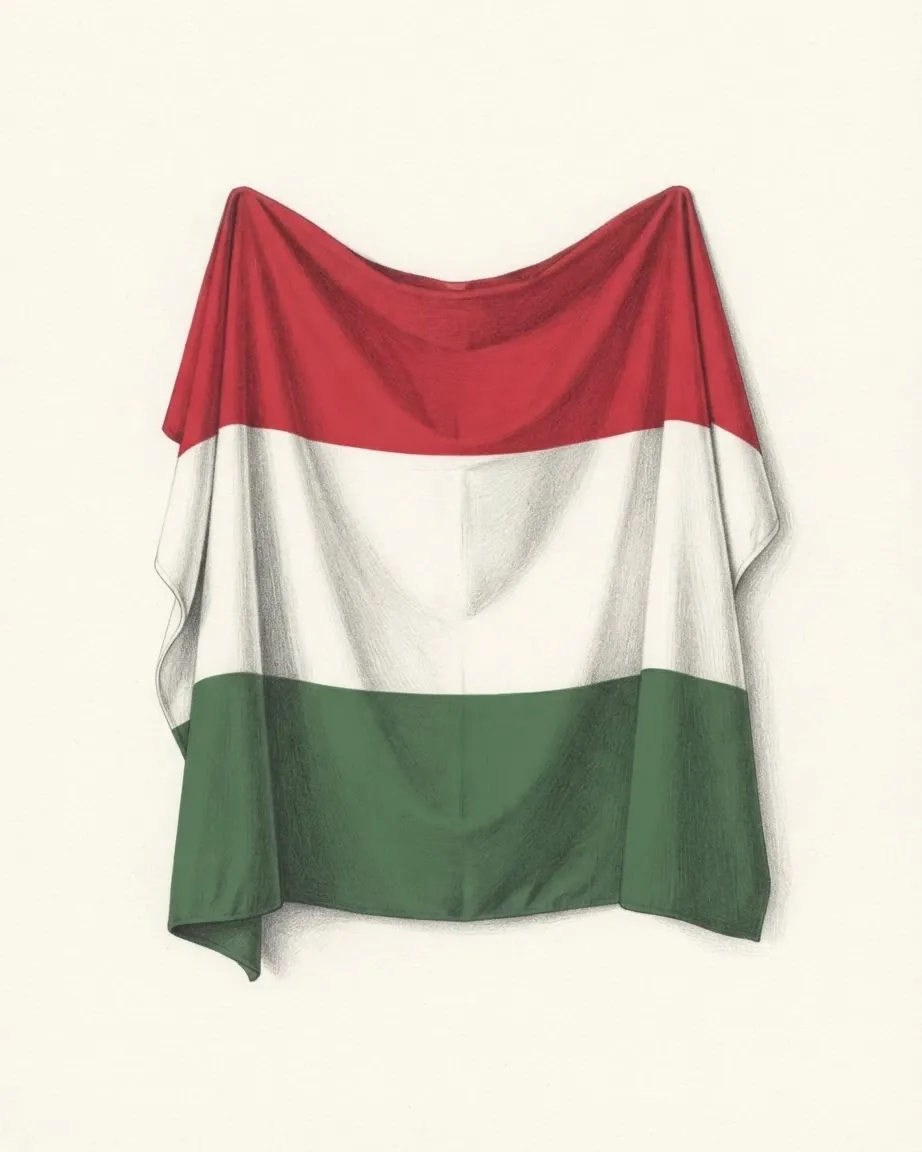
About Hungarian
How the Ugric-Turkic war was settled
Links between Hungarian and other Uralic languages were noticed in the 1670s, and the family was established in 1717. In the second half of the 19th century a rival hypothesis tied Hungarian to the Turkic languages, and the academic dispute that followed was called the Ugric-Turkic war. The Finno-Ugric side was judged sounder, largely on the work of the German linguist Josef Budenz. The Turkic words are loans all the same: Oghur speakers lent szó, word, borjú, calf, and many terms for farming and livestock between the 5th and 9th centuries.
Which texts preserve Old Hungarian
The earliest fragments sit in the founding charter of the abbey of Tihany, dated 1055, among Latin text. The first text entirely in Hungarian is the Funeral Sermon and Prayer from the 1190s. The Lamentations of Mary, from the 14th century, is the earliest religious poem, and the Hussite Bible of the 1430s is the first Bible translation. Almost nothing written in the older Hungarian runes survives, because they were carved in wood.
What Kazinczy's reformers added
In the 19th century Ferenc Kazinczy and other writers led the nyelvújítás, a renewal of the language. They shortened words, spread dialect words nationwide, revived extinct ones and coined new ones from suffixes, over ten thousand in all, and most remain in use.
Why the compass points follow the sun
North is észak, from night; south is dél, noon; east is kelet, the sun's rising; west is nyugat, its setting. About 20% of Hungarian loanwords come from neighbouring Slavic languages, among them szerda, Wednesday, and karácsony, Christmas.
Where Trianon left its speakers
The Treaty of Trianon in 1920 cost Hungary 71% of its territory and a third of its ethnic Hungarians. About 2.2 million speakers live in lands of the former kingdom, about 1.25 million of them in Transylvania. Hungarian is official in Vojvodina and, beside Slovene, in Hodoš, Dobrovnik and Lendava, and it is a recognised minority language in Austria, Croatia, Romania, Slovakia and Zakarpattia in Ukraine.
Common questions
Questions about Hungarian
Is Hungarian related to Finnish?
Yes, distantly. Both are Uralic, but Hungarian sits in the Ugric branch, whose closest members are Mansi and Khanty in western Siberia.
When is red piros and when vörös?
Piros is used for artificial things and neutral or cheerful ones, such as traffic lights or paprika. Vörös covers natural and emotionally charged ones, such as red wine, the Red Sea and the Red Army. Fixed phrases often override the rule.
Where is Hungarian official outside Hungary?
In Serbia's province of Vojvodina and in three Slovene municipalities. It is also a recognised minority language in five other countries, and in Romania it can be used locally where Hungarians make up over 20% of the population.