The Czech koruna
Currency · CZK · Kč · 1 country
The Czech koruna came into force on 8 February 1993, when the Czech and Slovak parliaments ended a short monetary union and split the Czechoslovak koruna in two. The first Czech notes were Czechoslovak ones with a stamp stuck on. By law one koruna, written Kč, divides into 100 hellers, a unit that now survives only in accounts.
The abbreviation
Kč stands for koruna česká, Czech crown. The Act on the Czech National Bank fixes the abbreviation in its article on the monetary unit. It usually follows the amount, as in 50 Kč, but stands before the figure on the 10 koruna coin.
- ISO code
- CZK
- ISO number
- 203
- Subunit
- haléř (heller), 1/100
An amount, written out
Kč 1,234.50
- Kč 1,234.50English
- 1 234,50 KčCzechCzechia
In English the sign comes before the amount. Where the Czech koruna is used, it comes after the amount in Czechia.
The abbreviation in code
HTML, CSS, JavaScript, UTF-8
- HTML
KčKč- CSS
content: "K\010D";- JavaScript
"K\u010D"- UTF-8
0x4B 0xC4 0x8D- UTF-16
0x004B 0x010D- UTF-32
0x0000004B 0x0000010D
Where the Czech koruna is the official currency
Czechia keeps the koruna for itself. Slovakia shared the Czechoslovak koruna with it until February 1993, and Czechia is bound to adopt the euro once it meets the convergence criteria.
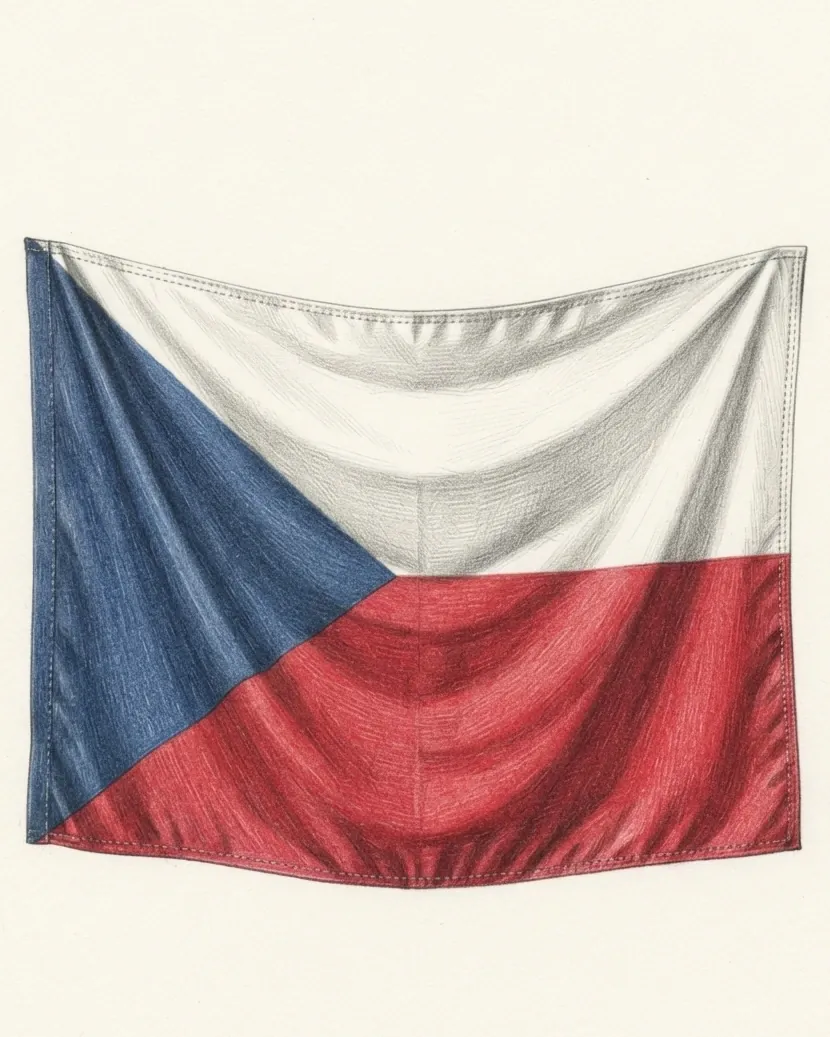
About the Czech koruna
How the Czechoslovak koruna was split
When Czechoslovakia dissolved, its two successor states briefly kept a common currency, and the Czech National Bank was established on 1 January 1993 by dividing the State Bank of Czechoslovakia. Five weeks later, on 8 February, the separate Czech and Slovak korunas took effect.
The first Czech notes were Czechoslovak 100, 500 and 1,000 koruna notes with an adhesive stamp stuck on. Lower denominations went on circulating as they were. Each stamp carried a Roman and an Arabic numeral for its note: C and 100, D and 500, M and 1,000. Later printings of the 1,000 note replaced the stamp with a printed image of it.
Who holds the right to issue it
The Act on the Czech National Bank gives the bank the exclusive right to issue banknotes and coins, commemorative coins included. It orders the printing and the minting, manages the stocks and guards the plates, the dies and the withdrawn notes until they are destroyed. When it declares notes or coins invalid, it must exchange them at face value for at least five years. Precious-metal and collector coins may sell above face value.
Where the name crown came from
Austria-Hungary introduced the krone in 1892 in place of the gulden, at two kronen to one gulden, and that rate is why Czechs still call the 10 koruna coin a pětka, a fiver. When the empire dissolved in 1918, Czechoslovakia kept the name for its own currency, which went through a highly controversial monetary reform in 1953.
What happened to the heller coins
The 1993 coinage ran from 10 hellers to 50 koruna, struck at first in Winnipeg and Hamburg and later at home. The 10 and 20 heller coins were withdrawn by 31 October 2003 and the 50 heller by 31 August 2008, as their value shrank. Accounts are still kept to the heller. A cash payment is rounded to the nearest koruna.
How the banknotes have changed since
A new series drawn by Oldřich Kulhánek arrived later in 1993, with Czech figures from history on the front and abstract compositions on the back. From 2007 the bank reissued the notes with a colour-shifting thread and more watermarks, starting with the 2,000 and finishing with the 100 and 200 in 2018, and in 2022 it withdrew the older versions of the 100 to 2,000 notes.
To mark thirty years of the split, the bank issued 200,000 copies of the 2008 version of the 1,000 note on 8 February 2023, overprinted with the motif of the 1993 stamp. The 5,000 note is seldom seen in circulation, partly because it lends itself to money laundering. In December 2025 there were 24.4 million of them out, against 209.7 million 2,000 notes.
Why the Czech Republic still keeps the koruna
The Czech Republic is bound to adopt the euro once it meets the convergence criteria. It planned to do so in 2010, and its government suspended that plan indefinitely in 2005. Support has stayed low: 16% of Czechs favoured replacing the koruna in an April 2014 survey, and 20% of those over 15 in an April 2018 survey by the Public Opinion Research Center. At the twentieth anniversary conference in 2013 the bank's governor said the bank saw no strong reason to give up its currency in the foreseeable future.
The bank has also used the exchange rate as a tool. In November 2013 it intervened to weaken the koruna and capped its strength. After inflation ran higher than expected, it removed the cap at a special meeting on 6 April 2017.
Common questions
Questions about the Czech koruna
Does the Czech Republic use the euro?
No. The country is legally bound to adopt the euro once it meets the convergence criteria, but in 2005 its government suspended the plan to adopt it in 2010, indefinitely. Surveys found 16% in favour in April 2014 and 20% in April 2018. Notes and coins of the Czech National Bank, which holds the exclusive right of issue, are legal tender for all payments in the country.
What does Kč stand for?
Koruna česká, Czech crown. The Act on the Czech National Bank sets the abbreviation and divides the koruna into 100 hellers. Amounts are normally written with Kč after the number.
Are heller coins still legal tender?
No. The 10 and 20 heller coins were withdrawn by 31 October 2003 and the 50 heller coin by 31 August 2008, because they bought too little to be worth handling. The heller did not disappear altogether: prices, invoices and financial statements are still written to two decimal places, and a shop's price is often a multiple of ten hellers. A cash total is rounded to a whole koruna, because 1 Kč is now the lowest value any coin carries.
Why is the 10 koruna coin called a pětka?
The nickname means fiver and goes back to 1892, when the Austro-Hungarian krone replaced the gulden at two kronen to one gulden, so ten kronen made five gulden. Emperor Franz Joseph I had suggested the name krone. Czechoslovakia kept it after 1918, and Czechs still say pětka for the 10 koruna coin in informal speech.