The Belarusian ruble
Currency · BYN · 1 country
The National Bank of the Republic of Belarus issues the ruble in its third post-Soviet form. On 1 July 2016 one new ruble took the place of 10,000 old ones, and Belarus put coins into general circulation for the first time. Its notes and coins had been made years before and still carry the date 2009.
No sign of its own
The catalogue records no sign of its own for the Belarusian ruble. Amounts are written with an abbreviation of the word, руб. or р. in Cyrillic and Rbl in English, or with the ISO code BYN, which replaced BYR in 2016 as BYR had replaced BYB in 2000.
- ISO code
- BYN
- ISO number
- 933
- Subunit
- kopeck, 1/100
- ISO name
- Belarusian Ruble
An amount, written out
BYN 1,234.50
- BYN 1,234.50English
- 1234,50 BrBelarusianBelarus
In English the code comes before the amount. Where the Belarusian rouble is used, it comes after the amount in Belarus.
Where the Belarusian rouble is the official currency
Belarus is the member. Its National Bank values the ruble against a basket of the Russian ruble, the US dollar and the renminbi.
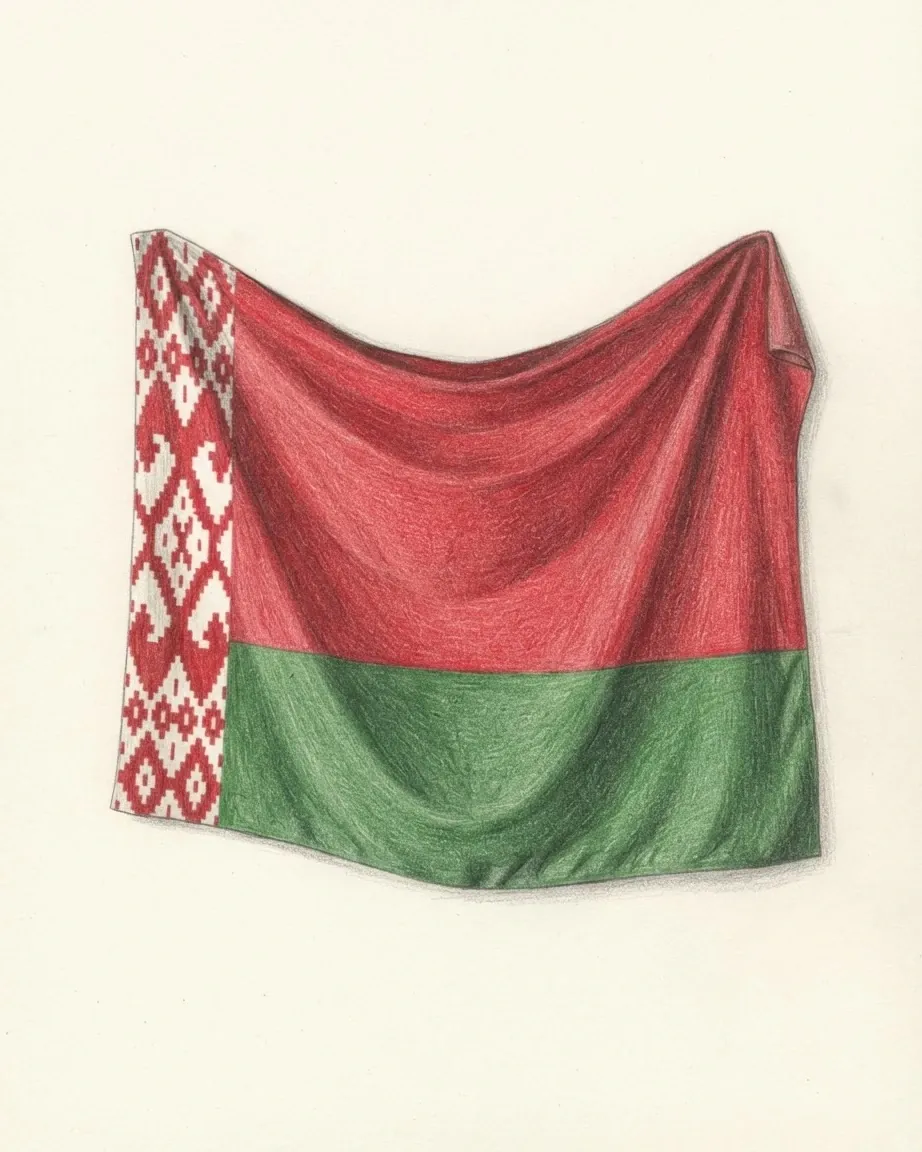
About the Belarusian rouble
Who issues the ruble and how it is valued
The National Bank of the Republic of Belarus issues the notes and coins. Its exchange rate is set against a basket of foreign currencies: the Russian ruble, the US dollar and the renminbi. The euro sat in that basket until December 2022, when the bank took it out because trade between Belarus and the European Union had fallen.
Why Belarus kept the name ruble
When the Soviet supply chains broke up, trade moved to cash, and the Belarusian branch of the USSR State Bank had neither the capacity nor the licence to print Soviet notes. The government decided to issue a currency of its own. The name thaler, divided into groschen, was put forward. The Communist majority in the Supreme Soviet of Belarus rejected it and kept ruble, the word used under the Soviet Union and the Russian Empire.
How three rubles followed each other
The National Bank's notes replaced Russian ruble notes in May 1992, at ten Soviet or Russian rubles to one Belarusian ruble. That first ruble, ISO code BYB, took about two years to become the country's official currency, in 1994. A second ruble, BYR, came in 2000 and removed three zeros. It had no coins in circulation and no notes in kopecks, and its highest note, of 200,000 rubles, appeared in 2012.
The third ruble, BYN, removed four more zeros on 1 July 2016. Old and new money circulated side by side until 31 December 2016, and shops had to show both prices. The old notes could be exchanged without limit or commission through 2021 and became invalid on 1 January 2022.
Why the new money sat in a vault
The notes of the current series were printed on the National Bank's order as early as 2008. The redenomination was then put off because of the global economic crisis, and the finished notes went into the bank's Central Vault. De La Rue printed them. The coins came from the Lithuanian Mint and the Kremnica Mint. Slovakia had offered to strike them and supplied prototypes.
The long wait left marks on the money. The notes bear the facsimile signature of the chairman of the bank's board at the time they were printed. The 50 ruble note spells fifty the way Belarusian did before a 2008 spelling law changed one vowel, and the bank said later print runs would correct it.
What the notes and coins show
The seven notes, from 5 to 500 rubles, follow the motto Belarus is my country. Each is given to one region or to the city of Minsk, matched to the denominations in alphabetical order, and shows its buildings and monuments. The eight coins run from 1 kopeck to 2 rubles. Every obverse shows the state coat of arms. Coins up to 5 kopecks are copper-plated steel, the 1 ruble nickel-plated steel, and the 2 ruble pairs a brass-plated ring with a nickel-plated centre.
What became of a shared currency with Russia
Article 13 of the 1999 treaty creating the Union State of Russia and Belarus foresaw a single currency. The two governments had set 2005 as their goal. The talks ran well past it, and Belarus still issues its own ruble.
Common questions
Questions about the Belarusian rouble
Why does Belarus call its money a ruble and not a thaler?
Thaler, split into groschen, was proposed as the name of the new national currency when the first ruble was being planned. The Communist majority in the Supreme Soviet of Belarus turned the proposal down and kept ruble, the name the country had used under the Soviet Union and the Russian Empire. The word also named a unit of money in the medieval Grand Duchy of Lithuania.
Are old Belarusian rubles still worth anything?
Not as money. The notes of the 2000 series circulated alongside the new ones until 31 December 2016, and from 2017 through 2021 they could be swapped for new money at 10,000 to one without limit and without a fee. Banks took them until the end of 2019; after that only the National Bank did. Since 1 January 2022 they have been invalid.
Why do Belarusian banknotes say 2009 if they came out in 2016?
The National Bank ordered them before the global financial crisis, and they were printed as early as 2008. The crisis pushed the redenomination back, and the notes waited in the bank's Central Vault until 1 July 2016. They carry the date of the first attempt and the facsimile signature of the chairman of that time, and the 50 ruble note keeps a spelling of fifty that a 2008 law had already changed. The coins were ready by 2009 as well.
Is the Belarusian ruble tied to the Russian ruble?
The National Bank manages it against a basket of three currencies, the Russian ruble, the US dollar and the renminbi. A single currency with Russia was written into the 1999 Union State treaty, but talks overran the 2005 target, and Belarus kept its own ruble.