History of the United States: a founding promise enforced two centuries later
2 010 words · 9 min · updated 2026-09-30
 Back to United States
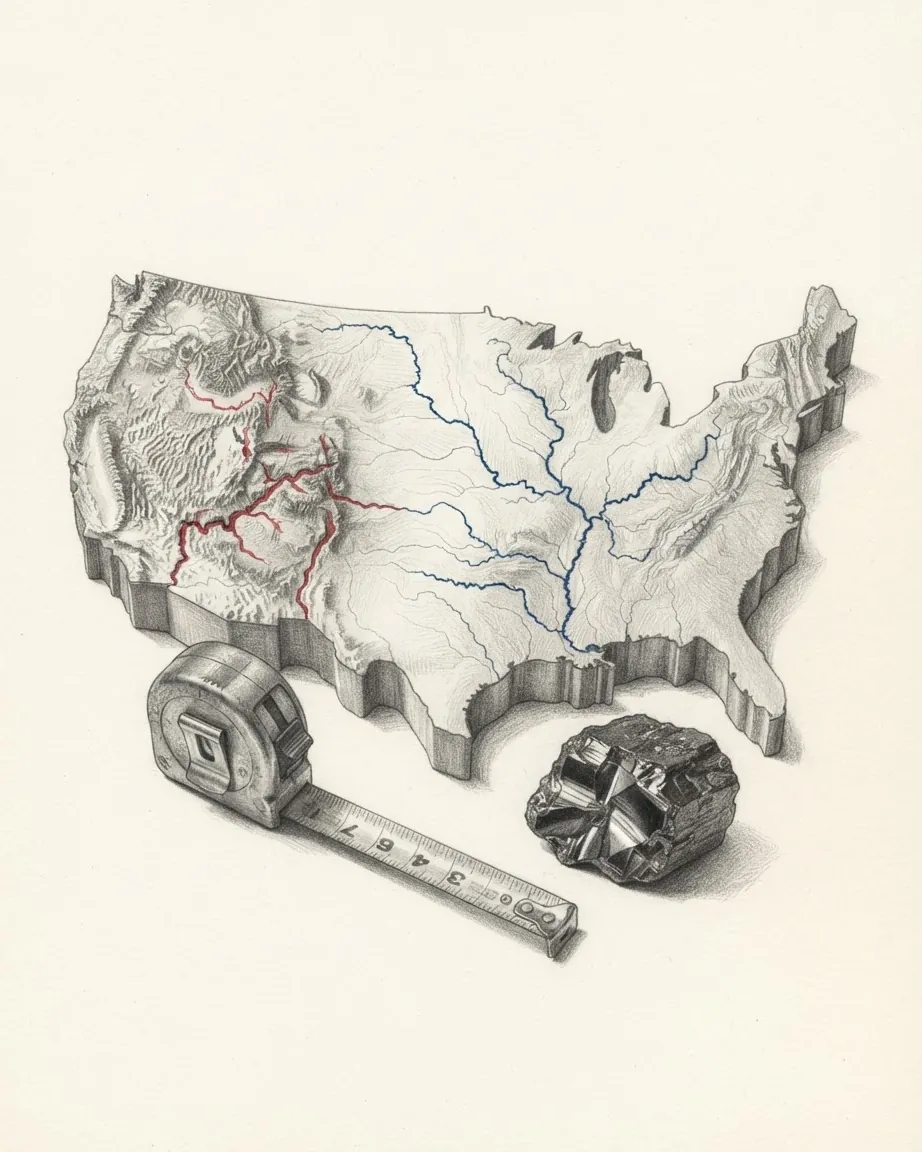
The United States declared on 4 July 1776 that all men are created equal, at a time when enslaved Africans made up about a fifth of the colonial population, and it took a civil war and three constitutional amendments between 1865 and 1870 to write that claim into law. It took almost another century, until the Civil Rights Act of 1964 and the Voting Rights Act of 1965, before the federal government enforced it across the South. The same years carried the country from thirteen colonies on the Atlantic coast to fifty states reaching the Pacific, the Arctic and the middle of the Pacific Ocean, on land taken, bought and conquered from Indigenous nations, France, Spain, Mexico and Russia.
In short
- Declaration of Independence
- 4 July 1776
- Independence recognised
- Treaty of Paris, 3 September 1783
- Constitution signed
- 17 September 1787, in force 1789
- Amendments
- 27, the first ten as the Bill of Rights in 1791
- Slavery abolished
- 13th Amendment, ratified 6 December 1865
- Civil War dead
- About 750,000 soldiers, 1861 to 1865
- Newest state
- Hawaii, 1959
Who lived in North America before the colonies
People reached North America from Eurasia across Beringia, the land bridge that joined Siberia to Alaska during the Ice Age, and by 10,000 BCE they were established across the continent. The Clovis culture, known from its fluted spear points, dates from about 9,100 to 8,850 BCE. Farming spread north from Mexico: corn was growing in the valleys of Arizona and New Mexico by 3,000 BCE.
Later societies built on a large scale. The Mississippian city of Cahokia, near present-day St. Louis, held an estimated 20,000 people at its peak in the twelfth century, around an earthwork, Monks Mound, 30 metres high. In the Southwest the Anasazi built stone and adobe pueblos, many into cliff faces, and Pueblo Bonito along the Chaco River in New Mexico once had 800 rooms. In present-day upstate New York the Oneida, Mohawk, Onondaga, Cayuga and Seneca formed the Iroquois Confederacy in the fifteenth century. Hawaii was first settled most likely between 940 and 1130 CE.
Britannica puts the Indigenous population of what is now the continental United States at roughly 1.5 million when Columbus arrived, and notes that estimates vary greatly. European diseases, smallpox and measles above all, killed very large numbers of them, often before European settlement reached their land. Their descendants today belong to 575 federally recognised tribes.
How the English colonies grew along the coast
Spain came first. Juan Ponce de León landed in Florida in 1513, and in 1565 Spanish forces founded St. Augustine. The English colony at Jamestown in Virginia, founded by the Virginia Company in 1607, nearly failed until John Rolfe planted a West Indian tobacco in 1612; within a decade it was the colony's main source of revenue. Virginia's House of Burgesses first met in July 1619, the year the first enslaved Africans arrived. The Pilgrims landed at Plymouth in 1620 and about half of them died in the first winter.
The colonies took different shapes. Puritans founded the Massachusetts Bay Colony in 1630, and dissenters expelled from it founded Rhode Island and Connecticut. The Dutch colony of New Netherland was taken by the English in 1664 and renamed New York. William Penn received Pennsylvania in 1681 and promised religious toleration. In the South, tobacco, rice and indigo were grown on plantations, and Georgia was founded in 1732.
Labour was scarce everywhere. More than half of all European immigrants arrived as indentured servants, bound to work four to seven years for their passage. Slavery hardened in the 1660s into a lifelong, inherited condition tied to skin colour, and by the 1770s enslaved Africans made up about a fifth of the population of the colonies.
Why thirteen colonies broke with Britain
The French and Indian War of 1754 to 1763 sharply reduced French power on the continent and ended the threats that had kept the colonies dependent on British protection. Parliament taxed the colonies directly: the Stamp Act of 1765 met the answer of no taxation without representation. British troops killed five people in Boston on 5 March 1770, colonists destroyed a cargo of taxed tea in Boston harbour on 16 December 1773, and Parliament responded in 1774 with laws the colonists called the Intolerable Acts, which put Massachusetts under military rule.
Fighting began at Lexington and Concord on 19 April 1775. The Second Continental Congress voted for independence on 2 July 1776 and adopted the Declaration of Independence on 4 July, the date kept since as Independence Day. The American victory at Saratoga in 1777 brought France, the Netherlands and Spain in on the American side, and a British army surrendered at Yorktown on 19 October 1781. By the Treaty of Paris of 3 September 1783, Britain recognised the independence of the United States.
How the Constitution replaced a weak confederation
The first national government, under the Articles of Confederation, could not tax, regulate trade between the states or pay its debts. After Shays' Rebellion in Massachusetts in 1786, delegates met in Philadelphia from 25 May to 17 September 1787 and wrote a new constitution, which 39 of them signed. It created a federal government with a president, a two-chamber Congress and a Supreme Court, and gave it the power to tax. New Hampshire became the ninth state to ratify on 21 June 1788, enough for it to take effect, and it began operating in 1789. The first ten amendments, the Bill of Rights, followed in 1791.
The document protected slavery without naming it. The Three-Fifths Compromise let states count three fifths of their enslaved people for representation in Congress, and a fugitive clause required escaped slaves to be returned even from states that had abolished slavery. Congress ended American participation in the Atlantic slave trade in 1807. In 1803 the Supreme Court, in Marbury v. Madison, claimed the power to strike down laws that violate the Constitution. The Constitution has been amended 27 times since it took effect.
How the country grew to the Pacific
The United States doubled in size in 1803 when it bought Louisiana from France for $15 million: 828,000 square miles, about 530 million acres, covering all or part of fifteen future states between the Mississippi and the Rockies. Westward settlement then ran over Indigenous land. The Indian Removal Act of 1830 authorised treaties exchanging tribal land in the East for land west of the Mississippi, and about 4,000 of the 16,000 Cherokee forced west in 1838 died on the way, on the route remembered as the Trail of Tears.
| Year | Territory | Acquired from | How |
|---|---|---|---|
| 1803 | Louisiana | France | Purchase, $15 million |
| 1845 | Texas | Republic of Texas | Annexation by joint resolution |
| 1846 | Oregon Country | Britain | Oregon Treaty |
| 1848 | California and the Southwest | Mexico | Treaty of Guadalupe Hidalgo after war |
| 1867 | Alaska | Russia | Purchase, $7.2 million |
| 1898 | Puerto Rico, Guam, the Philippines | Spain | Treaty after the Spanish-American War |
Texas, independent of Mexico since 1836, was admitted as a state on 29 December 1845 after Congress passed a joint resolution. The war with Mexico that followed ended in the Treaty of Guadalupe Hidalgo in 1848, which gave the United States much of the Southwest, California and New Mexico among it, with $15 million paid to Mexico. Gold was found in California the same year. Alaska was bought from Russia for $7.2 million, agreed on 30 March 1867 and transferred on 18 October that year. The first transcontinental railroad was finished in 1869.
The wars with Indigenous nations continued until the end of the century. The Census Bureau counted in 1894 that the Indian Wars had killed 19,000 white people and more than 30,000 Indians since 1789. In 1898 the war with Spain brought Puerto Rico, Guam and the Philippines under American rule. Hawaii became the fiftieth state in 1959.
Why the Union fought a civil war over slavery
By 1860 four million people were enslaved in the South, and the question that divided the country was whether slavery could spread into the new western territories. The Missouri Compromise of 1820 drew a line; the Kansas-Nebraska Act of 1854 erased it and left each territory to vote, and the Republican Party was founded to oppose the expansion of slavery. In 1857 the Supreme Court ruled in Dred Scott v. Sandford that Black Americans were not citizens.
Abraham Lincoln, a Republican, won the presidential election of 1860. Seven Southern states seceded and formed the Confederate States of America on 8 February 1861, and Confederate forces fired on Fort Sumter in South Carolina on 12 April 1861; four more states then joined them. The two sides were unequal. The National Park Service counts 18.5 million people in the Union against 5.5 million free and 3.5 million enslaved people in the Confederacy, 101,000 factories against 21,000, and 20,000 miles of railroad against 9,000.
The war lasted four years. The Battle of Antietam in Maryland on 17 September 1862 caused more than 23,000 casualties. Lincoln's Emancipation Proclamation of 1 January 1863 declared free the enslaved people in the states in rebellion, though not in the border states that stayed loyal. The Union won at Gettysburg and Vicksburg in July 1863, and Robert E. Lee surrendered at Appomattox in April 1865. About 750,000 soldiers died, and Lincoln was assassinated days after the surrender. Congress had passed the Thirteenth Amendment on 31 January 1865, the House by 119 votes to 56, and it abolished slavery when the states ratified it on 6 December 1865.
What Reconstruction promised and what replaced it
The Fourteenth Amendment of 1868 made everyone born in the United States a citizen and guaranteed equal protection of the laws; the Fifteenth, in 1870, barred states from denying the vote on account of race. For a few years Black men voted and held office across the occupied South, under a federal Freedmen's Bureau and the protection of the army. The Ku Klux Klan and later paramilitary groups answered with terror.
Reconstruction ended with the Compromise of 1877, which settled a disputed presidential election and withdrew the last federal troops from the South. Southern legislatures then passed the Jim Crow laws, using poll taxes and literacy tests to strip Black citizens of the vote, and the Supreme Court upheld segregation in Plessy v. Ferguson in 1896. The Chinese Exclusion Act of 1882 barred Chinese immigrants. Between 1880 and 1914 more than 22 million immigrants came, mostly from Europe, to work in the mines, mills and factories of an industrialising country. Women gained the vote nationally under the Nineteenth Amendment, first used in 1920, and the Indian Citizenship Act of 1924 made citizens of all Native Americans born in the country who were not already.
How the twentieth century made a world power
The United States entered the First World War in April 1917. The Wall Street crash of 29 October 1929 opened the Great Depression, and unemployment rose from 3% in 1929 to 25% in 1933. The New Deal answered with Social Security, unemployment insurance and public works. Japan's attack on Pearl Harbor on 7 December 1941 brought the country into the Second World War; more than 120,000 Americans of Japanese descent were removed from their homes to internment camps, about 400,000 American military personnel and civilians were killed, and in August 1945 the United States used atomic bombs on Hiroshima and Nagasaki.
After 1945 the country led the Western side of the Cold War. Post-war aid to Europe totalled $25 billion out of a GDP of $258 billion in 1948, and in 1949 the United States formed NATO, its first peacetime alliance. It fought in Korea and in Vietnam, where 58,000 American troops died, and landed astronauts on the Moon in 1969.
At home the Supreme Court ruled school segregation unconstitutional in Brown v. Board of Education in 1954, and the civil rights movement carried the argument into the streets, from the Montgomery bus boycott of 1955 to the Selma to Montgomery march of 1965. The Civil Rights Act, signed on 2 July 1964, banned discrimination in public places and in employment, and the Voting Rights Act of 1965 enforced the right to vote. The Soviet Union dissolved in 1991. On 11 September 2001 hijackers killed 2,977 people in New York, at the Pentagon and in Pennsylvania, and the United States invaded Afghanistan that year and Iraq in 2003. In 2008 the country entered the Great Recession.
Timeline
The dates in order
- 1607
- The Virginia Company founds Jamestown.
- 1619
- The House of Burgesses meets; the first enslaved Africans arrive in Virginia.
- 1776
- The Declaration of Independence is adopted on 4 July.
- 1783
- The Treaty of Paris recognises American independence.
- 1787
- The Constitution is signed in Philadelphia on 17 September.
- 1803
- The Louisiana Purchase doubles the country's size.
- 1830
- The Indian Removal Act authorises the removal of eastern nations.
- 1848
- The Treaty of Guadalupe Hidalgo cedes the Southwest.
- 1861
- Southern states secede; the Civil War begins at Fort Sumter.
- 1865
- The Confederacy surrenders; the 13th Amendment abolishes slavery.
- 1877
- Reconstruction ends; Jim Crow laws follow.
- 1920
- Women vote nationally under the 19th Amendment.
- 1941
- Pearl Harbor brings the country into the Second World War.
- 1964
- The Civil Rights Act bans discrimination in public places and employment.
- 1991
- The Soviet Union dissolves, ending the Cold War.
- 2001
- The attacks of 11 September kill 2,977 people.
Common questions
Questions about United States
Why is the Fourth of July Independence Day?
Because the Second Continental Congress adopted the Declaration of Independence on 4 July 1776. The vote for independence itself came two days earlier, on 2 July, when Congress approved the Lee Resolution. Britain recognised the new country only with the Treaty of Paris of 3 September 1783, after the war ended.
What was the Three-Fifths Compromise?
A clause of the 1787 Constitution that let states count three fifths of their enslaved population when seats in the House of Representatives were apportioned. It gave slaveholding states more representation than their free population alone would have earned. It ceased to apply once slavery was abolished, and the Fourteenth Amendment of 1868 replaced it with a count of the whole number of persons.
How did the United States get so much land?
By purchase, annexation, treaty and war over roughly a century. France sold Louisiana in 1803 for $15 million; Texas was annexed in 1845; Britain ceded the Oregon Country in 1846; Mexico ceded much of the Southwest in 1848 after a war; Russia sold Alaska in 1867 for $7.2 million; and Spain ceded Puerto Rico, Guam and the Philippines in 1898. Much of the land was first taken from Indigenous nations through treaties, removal and war.
When did slavery end in the United States?
The Thirteenth Amendment, passed by Congress on 31 January 1865 and ratified on 6 December 1865, abolished it nationwide. Lincoln's Emancipation Proclamation of 1 January 1863 had freed enslaved people only in the Confederate states in rebellion, and the Northern states had abolished slavery on their own in the decades after independence.
What did the Civil Rights Act of 1964 do?
Signed on 2 July 1964, it prohibited discrimination in public places, provided for the integration of schools and other public facilities, and made employment discrimination illegal. The Voting Rights Act of 1965 followed with provisions to enforce the constitutional right to vote, which Southern states had denied Black citizens since the end of Reconstruction in 1877.