Turkmen culture: the carpet on the flag and what came with it
2 057 words · 9 min · updated 2026-10-02
 Back to Turkmenistan
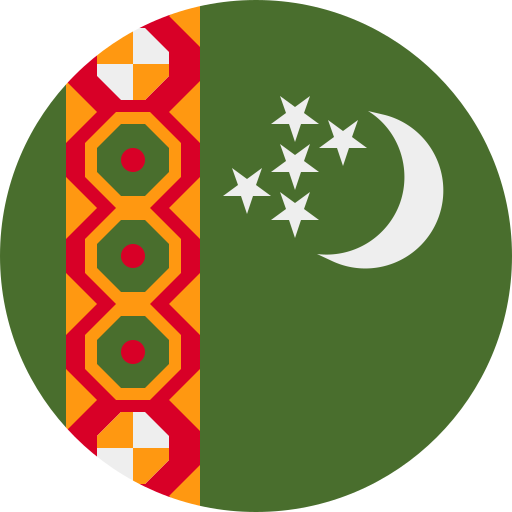
Five carpet medallions, one for each of the main Turkmen tribes, run down a red stripe near the hoist of Turkmenistan's flag, and the same five sit in the red disc of the state emblem. The carpet is the plainest case of a pattern that runs through Turkmen culture, in which a craft that once told one tribe from another has become a symbol of the nation, with a public holiday of its own. Between 2015 and 2025 UNESCO inscribed ten elements from Turkmenistan on its list of intangible heritage, among them the carpet, the two-stringed dutar, the Gorogly epic, the Akhal-Teke horse and the alabay dog.
In short
- State language
- Turkmen, in Latin script since 1993
- Main tribes
- Teke, Yomut, Ersari, Chowdur, Gokleng, Saryk
- Muslims
- 93.1% (Pew Research Center, 2009)
- UNESCO intangible heritage
- 10 elements, 2015 to 2025
- Carpet Day
- Last Sunday in May, a holiday since 1992
- National instrument
- Dutar, a two-stringed lute
- Drink the country is known for
- Çal, fermented camel's milk
What a Turkmen carpet records
UNESCO, which inscribed traditional Turkmen carpet making in 2019, describes hand-woven wool carpets with a dense texture and coloured patterns that belong to one of the five main Turkmen tribes. The patterns form clear linear geometric arrangements, and the weavers draw the combination of threads and colours from the plants, animals and landscape around them. Carpets are woven on horizontal or vertical looms, mostly from coloured wool, and serve as floor coverings and wall hangings; special carpets are made for the birth of a child, for weddings, for prayer and for mourning. Skills pass within the family.
Each tribe had its own repeating medallion, or gul. The Turkmen rug article names the Yomut, Ersari, Saryk, Salur and Teke as the best-known weaving tribes, and the five motifs in the state emblem stand for five tribes in their traditional order: Teke, Yomut, Arsary, Chowdur and Saryk. Several centuries ago almost all Turkmen rugs were made by nomadic households from the wool of their own flocks, dyed with plants, on looms small enough to be folded up and carried to the next camp. Synthetic dyes came into use beside natural ones from about 1910, and larger rugs moved into village and city workshops.
Outside the country, Turkmen designs travelled under other names. The repeating Teke main carpet became the "Bukhara" design of export rugs, often on a red or tan ground, and the octagonal "elephant's foot" comes from the Ersari main carpet; most rugs sold as Turkmen in Pakistan and Iran are made with synthetic dyes and cotton warps and have little in common with the tribal originals.
The state took the carpet over after independence. Carpet Day has been a public holiday since 1992, held on the last Sunday in May. A presidential decree of 20 March 1993 created the Turkmen Carpet Museum in Ashgabat, which holds about 2,000 carpets; some antique pieces it restores carry up to 1,350,000 knots. A carpet of 301 square metres woven in 2001 entered the Guinness Book of Records in 2003, and the factory in Bereket has woven carpets since 1923.
Which traditions UNESCO has listed
Turkmenistan ratified the UNESCO convention on intangible heritage on 25 November 2011. Its inscriptions on the Representative List, as UNESCO records them, are below; three of them are shared with neighbouring countries.
| Year | Element |
|---|---|
| 2015 | Epic art of Gorogly |
| 2017 | Kushtdepdi rite of singing and dancing |
| 2019 | Traditional Turkmen carpet making art |
| 2021 | Dutar making craftsmanship and traditional music performing art combined with singing |
| 2022 | Turkmen-style needlework art |
| 2022 | Sericulture and traditional production of silk for weaving, shared |
| 2022 | Telling tradition of Nasreddin Hodja anecdotes, shared |
| 2023 | Art of Akhal-Teke horse breeding and traditions of horses' decoration |
| 2024 | Nowruz, shared |
| 2025 | The art of breeding Turkmen alabay |
A further nomination, for the traditions of baby cradling and singing lullabies, is listed for 2026.
How Turkmen music is made
The dutar is a long-necked lute with two strings and a pear-shaped body. UNESCO's description of its making is exact: body and soundboard come from mulberry wood, the neck from the dried trunk of an apricot tree, and the thin wooden cover is baked for up to twenty-four hours to drive out moisture before it is glued over the hollow with bone glue. The dutar is used in all the main genres of Turkmen music. Music for the instrument alone is called dutarchy and music with singing bagshy; one sub-type, dessanchy bagshy, is an epic performance that alternates poetry and prose, narration and improvised song.
The Gorogly epic is the main work in that repertoire. It tells of the hero Gorogly and his forty horsemen, and UNESCO calls it an oral encyclopaedia of customs and knowledge, stock breeding and traditional healing included. It is performed seated, to the dutar or the bowed gyjak, by men and women who specialise in it, and annual competitions are held between performers. The epic took shape in the 16th and 17th centuries, the period that also produced the poets Döwletmämmet Azady and Magtymguly Pyragy. Turkmenistan venerates Magtymguly as the father of its literature and marks a Day of Culture, Art and Poetry in his name on 27 June.
Kushtdepdi, inscribed in 2017, is a rite of improvised singing and dancing with movements of the hands and feet in time to the song, performed to convey good wishes at ceremonies and national celebrations.
The state runs the stage. The government counts 10 state theatres, one circus, two film and concert centres and 36 state museums. It says six of the theatres are in the capital; the Culture of Turkmenistan article says five. Niyazov banned opera and the circus as insufficiently Turkmen, and his successor lifted the ban.
Who the Turkmen are
Turkmen society is organised by tribe, and the Turkmenistan article names the Teke, Yomut, Ersari, Chowdur, Gokleng and Saryk as the major ones, the Teke being the most numerous. The Culture of Turkmenistan article notes that each clan has its own dialect and style of dress, and holds that the tribes were not forged into one nation until the 1930s, under Stalin.
The old forms of housing were two. The yurt, a circular dwelling with a domed roof on a wooden frame covered in felt, is built by herding peoples across the region. Where people settled, as at Ashgabat before 1881, every building other than a yurt was of adobe and kept to a single storey because of the earthquakes.
Turkmen, the state language under the constitution, is a Turkic language with a degree of mutual intelligibility with Azerbaijani and Turkish. It moved to the Latin alphabet in 1993, and Russian lost its status as the language of communication between ethnic groups in 1996. In 1999 Turkmen was spoken by 72% of the population, Russian by 12% and Uzbek by 9%. Schools teach Turkmen, English and Russian.
How many Turkmens there are depends on whose count is used. Official figures announced in February 2001 put Turkmens at 91% of the population, Uzbeks at 3% and Russians at 2%. Results of the 2012 census released by opposition media gave 85.6% Turkmen, 5.8% Uzbek and 5.1% Russian, and an official delegation reported to the UN in January 2015 just under 9% Uzbek and 2.2% Russian. The government says more than 100 nationalities live in the country.
How Islam is practised
Most Turkmens are Sunni Muslims. A Pew Research Center report of 2009 put Muslims at 93.1% of the population, and most of the Christian minority is Eastern Orthodox, with 12 Russian Orthodox churches, four of them in Ashgabat. Under Soviet rule most mosques were closed and religious schooling was banned, and much of Turkmen Islam survived in rural areas in folk form. Sufism was especially strong in the Turkmen SSR, where it formed a parallel spiritual hierarchy and was bound up with tribal identity; in some tribes every member counted himself a Sufi adept.
That local character shows in pilgrimage. Many tribes trace their descent to early missionaries who became the patrons, and in effect the founders, of clans, and Kunya-Urgench is known locally as the Mecca of Turkmenistan for its concentration of holy places. The Russian Academy of Sciences has documented pre-Islamic Turkic beliefs in Turkmen practice.
Niyazov's Ruhnama, published in 2001 and 2004, was given equal status with the Quran, and mosques were required to display the two books side by side. Quotations from it were inscribed on the walls of the Türkmenbaşy Ruhy Mosque, which many Muslims consider sacrilegious. The constitution separates religion from the state, and the only institution now teaching religion is the theological faculty of Turkmen State University.
What people wear
Traditional men's dress is the telpek, a tall shaggy sheepskin hat in black or white, with a red robe over a white shirt. The red silk robe, the gyzyl don, is now worn only for ceremonies, and the embroidered collars of men's shirts come in several cuts, the chak yaka the most common. Clothes were dyed with pomegranate peel, walnut and herbs.
Women wear a long dress over narrow trousers trimmed with a band of embroidery at the ankle, and silver jewellery, bracelets and brooches set with semi-precious stones. The embroidery itself is listed: UNESCO inscribed Turkmen-style needlework in 2022.
Why the horse and the dog have holidays
The Akhal-Teke is a horse breed formed in what is now Turkmenistan, and UNESCO describes it as large, agile and hardy, able to go long periods without food or water. Customs around it include naming rituals, beauty contests for horses, racing and riding games, and weddings at which the groom takes the bride away on a decorated Akhal-Teke. The jewellery and lace for the horses are made mostly by women. The breed was inscribed in 2023, and the National Holiday of the Turkmen Horse falls on the last Sunday of April.
The alabay dog followed. The government counted 2020 a significant year for promoting the breed: a monument to it was placed on a new Ashgabat roundabout, a breeding complex opened in Ahal and nurseries were under construction in the other provinces and the capital. UNESCO inscribed its breeding in 2025, and Alabay Day is held on the last Sunday of October. Both days are marked without a day off.
How the calendar marks the culture
The official calendar is where the state's version of Turkmen culture is easiest to read. Beside the days off, the government lists twenty days that are celebrated without a holiday when they fall on a working day. Several of them belong to a craft or an animal: the Turkmen Horse on the last Sunday of April, the Turkmen Carpet on the last Sunday of May, the Day of Culture, Art and Poetry of Magtymguly on 27 June, the Alabay on the last Sunday of October and the Harvest on the second Sunday of November. Nowruz, the spring new year, is a holiday of two days on 21 and 22 March.
The calendar has itself been rewritten. Niyazov renamed the months and the days of the week, after himself and his mother among others, and in 2008 the earlier names were restored.
Family custom has had a similar history. The bride price, kalym, was outlawed in the 1920s and made a criminal offence, had almost disappeared by the 1930s, and became common again in the late 1980s. Weddings are where several listed traditions meet: the groom leads the bride away on a decorated horse, special carpets are woven for the occasion, and kushtdepdi, which UNESCO calls an inseparable part of ceremonies, carries the good wishes.
What goes on the table
Turkmen cooking grew out of herding, and meat, especially mutton and lamb, is at its centre; Turkmens do not eat horse meat. Beyond salt and black pepper it uses few spices, and cottonseed oil is the usual fat. Palaw, rice cooked with mutton, carrots and onion in a cast-iron cauldron, is served at celebrations and eaten with the hands. Shurpa, a meat broth, is the base of most soups, and dograma is made with diced offal, bread, onion and tomato.
Bread, çörek, is baked in thick round loaves in a clay tamdyr oven, and it is considered impolite to turn a loaf upside down. Small fried breads called pishme are offered to arriving guests. Green tea is drunk at all hours, and çal, fermented camel's milk, is the drink the country is known for. Turkmen sources claim up to 400 varieties of melon, and Melon Day is one of the holidays particular to the country. The travel article covers where these traditions are seen.
Common questions
Questions about Turkmenistan
What do the five patterns on Turkmenistan's flag mean?
They are carpet guls, the medallions that each of the five main Turkmen tribes wove into its carpets. The emblem lists them in a fixed order, Teke, Yomut, Arsary, Chowdur and Saryk, and the state presents the set as a sign of national unity.
What is a telpek?
The tall shaggy sheepskin hat of Turkmen men, in black or white, by which, the Culture of Turkmenistan article says, a Turkmen man can be identified anywhere. In traditional dress it is worn with a red robe over a white shirt.
Why is a dog breed part of Turkmen heritage?
The government made the alabay breed a national cause in 2020, with a monument in Ashgabat, a breeding complex in Ahal and nurseries planned in the other provinces. UNESCO inscribed the art of breeding the Turkmen alabay on its Representative List in 2025, and Alabay Day falls on the last Sunday of October, marked without a day off.
Is the Ruhnama still a sacred text in Turkmenistan?
It had that position under Niyazov, who published it in 2001 and 2004. Mosques were required to display it beside the Quran, schools taught it and knowledge of it was required even for a driving licence. Quotations from it remain on the walls of the Türkmenbaşy Ruhy Mosque. The constitution now separates religion from the state.
What is the Gorogly epic?
An oral epic about the hero Gorogly and his forty horsemen, performed seated by a singer with a dutar or gyjak, alternating narration, verse and improvised song. It took shape in the 16th and 17th centuries and carries, in UNESCO's words, traditional knowledge of stock breeding and healing. UNESCO inscribed it in 2015, and performers compete every year.