Saint Pierre and Miquelon's culture: a French of 1816 in North America
2 038 words · 9 min · updated 2026-10-04
 Back to Saint Pierre and Miquelon
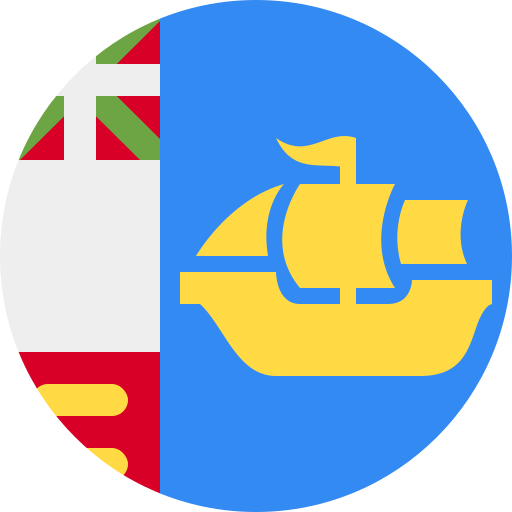
Saint Pierre and Miquelon speaks a French closer to that of Paris than to the French spoken across the strait in Canada, because its people descend from a resettlement that came after the Revolution. The Université Laval language atlas traces the difference to 1816: the colonists who returned that year brought the pronunciation of nineteenth-century France, while Quebec and Acadia kept the French of the seventeenth. Around that language the islanders keep the marks of where their families came from, Basque pelota and a Basque week every August, Breton and Norman surnames, Acadian words, a flag that carries all three regions, and the daily habits of North America: ice hockey in Newfoundland leagues, English as a second language and wooden houses clad in clapboard.
In short
- Language
- French, with English as a common second language
- Origins
- Basque, Breton, Norman and Acadian, with English and Irish ancestry
- Basque language
- Spoken at home into the twentieth century, gone by the late 1950s
- Fête basque
- Every August; the 43rd from 10 to 16 August 2026
- Religion
- Mostly Catholic; diocese of La Rochelle and Saintes since 1 March 2018
- Protected buildings
- 14, eight of them on Île aux Marins
- Most followed sport
- Ice hockey, in Newfoundland-based leagues
Where the islanders' families came from
The population that lives on the islands now was formed after the resettlement of 1816, from fishing families of the Basque Country, Brittany and Normandy and from Acadians whose ancestors had first arrived in 1763. English Wikipedia lists the Saintonge among the origins and adds Acadians from Cape Breton, the Gaspé and Prince Edward Island, and French speakers from the Port au Port Peninsula of Newfoundland. French Wikipedia points to a strand that is often left out: a significant English and Irish ancestry, from young women of the Newfoundland coast who came over in the nineteenth century and the first half of the twentieth to work in Saint-Pierre households, and married there.
The surnames still show it, more than two centuries after the resettlement. English Wikipedia's article on the islanders gives Bourgeois, Coste, Poirier and Vigneau as Acadian, Detcheverry, Apesteguy and Arozamena as Basque, and Briand, Landry and Dagort as Norman or Breton. The Acadian families settled mostly at Miquelon, and the village there is still described as mainly of Basque and Acadian descent; Laval notes that the Acadians of Saint-Pierre came by a different road, from the old French colony at Plaisance by way of Louisbourg.
A second population sits beside the first. Civil servants and contract workers from metropolitan France come on temporary postings, and long-settled islanders call them Mailloux or métros. The Quebec government's Centre de la francophonie des Amériques describes the Saint-Pierrais and Miquelonnais as a French-speaking society "culturally distinct from France". At the census of 1999, 76% of residents had been born on the archipelago and 16.1% in metropolitan France.
Why island French sounds closer to Paris than Quebec
The explanation Laval gives is a matter of dates. The ancestors of Quebecers, Acadians and Franco-Ontarians reached New France long before the British conquest of 1763 and kept much of the pronunciation of the seventeenth century, because the changes the Revolution brought to French reached them late or never. The people of Saint-Pierre and Miquelon came out in 1816 with the pronunciation of the nineteenth-century Parisian bourgeoisie, which had by then become the standard. The result, in Laval's words, is a regional French close to that of Paris, with a small number of archaisms and borrowings.
The local vocabulary is where the islands' history shows. Much of it is nautical, applied to life on land: one embarque into bed or into a car, amarre one's shoes or a cow in a field, and mouille to stop, not to drop anchor. Other words came from the neighbours.
| Borrowed from | Examples recorded by Laval | Meaning |
|---|---|---|
| Canadian French | catin, bordée, garrocher | doll, heavy snowfall, to throw |
| Acadian French | crémi, neige basque, le temps se graisse | loose sea ice, snow in large flakes, the weather is turning |
| English | truck, plug, smatte, clabord | lorry, fuse, in good form, clapboard |
| Indigenous languages | cacaouite, moyac | migrating ducks |
Basque survived as a household language for a while. Laval cites accounts of descendants still speaking it at the start of the twentieth century, most of them speakers of the Labourd dialect, and English Wikipedia dates its disappearance to the late 1950s. Breton and Norman families had switched to French long before. English is now the second language of most adults, used with tourists, with Newfoundland fishermen and on the trips to St. John's that islanders make for shopping, hospital care and flights.
How the Basque heritage is kept alive
The Basques are the strand the islands celebrate in public. Every August for more than forty years, a collective of local associations has held the Fête basque in Saint-Pierre: the 42nd ran from 11 to 17 August 2025 and the 43rd from 10 to 16 August 2026, according to Outremers360. Its evenings are given to pelota in several forms, pala, joko garbi and bare hand, with local players facing pelotaris invited from metropolitan France and Canada, and its Sunday to Basque strength games, dances, songs by the choir Bankuen Korua and a public ball on the Zazpiak Bat square. English Wikipedia lists stone lifting and wood chopping among the strength games.
The pelota court itself is the red fronton Zazpiak Bat near the old hospital in Saint-Pierre. It shares its name with the Basque arms that Flags of the World identifies on the first version of the islands' coat of arms. The flag that islanders fly carries the ikurriña at the top of its hoist, above Brittany and Normandy. Outremers360 records that Basque fishermen kept coming and settling until cod fishing declined in the early 1980s.
What the wooden town looks like
Saint-Pierre is a town of wooden houses painted in strong colours. The tourism agency of France explains both halves: the archipelago's slow-growing trees never supplied enough timber, so boards of oak, beech, maple and cherry arrived by boat from Canada and the eastern United States from the nineteenth century, when wood also cost less than stone or brick; and the colours date from the 1950s, when islanders painted their houses with paint left over from the boats. Before that, door and window frames were protected with red or yellow ochre mixed with cod liver oil.
Two features recur on almost every house. The walls are shingled or clad in clapboard, and the front door opens into a tambour, a small enclosed porch that works as an airlock where coats and boots come off without letting the cold in. A La 1ère documentary of 2023 traces how that vernacular architecture grew up around the climate and the town's grid of streets after the great fire of 1867. The collectivity treats it as heritage: the IEDOM records a grant of up to 80% of the cost, capped at €12,000, for keeping wooden clapboard and shingles, and a grant of up to €763 for traditional exterior paint.
Île aux Marins, the former fishing village facing the harbour, is preserved almost whole. It was called Île aux Chiens until 2 May 1931, its people were nicknamed Pieds rouges, and at its height it had up to 600 or 700 inhabitants, by French Wikipedia's and Laval's counts; the last school closed in 1963. French Wikipedia records that seven of its buildings, among them the chapel of Notre-Dame-des-Marins, were listed as historic monuments in 2011 and an eighth, the Jézéquel house, in 2014, so that eight of the archipelago's fourteen protected buildings stand there. Children and teenagers sent from Brittany, Normandy and the Basque Country once worked its stone drying grounds as graviers, spreading cod to dry for sixteen hours a day.
Directions in Saint-Pierre are seldom given by street name. English Wikipedia notes that islanders place a house by the nickname of a neighbourhood or the name of the family that lives near it. The geographer Henri Baulig, quoted on French Wikipedia, called the town of wooden houses, gardens and Breton, Norman and Basque voices "a piece of old France fixed to American shores".
What islanders eat
The table is built on the sea. The French agriculture ministry lists Atlantic cod, halibut, lobster and snow crab as the staples, with skate, squid and Iceland scallops among the main fisheries and swordfish, salmon and scallops eaten mostly smoked. Cod is eaten plain or as acras, fritters made with potato, and English Wikipedia adds mussels to the list. The archipelago's distinctive fruit is the plate-bière, the bakeapple or cloudberry of the bogs, an orange wild berry made into jam or sorbet. The Conservatoire du littoral describes walkers on the isthmus picking it with blueberries and wild strawberries, and gathering mussels and clams at the Goulet de Langlade.
Bakeries and pastry shops are among the things the tourism office lists for visitors, and the town keeps French hours: American Heritage found in 2007 that shops still closed for two hours at noon. A goat farm at Miquelon sells cheese and the Anse brewery brews beer locally. Food from further afield comes from Canada and France, as the economy article describes.
Which sports islanders play
Ice hockey is the sport most followed, and it is played North American style: local teams compete in leagues based in Newfoundland, and several players from the islands have gone on to French and Canadian clubs and to the France national team. In 2008 a team from the archipelago played the French national side in an exhibition match and lost 8 to 6. The collectivity owns the rink in Saint-Pierre.
Football is French in its structure: a domestic league of three teams, and since 2018 the islands' clubs have entered the Coupe de France. The territory also fields a team of its own, which belongs to neither FIFA nor CONCACAF. French Wikipedia lists volleyball, rugby, Basque pelota, tennis, curling, swimming, basketball, boxing, pétanque and martial arts among the sports played, organised from a cultural and sports centre in Saint-Pierre and a Maison des loisirs in Miquelon. The 25 km race at Miquelon each June draws a few hundred runners.
Summer is the season of the islands' own events. Beside the Fête basque the IEDOM lists the 25 km race and a seafood festival at Miquelon and the Dunefest music festival at Langlade, which was cancelled in 2025, and English Wikipedia describes Bastille Day at Miquelon with games, food, fireworks and dancing.
How faith and memory hold the islands together
Most islanders are Catholic. The archipelago had its own apostolic vicariate until 1 March 2018, when it was merged into the diocese of La Rochelle and Saintes in western France. The cathedral of Saint-Pierre, rebuilt from 1905 to 1907 after a fire, stands north of the main square. Evangelical Christians and Jehovah's Witnesses have places of worship of their own.
The sea's losses are remembered in public, and the remembrance is religious in form. At the fête des marins at the start of summer, a procession leaves the cathedral carrying models of ships lost at sea, the trawler Ravenel among them; the history article records how its wreck was identified in 2025. The islands' single execution by guillotine, in 1889, became the subject of the film La Veuve de Saint-Pierre in 2000, and the guillotine itself is in a museum in Saint-Pierre.
The archipelago has five museums, one at Miquelon and two on Île aux Marins, according to French Wikipedia. L'Arche, which opened in 1998 and holds both the collectivity's archives and its museum, closed to visitors for works in 2024, according to the IEDOM. The Francoforum, a French-language institute run by the collectivity, has taught French to English-speaking Canadians since the early 1990s; French Wikipedia dates it to 1992 and the IEDOM to 1993. The Acadian strand has its own institutions. A convention signed in 2002 with the Université de Moncton in New Brunswick, to strengthen what French Wikipedia quotes as the ties "that unite Acadia and these French islands", gives island students the fees of New Brunswick residents, and the state and collectivity's investment contract for 2024 to 2027 plans a museum space on Acadia at Miquelon. The same contract commits the collectivity to begin a bid for UNESCO World Heritage listing. The local station of La 1ère broadcasts television and radio, and the writer Eugène Nicole, born in Saint-Pierre in 1942, set his long autobiographical novel L'Œuvre des mers in the archipelago.
Common questions
Questions about Saint Pierre and Miquelon
What language is spoken in Saint Pierre and Miquelon?
French, the only official language, in a regional form close to that of Paris with a small number of archaisms and borrowings, according to the Université Laval language atlas. Most adults also speak English, which they use with tourists, with Newfoundland fishermen and in St. John's. Basque, once spoken at home by families of Basque descent, had disappeared by the late 1950s.
Why do the people of Saint Pierre and Miquelon not speak like Quebecers?
Because their ancestors arrived later. Quebecers and Acadians descend from settlers who reached New France before 1763 and kept seventeenth-century pronunciations. The islands were resettled in 1816, after the Revolution had changed French speech, and the colonists brought the pronunciation of nineteenth-century Paris. Some Acadian and Canadian words came into island French all the same, such as crémi for loose sea ice and bordée for a heavy snowfall.
What is the Fête basque in Saint-Pierre?
A week of Basque sport and culture held every August for more than forty years by local associations; the 43rd ran from 10 to 16 August 2026. Evenings bring pelota matches between local players and pelotaris from France and Canada, and the closing Sunday has strength games, dances, a choir and a public ball on the Zazpiak Bat square.
Why are the houses in Saint-Pierre so colourful?
The bright colours date from the 1950s, when islanders painted their wooden houses with paint left over from the fishing boats. The wood itself was shipped in from Canada and the eastern United States from the nineteenth century, because local trees grow too slowly for timber. The collectivity now subsidises traditional clapboard, shingles and paint to keep the look.
What is a tambour in Saint Pierre and Miquelon?
The small enclosed porch built onto the front of most houses, through which the house is entered. It works as an airlock: coats and boots come off inside it without the cold air reaching the rooms. La 1ère's documentary on the town's architecture treats the tambour, with shingles and coloured facades, as one of the marks of Saint-Pierre's vernacular building.
What food is Saint Pierre and Miquelon known for?
Seafood above all: cod, halibut, lobster, snow crab and mussels, with smoked swordfish, salmon and scallops. Cod is eaten plain or as acras, potato fritters. The local fruit is the plate-bière, an orange bog berry turned into jam and sorbet, and Miquelon has a goat cheese farm and a brewery.