Honduras's government: a Congress that shares out the courts
2 897 words · 13 min · updated 2026-10-04
 Back to Honduras
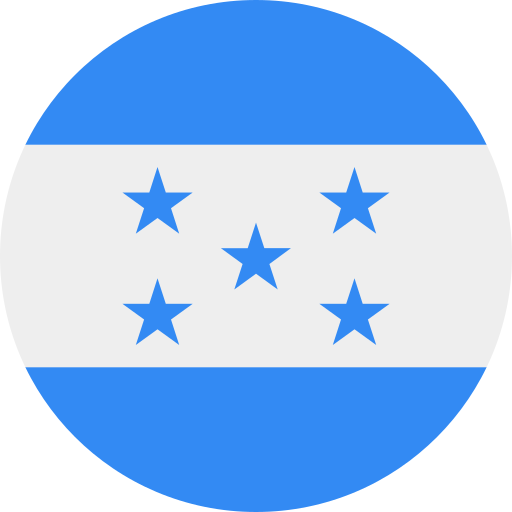
Honduras elects its Supreme Court inside the National Congress, by two-thirds of all 128 members, and when no party holds that many seats the bench is divided by party share: the 15 justices chosen in February 2023 came six from Libre, five from the National Party and four from the Liberal Party. The public prosecutor and the accounts tribunal pass through the same two-thirds vote, so the parties that compete for the presidency also apportion the offices meant to check it. Even the blue of the flag has moved with the alternation of parties, to turquoise in January 2022 and back to navy in January 2026.
In short
- System
- Presidential republic with a single-chamber Congress
- Constitution
- Approved 1982, drafted by an assembly elected in April 1980
- National Congress
- 128 seats, elected every four years by department
- President
- One four-year term, plurality vote, no runoff
- Supreme Court
- 15 justices, elected by two-thirds of Congress
- Unamendable clauses
- Article 374: term, re-election ban, territory, form of government
- Local government
- 18 departments, 298 municipalities
- Freedom House 2026
- 47 of 100, Partly Free
How a two-thirds vote divides the Honduran state
The National Congress is a single chamber of 128 representatives, fixed at that number by Article 202 of the constitution and elected every four years by proportional representation, with the seats distributed by department. It meets in Tegucigalpa from 25 January to 31 October each year without needing to be summoned. Its powers reach well past legislation, because the constitution makes it the body that staffs several of the institutions that are supposed to stand apart from it.
The Supreme Court of Justice has 15 justices, and Congress elects them with the favourable vote of two-thirds of its total membership, from a pool of no fewer than three candidates for each seat drawn up by a Nominating Board. If the full slate fails to reach that majority, the text provides for direct and secret votes on individual justices "as many times as necessary" until two-thirds is reached. The election is set for 25 January. The public prosecutor and a deputy are elected by Congress the same way, for five years, from a pool of five candidates. The three members of the Superior Tribunal of Accounts are elected by two-thirds for seven years and may not be re-elected.
| Office | Members | Term | Vote in Congress |
|---|---|---|---|
| Supreme Court of Justice | 15 justices | seven years | two-thirds of all members |
| Public Ministry | prosecutor and deputy | five years | two-thirds, from five candidates |
| Superior Tribunal of Accounts | 3 | seven years, no re-election | two-thirds of all members |
| Constitutional amendment | two-thirds, ratified in the next regular session |
A two-thirds rule in a chamber where no party holds two-thirds turns every appointment into a negotiation between parties, and the outcome is readable in the composition of the bench. In 2009, the year the court issued an arrest warrant for President Manuel Zelaya, the bench had eight justices selected by the Liberal Party and seven by the National Party. A 2022 law tightened the rules for the Nominating Board, and in 2023 the board produced a list of candidates on merit. Congress then chose the bench from that list in February 2023 on a partisan basis, six from Libre, five from the National Party and four from the Liberals, according to Freedom House and the Bertelsmann Transformation Index (BTI).
The same mechanism stalled in 2023 over the attorney general. With Congress deadlocked, a committee dominated by Libre appointed an attorney general and a deputy on an interim basis in November 2023, a move the opposition parties denounced. In February 2024 Libre, the National Party and the Liberal Party agreed that the attorney general would stay, gave the deputy post to a Liberal, and split appointments to several other bodies between them. The BTI country report for 2026 describes a judiciary politicised at every level, with each side accusing the other of trying to dismantle its independence.
Why Honduras forbids a second presidential term
The president is elected jointly with three presidential designates by a simple majority of votes, which Freedom House records as a plurality with no runoff. The term is four years and begins on 27 January after the election. Article 239 then closes the office behind its holder: a citizen who has held the presidency "under any title" may not be president or designate again.
The article goes further than a term limit. Anyone who violates it or advocates its amendment, together with those who directly or indirectly support them, "shall immediately cease to hold their respective offices" and is barred from public office for ten years. Article 42 adds loss of citizenship for "inciting, promoting, or abetting the continuation in office or the reelection" of a president. Article 4 makes alternation in the presidency obligatory and calls its violation treason. Article 374 lists the presidential term, the ban on re-election and the bar on former presidents among the provisions that "may not be amended in any case", together with the amendment procedure itself, the form of government and the national territory. Wikipedia's account of Honduran politics counts eight articles made unalterable this way.
Honduran presidents have tried to stay on before. General Terencio Sierra refused to step down when a successor was elected in 1902 and was overthrown by Manuel Bonilla in 1903. In 1936 Tiburcio Carías Andino called a handpicked constituent assembly whose constitution eliminated the prohibition on immediate re-election, lengthened the term from four years to six and kept the incumbent in office until 1943; in 1939 a Congress controlled by his National Party extended the term by another six years, to 1949. Constituent assemblies before 1936 had written thirteen constitutions, ten of which entered into force. The 1982 text was drafted by a constituent assembly elected in April 1980, at the end of a run of military governments that had begun with a coup in October 1963.
What happened each time the ban was tested
Why soldiers flew Zelaya to Costa Rica
In 2009 President Zelaya proposed a non-binding poll on whether to add a fourth ballot box to the November elections, beside the presidential, legislative and municipal contests, asking voters whether to convene a constituent assembly. His opponents read it as an attempt to reopen re-election. Zelaya said all reforms would take effect after his presidency, and since the vote would have coincided with the election of his successor, his term would have ended before any change. The courts annulled his decrees authorising the poll, the Supreme Court issued a sealed arrest warrant on 26 June, and on 28 June soldiers took Zelaya from his residence and flew him to Costa Rica. That day Congress, most of whose members belonged to Zelaya's own Liberal Party, accepted a resignation letter he denied signing and named the President of Congress, Roberto Micheletti, to complete the term ending on 27 January 2010.
Two readings of that day survive, and this catalogue records both. A former Supreme Court president, Vilma Morales, argued that Zelaya automatically ceased to be president when he published his decree for the poll, so that no coup took place, and the Honduran Supreme Court ruled the proceedings legal. The United Nations, the Organization of American States and the European Union condemned the removal as a military coup, and on 5 July 2009 the OAS suspended Honduras, invoking Article 21 of the Inter-American Democratic Charter for the first time. In July 2011 a Truth and Reconciliation Commission concluded that Zelaya had broken the law by defying the Supreme Court and that his removal was also illegal and constituted a coup. The Honduran history article follows the crisis further.
How the Supreme Court lifted the ban
In April 2015 the Supreme Court struck down the prohibition that prevented presidents from seeking a second term, at the urging of allies of President Juan Orlando Hernández, according to Britannica. The account of Honduran politics on Wikipedia describes the change as unconstitutional, and Article 374 lists the re-election ban among the clauses that may not be amended. Hernández stood again in November 2017. With some 57% of the vote counted the challenger, Salvador Nasralla, led by 5 points; public announcements of results then stopped for more than a day, and when they resumed the lead had narrowed. The electoral commission declared on 17 December 2017 a final count of 42.95% for Hernández against 41.42% for Nasralla. Protests left more than 20 dead. European Union observers found no irregularities in the recount, and the OAS called for new elections. In 2019 Congress replaced the Supreme Electoral Tribunal with two new bodies, the Electoral Court of Justice and the National Electoral Council.
How the Honduran constitution gets amended
Article 373 sets one procedure for every change the constitution permits. Congress decrees the amendment in a regular session by two-thirds of all its members, naming the articles affected, and the subsequent regular session must ratify it by the same majority before it takes effect. A reform therefore has to hold its majority across two annual sessions, and a decree that loses it in the second stays half finished.
The employment and economic development zones known as ZEDEs show both halves of that rule. On 12 June 2013 Congress passed the ZEDE law by 102 votes to 26, together with reforms to Articles 294, 303, 304 and 329, creating zones with their own judicial, economic and administrative regimes. Three were established: Próspera on Roatán, Orquídea in Choluteca and Ciudad Morazán in Cortés. Congress repealed the law and the constitutional reforms in 2022, but the repeal was never ratified in the following session, so the zones went on operating legally for more than two years. On 20 September 2024 the Supreme Court declared the framework unconstitutional from its inception, in a resolution signed by 15 magistrates, holding that it violated articles of the constitution "written in stone". Reuters reported a majority vote; Contracorriente reported unanimity on the unconstitutionality and a majority on the retroactive effect. Próspera's investors had already filed a claim at the International Centre for Settlement of Investment Disputes after the 2022 repeal.
The amendment procedure has also been used to make later amendment harder. In January 2021 Congress changed the constitution in a way that made it almost impossible to legalise abortion in future, in a country that already banned it completely. The BTI report for 2026 records that the ban covers cases of rape and incest and those in which the woman's life is at risk.
Which parties have governed Honduras since military rule
Since about 1920 Honduran electoral politics has belonged to two parties, the Liberal Party, founded in 1891, and the National Party, which Wikipedia dates to 1918. A coup in October 1963 opened a run of military governments, and in November 1981 a civilian government was elected after 17 years of almost continuous military rule. In 1986 the Liberal José Azcona Hoyo succeeded to the presidency despite having received far fewer votes than the National candidate, Rafael Leonardo Callejas. When Callejas took office in 1990 it was the first time in 57 years that an opposition government had taken power peacefully.
The coup of 2009 broke that pattern. Liberty and Refoundation, known as Libre, was founded in 2011 by a coalition of left-wing organisations opposed to the coup, and it contested its first elections in 2013 alongside the Anti-Corruption Party. That year the National Party won the presidency with just over 36% of the vote against about 29% for Libre and held 48 of the 128 seats. In November 2021 Libre's candidate, Xiomara Castro, was elected with 51.1% of the vote on a turnout of about 68%, the first woman to hold the office and the first peaceful transfer of power since the coup.
| Party | Founded | Seats won, November 2021 |
|---|---|---|
| Liberty and Refoundation (Libre) | 2011 | 50 |
| National Party (PN) | 1918 | 44 |
| Liberal Party (PL) | 1891 | 22 |
| Savior Party of Honduras (PSH) | not recorded in the sources | 10 |
| Christian Democratic Party (PDCH) | 1968 | 1 |
| Anti-Corruption Party (PAC) | 2012 | 1 |
The National Party lost 17 seats in that election and the Liberals lost five. Libre itself lost deputies through changes of allegiance during the term, and the coalition behind the 2021 victory splintered soon after the election, which the BTI report for 2026 treats as the reason the government spent its term striking ad hoc deals. At least 68 candidates were murdered before the 2021 vote. Parties must place women on 40% of their congressional slates, and in 2024 Freedom House counted 27.3% of the seats held by women.
The general election of November 2025 repeated the pattern of disputed counts. Roughly 14.5% of the tally sheets contained inconsistencies and required review, and the outgoing president and two of the defeated candidates alleged fraud. Freedom House lowered its score for the fairness of electoral administration from 3 to 2 in its 2026 report, citing irregularities in the March primaries and the November general election and threats against opposition members of the National Electoral Council. It scored Honduras 47 out of 100 that year, 21 of 40 for political rights and 26 of 60 for civil liberties, and rated it Partly Free.
Why the flag changed colour with the government
The flag itself has followed the alternation of parties. A legislative decree of 1949 defined the blue of the stripes and stars as turquoise, but the flag went on being produced in navy blue for 73 years. In 2020 the National Autonomous University of Honduras published guidelines adopting a lighter shade, and on 4 January 2022, as Libre prepared to take office, the armed forces announced they would show the flag in turquoise on their monograms and uniforms, presented as a "historical vindication" against the navy used by previous administrations. In January 2026 the National Party kept a campaign promise to return the flag to navy blue.
How emergency rule became ordinary government
The constitution lets the president, in agreement with the Council of Ministers, suspend a listed set of guarantees by decree. In December 2022 the government declared a state of emergency against the extortion of businesses by criminal gangs, suspending the rights of association and assembly and allowing arrests and searches without a warrant. It was extended repeatedly, covered 226 of the 298 municipalities when renewed in August 2024 and was extended again that October. The UN human rights office reported in July 2024 that on three occasions in 2023 emergency decrees did not receive legislative ratification, and it linked seven potential enforced disappearances and five extrajudicial killings to the emergency.
Hard-line policing predates the emergency. A penal code of 2003 outlawed the street gangs MS-13 and 18th Street and set prison terms of up to 12 years for proven membership, and the Military Police of Public Order, which the Hernández administration empowered to fight crime, kept that role under its successor. Homicide was recorded at 154 per 100,000 people in 1999 and about 49 per 100,000 around 2005, and the BTI gives 31 per 100,000 in 2023 and 25.3 in 2024.
Trust in the institutions that run this system is low. In the 2024 Latinobarómetro survey 19% of Hondurans expressed a lot or some trust in the judiciary, 16% in Congress and 15% in the government, against 73% for the Catholic Church and 32% for the armed forces. The United States Institute of Peace found 78% of voters with no interest in politics, a figure the BTI report for 2026 cites.
Who Honduras stands with abroad
The United States keeps a military presence at a Honduran base, and much of the relationship runs through US courts. For several years extradition has been the main check on abuse of office: former President Hernández was arrested in February 2022, extradited in April 2022, found guilty by a US federal jury of importing cocaine in March 2024 and sentenced to 45 years in June 2024, and he was pardoned by the Trump administration in 2025. In August 2024 the government announced the end of the extradition treaty after the US ambassador criticised a meeting between the Honduran and Venezuelan defence ministers; it later reached an agreement with Washington to revive it.
Honduras has changed sides on China. It broke diplomatic ties with Taiwan, opened an embassy in Beijing and opened negotiations for a free-trade agreement, a turn the BTI describes as decidedly more pro-China than its immediate neighbours took. In 2008 it joined the Bolivarian Alliance for the Americas, formed by Venezuela and Cuba, and withdrew in 2010 after the coup. An agreement signed in Colombia in May 2011 opened the way for Zelaya's return home and for the readmission of Honduras to the OAS, and in September 2020 it announced that it would move its embassy in Israel to Jerusalem. The IMF approved an $822 million credit facility in 2023, and in 2024 Honduras was in the process of withdrawing from the investment-dispute centre where the Próspera claim was filed.
The borders have been settled by courts too. After the Football War of 1969, Honduras and El Salvador signed a peace treaty in Lima on 30 October 1980 and sent the Gulf of Fonseca and five sections of land boundary to the International Court of Justice, which in 1992 awarded most of the disputed territory to Honduras; El Salvador took until 1999 to accept the decision. The United States handed over the Swan Islands under a treaty signed on 22 November 1971. Honduras belongs to the United Nations, the Organization of American States, which it joined in 1948, the Central American Integration System and the World Trade Organization, and in 2017 it signed the UN treaty on the Prohibition of Nuclear Weapons.
Timeline
The dates in order
- 1903
- General Terencio Sierra, who refused to leave office after the 1902 election, is overthrown.
- 1936
- A constituent assembly called by Carías removes the ban on immediate re-election and lengthens the term to six years.
- 1963
- A military coup in October opens nearly two decades of military government.
- 1980
- A constituent assembly is elected in April.
- 1982
- The present constitution is approved and a civilian government takes office.
- 2009
- Soldiers remove President Zelaya on 28 June; the OAS suspends Honduras on 5 July.
- 2013
- Congress passes the ZEDE law on 12 June by 102 votes to 26.
- 2015
- In April the Supreme Court strikes down the ban on a second presidential term.
- 2017
- An incumbent is declared re-elected on 17 December with 42.95% to 41.42%.
- 2019
- Congress replaces the electoral tribunal with an electoral court and a National Electoral Council.
- 2021
- Libre wins the presidency with 51.1% and 50 of the 128 seats.
- 2022
- A state of emergency is declared in December; Congress repeals the ZEDE law without ratifying the repeal.
- 2024
- On 20 September the Supreme Court declares the ZEDE framework unconstitutional.
- 2026
- The flag returns to navy blue in January.
Common questions
Questions about Honduras
Can a former Honduran president run for office again?
For the presidency, the constitution says no. Article 239 bars anyone who has held the office under any title from being president or presidential designate again, and Article 374 places that bar beyond amendment. In April 2015 the Supreme Court struck the prohibition down, and an incumbent was declared the winner of a second term in December 2017. Critics called the change unconstitutional, since the clause is one of those Article 374 says may not be amended.
Who chooses the justices of the Honduran Supreme Court?
The National Congress, by two-thirds of its 128 members, from candidates proposed by a Nominating Board. In February 2023 it chose six justices from Libre, five from the National Party and four from the Liberal Party.
Why do Hondurans still argue over whether 2009 was a coup?
Because both readings have institutional backing. The Honduran Supreme Court ruled the proceedings legal, and a former court president argued that Zelaya automatically ceased to be president once he published his decree for the poll. The United Nations, the OAS and the European Union called it a military coup, and a Truth and Reconciliation Commission concluded in July 2011 that his removal was illegal and constituted a coup, while finding that Zelaya had also broken the law by defying the Supreme Court.
What were the ZEDE zones in Honduras?
Employment and economic development zones with their own legal, fiscal and administrative regimes, created under a law passed on 12 June 2013 after four constitutional articles were reformed. Three were set up, including Próspera on Roatán. Congress repealed the law in 2022 without ratifying the repeal, and on 20 September 2024 the Supreme Court declared the whole framework unconstitutional from its inception.
Which China does Honduras recognise?
The People's Republic. Honduras broke diplomatic ties with Taiwan, opened an embassy in Beijing and began negotiating a free-trade agreement with China, according to the BTI country report for 2026, which found the talks slow and their results so far limited mostly to Chinese investment in education.