Travel in China: a country built for its own six billion trips
2 050 words · 9 min · updated 2026-10-02
 Back to China
In 2025 China recorded 6.52 billion domestic trips and 154.50 million inbound visits, of which 35.17 million were made by foreigners. The other 119.32 million came from Hong Kong, Macau and Taiwan. The National Bureau of Statistics also counted 30.08 million foreign arrivals under visa-free arrangements, up 49.5% in a year. What a visitor meets follows from that: holidays that move the whole country at once, a rail network laid out for its own cities, phone payments in place of cash, and rules on identity and on sensitive regions.
In short
- Domestic trips in 2025
- 6.52 billion
- Inbound visits in 2025
- 154.50 million, 35.17 million by foreigners
- World Heritage properties
- 61: 42 cultural, 15 natural, 4 mixed
- Rail network
- About 165,000 km
- Emergency numbers
- Police 110, fire 119, ambulance 120
- Permit regions
- Tibet Autonomous Region, organised tours only
- Payments
- Phone apps such as WeChat and Alipay almost universal
Who travels in China
Tourism hardly existed as an industry in the People's Republic before 1978. The state-owned China International Travel Service was founded in 1954 to handle foreign guests, most of them invited for diplomatic reasons, and international tourism stopped altogether in the early years of the Cultural Revolution. In 1978 China received about 230,000 foreign tourists; in 1985, approximately 1.4 million. By the mid-1980s more than 250 places had been opened to foreign visitors; at about 100 of them a visa or residence permit was enough, and the others required a travel permit from the public security departments.
The figures for 2025 are of a different order.
| Travel in 2025 | Figure | Change on 2024 |
|---|---|---|
| Domestic trips | 6.52 billion | up 16.2% |
| Spending by domestic tourists | 6,300.3 billion yuan | up 9.5% |
| Inbound visits | 154.50 million | up 17.1% |
| of which by foreigners | 35.17 million | |
| Foreign arrivals under visa-free policies | 30.08 million | up 49.5% |
| Spending by inbound visitors | 131.1 billion US dollars | up 39.2% |
| Outbound visits by mainland residents | 167.92 million |
Of the outbound visits, 112.71 million were to Hong Kong, Macau and Taiwan. Trips by rural residents grew faster than those by city dwellers: they made 1.53 billion trips in 2025, 22.6% more than in 2024, against 5.00 billion trips by city residents, up 14.3%. Rural tourists spent 1,001.2 billion yuan and urban ones 5,299.0 billion.
Domestic tourism has its own forms: red tourism to sites of the Communist Party's history, which grew from the late 1990s and which the government promotes, and nongjia le, stays on farms by city families.
Why the national holidays move everyone at once
The State Council builds the long holidays each year out of the statutory days and borrowed weekends. The arrangement published for 2026 gave nine consecutive days at the Spring Festival, from 15 to 23 February, and seven at National Day, from 1 to 7 October, each paid for with Saturdays or Sundays designated as working days. The notice itself encouraged employers and employees to add paid annual leave so that travel would be staggered.
The pressure shows in single holidays. During the Qingming holiday of 2025 the country made 126 million domestic trips, 6.3% more than a year earlier.
How the routes run
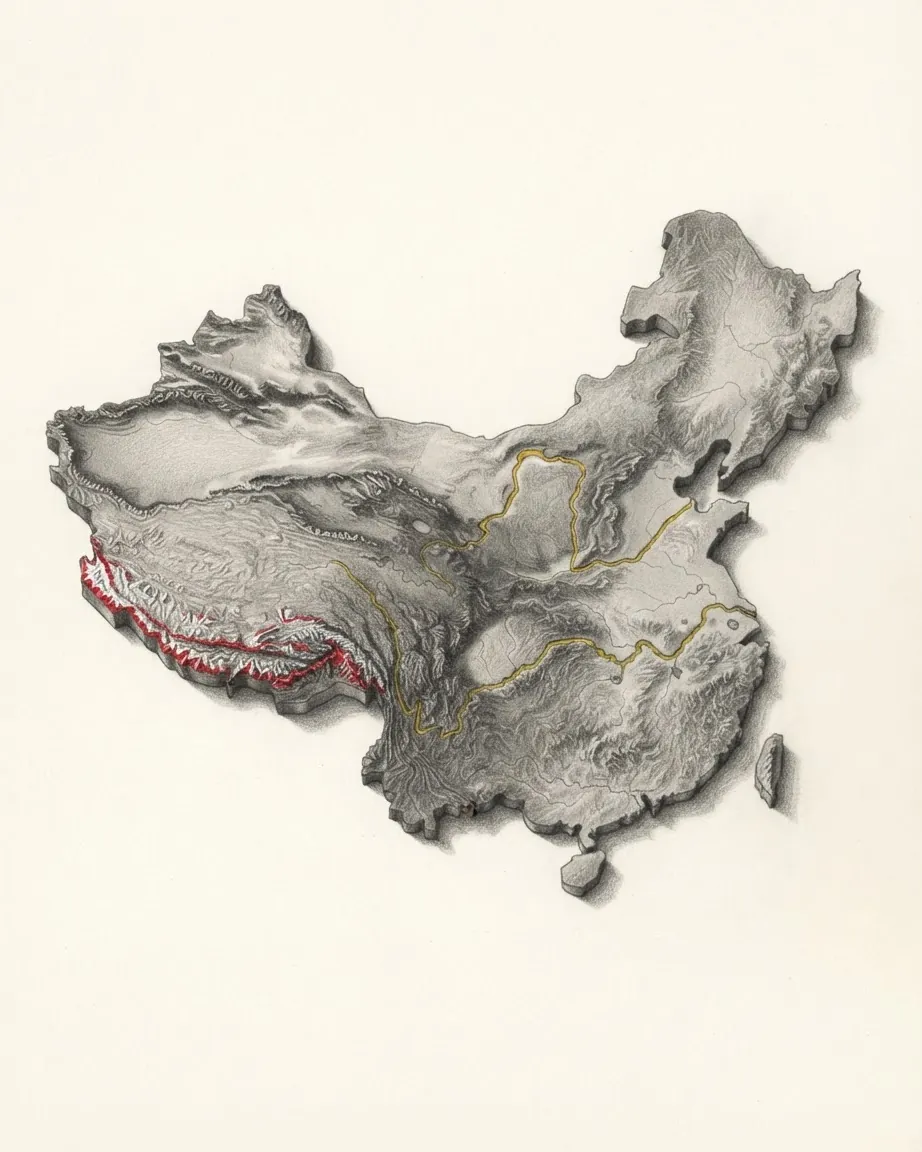
The distances are continental. Britannica gives the country's extent as about 5,250 kilometres from east to west and 5,500 from north to south. The rail network runs to roughly 165,000 kilometres, and by state data more than 95% of cities with over a million people had high-speed rail by 2022. In 2025 alone 3,109 kilometres of new railway opened, 2,862 of them high-speed. China had 262 airports in 2025, and Beijing is served by two international airports, Capital and Daxing.
Long routes still follow old lines. The Hexi Corridor in Gansu carries the road and railway to Xinjiang along the line of the Silk Road, between the Qilian Mountains and the Gobi, and UNESCO lists the Chang'an-Tianshan corridor of the Silk Roads as World Heritage. The Grand Canal was inscribed in the same year. The Yangtze itself is navigable for most of its length.
Driving is a weaker option for visitors. The British Foreign Office notes that driving requires a Chinese licence and valid insurance, that the penalties for driving without them include detention, and that accidents are common.
How Beijing is laid out
Beijing sits at the northern tip of the North China Plain, with mountains to the north, north-west and west, and the Great Wall runs across the northern part of the municipality. The city spreads outward in concentric ring roads; the Second Ring Road traces the line of the old city walls. At its centre are Tian'anmen and the square in front of it, directly south of the Forbidden City, the former residence of the emperors, and Chang'an Avenue runs between them as the main east-west axis.
The old city is built of siheyuan, houses around courtyards, joined by hutongs, alleys that mostly run east to west so that doorways face north and south. Whole blocks of them have been replaced by high-rise housing. Three periods of building stand side by side: the imperial, the boxy Soviet-influenced blocks of the 1950s to the 1970s, and the towers of the central business district in the east.
The city's seasons are those of the north. Summers are hot and humid under the East Asian monsoon, winters short, cold and dry, and in spring sandstorms can blow in from the Gobi. Beijing is also a rail hub: high-speed lines run to Shanghai, opened in 2011, and to Guangzhou, opened in 2012, international trains run to Mongolia, Russia, Vietnam and North Korea, and passenger trains across China are numbered by their direction relative to the capital. The city is the northern end of the Grand Canal to Hangzhou, built more than 1,400 years ago, and of the South-North Water Transfer Project, which brings water from the Yangtze basin.
Where the older capitals stand
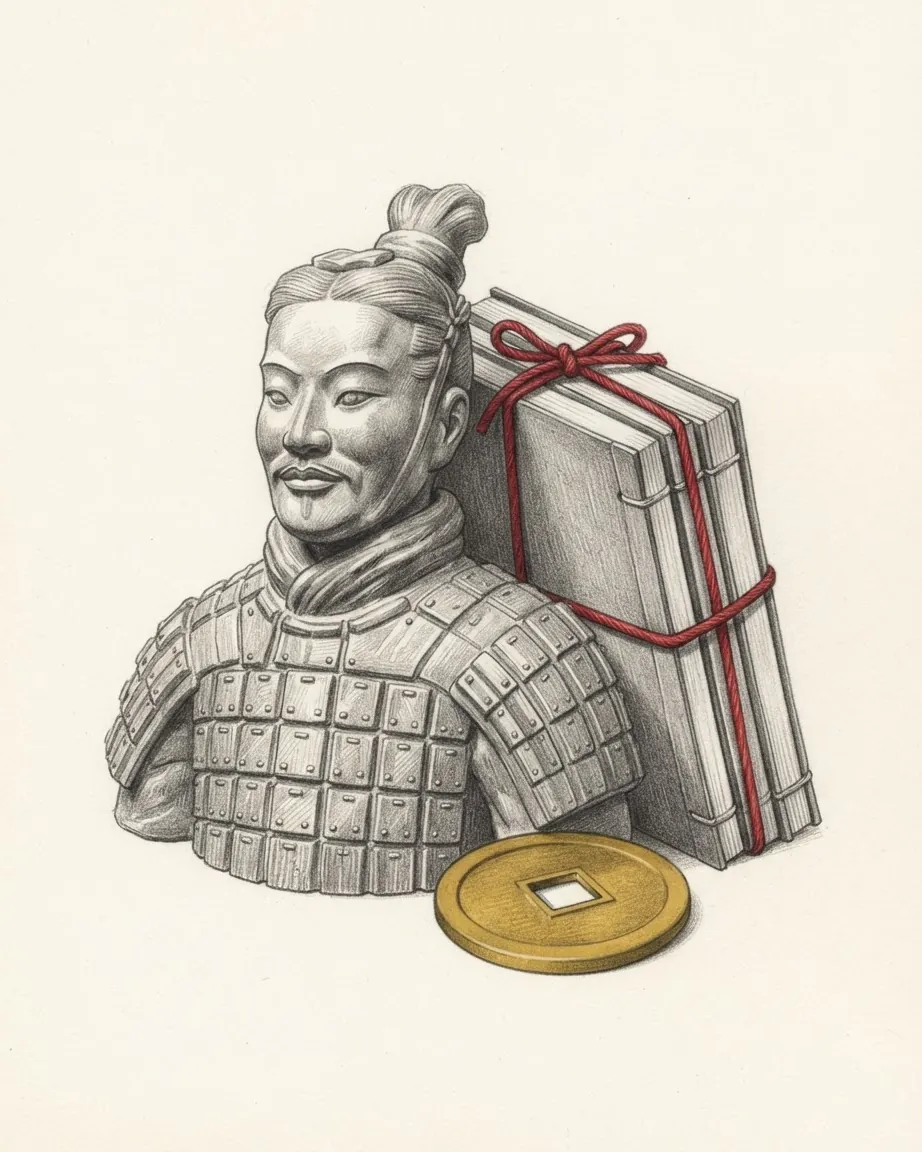
The history left a chain of former capitals. Xi'an is the former Chang'an, capital of the Han, the Sui and the Tang. The First Emperor's mausoleum, laid out to mirror the plan of his capital at Xianyang, was discovered only in 1974; UNESCO notes that thousands of its terracotta figures probably remain to be excavated and that no two of those found are alike. Nanjing was the first Ming capital, Kaifeng and then Hangzhou the capitals of the Song, and Hangzhou's West Lake has been a World Heritage cultural landscape since 2011.
Other cities owe their shape to the treaty ports. Shanghai was one of the four ports opened to British trade in 1842 beside Canton, and Britannica dates its growth into a major commercial city from that opening. Quanzhou in Fujian is listed by UNESCO as an emporium of the world in Song and Yuan China, inscribed in 2021.
The Potala Palace in Lhasa has been World Heritage since 1994, extended in 2000 and 2001, and the Mogao Caves since 1987.
What the World Heritage list covers
UNESCO lists 61 World Heritage properties in China: 42 cultural, 15 natural and 4 mixed, the latest of them the Jingdezhen porcelain industry sites, inscribed in 2026.
| Property | Inscribed |
|---|---|
| The Great Wall | 1987 |
| Mausoleum of the First Qin Emperor | 1987 |
| Imperial Palaces of the Ming and Qing Dynasties in Beijing and Shenyang | 1987, 2004 |
| Mount Taishan | 1987 |
| Historic Ensemble of the Potala Palace, Lhasa | 1994, 2000, 2001 |
| Mogao Caves | 1987 |
| West Lake Cultural Landscape of Hangzhou | 2011 |
| Cultural Landscape of Honghe Hani Rice Terraces | 2013 |
| Beijing Central Axis | 2024 |
Beijing alone holds eight of them: the Forbidden City, the Temple of Heaven, the Summer Palace, the Ming Tombs, the Peking Man Site at Zhoukoudian, the Central Axis and parts of the Great Wall and the Grand Canal. Its hutongs, the narrow alleys between courtyard houses, are visited for themselves.
The Great Wall is many walls. A survey by the National Cultural Heritage Administration counted 10,051 wall sections and 29,510 individual buildings, with walls and trenches totalling 21,196.18 kilometres, of which the Ming wall accounts for 8,850 kilometres: 6,259 kilometres of wall, 359 of trenches and 2,232 of hills and rivers used as natural barriers. Badaling, near Zhangjiakou, was the first section opened to the public in the People's Republic and received nearly 10 million visitors in 2018. The Foreign Office advises against hiking alone on isolated sections because of unpredictable weather and the risk of injury.
The natural properties run from the karst of the south to the deserts of the north-west: Jiuzhaigou, Huanglong, Wulingyuan, the South China Karst, Xinjiang Tianshan and the Badain Jaran Desert. The four mixed properties are mountains: Taishan, Huangshan, Emei with the Leshan Giant Buddha, and Wuyi.
What visitors hear and where the rules change
Some form of Chinese is spoken almost everywhere, with Mandarin as the standard and other varieties such as Cantonese and Shanghainese each spoken by tens of millions. English is rare: research by The Daily Telegraph in 2017 put the number of people who speak it conversationally at about 10 million, under 1% of the population. The mainland writes in simplified characters and romanises with Hanyu Pinyin. The culture article covers the spoken languages in detail.
Hong Kong and Macau have their own entry rules, separate from the mainland's, and a visitor who goes from the mainland to Hong Kong needs a visa allowing a second entry to return. Macau is the only place in China where gambling is legal, and favourable taxes make it a shopping destination for mainland tourists; its historic centre has been World Heritage since 2005. Both territories write Chinese in traditional characters.
How the seasons shape a route
The geography sets the calendar. The summer monsoon brings most of the year's rain to the east and south, and the British government gives the typhoon season as normally May to November, affecting the southern and eastern coasts and sometimes air and other transport; typhoons reached China ten times in 2025. Dengue is present in Guangdong and some other areas, mainly in the rainy season from May to November. Winters in the north are cold and dry under the Siberian high.
Altitude is a risk of its own. The Tibetan plateau averages over 4,000 metres, and the Foreign Office lists altitude sickness among the health risks of parts of China. In August 2026 floods and landslides damaged roads and buildings in Gyirong County in Shigatse, near the Nepal border.
Tap water is generally not drinkable, by the same advice, and healthcare is not free. The emergency numbers are 110 for police, 119 for fire and 120 for an ambulance.
What the rules require of visitors
Identity is checked often. The Foreign Office advises visitors to carry their passport at all times, because police carry out random checks and do not accept copies, and immigration authorities may collect fingerprints and photographs at entry. China does not recognise dual nationality, and a person born in China to a Chinese parent may be treated as a Chinese citizen whatever passport they use.
Some regions have separate rules. Foreigners need a permit, arranged through a specialist agent in China, to visit the Tibet Autonomous Region, and must travel on an organised tour; the authorities sometimes stop issuing permits without notice. In Xinjiang the security presence is heavy, with airport-style checks at shopping centres, markets and parks, and the Foreign Office advises against photographing protests, security officials or installations, and notes that the authorities treat mosques and other religious sites as sensitive. Its advice notes widespread arbitrary arrests there, mainly affecting Uyghurs and other minorities.
The internet is controlled. Google, Facebook and YouTube are permanently blocked, access can be limited around political events, and tools such as virtual private networks must be licensed by the government. Payment has gone the other way: cashless payment through phone apps such as WeChat and Alipay is almost universal, while outside the large cities credit cards are not always accepted and cash machines are few.
National security is defined broadly in Chinese law. The Foreign Office warns that foreign nationals have been detained under national security laws, that activity outside the mainland, online activity included, can fall within their scope, and that there is a risk of arbitrary detention. Only registered religious organisations may hold religious activities, and rules on how foreigners may practise religion in China came into force on 1 May 2025.
Penalties for drug offences are severe and include the death penalty, and the police may test foreign nationals for drugs at random. Foreign nationals can also be placed under exit bans in legal or commercial disputes, sometimes for months or years.
Common questions
Questions about China
How many foreign tourists visit China?
The National Bureau of Statistics counted 154.50 million inbound visits in 2025, of which 35.17 million were made by foreigners and 119.32 million by people from Hong Kong, Macau and Taiwan. Foreign arrivals under visa-free policies came to 30.08 million, up 49.5% on 2024.
How long are China's national holidays?
The statutory days are joined to weekends by the State Council each year into longer blocks. In 2026 the State Council's arrangement gave nine consecutive days off at the Spring Festival, 15 to 23 February, and seven at National Day, 1 to 7 October. The Qingming holiday of 2025 alone saw 126 million domestic trips.
Can visitors use Google and other foreign websites in China?
Not directly. The British Foreign Office lists Google, Facebook and YouTube among services permanently blocked in China, notes that access can be limited around political events, and states that tools such as VPNs need a government licence.
Do visitors need a permit for Tibet?
Yes. Foreigners need a permit, arranged through a specialist travel agent in China, to enter the Tibet Autonomous Region, and must travel on an organised tour. The Foreign Office notes that the authorities sometimes stop issuing permits without notice and may also restrict travel to Tibetan areas in neighbouring provinces.
How do people pay for things in China?
Mostly by phone. Cashless payment through apps such as WeChat and Alipay is almost universal, according to the British Foreign Office, while outside the major cities credit cards are not always accepted and cash machines are limited. Counterfeit 100-renminbi notes are common.
How long is the Great Wall?
A survey by the National Cultural Heritage Administration put the walls and trenches of all periods at 21,196.18 kilometres, made up of 10,051 wall sections and thousands of towers, ramparts and passes. The Ming wall alone measures 8,850 kilometres, including 6,259 kilometres of actual wall. UNESCO dates the joining of the earlier walls into one line to about 220 BC.