China's history: a constitution that starts the story in 1840
2 006 words · 9 min · updated 2026-10-02
 Back to China
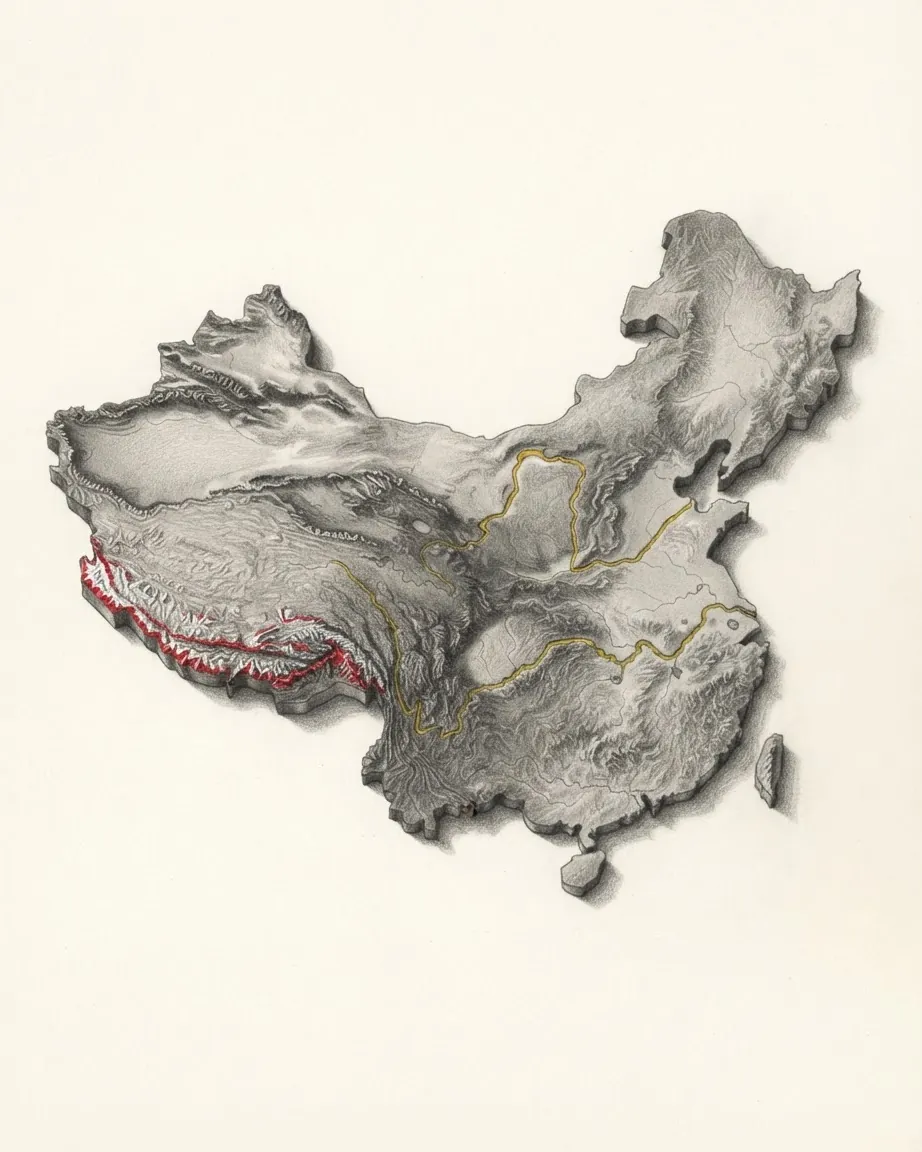
The preamble of China's 1982 constitution dates the country's modern history from 1840, when, in its words, feudal China began to be reduced to a semi-colonial and semi-feudal country. Everything the document says came afterwards, the revolution of 1911, the founding of the People's Republic in 1949 and the socialist state it describes, is told as recovery from that point. The territory the state claims is older: first joined into one empire in 221 BC, broken apart and rejoined many times, and roughly doubled by the Qing in the seventeenth and eighteenth centuries. One piece of it, Taiwan, has been governed separately since 1949, and the two governments describe that fact in opposite terms.
In short
- First unified empire
- Qin, 221 BC
- Last dynasty
- Qing, 1644 to 1912
- Republic proclaimed
- 1 January 1912
- People's Republic proclaimed
- 1 October 1949
- UN seat
- Resolution 2758, October 1971
- Current constitution
- Adopted 4 December 1982
- Hong Kong and Macau return
- 1997 and 1999
How one kingdom gave the country its name
Rice was being cultivated by the Yangtze 8,000 years ago, and millet in the Yellow River valley by about 7000 BC. The oldest Chinese writing yet found is on the oracle bones of the late Shang dynasty at Anyang, divination records dated from about 1250 to 1046 BC. For most of the first millennium BC, though, there was no single state in the two river basins. The Zhou kings, who ruled from 1046 BC, delegated authority to hundreds of settlement states, and from 771 BC those states fought one another until, by the fifth century BC, seven remained. The period that followed is called the Warring States, and it ended when the state of Qin conquered the other six.
In 221 BC the king of Qin, Ying Zheng, declared himself Shi Huangdi, the First Emperor. The Qin divided its territory into more than 36 commanderies made up of counties, standardised weights, measures, the seal script and the metal currency, and kept detailed population records. The terms for its units survive in the sheng and xian, the provinces and counties of the present state. The dynasty's name is probably the origin of the Western word "China".
UNESCO dates the Great Wall as a single defensive line to about 220 BC, when sections of earlier fortifications were joined under Qin Shi Huang against invasions from the north. The emperor's mausoleum, with its terracotta army, was not discovered until 1974. The Qin itself capitulated to rebels in 207 BC, three years after the emperor's death.
The Han dynasty that replaced it lasted from 206 BC to AD 220, elevated Confucianism to official orthodoxy and pushed the empire west into the Tarim Basin along what became the Silk Road. Its name became the name of the majority people and of the written language.
Why the empire kept breaking and rejoining
The Qin and Han set the pattern later dynasties claimed: one emperor, one bureaucracy, one written standard. After the Han fell, northern China split into the Sixteen Kingdoms, most founded by Xiongnu, Xianbei, Jie, Di and Qiang rulers, and parallel dynasties ruled the north and south. The Sui ended three centuries of political division when it conquered the southern Chen in 589.
The Sui lasted from 581 to 618 and left two institutions that outlived it. It selected officials by imperial examination, and it built the Grand Canal linking its capitals to the grain of the south-east. The Tang, from 618 to 907, kept both and ruled at its height an empire of at least 50 million people, until the An Lushan Rebellion of 755 to 763 broke central control over the frontier governors.
The Song, founded in 960, never recovered the northern frontier and lost the whole north to the Jurchen Jin in 1127, yet its population passed 100 million. Paper money was first used in Chengdu under the Song, and movable-type printing was invented in the same period.
Two of the later imperial houses were conquerors from beyond the Great Wall. Kublai Khan proclaimed the Yuan dynasty in 1271 and completed the conquest of the Southern Song in 1279; the Yuan put its capital at Khanbaliq, the present Beijing, and Beijing has largely remained the capital of the unified governments that followed. The Ming, founded by Zhu Yuanzhang in 1368, sent fleets under Zheng He across the Indian Ocean as far as East Africa, then banned private voyages abroad after the Yongle Emperor's death. It rebuilt the Great Wall after an Oirat Mongol army captured the Zhengtong Emperor at Tumu in 1449, and most of what stands today is Ming work.
| Dynasty | Years | Capital |
|---|---|---|
| Qin | 221 to 207 BC | Xianyang |
| Han | 206 BC to AD 220 | Chang'an (Xi'an), then Luoyang |
| Sui | 581 to 618 | Daxing (Chang'an) |
| Tang | 618 to 907 | Chang'an |
| Song | 960 to 1279 | Kaifeng, then Hangzhou |
| Yuan | 1271 to 1368 | Khanbaliq (Beijing) |
| Ming | 1368 to 1644 | Nanjing, then Beijing |
| Qing | 1644 to 1912 | Beijing |
What the Qing added to the map
The Qing was founded by the Manchus, formerly the Jurchens of the north-east, and it took Beijing in 1644 after a peasant rebellion had already driven the last Ming emperor to suicide. The transition cost as many as 25 million lives. The new dynasty then spent a century and a half expanding. It took Taiwan from the Ming loyalist kingdom of Tungning in 1683, settled its northern frontier with Russia at Nerchinsk, and between the late seventeenth century and the end of the eighteenth conquered Tibet and much of Central Asia.
By the end of the Qianlong Emperor's reign in 1796 the Qing ruled roughly twice the territory of the Ming. Taiwan, Tibet and much of Central Asia all came under the same court in that expansion.
What the constitution means by its opening date
The date in the preamble is the start of the First Opium War, which Britannica dates from 1839 to 1842. In the spring of 1839 Qing officials confiscated and destroyed more than 20,000 chests of opium, about 1,400 tons, held by British merchants at Canton. Britain sent an expeditionary force in 1840, captured Nanjing in August 1842 and imposed the Treaty of Nanjing on 29 August: an indemnity, the cession of Hong Kong Island, and five treaty ports open to British trade and residence in place of one. A supplementary treaty in October 1843 gave British subjects the right to be tried in British courts.
A second war, fought by Britain and France from 1856 to 1860, ended with the burning of the emperor's summer palace in October 1860, the legalisation of opium imports and the cession of the southern Kowloon Peninsula. Defeat by Japan in 1894 and 1895 cost Taiwan. In 1900 an eight-nation force ended the Boxer Uprising and the Boxer Protocol imposed an indemnity on the court.
Attempts at reform came from inside the court. The Self-Strengthening Movement of the 1860s imported Western factories and communications, and the Hundred Days' Reform of 1898 was suppressed by the Empress Dowager Cixi within the year. The worst losses were internal. The Taiping Rebellion, a movement led by Hong Xiuquan, held roughly a third of China proper from 1851 to 1864, and its suppression left a death toll of about 20 million. Provincial officials raised their own armies to fight it, and the court never again commanded a strong central force.
How the republic lost the country it inherited
A mutiny among troops in Wuchang on 10 October 1911 began the revolution. By the end of that year 14 provinces had declared against the dynasty. The Republic of China was proclaimed on 1 January 1912 with Sun Yat-sen as provisional president, and the child emperor Puyi abdicated on 12 February. Sun handed the presidency to the general Yuan Shikai, who dissolved the parliament and in late 1915 declared himself emperor; his death in June 1916 left the country to provincial military governors.
The Chinese Communist Party was founded in July 1921 out of the May Fourth Movement of 1919, the protests against the Versailles terms that handed Germany's holdings in Shandong to Japan. It allied with the Nationalist Party until 1927, when Chiang Kai-shek turned on it. Driven from its southern bases, the party's army began the Long March in 1934 and rebuilt itself at Yan'an under Mao Zedong.
Japan occupied Manchuria in 1931 and invaded the rest of China in 1937. The civil war between the Nationalists and the Communists resumed after Japan's surrender in 1945, and by 1949 the Communists held most of the mainland. The Nationalist government withdrew to Taiwan, which it had taken over from Japan in 1945.
What Mao's campaigns cost
Mao Zedong proclaimed the People's Republic on 1 October 1949. Land reform between 1950 and 1952 redistributed landlord land and killed upwards of a million people, and collectivisation followed. The People's Republic occupied Tibet in 1950.
The Great Leap Forward began with an experimental commune in Henan early in 1958 and set out to raise farm and steel output together by organising labour. Farming tools were melted in backyard furnaces, and three years of natural disasters turned the disruption into famine: Britannica puts the toll at about 20 million deaths from starvation between 1959 and 1962. The government began repealing the programme by early 1960.
The Cultural Revolution followed in 1966. Mao shut the schools and set the Red Guards on party officials and on what they called bourgeois values; the president, Liu Shaoqi, and the party's general secretary, Deng Xiaoping, were removed. Industrial production in 1968 was 12% below its 1966 level. The movement lasted until Mao's death in 1976.
China tested its first atomic bomb in 1964, after the split with the Soviet Union had left it isolated from both blocs, and began the Third Front, a programme moving industry and defence plants into the interior. In October 1971 the United Nations General Assembly adopted Resolution 2758, which seated the People's Republic and expelled the representatives of Chiang Kai-shek, and in 1972 Mao and Zhou Enlai received the American president Richard Nixon in Beijing.
How reform rewrote the state under Deng
Deng Xiaoping outmanoeuvred Mao's chosen successor and led the country in practice from 1978 without ever heading the party or the state. The communes were disbanded and farmers received land leases, and free-market areas such as Shenzhen were opened. The present constitution was adopted on 4 December 1982. The party's own term for the result is socialism with Chinese characteristics.
Protests that began after the death of the former general secretary Hu Yaobang in 1989 were ended on 4 June, when troops cleared Tiananmen Square with considerable loss of life.
Hong Kong returned in 1997 and Macau in 1999, each as a special administrative region. China joined the World Trade Organization on 11 December 2001. An amendment adopted in 2018 removed the limit on the president's terms, and Article 79 now ties them only to the term of the National People's Congress.
Why Taiwan remains outside the settlement
The People's Republic has never administered Taiwan. The Nationalist government ruled the island under martial law until 1987, and the Republic of China held its first direct presidential election there in 1996. The People's Republic's position, set out in a white paper of 10 August 2022, is that the People's Republic succeeded the Republic of China in 1949 as the only legitimate government of the whole country, that Resolution 2758 settled China's representation including Taiwan, and that "Taiwan has never been a state". The Mainland Affairs Council in Taipei states the opposite: that the Republic of China is a sovereign state and that Taiwan has never been part of the People's Republic. This catalogue records both positions and takes neither.
Since 2017 the government's campaign in Xinjiang has been described in a separate dispute. The UN human rights office reported on 31 August 2022 that serious human rights violations had been committed there in the context of counter-terrorism policies and that detention in so-called vocational education and training centres, at least between 2017 and 2019, may constitute crimes against humanity. The government has denied the accusations, and the report itself records the government's claim that the centre system had been reduced in scope or wound up.
Timeline
The dates in order
- 221 BC
- Qin unifies the warring states and its king takes the title First Emperor.
- 206 BC
- The Han dynasty begins; it lasts until AD 220.
- 589
- The Sui reunify north and south after three centuries of division.
- 1271
- Kublai Khan proclaims the Yuan dynasty; Khanbaliq, now Beijing, becomes the capital.
- 1368
- Zhu Yuanzhang founds the Ming.
- 1644
- The Manchu Qing take Beijing.
- 1683
- The Qing take Taiwan.
- 1842
- The Treaty of Nanjing cedes Hong Kong Island and opens five treaty ports.
- 1851
- The Taiping Rebellion begins; it is suppressed in 1864.
- 1911
- Mutiny at Wuchang on 10 October begins the revolution.
- 1912
- The Republic of China is proclaimed; Puyi abdicates on 12 February.
- 1921
- The Chinese Communist Party is founded.
- 1937
- Japan invades China beyond Manchuria.
- 1949
- The People's Republic is proclaimed; the Nationalist government withdraws to Taiwan.
- 1958
- The Great Leap Forward begins.
- 1966
- The Cultural Revolution begins; it ends with Mao's death in 1976.
- 1971
- UN General Assembly Resolution 2758 seats the People's Republic.
- 1978
- Reform and opening up begins.
- 1982
- The current constitution is adopted on 4 December.
- 1989
- Troops clear Tiananmen Square on 4 June.
- 1997
- Hong Kong returns; Macau follows in 1999.
- 2001
- China joins the World Trade Organization.
Common questions
Questions about China
Why does China's constitution begin its modern history in 1840?
The preamble of the 1982 constitution says that feudal China was gradually reduced after 1840 to a semi-colonial and semi-feudal country. The date is the First Opium War, which ended in the Treaty of Nanjing of 29 August 1842: an indemnity, the cession of Hong Kong Island to Britain and five treaty ports in place of one. The preamble then tells 1911, 1949 and the socialist state as recovery from that defeat.
How many people died in the Great Leap Forward?
Britannica puts the toll at about 20 million deaths from starvation between 1959 and 1962. The campaign began in 1958 with rural communes and backyard furnaces meant to raise steel and grain output together; farm labour was diverted, tools were melted down, and three years of natural disasters turned the disruption into famine. The government began repealing the programme by early 1960.
When did the Qing dynasty end?
The revolution began with a mutiny in Wuchang on 10 October 1911, the Republic of China was proclaimed on 1 January 1912 and the last emperor, Puyi, then a child, abdicated on 12 February 1912. The Qing had ruled from Beijing since 1644.
Is Taiwan part of China?
The two governments disagree. The People's Republic, in a white paper of 10 August 2022, says it succeeded the Republic of China in 1949 as the sole legitimate government of all China, that UN Resolution 2758 of 1971 covered Taiwan and that Taiwan has never been a state. The Mainland Affairs Council in Taipei says the Republic of China is a sovereign state and that Taiwan has never been part of the People's Republic. The People's Republic has never administered the island.
Where does the name China come from?
It is generally traced to Qin, the state whose king unified the country in 221 BC and called himself the First Emperor. The people and the written language take their own name, Han, from the dynasty that followed, which lasted from 206 BC to AD 220.
When did Hong Kong and Macau return to China?
Hong Kong in 1997 and Macau in 1999, each as a special administrative region of the People's Republic. Hong Kong Island had been ceded to Britain by the Treaty of Nanjing in 1842 and the southern Kowloon Peninsula by the Beijing Convention of 1860; the Portuguese had been allowed to settle at Macau in 1557.