Tetum
Language · official in 1 country
Tetun spread across central and eastern Timor in the 15th century as a contact language of the Belunese-speaking Kingdom of Wehali, before the Portuguese arrived. Its Dili form, Tetun Prasa, carries a large Portuguese vocabulary, and since independence in 2002 it has been an official language of Timor-Leste beside Portuguese.
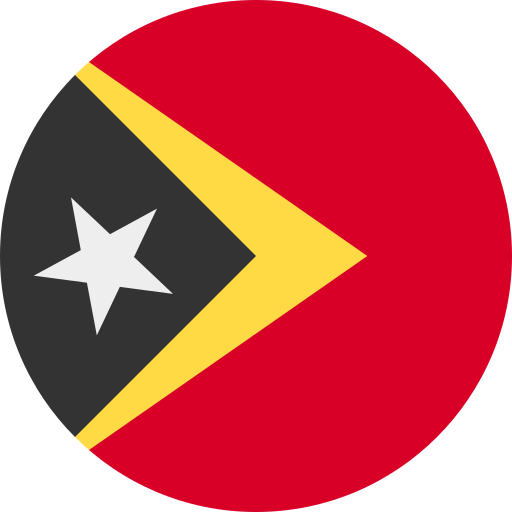
The language on record
- Own name
- Tetun
- ISO 639-3
- TET
- Script
- Latin
- Family
- Austronesian
- Official in
- 1 country
Where Tetum is official
Timor-Leste is the one country on record, where Tetun shares official status with Portuguese. Over the border in Indonesian West Timor it is a regional language with no official standing.
Official beside Tetum
About Tetum
Why a local language became the colony's lingua franca
The Portuguese, present in Timor from about 1556, settled mostly in the west, where Dawan was spoken. Only after the capital moved from Lifau to Dili in 1769 did they promote Tetun as a language between regions. Timor was one of the few Portuguese colonies where a local language, not a form of Portuguese, became the lingua franca, because Portugal ruled indirectly through local kings who took up Catholicism.
What the occupation years did to Tetun
After Portugal's Carnation Revolution of 1974, Indonesia invaded East Timor, banned Portuguese and made Indonesian the sole official language. The Catholic Church adopted Tetun as its liturgical language, and it became a focus of national identity. When the United Nations transitional administration took over in 1999, Tetun Dili was proclaimed the official language. At independence in Timor-Leste in 2002, Tetun and Portuguese were both declared official.
How the four dialects divide
Geoffrey Hull counts four. Tetun Dili, or Tetun Prasa, is the Tetun heard throughout the country; Ethnologue counted 50,000 native speakers and 370,000 second-language users in 2004, and some researchers classify it as a Tetun-based creole, a view others dispute. Tetun Terik belongs to the south and southwest coast. Tetun Belu runs across the middle of the island and into West Timor, where the Diocese of Atambua uses it in Catholic rites. Nana'ek is the dialect of Metinaro village.
Who set the spelling
The National Institute of Linguistics devised the standard orthography, declared official by Government Decree 1/2004 of 14 April 2004. It grew from the literacy campaigns of 1974 and from the church's usage, which respelled Portuguese words: educação became edukasaun. In 2002 ñ and ll replaced the Portuguese digraphs nh and lh, so senhor became señór. Spelling still varies; 'when' appears as bainhira, bain-hira, wainhira and uaihira.
Common questions
Questions about Tetum
Is it spelled Tetun or Tetum?
Tetun is the name in the language itself and in Indonesian, Bahasa Tetun. Tétum is the Portuguese spelling.
What does Prasa mean in Tetun Prasa?
It comes from the Portuguese praça, 'town square', and the name is usually glossed as 'market Tetun'. It is the Portuguese-influenced form that grew up in Dili under colonial rule.
When did Tetun get an official spelling?
Government Decree 1/2004 declared the National Institute of Linguistics orthography official on 14 April 2004.